
More project photos (3)
The problem
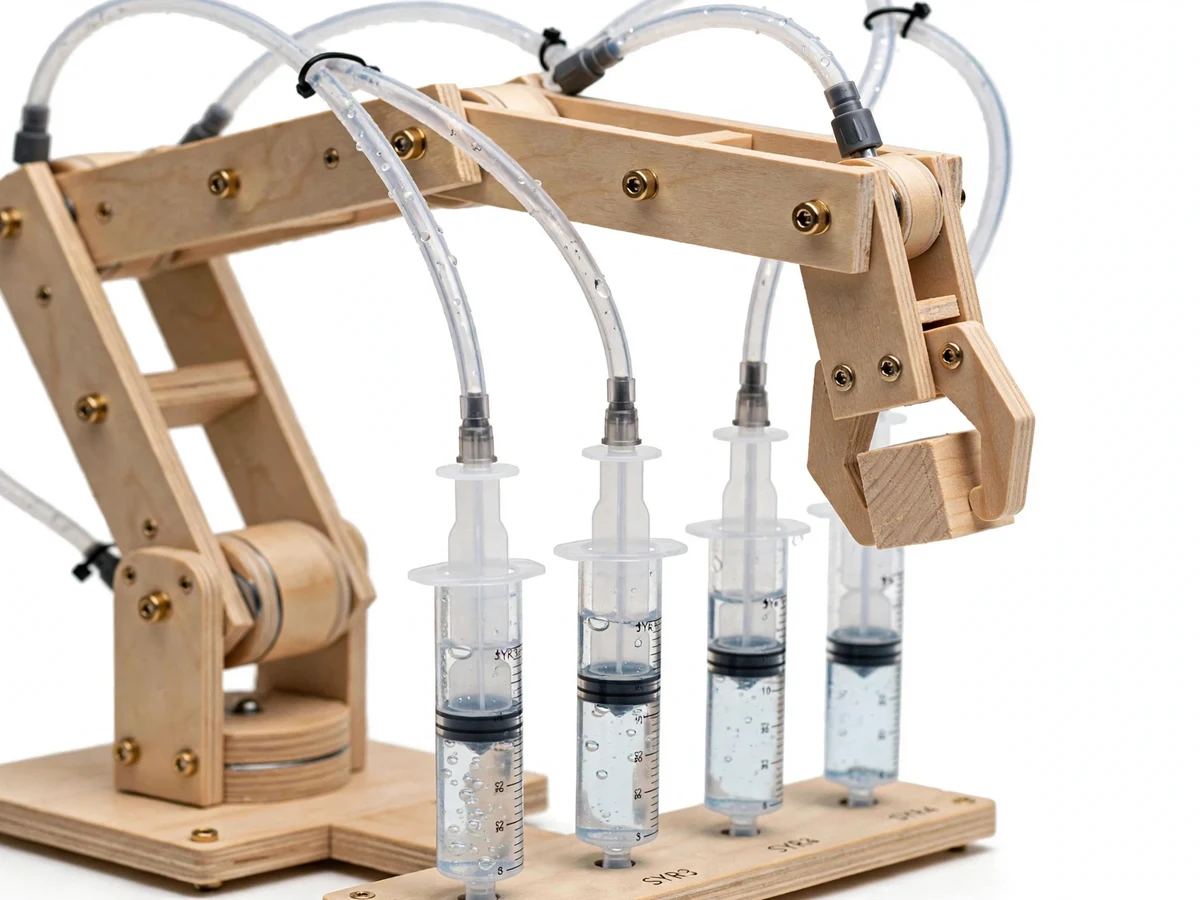
Hydraulics moves the world — excavators, aircraft controls, presses — yet in most mechanical engineering labs it is a chapter of equations: Pascal's law, pressure ratios, force multiplication. The missing piece is a rig where a student can push a small syringe and watch a robot arm joint lift a real load, feeling the force multiplication in their own hand. Commercial hydraulic trainer kits exist but are expensive and usually PLC-based, leaving no room for the student to build and tune. This project fills the gap with an affordable, fully student-built 4-DOF arm: a wooden/cardboard frame with shoulder, elbow, wrist and gripper joints, each driven by a slave syringe plumbed to a master syringe on the control panel. The innovation over the classic classroom model is electronic control — a joystick panel of four potentiometers is read by an Arduino, which drives four servos that push the master syringes, giving smooth, repeatable, recordable motion. Pressure relief and hard stops protect the plumbing, and the student measures actual lifted loads against the theoretical force ratios from Pascal's law.
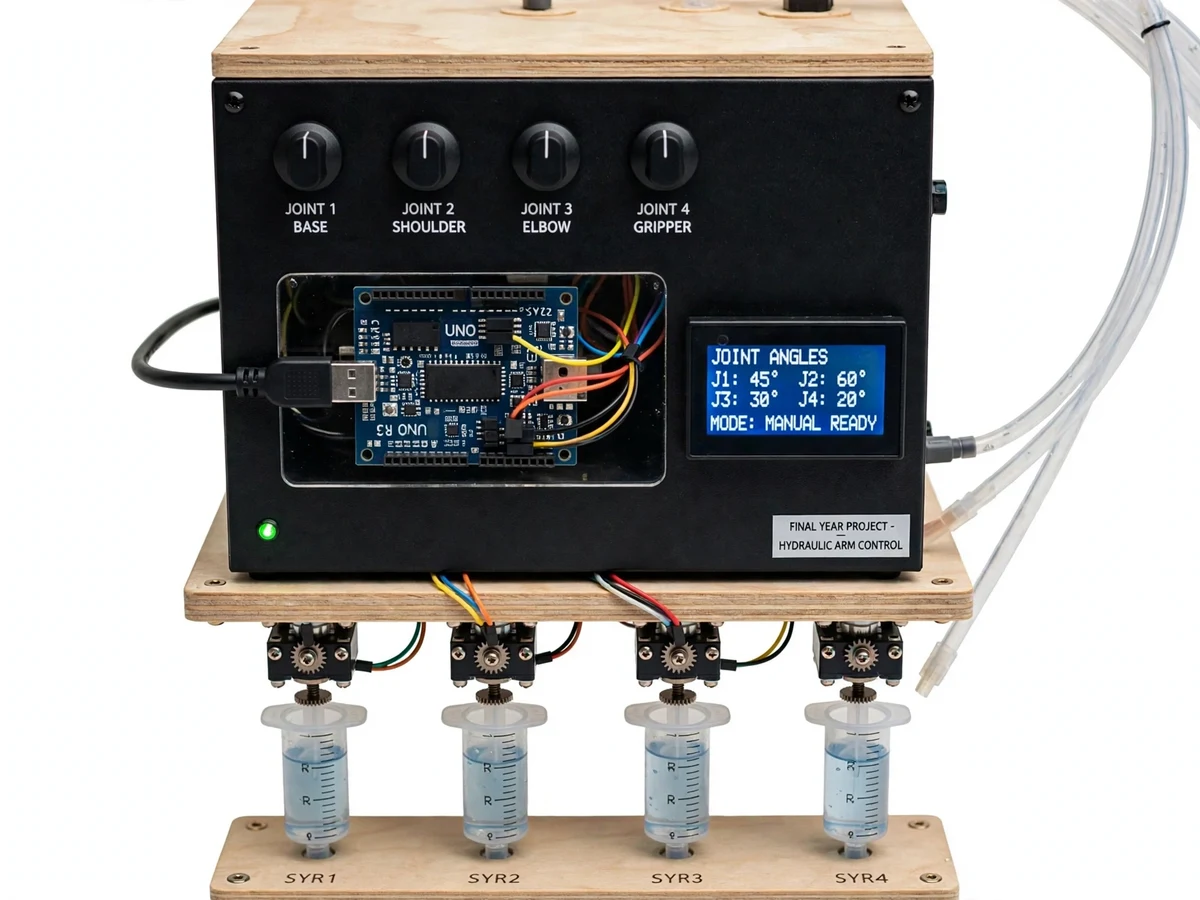
Four panel potentiometers form the joystick; moving one sets the target angle for its arm joint.
Follow the working sequence
How it works
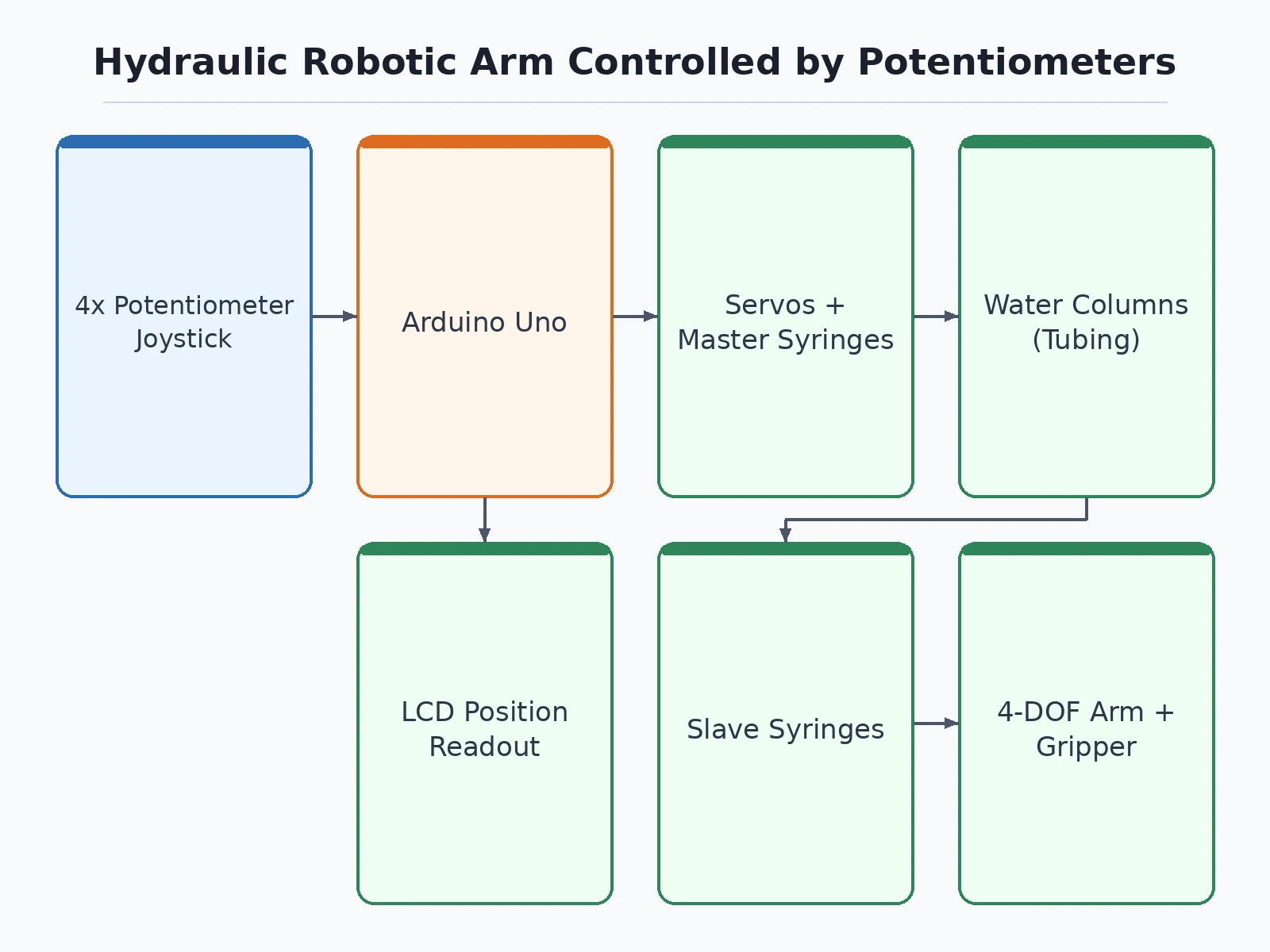
- The student moves a joystick potentiometer; the Arduino reads the wiper voltage on its ADC.
- The firmware maps the reading to a servo angle and drives the servo, which pushes the master syringe plunger by a proportional stroke.
- Water in the sealed tubing transmits the pressure (Pascal's law) to the slave syringe on the arm joint.
- The slave plunger extends or retracts, rotating the joint through its linkage — the bore ratio sets the force multiplication and the stroke trade-off.
- The gripper syringe closes the claw, letting the arm pick and place small objects within its working envelope.
- The record-and-play mode captures the potentiometer stream and replays it through the same path, and the student logs joint angles and lifted loads for their analysis.
Tech stack:
- Arduino-class microcontroller
- 4 potentiometers (joystick control panel)
- 4 servo motors (master-syringe drive)
- Medical-grade syringes (master/slave pairs) with flexible tubing
- Wooden/cardboard arm frame with 4-DOF linkages
- LCD position readout
- Pressure-relief path and mechanical hard stops
- Arduino IDE (C/C++ firmware)
| Parameter | Value |
|---|---|
| Degrees of freedom | 4 — base/shoulder, elbow, wrist, gripper |
| Hydraulic medium | Water (food coloring optional for visibility) in sealed syringe-tubing circuits |
| Control | 4 potentiometers → Arduino ADC → 4 servos on master syringes |
| Payload | Design target 50–150 g at the gripper (student measures actual on their build) |
| Force demo | Master/slave bore ratios demonstrate Pascal's-law force multiplication; student compares theory vs measured lift |
| Protection | Relief path and hard stops against overpressure; tubing rated for the demo pressure band |
| Feedback | LCD/serial joint-position readout for repeatability logging |
| Modes | Live joystick control + record-and-play sequence replay |
Project features
- [4-DOF syringe hydraulics] Shoulder, elbow, wrist and gripper joints each driven by a water-filled master/slave syringe pair through flexible tubing — a true closed hydraulic circuit per axis.
- [Potentiometer joystick control] Four panel potentiometers form the joystick; the Arduino maps each to its joint servo, so hand motion becomes arm motion with proportional control.
- [Arduino + servo master drive] Servos push the master syringes with consistent, repeatable strokes — smoother than hand-pushed plungers and enabling programmed sequences.
- [Force multiplication demo] Different master/slave syringe bores give visible mechanical advantage; the student compares measured lifted loads with Pascal's-law predictions.
- [Pressure relief and hard stops] A relief path and mechanical stops protect tubing and syringes from overpressure — an honest inclusion, since blown tubing is the classic failure of toy builds.
- [Position feedback readout] Potentiometer positions are shown on an LCD/serial readout, letting the student record joint angles for their report's repeatability study.
- [Programmed sequence mode] A record-and-play routine stores a joystick sequence and replays it — demonstrating automation beyond manual control.
What is included
- Working hydraulic arm prototype (frame, syringe circuits, joystick panel, electronics)
- Complete firmware source code (joystick mapping, record-and-play, LCD)
- Fabrication and assembly documentation with cutting/drilling drawings
- Hydraulic circuit diagram (per-axis master/slave pairing, relief path)
- Force-measurement procedure (compare measured lift vs Pascal's-law prediction)
- Component list with ratings
- Project report PDF (hydraulics theory, mechanism design, methodology, test data)
- PPT presentation for final review
- Viva Q&A preparation document (Pascal's law, hydraulic advantage, servo control)
- Setup and demonstration guide
Limitations & prerequisites
- Payload and precision are design targets, not guaranteed figures — syringes leak microscopically, tubing stretches, and every build's numbers differ; the student measures and reports their own.
- Water hydraulics are for demonstration: the rig is not a substitute for oil-hydraulic industrial practice, and the report must say so.
- Air bubbles in the lines cause spongy motion; the bleeding procedure is part of the kit, but some hysteresis always remains — this is documented, not hidden.
- The frame is a light student build (wood/cardboard); it will not carry kilogram loads and must not be overloaded — hard stops are sized for the design envelope.
- Repeatability is limited by syringe friction and servo deadband; the LCD logging exists precisely so the student can quantify this honestly.
Frequently Asked Questions
Why potentiometers instead of hand-pushed syringes?
The classic classroom model uses hand plungers; here an Arduino reads joystick potentiometers and servos push the masters, giving smoother, proportional, repeatable motion plus a record-and-play mode the hand version cannot do.
What fluid is used?
Plain water (food coloring optional for visibility). It is safe, cheap and incompressible enough for the demo; oil hydraulics are discussed in the report as the industrial counterpart.
How much can it lift?
The design target is 50–150 g at the gripper, but the real number comes from your build: the kit includes a procedure to measure lifted load against the Pascal's-law prediction and report both.
What happens if a tube pops off?
The relief path and hard stops limit pressure, and water (not oil) makes spills harmless — but the tubing must be the specified bore and the clamps fitted as documented.
Can it run a programmed sequence?
Yes — record-and-play captures your joystick motion and replays it, which is also how the repeatability study in the report is done.
Is this project suitable for a final-year project?
Yes — for Mechanical and Mechatronics programs. It demonstrates fluid power, mechanisms, embedded control and honest experimental comparison of theory versus measurement. Suitable for B.E./B.Tech final-year projects in Mechanical and Mechatronics engineering.
Components & software requirements
- Arduino-class microcontroller
- 4 potentiometers (joystick control panel)
- 4 servo motors (master-syringe drive)
- Medical-grade syringes (master/slave pairs) with flexible tubing
- Wooden/cardboard arm frame with 4-DOF linkages
- LCD position readout
- Pressure-relief path and mechanical hard stops
- Arduino IDE (C/C++ firmware)
Delivery information
Built-to-order project. Delivery timeline is shared after order confirmation based on current queue.
Support terms
Complete documentation, setup guide, and viva preparation included. Support for setup and explanation provided.
Download free synopsis (PDF)
Enter your name and WhatsApp number — the synopsis PDF downloads immediately. We may send occasional project updates on WhatsApp; no spam.