
More project photos (2)
The problem
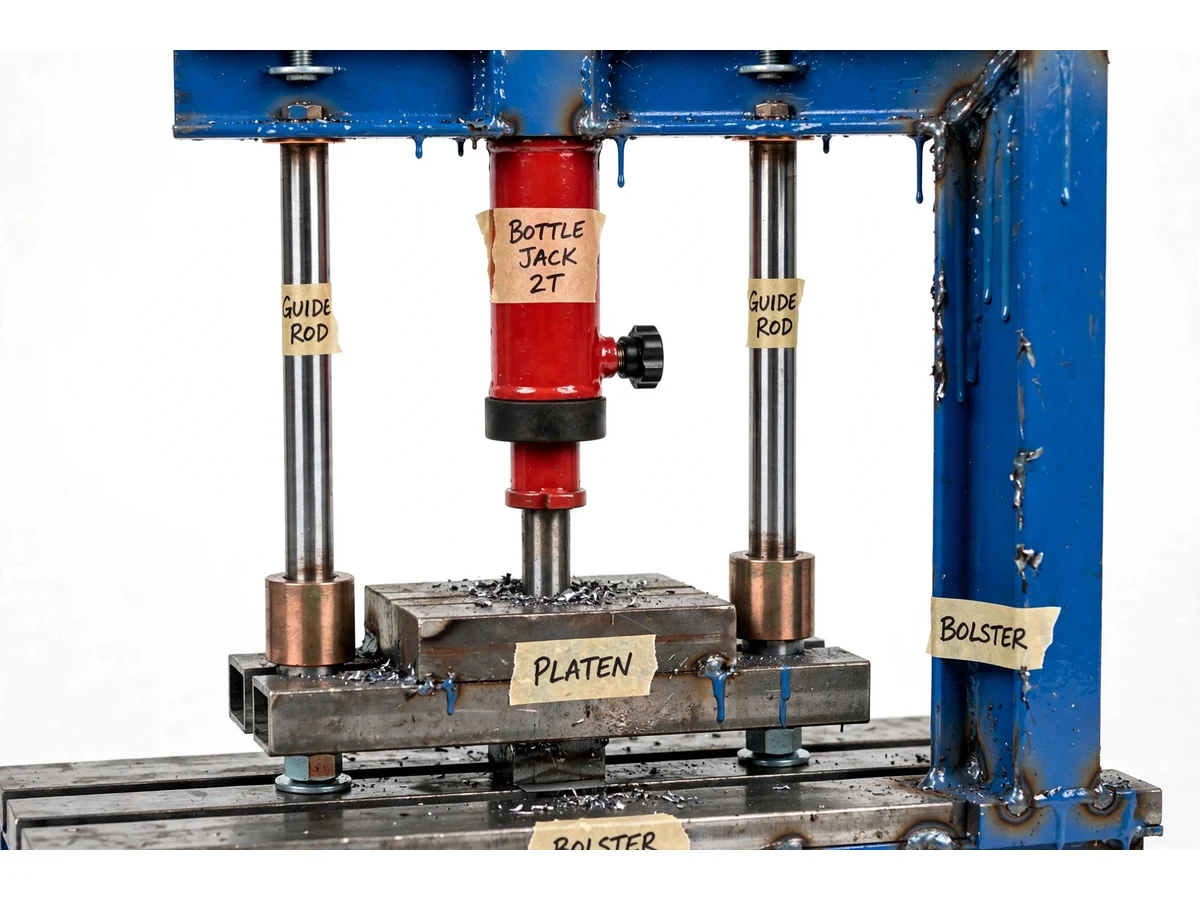
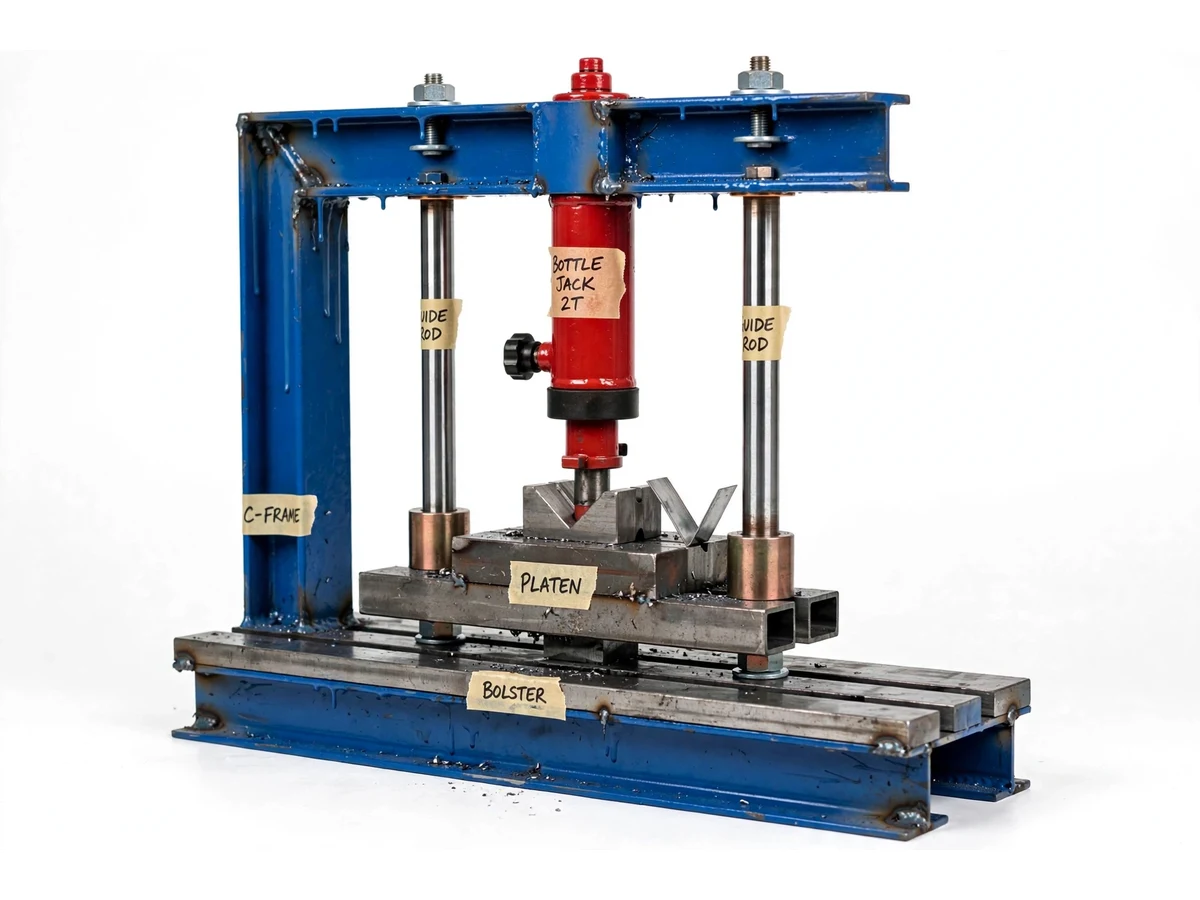
Small workshops, college machine shops and project labs regularly need to press bearings on and off shafts, bend sheet-metal strips, flatten parts or form simple shapes. Industrial hydraulic presses do this easily, but they are floor-standing and expensive — far beyond what a student lab can justify for small parts — so most mechanical students graduate having seen press work only in textbooks. This project closes that gap with a bench-scale DIY hydraulic press built around an off-the-shelf 2-ton bottle jack. The jack's hand-pumped cylinder does the force multiplication through Pascal's principle, so the student builds and understands everything around it: a welded mild-steel C-frame that carries the jack reaction, a moving platen guided on twin rods so the ram stays aligned with the workpiece, and a slotted bolster table that accepts simple pressing plates and a V-bending die. Because every part is visible and nothing is sealed inside a commercial unit, the build teaches load paths, alignment, fabrication and the safety discipline that real press work demands.
Pumps the jack handle, positions the workpiece under the platen, and opens the release valve when done.
Follow the working sequence
How it works
- Clamp the press frame to a sturdy bench through the base mounting holes, set the chosen die or pressing plate on the bolster, and place the workpiece squarely under the platen with clearance above the part.
- Turn the jack's release valve clockwise to close it so the cylinder holds pressure, then pump the supplied handle: each stroke drives a small piston that displaces oil into the main cylinder, raising the ram (Pascal's principle).
- The ram pushes the moving platen down along the twin guide rods; force on the part equals hydraulic pressure multiplied by the ram area, hard-capped by the jack's 2-ton datasheet rating (approximately 20 kN).
- Keep pumping until the bend, form or press-fit completes — the bushings hold the platen parallel to the bolster so the load stays centered instead of skewing the part.
- Open the release valve counterclockwise: pressure bleeds off, the ram retracts under the platen weight, and the part is freed — never reach into the work zone until the platen has stopped moving.
- For repeat work the closed valve holds pressure between strokes, and opening it returns the press to rest; a guard screen in front of the work zone is recommended whenever pressing small parts.
Tech stack:
- 2-ton hydraulic bottle jack · hand-pumped (datasheet-rated force source)
- Mild steel channel & angle sections (C-frame stock)
- Twin guide rods · bronze bushings (platen alignment)
- Moving platen & slotted bolster worktable
- MMAW welding electrodes · enamel paint (fabrication & finish)
- V-bending die & pressing plates (student-fabricated tooling)
- Bench-mount base with clamping holes
| Parameter | Value |
|---|---|
| Rated press force | 2 tons, approximately 20 kN (jack datasheet rating; design maximum) |
| Ram stroke | Approximately 100–125 mm (typical 2-ton bottle jack; exact value from the jack's datasheet) |
| Frame daylight opening | Approximately 300 mm (design target, set during fabrication) |
| Moving platen | Approximately 200 mm x 200 mm steel plate (design target) |
| Guide rods | Approximately 20 mm diameter polished MS rods (design target) |
| Bolster table | Slotted steel plate, approximately 250 mm x 250 mm (design target) |
| Overall press height | Approximately 600–700 mm (expected, fabrication-dependent) |
| Unit weight | Approximately 18–25 kg (expected, fabrication-dependent) |
| Power | Fully manual; no electricity required |
| Finish | Enamel paint over welded MS frame |
Project features
- [2-ton bottle jack drive] A standard off-the-shelf 2-ton hand-pumped bottle jack is the force source. Each pump stroke pushes a small piston that displaces oil into the main cylinder, multiplying force through Pascal's principle; the operator builds pressure with the supplied handle and no electricity is needed.
- [Fabricated mild-steel C-frame] The frame is welded from MS channel and angle sections and enamel-painted, sized so the jack reaction passes straight through the top beam into the base. The open-front C geometry leaves the work zone fully visible and easy to load.
- [Guided moving platen] The pressing platen rides on twin polished guide rods through bronze bushings, so the ram axis stays aligned with the bolster and the part throughout the stroke. Alignment is what keeps a bend clean instead of letting the workpiece slip.
- [Slotted bolster worktable] The base carries a flat steel bolster with slots for clamping pressing plates, arbors and dies. The base build ships with flat pressing plates and a student-fabricated V-bending die for sheet-metal bending demonstrations.
- [Pressure-release safety] The jack's built-in release valve is the primary safety device: opening it bleeds hydraulic pressure so the ram retracts and no force stays stored. Maximum force is hard-limited by the jack's 2-ton datasheet rating.
- [Bench-mountable wide base] The welded base frame is deliberately wide so the press sits stable while pumping, and it carries holes for clamping or bolting to a bench before any pressing operation.
- [V-bending and press-fit tooling] The base tooling covers the two classic student demonstrations — V-bending a sheet strip and pressing a bearing or bushing into a housing — both done with parts the student fabricates and can explain.
What is included
- Welded and painted MS C-frame with twin guide rods, bronze bushings and moving platen
- 2-ton bottle jack with pump handle (datasheet-rated force source)
- Slotted bolster worktable on a bench-mountable wide base
- Flat pressing plates and student-fabricated V-bending die
- Assembly, alignment and jack-operation guide (valve handling, upright-use rule, bleed and retract procedure)
- Project report PDF (Pascal's principle, frame design notes, fabrication steps, safety plan, test log)
- PPT presentation for final review
- Viva Q&A preparation document (hydraulic force multiplication, load paths, alignment, release-valve safety)
Limitations & prerequisites
- Bench-scale academic prototype for forming, bending and press-fit demonstrations — not a production press and not for commercial use.
- Maximum force is hard-limited by the 2-ton jack rating (approximately 20 kN); it must never be pushed beyond the jack's datasheet limit.
- The base build has no pressure gauge, so the operator judges applied force by part deformation; a gauge port is an optional customization.
- A bottle jack is designed to work upright; the frame holds it vertical, and it must not be tipped beyond the jack manufacturer's operating angle or it can lose pressure.
- Frame strength depends on weld quality; welds must be inspected before first use, and nobody should stand in line with the load path while pumping.
- There is a pinch hazard between the moving platen and the bolster — hands stay clear until the platen stops, and a guard screen is recommended during demos.
- Complex forming dies beyond the base plates and V-die are optional customizations, not part of the base build.
Frequently Asked Questions
Is this project suitable for a final-year project?
Yes — for Mechanical, Production and Automobile programs. It demonstrates Pascal's principle applied to a real machine, welded-frame design and load paths, machining and alignment of guide rods and bushings, tooling design for bending and press-fits, and the safety discipline real press work demands — all explainable piece by piece in a viva.
What is the maximum force the press can apply?
The 2-ton bottle jack sets the design maximum — approximately 20 kN. The jack's built-in release valve is the hard limit: nothing in this build can exceed the jack's datasheet rating, which is exactly how the safety case is made during a demonstration.
Does it need electricity?
No. It is a fully manual hydraulic machine — the operator's pumping arm is the only power source. That also means it works anywhere in the workshop, and there is no motor, wiring or control panel that can fail.
Can different dies and tooling be fitted?
Yes. The slotted bolster accepts any plate, arbor or die the student fabricates; the base build includes flat pressing plates and a V-bending die. More complex forming dies are an optional customization quoted separately.
What will I receive with the project?
The complete welded and painted press (C-frame, jack, platen, guide rods, bolster), pressing plates and V-bending die, an assembly, alignment and operation guide, the project report PDF, a review PPT and a viva Q&A document — everything prepared built-to-order.
Components & software requirements
- 2-ton hydraulic bottle jack · hand-pumped (datasheet-rated force source)
- Mild steel channel & angle sections (C-frame stock)
- Twin guide rods · bronze bushings (platen alignment)
- Moving platen & slotted bolster worktable
- MMAW welding electrodes · enamel paint (fabrication & finish)
- V-bending die & pressing plates (student-fabricated tooling)
- Bench-mount base with clamping holes
Delivery information
Built-to-order project. Delivery timeline is shared after order confirmation based on current queue.
Support terms
Complete documentation, setup guide, and viva preparation included. Support for setup and explanation provided.
Download free synopsis (PDF)
Enter your name and email — the synopsis PDF downloads immediately. We may send occasional project updates; no spam, unsubscribe anytime.