
More project photos (3)
The problem
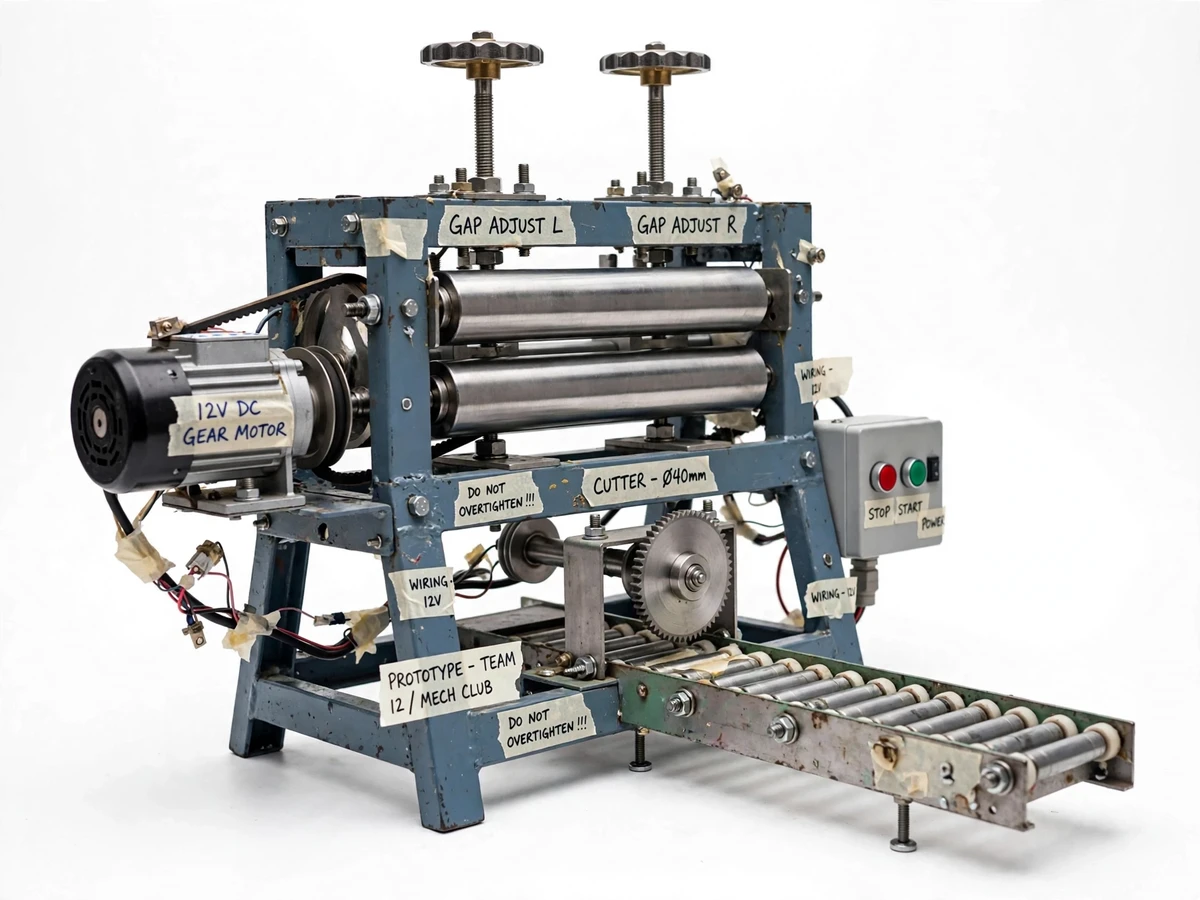
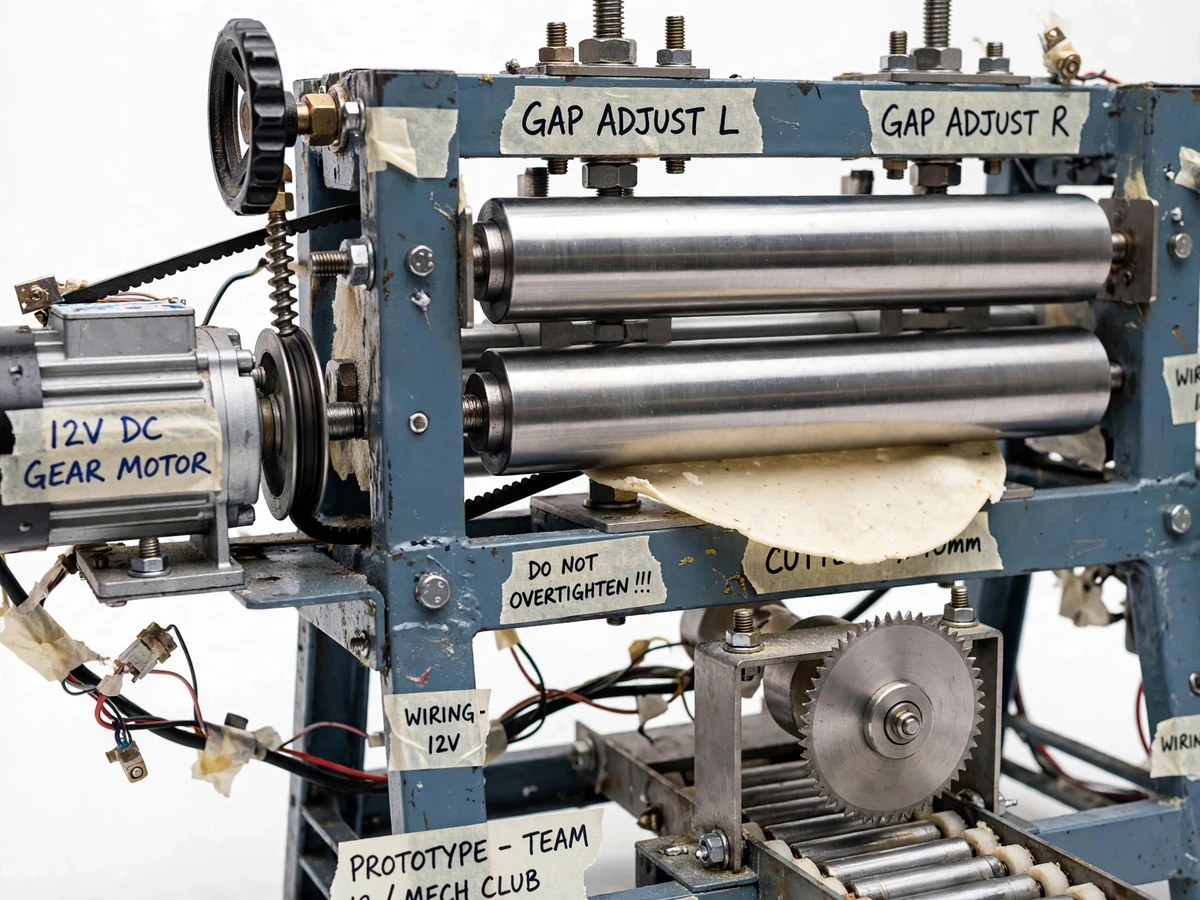
Papad is a staple across Indian households, and small papad units and home businesses still make it the old way — dough balls rolled by hand with a belan, one piece at a time. Hand rolling is slow, tiring, and produces uneven thickness, so pieces fry or roast inconsistently and the quality varies from piece to piece. Commercial papad lines solve this with plant-scale equipment that no small producer can afford and no student can meaningfully study. This project bridges that gap with a bench-top automated papad making machine: a DC gear motor drives paired stainless sheeting rollers whose gap is set by lead-screw handwheels, a rotary die cutter trims uniform discs, and a small hydraulic press evens each piece to consistent thickness. The build combines machine design, fabrication, power transmission and basic electrical control into one working prototype.
The operator who places dough on the feed tray and sets the roller gap with the handwheels.
Follow the working sequence
How it works
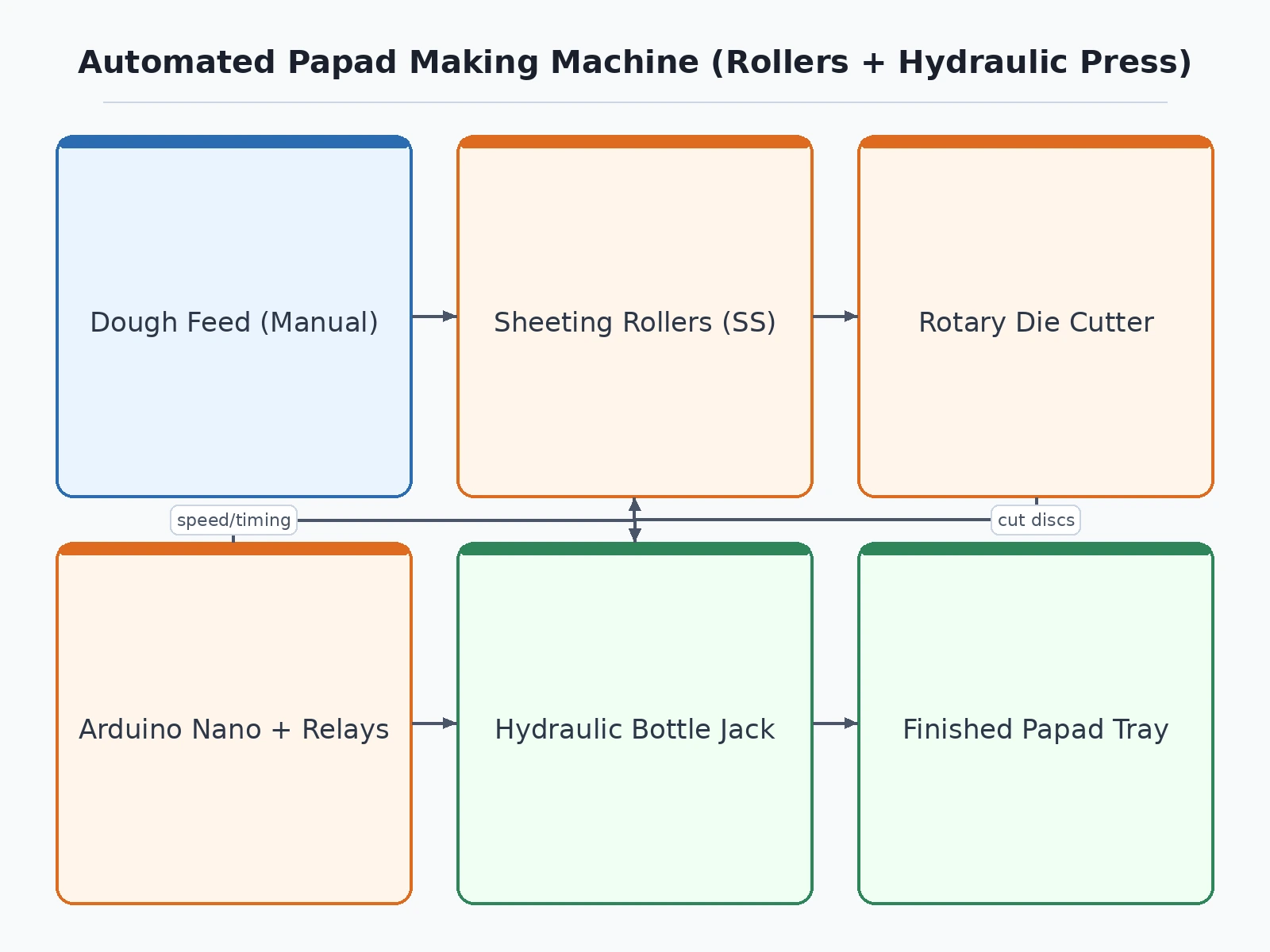
- Prepared papad dough (urad or rice flour, mixed manually) is placed on the feed tray at the roller inlet.
- The operator sets the roller gap with the lead-screw handwheels using the supplied calibration guide (gap vs sheet thickness).
- The DC gear motor drives the roller pair through a belt drive; the rollers grip the dough and sheet it to a continuous thin layer.
- The sheet travels along the short roller conveyor to the rotary die-cutter station.
- The rotary die cutter trims a uniform disc from the sheet; limit switches or Arduino timing coordinate the cut.
- The cut disc is positioned under the press platen; the hydraulic bottle jack is actuated to even the disc to uniform thickness.
- The finished papad lands on the collection tray, ready for sun-drying or storage.
Tech stack:
- 12V DC gear motor
- Food-grade stainless sheeting rollers
- MS angle frame (fabrication)
- Hydraulic bottle jack
- Rotary die cutter
- Arduino Nano · relay module
- Limit switches
- 12V SMPS power supply
| Parameter | Value |
|---|---|
| Papad diameter | Approximately 15–25 cm (design target) |
| Sheet thickness | Approximately 0.5–1 mm after pressing (design target) |
| Roller gap | 0.5–3 mm adjustable via lead-screw handwheels (design target) |
| Roller speed | Approximately 30–60 RPM (design target, motor-class dependent) |
| Drive motor | 12V DC gear motor (datasheet value, 30–60 RPM class — design target) |
| Press force | Approximately 2–5 tonnes (bottle-jack rated — design target) |
| Power supply | 12V DC SMPS, approximately 5 A (expected) |
| Machine footprint | Approximately 60 x 40 x 50 cm (design target) |
| Throughput | Continuous feed; rate dough- and operator-dependent (not measured) |
Project features
- [Motor-driven sheeting rollers] Paired food-grade stainless rollers driven by a 12V DC gear motor pull fed dough through a set gap, flattening it into a continuous thin sheet without hand rolling.
- [Lead-screw gap adjustment] Two handwheels on threaded lead screws set the roller gap in fine steps, so the operator dials sheet thickness per the calibration guide instead of guessing.
- [Rotary die cutter] A circular steel die cutter downstream of the rollers trims the sheet into uniform papad discs, keeping piece-to-piece diameter consistent.
- [Hydraulic pressing stage] A small hydraulic bottle jack actuates a flat stainless platen that presses each cut disc once, evening out thickness for consistent frying.
- [Roller conveyor output] A short roller conveyor carries the sheet from the rollers to the cutter and the finished papad to the collection tray.
- [Simple relay/Arduino control] Start/stop, motor direction and cutter timing are handled by a compact relay panel; an Arduino Nano can be added for timed press cycles.
- [Safety interlocks] Limit switches at the press stage and a red emergency-stop push button halt the drive, covering the pinch points a student build must address.
What is included
- Working bench-top papad making machine prototype
- Wiring and control documentation
- Roller-gap vs sheet-thickness calibration guide
- Project report PDF (background, design calculations, methodology, results)
- PPT presentation for final review
- Viva Q&A preparation document (sheeting mechanics, hydraulic pressing, machine design, control)
Limitations & prerequisites
- Dough must be mixed manually; its consistency directly affects sheet uniformity and output quality.
- The machine does not dry the papads — finished pieces need sun-drying or a separate drying rack.
- Food-contact hygiene (cleaning, keeping oil/grease away from food-contact parts) is the operator's responsibility; the prototype is not food-certified.
- Press force, sheet thickness and throughput are design targets from component ratings and typical values, not lab-verified figures.
- Output rate is not measured — it depends on dough consistency, gap setting and operator pace.
- The prototype is built for academic demonstration, not continuous commercial production.
Frequently Asked Questions
Which electrical control is used?
A compact relay panel handles start/stop and motor direction; an Arduino Nano is used where timed press cycles or cutter coordination are needed. There is no IoT or cloud component — the control is deliberately simple and explainable.
What power supply does it need?
A standard 12V DC SMPS (approximately 5 A expected) powers the gear motor and control panel — a normal wall socket is all the machine needs at the bench.
Can the papad size and thickness be changed?
Yes. Sheet thickness is set with the lead-screw handwheels per the calibration guide, and the rotary die cutter can be swapped for a different diameter disc — an optional customization.
Can this project be customized?
Realistic options: a motorized hydraulic pump instead of the manual jack, wider rollers, PWM variable-speed drive, or a dough-mixer attachment. Automatic drying and PLC control belong to future scope, not the base build.
What are the main limitations?
Dough is mixed manually, drying is not automated, food-contact hygiene is the operator's responsibility, and thickness/throughput are design targets — the Limitations section above states everything honestly.
Is this project suitable for a final-year project?
Yes — for Mechanical Engineering and Food Technology programs. It demonstrates machine design, sheet-metal fabrication, power transmission, hydraulic pressing and basic electrical control in one working build, with a clear calibration experiment for the report.
Components & software requirements
- 12V DC gear motor
- Food-grade stainless sheeting rollers
- MS angle frame (fabrication)
- Hydraulic bottle jack
- Rotary die cutter
- Arduino Nano · relay module
- Limit switches
- 12V SMPS power supply
Delivery information
Built-to-order project. Delivery timeline is shared after order confirmation based on current queue.
Support terms
Complete documentation, setup guide, and viva preparation included. Support for setup and explanation provided.
Download free synopsis (PDF)
Enter your name and email — the synopsis PDF downloads immediately. We may send occasional project updates; no spam, unsubscribe anytime.