
More project photos (2)
The problem
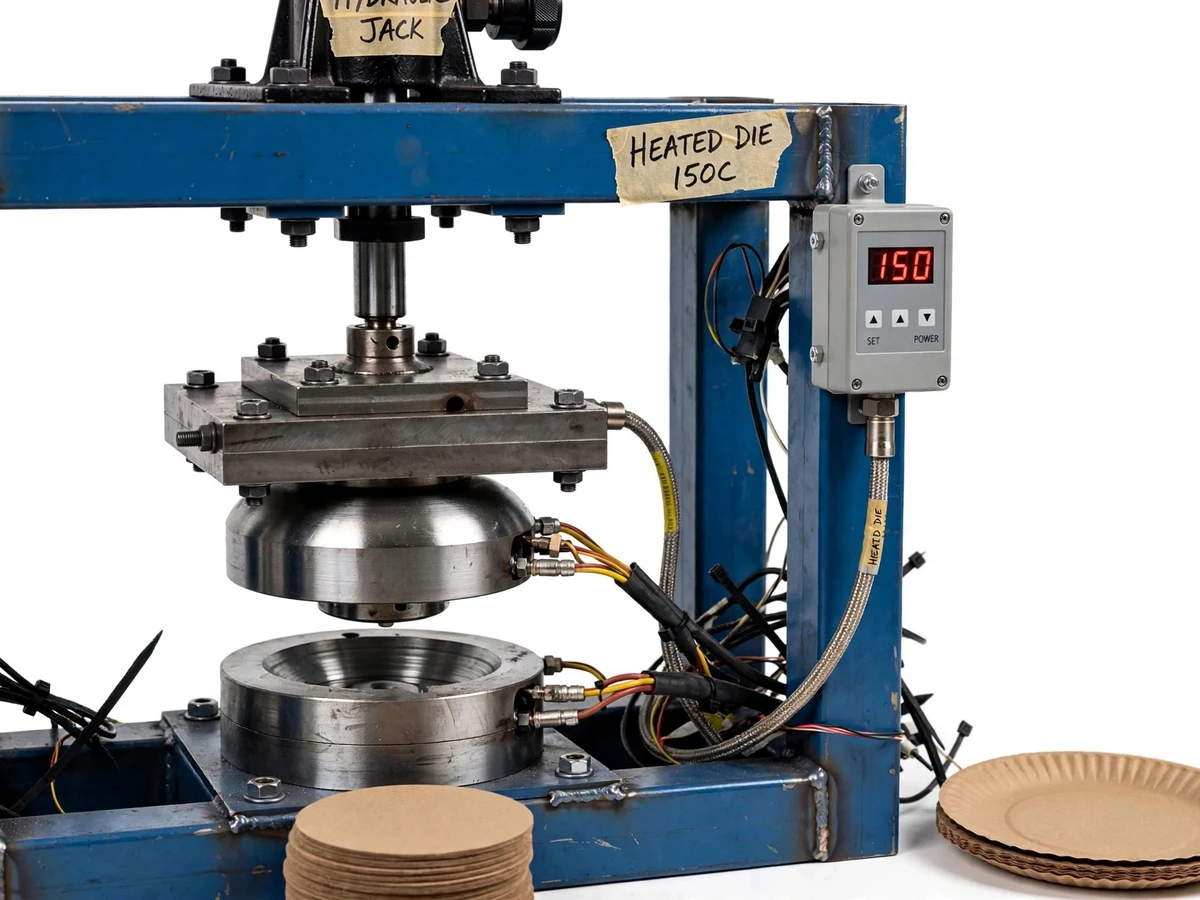
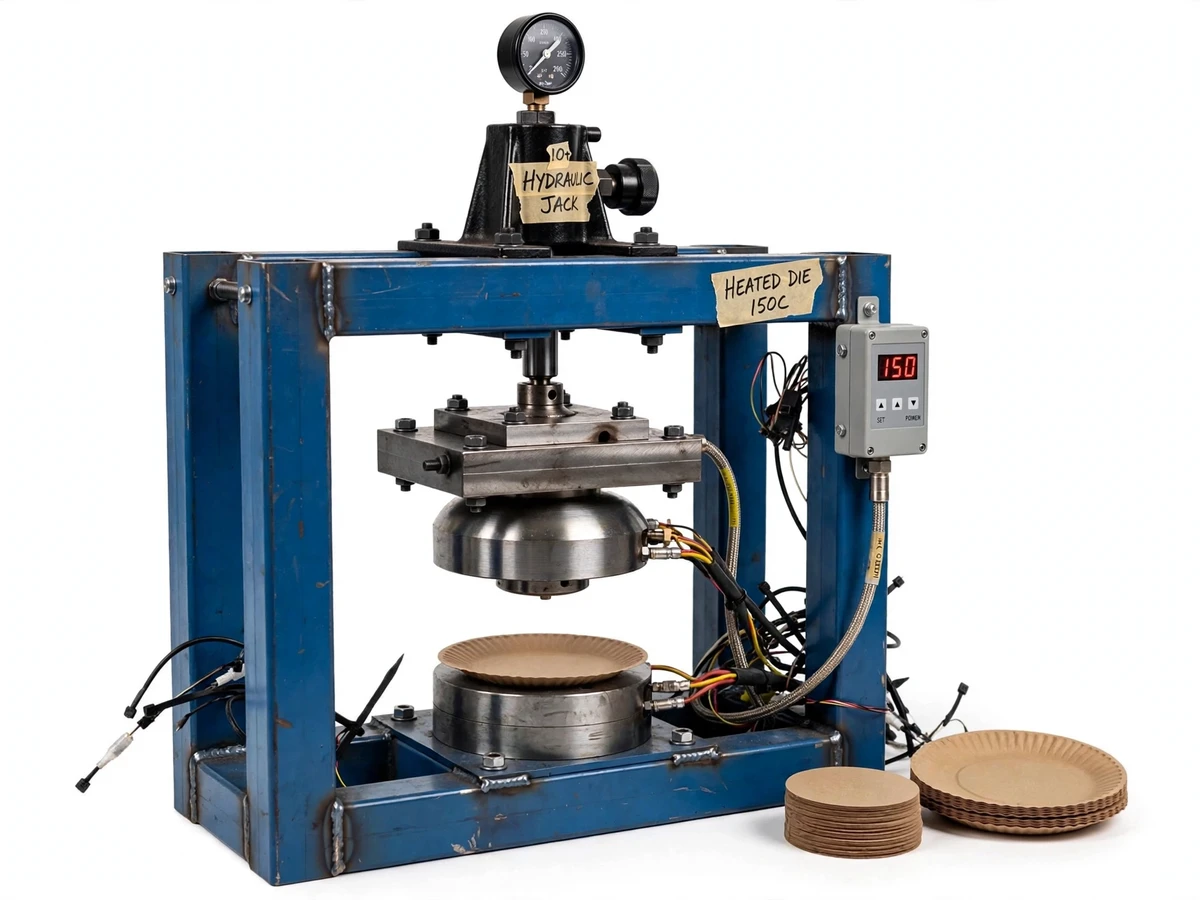
Single-use plastic tableware is being phased out, and small food vendors, caterers and canteens need affordable disposable plates — but commercial paper-plate machines are costly, fully automatic lines that a student or a small workshop cannot buy or learn from. The engineering gap is a small, understandable machine: a hydraulic press that forms plates from kraft blanks between heated dies, with the force, temperature and die design all visible and measurable. This project builds exactly that — a workshop-scale hydraulic paper plate making machine where every subsystem (press frame, hydraulic jack, cartridge-heated die pair, temperature controller, interchangeable die inserts) is fabricated and wired by the student, so the theory of hydraulic force multiplication, heat transfer and die design becomes a machine they can operate and explain.
Sets temperature, places blanks, pumps the jack and removes plates.
Follow the working sequence
How it works
- Switch on the heater circuit and set the die temperature on the digital controller; the cartridge heaters warm the die pair to the setpoint (design target 150–200°C) in approximately 10–15 minutes.
- Place a pre-cut kraft/paperboard blank (approximately 200–350 GSM, design) centred on the lower female die.
- Pump the hydraulic jack handle to advance the moving platen; the heated male die presses the blank into the female die, forming the plate body and curling its rim.
- Hold the pressure for the dwell time (design target 10–20 s) while heat sets the formed shape.
- Open the jack's release valve to retract the platen, then lift the formed plate off the lower die.
- For a different plate size, unbolt the die inserts, fit the new set with hand tools, and re-run the warm-up and trial-press procedure.
Tech stack:
- Hydraulic bottle jack (10-ton class, datasheet rated)
- Cartridge heaters with K-type thermocouples
- Digital temperature controller (PID/ON-OFF)
- Aluminium die moulds with interchangeable inserts
- Welded MS C-channel press frame
- Pressure gauge and relief valve
- Kraft paperboard blanks (200–350 GSM)
- 230 V AC heater wiring with MCB and earthing
| Parameter | Value |
|---|---|
| Press force | Design target ~10 ton (jack datasheet rating) |
| Die temperature | Design target 150–200°C |
| Temperature stability | Typically ±5°C after calibration |
| Die-face uniformity | Typically ±5–8°C after calibration (edges run cooler) |
| Plate sizes | 6 / 8 / 10-inch interchangeable die inserts (design) |
| Cycle time | Approximately 30–60 s per plate (expected, operator-paced) |
| Output rate | Design target ~60–90 plates/hour at steady rhythm |
| Heater power | Approximately 1.0–1.5 kW total, 230 V AC single-phase (expected) |
| Blank material | Kraft/paperboard, approximately 200–350 GSM (design) |
| Machine footprint | Approximately 2.5 × 2 ft, height ~4.5 ft (expected) |
| Warm-up time | Approximately 10–15 min to setpoint (expected) |
Project features
- [Hydraulic pressing unit] A 10-ton-class hydraulic bottle jack mounted in the welded MS frame drives the moving platen, and a pressure gauge on the jack shows the applied load during every press stroke.
- [Heated male/female die moulds] A machined aluminium die pair with embedded cartridge heaters forms the plate body and curls its rim; the mould faces follow the plate profile for a clean, even form.
- [Temperature-controlled dies] A digital temperature controller with K-type thermocouple feedback holds the die setpoint (design target 150–200°C), typically within ±5°C after calibration.
- [Interchangeable die inserts] Bolt-on die inserts for 6, 8 and 10-inch plates (design); one size is fitted as standard and the set swaps with hand tools for a size change.
- [Manual pump operation] The jack's built-in hand pump and release valve run the complete press cycle — no compressor, external hydraulics or three-phase supply is needed.
- [Overpressure and electrical safety] A pressure relief valve guards the hydraulic circuit, while an MCB and proper earthing protect the 230 V heater circuit.
- [Trial-press calibration procedure] A step-by-step buyer-run procedure sets die temperature, dwell time and blank GSM on the student's own build before the final demonstration.
What is included
- Working hydraulic paper-plate press prototype with one fitted heated die set (8-inch)
- Heated male/female die mould pair with cartridge heaters and K-type thermocouple
- Digital temperature controller, wired and configured
- Fabrication drawings of the press frame and die profile
- Wiring diagram for the heater and control circuit
- Trial-press and calibration procedure document
- Project report PDF, PPT presentation and viva Q&A document
- Downloadable project abstract PDF
Limitations & prerequisites
- Manual, operator-paced cycle — design target ~60–90 plates/hour; not comparable with automatic pneumatic production lines.
- Die-face temperature uniformity is typically ±5–8°C after calibration; edges run slightly cooler than the centre.
- This is a student prototype, not an industrial-certified press; no industrial safety certification is claimed.
- Plate edge finish depends on blank GSM and moisture — wrinkling or cracking can occur with the wrong blank, corrected in the trial-press procedure.
- Warm-up takes approximately 10–15 minutes to reach the temperature setpoint.
- Dies stay hot during operation — burn hazard; insulated handling tools and the cool-down procedure are mandatory.
- Changing die sizes takes approximately 20–30 minutes (unbolt, swap, reheat, recalibrate).
Frequently Asked Questions
Is this project suitable for a final-year project?
Yes — for Mechanical and Production Engineering programs. It demonstrates hydraulic force application, heat transfer and temperature control, die and mould design, and workshop fabrication, with a working machine as the final demonstration. The report covers force calculations, thermal design and fabrication drawings for a confident viva.
What is the main technology used?
Hydraulic pressing combined with temperature-controlled heated dies. A 10-ton-class hydraulic jack provides the forming force, cartridge heaters with a K-type thermocouple and digital controller hold the die temperature, and interchangeable aluminium inserts define the plate size.
What power supply does it need?
230 V single-phase AC for the heater circuit (approximately 1.0–1.5 kW expected), protected by an MCB with proper earthing. The hydraulics are fully manual — no compressor or three-phase supply is needed.
Can it make different plate sizes?
Yes — bolt-on interchangeable die inserts cover 6, 8 and 10-inch plates (design). One die size is fitted as standard; additional die sets can be developed as a customization.
What are the main limitations?
It is a manual prototype: throughput is operator-paced (design target ~60–90 plates/hour), dies need approximately 10–15 minutes of warm-up, temperature uniformity is typically ±5–8°C, and edge quality depends on the blank. Full detail is in the Limitations section above.
What will I receive with the project?
The working press prototype with one heated die set and controller, fabrication and wiring drawings, the trial-press calibration procedure, plus the project report PDF, PPT presentation and viva Q&A document.
Suitable for B.E./B.Tech final-year projects in Mechanical Engineering.
Components & software requirements
- Hydraulic bottle jack (10-ton class, datasheet rated)
- Cartridge heaters with K-type thermocouples
- Digital temperature controller (PID/ON-OFF)
- Aluminium die moulds with interchangeable inserts
- Welded MS C-channel press frame
- Pressure gauge and relief valve
- Kraft paperboard blanks (200–350 GSM)
- 230 V AC heater wiring with MCB and earthing
Delivery information
Built-to-order project. Delivery timeline is shared after order confirmation based on current queue.
Support terms
Complete documentation, setup guide, and viva preparation included. Support for setup and explanation provided.
Download free synopsis (PDF)
Enter your name and email — the synopsis PDF downloads immediately. We may send occasional project updates; no spam, unsubscribe anytime.