
More project photos (2)
The problem
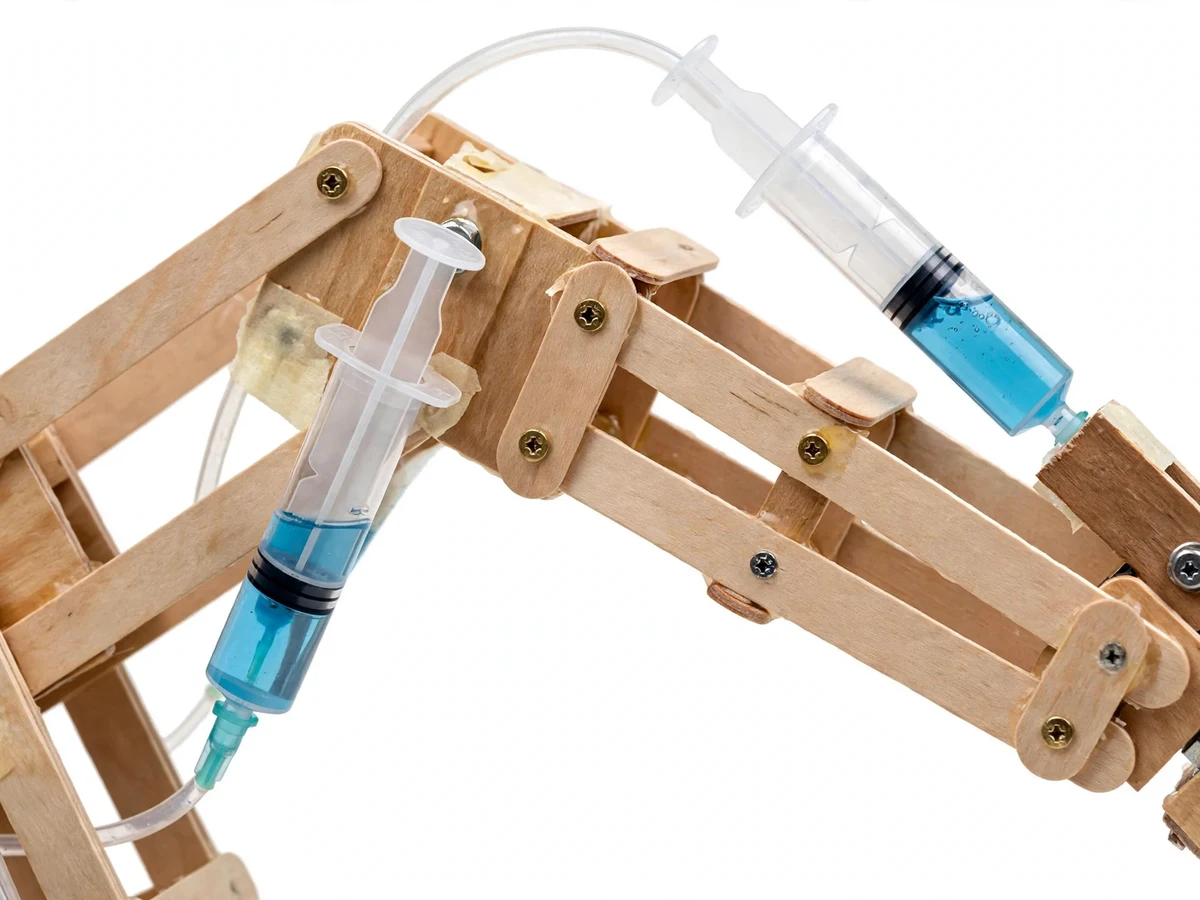
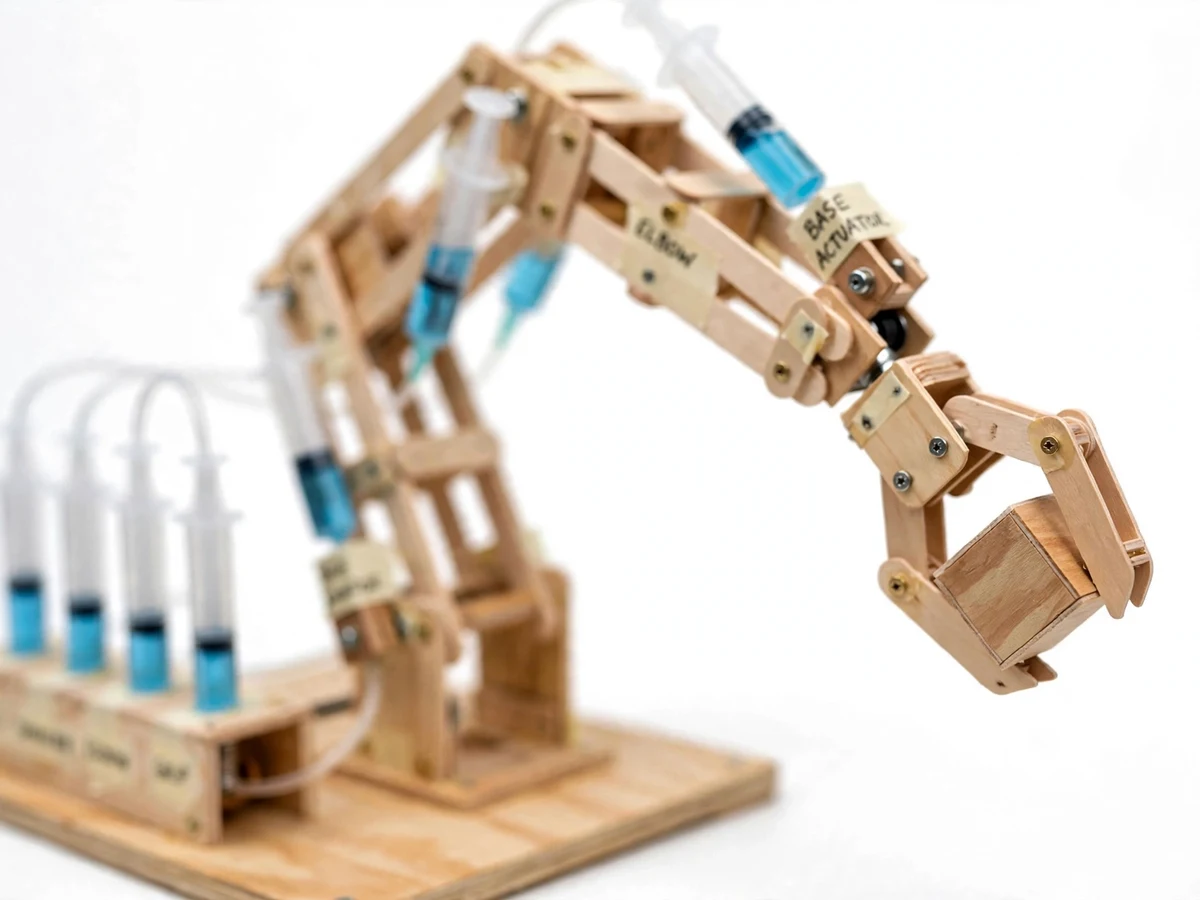
Hydraulics move the world — excavators, lifts, aircraft controls — but to a student Pascal's law is usually just an equation: pressure applied to a confined fluid transmits undiminished. The gap between the equation and the excavator is exactly what this trainer fills. It is a four-axis articulated arm built from wood, with clear syringes as hydraulic cylinders: a set of control syringes on a panel, transparent tubes, and working syringes at the shoulder, elbow, wrist and gripper. Push a control syringe and the joint moves; use a small control syringe on a large working one and the force multiplies. The student cuts the linkages, mounts the syringes, plumbs and bleeds the system, and learns why air bubbles ruin hydraulics — the full fluid-power lesson with water instead of oil and syringes instead of cylinders.
How it works
- The operator pushes a control syringe on the panel; the water inside is nearly incompressible, so the pressure transmits instantly through the tube.
- The working syringe at the joint extends or retracts under that pressure, and its rod pushes the linkage arm.
- The linkage converts the linear push into joint rotation — shoulder lifts, elbow bends, wrist tilts, gripper closes.
- Releasing or pulling the control syringe reverses the motion; the system is fully manual and proportional to the operator's hand.
- Where a small syringe drives a large one, the same hand force produces a larger push at the joint — force multiplication by area ratio.
- The student bleeds air from each line (air compresses and makes motion spongy) before final demonstration.
- A pick-and-place task — grip a wooden cube, lift, swing, release — validates all four axes.
Tech stack:
- Clear plastic syringes (control + working sets, multiple sizes)
- Transparent flexible tubing and connectors
- Wooden arm links (plywood/popsicle-stick construction)
- Pivot fasteners (bolts, washers, cable ties)
- Wooden base and control panel
- Colored water as hydraulic fluid
- Hand tools: saw, drill, files
| Parameter | Value |
|---|---|
| Axes | 4 (shoulder, elbow, wrist, gripper) |
| Actuation | Syringe pairs with water, manual control |
| Force multiplication | By syringe area ratio (design); measured by student |
| Linkages | Wooden arms, pivot-mounted |
| Fluid | Water with food coloring (visible) |
| Gripper | Two-finger, syringe-closed |
| Demo task | Pick-and-place of light wooden blocks |
Project features
- [Four hydraulic axes] Shoulder, elbow, wrist and gripper joints, each driven by its own syringe actuator pair.
- [Pascal's law demonstration] Pressure transmits through the water columns; the build makes the textbook law physically visible.
- [Force multiplication] A small control syringe driving a larger working syringe multiplies force — the student measures and reports the ratio.
- [Transparent hydraulics] Clear syringes and tubes show the fluid moving, so the cause-and-effect of every control input is visible.
- [Gripper end effector] A two-finger gripper closes on objects for pick-and-place demonstrations.
- [Air-bleed procedure] A documented bleeding sequence removes air bubbles — the classic hydraulics maintenance lesson.
- [Linkage geometry] Wooden link arms convert syringe linear motion into joint rotation; the student sets pivot positions for good travel.
What is included
- Working hydraulic arm trainer (arm, syringes, tubing, control panel, base)
- Fabrication and assembly documentation with linkage drawings
- Plumbing and air-bleed procedure
- Force-multiplication measurement guide
- Project report PDF (Pascal's law, linkage design, methodology, demo results)
- PPT presentation for final review
- Viva Q&A preparation document (hydraulics, Pascal's law, linkage kinematics, bleeding)
- Setup and demonstration guide
Limitations & prerequisites
- Manual control only — no motors, no automation; the operator's hand is the pump, which is the teaching point but also the limit.
- Syringe seals leak slowly and tubes can pop off at high force; the build is a trainer, not an industrial cylinder.
- Force and travel are small — light wooden blocks only; no load rating is claimed.
- Water evaporates and grows algae over weeks; the maintenance guide covers refilling and flushing.
- Plastic syringes wear; they are consumables and the guide covers replacement.
Frequently Asked Questions
How does a syringe act as a hydraulic cylinder?
A syringe is a piston in a cylinder. Pushing the control syringe pressurizes the water column; water barely compresses, so the pressure reaches the working syringe almost instantly and extends it. Transparent parts make the whole thing visible.
Where does force multiplication come from?
Pascal's law: the same pressure acts on both pistons, so force scales with piston area. A small control syringe driving a large working syringe multiplies force by the area ratio — at the cost of longer travel on the control side.
Why must air be bled out?
Air compresses, water doesn't. A bubble in the line absorbs the control stroke as compression instead of transmitting it, making the joint feel spongy and unresponsive. Bleeding is standard hydraulics practice.
Can it be motorized later?
The trainer is manual by design. Motorizing the control syringes with lead screws is a documented possible extension.
What are the main limitations?
Manual only, small forces, slow seal leakage, water maintenance, and syringe wear — it is a teaching trainer, not industrial hardware.
Is this project suitable for a final-year project?
Yes — for Mechanical programs. It demonstrates fluid power, Pascal's law, linkage design and hands-on plumbing, all strong viva material. Suitable for B.E./B.Tech final-year projects in Mechanical engineering.
Components & software requirements
- Clear plastic syringes (control + working sets, multiple sizes)
- Transparent flexible tubing and connectors
- Wooden arm links (plywood/popsicle-stick construction)
- Pivot fasteners (bolts, washers, cable ties)
- Wooden base and control panel
- Colored water as hydraulic fluid
- Hand tools: saw, drill, files
Delivery information
Built-to-order project. Delivery timeline is shared after order confirmation based on current queue.
Support terms
Complete documentation, setup guide, and viva preparation included. Support for setup and explanation provided.