
More project photos (3)
The problem
Packhouses grade fruit by eye or by expensive scanning lines, but a student has no bench-scale version to build: a real hyperspectral camera costs far more than a college budget and produces hundreds of bands a small board cannot process. Hectre-Inspired Hyperspectral Fruit Scanner answers that gap at student scale, lighting one fruit under six narrow LED bands plus white light, a NoIR camera photographing it, and an AS7341 sensor recording eleven channels into the near-infrared. The idea made headlines in late October 2026, when Auckland ag-tech firm Hectre opened a laboratory to add hyperspectral sensing to its Arc packhouse scanner, aiming to measure internal defects, starch and firmness instead of only colour, size and external defects. This student build translates that headline honestly to bench scale: discrete LED bands instead of a continuous cube, threshold grades calibrated on the builder's own samples instead of laboratory chemistry, and one fruit at a time instead of a packhouse line.
How it works
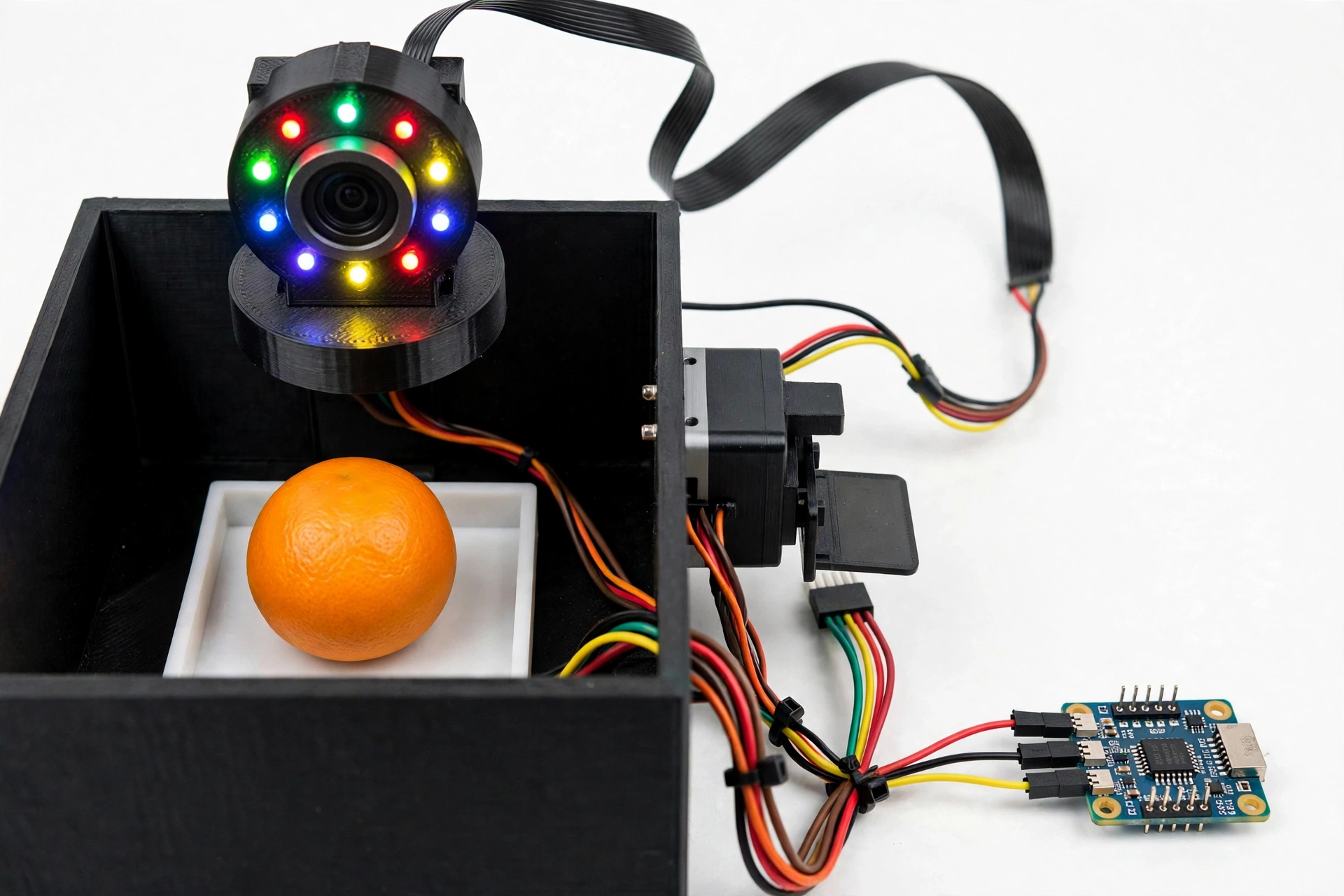
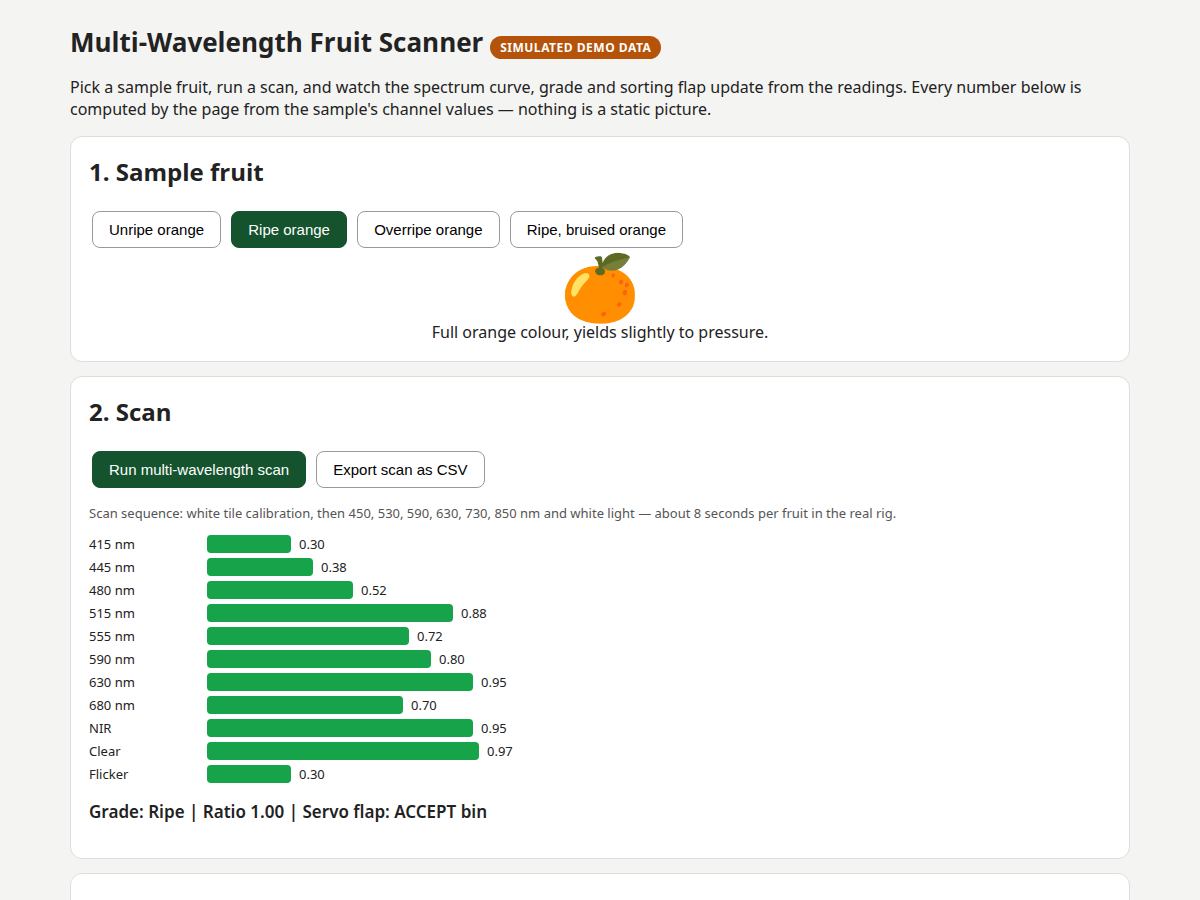
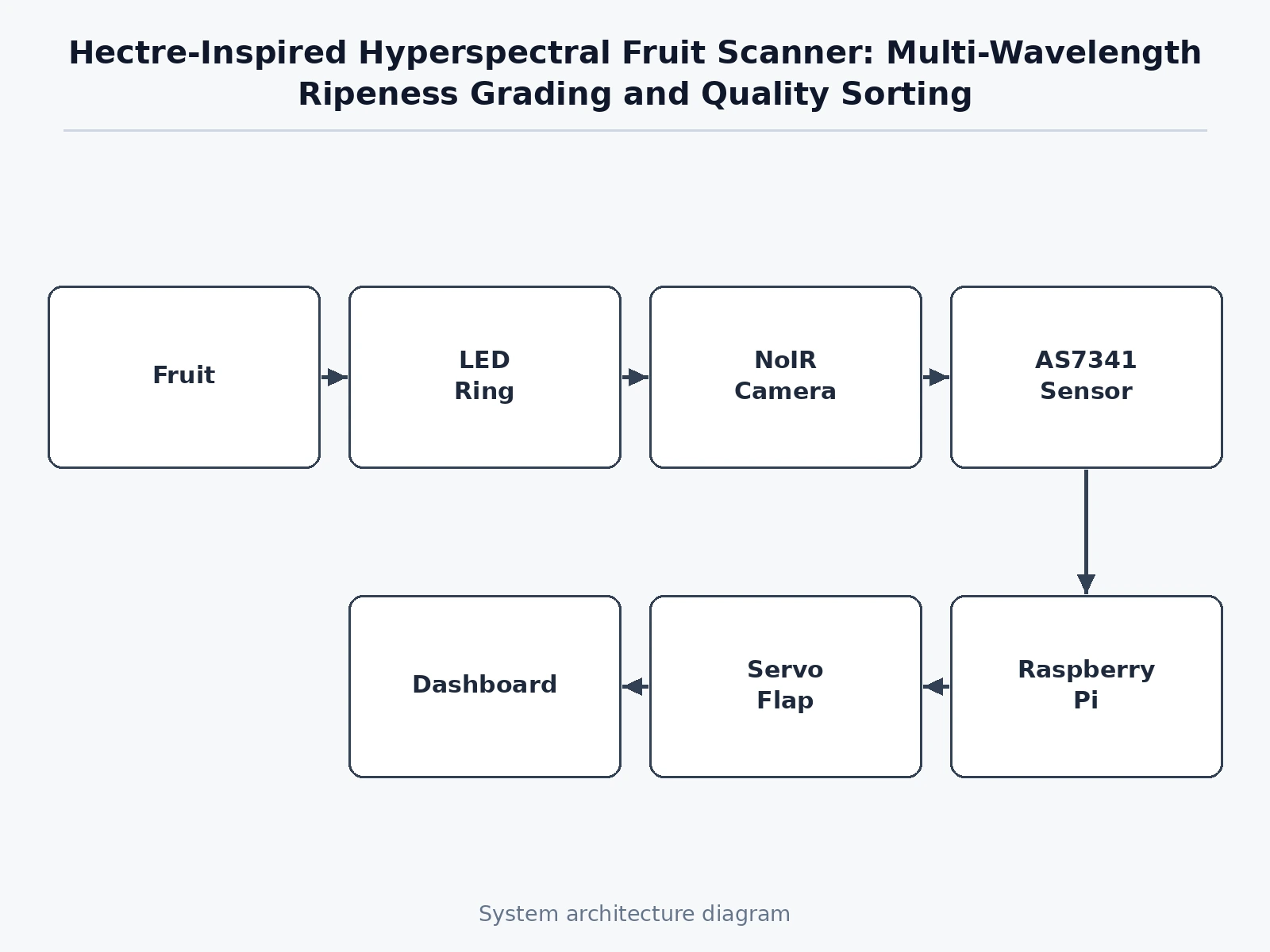
The end-to-end mechanism runs from a fruit placed on the tray to a flap that sorts it, with light doing the measurement and thresholds doing the deciding. The fruit sits in a dark enclosure so room light cannot contaminate the readings, and the Pi first scans the white reference tile to calibrate the session. Then the LED ring lights the fruit one band at a time while the NoIR camera photographs it and the AS7341 sensor records its eleven channels, building a small spectrum for that fruit. The Pi normalises the readings against the white tile, computes the red to near-infrared ratio and the green channel level, and applies the builder's threshold rules to assign Unripe, Ripe or Overripe, while the camera image is checked for dark-spot share. The dashboard displays the photograph, the spectrum curve, the grade and the defect flag, and the servo flap moves to send the fruit to the Accept or Reject bin.
- The builder assembles the dark enclosure, mounts the NoIR camera and LED ring above the tray, fits the AS7341 sensor beside the camera, and wires the servo flap at the tray exit to the Raspberry Pi.
- The builder places the white reference tile on the tray, runs a calibration scan, and checks that all eleven channels read near their reference levels before any fruit is graded.
- The builder collects a sample set of unripe, ripe and overripe fruit of one type, scans each one, and records the red to near-infrared ratio and green channel level for every sample.
- The builder sets the grade thresholds between the sample groups from those recorded values, writes them into the grading rules, and re-scans the sample set to check how many fruits land in their expected grade.
- For the grading demonstration, the builder places one fruit on the tray, runs a full multi-wavelength scan, and reads the grade, spectrum curve and defect share from the dashboard.
- For the sorting demonstration, the builder watches the servo flap direct a Ripe fruit to the Accept bin and an Overripe or defect-flagged fruit to the Reject bin.
- The builder logs every scan to CSV, notes any fruit the rules graded wrongly, and reports the sample-set accuracy honestly in the report, including the fruit type and the number of samples behind it.
Tech stack:
- Raspberry Pi 5 · quad-core host and dashboard server
- Pi Camera Module 3 NoIR · 12 MP imaging without IR filter
- AS7341 spectral sensor · 11-channel visible and NIR readings
- Multi-wavelength LED ring · six narrow bands plus white light
- White reference tile · per-scan reflectance calibration
- Servo sorting flap · Accept and Reject bin diverter
- Flask dashboard · spectrum chart grade and CSV export
- Python grading rules · threshold grades from builder samples
| Parameter | Value |
|---|---|
| Build type | Tabletop hybrid hardware and software build · scanner rig plus grading dashboard |
| Controller | Raspberry Pi 5 · quad-core Cortex-A76 up to 2.4 GHz · 5 V 5 A supply (Datasheet value) |
| Camera | Pi Camera Module 3 NoIR · Sony IMX708 12 MP · 4608 by 2592 pixels · phase-detection autofocus · no IR cut filter (Datasheet value) |
| Spectral sensor | AS7341 · 11 channels · 8 visible channels from about 415 nm to 680 nm · plus near-infrared channel · clear channel · flicker channel · spectral response about 350 nm to 1000 nm · 6 parallel ADCs (Datasheet value) |
| LED bands | 6 narrow bands plus white · 450 nm · 530 nm · 590 nm · 630 nm · 730 nm · 850 nm · white (design target) |
| Scan cycle | 7 illuminations per fruit · about 8 seconds per fruit including settling (design target) |
| Grades | 3 grades · Unripe · Ripe · Overripe · from builder-calibrated red to near-infrared ratio and green channel thresholds (design target) |
| Defect flag | Dark-spot pixel share above 5 percent of fruit outline area · flagged regardless of grade (design target) |
| Sorting | Servo flap · 2 bins · Accept and Reject (design target) |
| Calibration | White reference tile scanned at the start of every batch · readings normalised against tile (design target) |
| Dashboard | Flask web dashboard · fruit photograph · spectrum curve · grade · defect share · flap decision · CSV export (design target) |
| Trend reference | Hectre Arc packhouse scanner and new laboratory opened late October 2026 · hyperspectral development for internal defects · starch content · firmness · reported figures only · never claimed for this build |
| Builder note | On the prototype, room light leaking past the enclosure lid shifted the clear channel between morning and afternoon scans, so the build now checks the lid seal and re-scans the white tile whenever the enclosure is opened; glossy fruit skins also produced bright specular spots under the LED ring, so the LEDs are diffused and the defect check ignores the brightest highlight pixels, and the report states both limits plainly |
Project features
This scanner combines four capabilities that make a complete grading prototype rather than a camera pointed at a fruit. First, multi-wavelength illumination turns colour from a guess into a measurement: the same fruit is photographed under blue, green, amber, red, near-infrared and white light, so ripeness shows up as a changing pattern of reflected light rather than a single photograph. Second, the spectral sensor adds numbers the camera cannot give, with eleven channels from visible light into the near-infrared that the dashboard plots as a spectrum curve for every scan. Third, white-tile calibration keeps those numbers honest across sessions: each batch starts on a white reference tile, so a dimmer LED or a tired power supply shows up as a calibration shift instead of silently changing the grade. Fourth, the servo sorting flap closes the loop physically, moving the graded fruit into an Accept or Reject bin, so the demonstration ends with a sorted fruit, not a number.
- [Multi-wavelength LED illumination] A ring of six narrow-band LEDs plus white light illuminates the fruit one band at a time, so the same fruit yields a separate image and sensor reading per wavelength instead of a single colour photograph — implemented in the base build.
- [Eleven-channel spectral readings] The AS7341 sensor records eight visible channels plus near-infrared, clear and flicker channels, and the dashboard plots them as a spectrum curve that changes shape as the fruit ripens — implemented in the base build.
- [White-tile reflectance calibration] Every batch starts with a scan of a white reference tile, and all fruit readings are normalised against it, so lamp ageing and supply variation do not silently shift the grades — implemented in the base build.
- [Three-grade ripeness rules] Builder-calibrated threshold rules on the red to near-infrared ratio and the green channel assign each fruit to Unripe, Ripe or Overripe, with the thresholds recorded in the report from the builder's own sample set — implemented in the base build.
- [Surface-defect flagging] Dark-spot pixel share inside the fruit outline is measured from the camera image, and fruit above the builder's defect threshold is flagged even when its ripeness grade is Ripe — implemented in the base build.
- [Servo sorting flap] A servo-driven flap at the tray exit directs each graded fruit into an Accept bin or a Reject bin, so the scan ends in a physical sorting action the examiner can watch — implemented in the base build.
- [Grading dashboard with CSV export] A Flask dashboard shows the fruit photograph, the spectrum curve, the grade, the defect share and the flap decision, and exports every scan as a CSV row for the report — implemented in the base build.
- [Continuous conveyor sorting line] Future scope only, not implemented: a belt that feeds fruit through the scanner without hand placement, listed as an extension rather than a claimed feature, since the base build scans one hand-placed fruit at a time.
What is included
- Complete fabricated fruit scanning rig (dark enclosure, fruit tray, NoIR camera module, multi-wavelength LED ring, AS7341 sensor board, white reference tile, servo sorting flap, Accept and Reject bins, Raspberry Pi board)
- Grading dashboard software (multi-wavelength scan control, spectrum curve display, three-grade threshold rules, surface-defect flagging, servo flap control, CSV export)
- Calibration and measurement guide (white-tile procedure, sample-set collection, threshold-setting worksheet, scan log template)
- Project report PDF (spectral sensing background, illumination design, calibration method, grading results from the builder's sample set)
- PPT presentation for final review
- Viva Q&A preparation document (reflectance and ripeness, multispectral versus hyperspectral, AS7341 channels, calibration, threshold grading limits, trend-scanner differences)
Limitations & prerequisites
- Multispectral, not true hyperspectral: the build measures discrete LED bands and eleven sensor channels, not a continuous spectrum of hundreds of bands, so it cannot resolve fine spectral features a laboratory instrument can.
- Grades are threshold rules, not chemistry: the build never measures sugar content or firmness directly, so a grade is a reflectance pattern matched to the builder's samples, not a laboratory ripeness certificate.
- One fruit type per calibration: thresholds set on one fruit type do not transfer to another without a new sample set, and the report must name the fruit type and sample count behind every accuracy figure.
- One fruit at a time: the base build scans hand-placed fruit and cannot match packhouse throughput, and continuous conveyor feeding is future scope only.
- Enclosure discipline matters: room light leaks and glossy-skin reflections shift readings, so scans must run with the lid sealed and the white tile re-scanned whenever the enclosure is opened.
- Not a food-safety device: the scanner grades appearance-related ripeness and surface defects only, and it cannot detect internal rot, pesticide residue or contamination.
- This is an academic prototype, not a certified inspection instrument: mains-powered bench equipment needs supervision, LED glare should not be stared into at close range, and lithium battery handling needs supervision, correct polarity, and a protected holder where a battery pack is used.
Frequently Asked Questions
Is this project suitable for a final-year project?
Yes, for Electronics, IoT and Computer Engineering programs, because it combines optics, embedded hardware, sensor interfacing, image processing and a web dashboard in one build students can demonstrate with real fruit. It gives a clear viva thread: how reflected light changes as fruit ripens, why several wavelengths beat one photograph, how calibration keeps numbers honest, and where threshold rules stop being trustworthy.
How is this different from Hectre's Arc scanner?
Arc is a commercial packhouse system scanning fruit on open-top trucks as loads arrive, capturing colour, size and external defects, with hyperspectral sensing for internal defects, starch and firmness under development. This build is a tabletop student scanner grading one hand-placed fruit at a time with LED bands and an eleven-channel sensor, and the commercial scale and results are reported references only, never claimed for this build.
Is this really hyperspectral imaging?
Not in the strict sense, and the report says so plainly: a true hyperspectral camera records a continuous spectrum with hundreds of narrow bands, while this build records discrete LED bands plus eleven sensor channels. It is honestly a multispectral scanner inspired by hyperspectral packhouse work, and the distinction itself is a strong viva point, because it shows the student understands what the headline technology actually requires.
How does light reveal ripeness?
As fruit ripens, pigments break down and the skin's reflectance changes differently at different wavelengths: green reflectance falls as chlorophyll fades, red reflectance rises, and near-infrared behaviour shifts with internal structure. Measuring the same fruit under several bands turns those changes into a spectrum curve whose shape moves with ripeness, which is why one ordinary photograph, which mixes all wavelengths together, cannot separate the stages as cleanly.
Why is the white tile scanned before every batch?
Because LED brightness drifts with temperature and supply voltage, and the sensor reading for a fruit is meaningless without a reference taken under the same light. Scanning a white tile first gives a known-reflectance baseline for every channel, so fruit readings are normalised against it and a dimmer LED shows up as a calibration shift rather than silently changing the grade of every fruit that follows.
Can the scanner grade any fruit?
No, not without recalibration: thresholds are set from a sample set of one fruit type, and a different fruit has different skin pigments, thickness and ripening chemistry, so its spectrum curve sits in a different place. The build is demonstrated on one fruit type, the report names that type and the sample count, and grading a new fruit means collecting a fresh sample set and setting new thresholds first.
Components & software requirements
- Raspberry Pi 5 · quad-core host and dashboard server
- Pi Camera Module 3 NoIR · 12 MP imaging without IR filter
- AS7341 spectral sensor · 11-channel visible and NIR readings
- Multi-wavelength LED ring · six narrow bands plus white light
- White reference tile · per-scan reflectance calibration
- Servo sorting flap · Accept and Reject bin diverter
- Flask dashboard · spectrum chart grade and CSV export
- Python grading rules · threshold grades from builder samples
Delivery information
Built-to-order project. Delivery timeline is shared after order confirmation based on current queue.
Support terms
Complete documentation, setup guide, and viva preparation included. Support for setup and explanation provided.
Download free synopsis (PDF)
Enter your name and WhatsApp number — the synopsis PDF downloads immediately. We may send occasional project updates on WhatsApp; no spam.