
More project photos (3)
The problem
M1 Ultra-Inspired Turntable 3D Scanner: Photogrammetry Capture with ESP32 Turntable Control is a bench-top rig that turns an ordinary phone camera into a small-object 3D scanner, without any laser or structured-light hardware. Commercial handheld scanners sit far beyond a student budget, and a phone alone cannot record the exact angles between photos, so reconstructions come out warped or full of holes. This rig fixes the geometry problem mechanically: an ESP32 steps a motorised turntable in exact 10-degree stops, the phone photographs the object at every stop from a fixed tripod, and an LED ring keeps the lighting even, so the 36-photo set carries the overlap that open-source photogrammetry needs to rebuild a mesh. The idea takes its cue from the ELEGOO M1 Ultra all-in-one scanner launched in October 2026, whose reported laser accuracy of up to 0.02 mm is a commercial reference only and is never claimed for this student build.
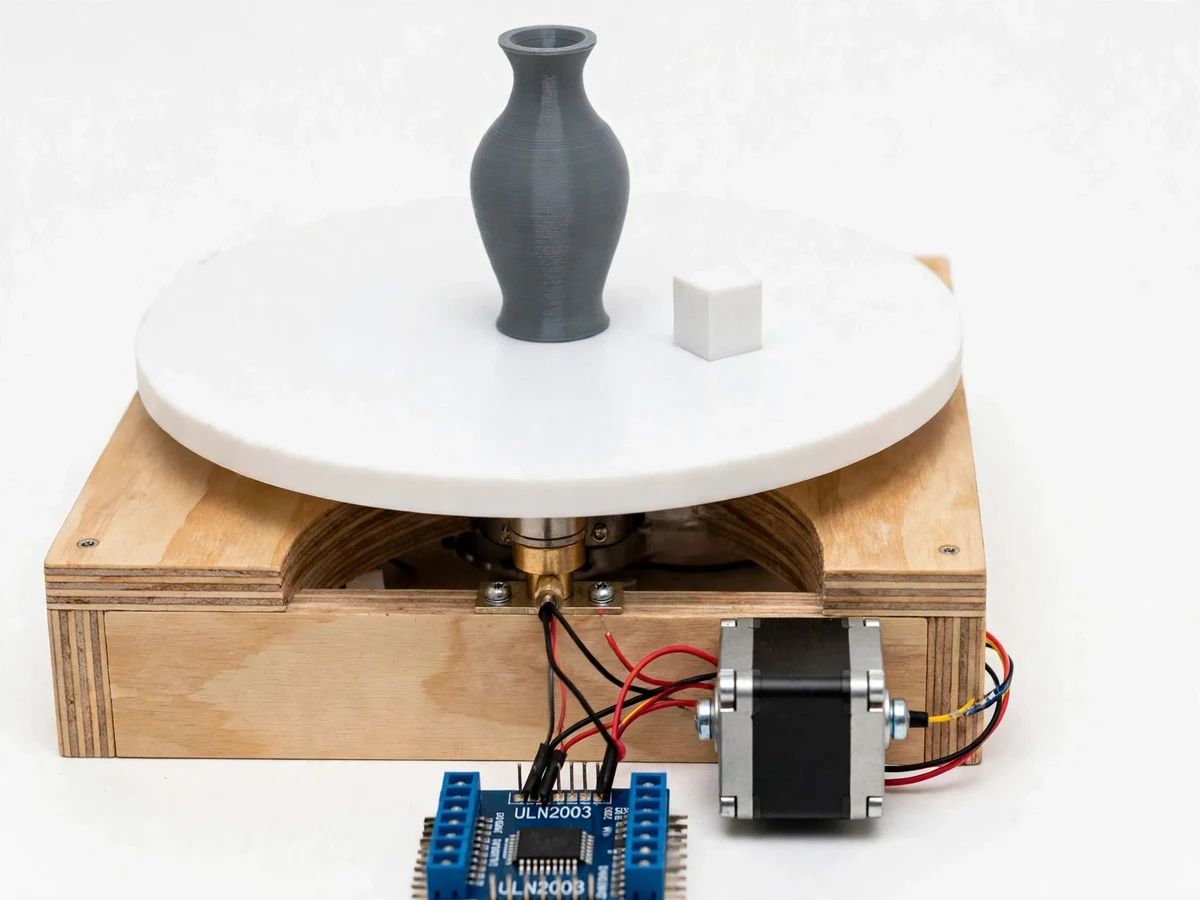
Small matte object centred on the turntable under the LED ring.
Follow the working sequence
How it works
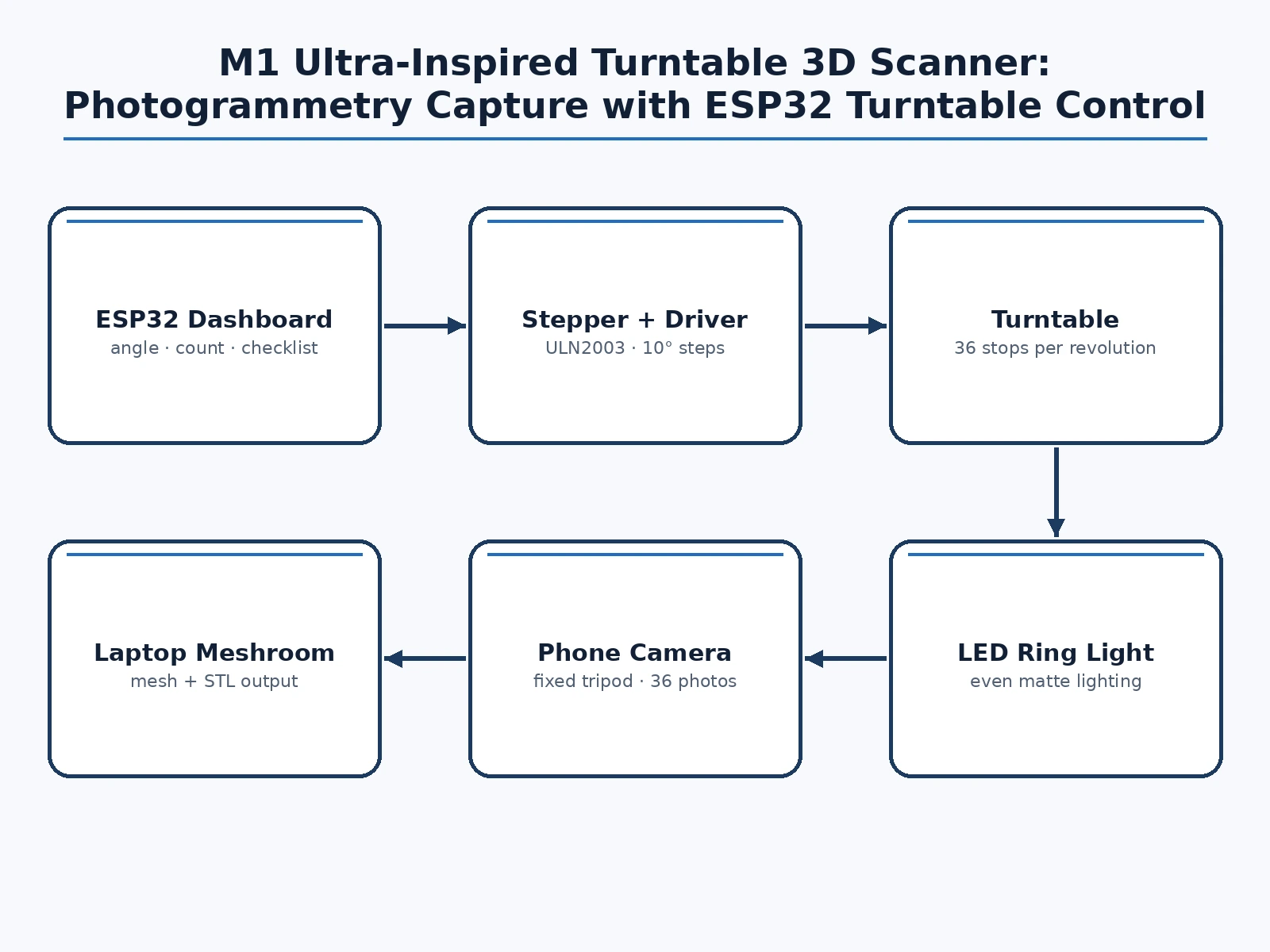
The end-to-end mechanism runs from a matte object placed on the turntable to a printable mesh file on the laptop in seven steps, with the turntable doing the precise work a hand-held camera cannot. The object is centred on the turntable under the LED ring, the phone is fixed on its tripod, and the ESP32 steps the turntable 10 degrees at a time. At each of the 36 stops the dashboard waits out its 2-second settle pause, prompts the photo, and counts it, so the photo set covers the full revolution at known, even angles. The photos move to the laptop, where open-source photogrammetry matches features across overlapping views, builds a sparse cloud, densifies it into a mesh, and exports an STL file that can be printed or measured against the calibration cube.
- The builder places a small matte, opaque, rigid object at the centre of the turntable, switches on the LED ring light, and fixes the phone on the tripod so framing stays unchanged for the whole session.
- The 20 mm calibration cube is scanned first: it is photographed through one full revolution, reconstructed, and measured with a vernier caliper so the builder knows their own dimensional error before scanning the real object.
- From the ESP32 dashboard, the builder starts the capture loop: the ESP32 drives the 28BYJ-48 stepper through the ULN2003 driver by one 10-degree step.
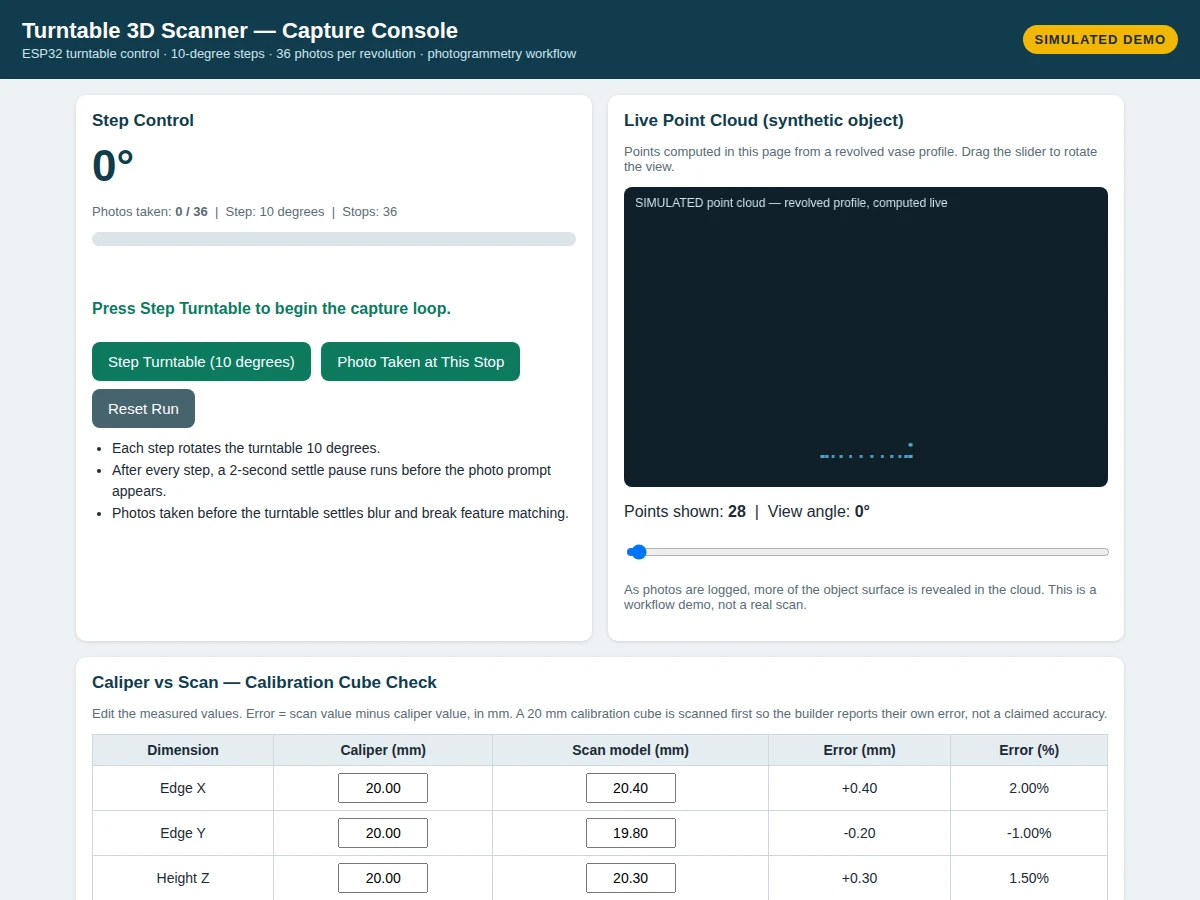
- The dashboard enforces its 2-second settle pause after the step, then prompts the photo; the builder takes the photo and confirms it, and the dashboard advances the count toward 36.
- Steps 3 and 4 repeat until all 36 stops around the revolution are photographed, giving a complete photo set with known, even angular spacing.
- The photo set is transferred to the laptop and opened in Meshroom or COLMAP, which matches features across overlapping photos, builds a sparse point cloud, densifies it, and meshes the result.
- The mesh is cleaned, scaled against the calibration cube, and exported as an STL file for 3D printing, and the builder records the measured error alongside the finished model.
Tech stack:
- ESP32 development board · Wi-Fi dashboard hosting
- 28BYJ-48 stepper motor · ULN2003 driver board
- Smartphone camera · fixed tripod mount
- LED ring light · even matte illumination
- Meshroom photogrammetry · COLMAP alternative
- Laptop reconstruction · STL export for 3D printing
- Vernier caliper · 20 mm calibration cube
- HTML dashboard · step counter and capture checklist
| Parameter | Value |
|---|---|
| Build type | Bench-top turntable photogrammetry rig · hybrid hardware and software build |
| Turntable step | 10 degrees per stop · 36 stops per full revolution (design target) |
| Stepper motor | 28BYJ-48 · 5 V · 4096 steps per output revolution in half-step mode (Datasheet value) |
| Controller | ESP32 · dual-core Xtensa LX6 up to 240 MHz (Datasheet value) |
| Camera | Smartphone camera on a fixed tripod · 1 photo at every stop · builder-supplied phone |
| Lighting | LED ring light · even illumination around the object (design target) |
| Reconstruction | Meshroom or COLMAP on a laptop · open-source photogrammetry software |
| Calibration | 20 mm calibration cube · measured with a vernier caliper (design target) |
| Output and object size | STL mesh file for 3D printing · objects approximately up to 150 mm tall (design target) |
| Builder note | On the prototype, photos taken before the turntable settled blurred enough to break feature matching, so the dashboard enforces a 2-second settle pause after every step before prompting the photo; and a light coat of matte spray or talc on glossy test objects was the difference between a hole-filled mesh and a closed one |
Project features
M1 Ultra-Inspired Turntable 3D Scanner combines four capabilities that make it a complete capture-to-mesh prototype rather than a bare rotating plate. First, the ESP32 step control turns the turntable in 10-degree stops, giving 36 evenly spaced camera positions around one revolution with no guesswork about angles. Second, the enforced 2-second settle pause after every step stops motion blur from breaking feature matching, which was the failure that ruined early test captures on the prototype. Third, the ESP32-hosted dashboard counts stops, prompts each photo and tracks the 36-photo checklist, so a capture session cannot silently skip an angle. Fourth, the laptop reconstruction stage turns the photo set into a mesh and an STL file for 3D printing, and the calibration-cube check gives the builder a measured error figure of their own.
- [ESP32 step control in 10-degree stops] The ESP32 drives the stepper motor through the ULN2003 driver in 10-degree steps, giving 36 evenly spaced stops per full revolution — implemented in the base build.
- [2-second settle pause before every photo] The dashboard enforces a 2-second pause after each step before prompting the photo, because photos taken before the turntable settled blurred enough on the prototype to break feature matching — implemented in the base build.
- [Phone camera capture from a fixed tripod] A phone camera mounted on a fixed tripod photographs the object at every stop, so framing, distance and focus stay unchanged across all 36 photos — implemented in the base build.
- [LED ring lighting for even matte illumination] A circular LED ring light surrounds the object with soft, even light, reducing harsh shadows and bright spots that confuse feature matching — implemented in the base build.
- [ESP32-hosted capture dashboard] A small web dashboard hosted on the ESP32 shows the current angle, the photo count out of 36, the settle countdown and the capture checklist, and prompts each photo in turn — implemented in the base build.
- [Open-source reconstruction to STL] The 36-photo set is rebuilt on a laptop with Meshroom or COLMAP into a dense cloud, a mesh and an STL file ready for 3D printing — implemented in the base build.
- [Calibration-cube error check] A 20 mm calibration cube is scanned first and measured with a vernier caliper, so the builder reports their own dimensional error for the scan instead of claiming any accuracy figure up front — implemented in the base build.
- [Second camera elevation and automated shutter trigger] Future scope only, not implemented: a second camera height for tall objects and an automated shutter trigger replacing the manual photo prompt, both listed as extensions rather than claimed features.
What is included
- Complete fabricated turntable scanner rig (turntable plate, 28BYJ-48 stepper and ULN2003 driver, ESP32 board, LED ring light, tripod mount)
- ESP32 dashboard firmware and capture checklist (step control, 2-second settle pause, 36-photo counter)
- Reconstruction guide (photo transfer, Meshroom or COLMAP pipeline, mesh cleanup, STL export, calibration-cube measurement)
- Project report PDF (background, photogrammetry theory, turntable design, capture procedure, calibration results template)
- PPT presentation for final review
- Viva Q&A preparation document (photogrammetry pipeline, stepper control, settle-pause reasoning, object limits, calibration method)
Limitations & prerequisites
- Matte, opaque, rigid objects only: shiny, transparent, featureless, very dark or moving objects fail, because photogrammetry needs stable surface features to match across photos, and a light matte coat is the practical remedy for mildly glossy test objects.
- This build uses no laser triangulation and no structured light, so it cannot match a commercial scanner: it claims no accuracy figure up front, and the calibration-cube error is the only honest accuracy statement for a given build.
- Phone-camera limits apply: sensor size, lens distortion and fixed focus all cap detail, and changing the framing mid-session breaks the reconstruction.
- Reconstruction runs on a laptop and takes time: a 36-photo set can take well over an hour on a modest machine, and Meshroom's full pipeline benefits from a capable graphics card.
- Lighting must stay even and constant: moving shadows, mixed daylight and flickering room lights all degrade feature matching and can leave holes in the mesh.
- The rig scans small bench-top objects only, not people and not large rooms or scenes, and it is not a metrology instrument: it must not be presented as certified measurement equipment.
- Results vary with the object, the phone and the laptop, so mesh quality and measured error differ from build to build and must be reported per build.
Frequently Asked Questions
Is this project suitable for a final-year project?
Yes, for Electronics, Electrical and Computer Engineering programs, because it combines embedded control, stepper-motor driving, a hosted web dashboard, computer-vision photogrammetry and hands-on calibration in one working rig that can be demonstrated live during a review. It gives a clear viva thread: why even angular steps matter, why the settle pause exists, how feature matching rebuilds a mesh, and how the calibration cube turns an accuracy claim into a measured result.
How is this different from the ELEGOO M1 Ultra scanner?
The M1 Ultra is a commercial handheld scanner with blue-laser and infrared structured-light modes and a reported accuracy of up to 0.02 mm for its laser mode, while this student build uses no laser and no structured light at all. Instead it photographs the object from 36 known turntable angles and rebuilds the shape with open-source photogrammetry on a laptop. The commercial figures are a reference point for the trend only and are never claimed for this build.
What objects can it scan?
It scans small, matte, opaque, rigid objects that stay perfectly still, such as a printed figurine, a small mechanical part or a calibration cube, up to approximately 150 mm tall as a design target. Shiny, transparent, featureless, very dark or moving objects fail because photogrammetry needs stable visible features to match across photos. A light coat of matte spray or talc can rescue a mildly glossy test object, but it cannot fix transparent or featureless surfaces.
Why does the dashboard enforce a 2-second settle pause?
The pause exists because photos taken before the turntable settled blurred enough on the prototype to break feature matching and leave holes in the mesh. The turntable may look still a fraction of a second after stepping, but vibration and overshoot continue briefly, and a blurred photo poisons the matching stage for its neighbours too. Waiting 2 seconds after every step costs just over a minute per revolution and protects the whole reconstruction.
What software rebuilds the photos into a mesh?
The photo set is rebuilt with Meshroom or COLMAP, both open-source photogrammetry tools that run on a laptop and need no licence fee. The pipeline matches features across overlapping photos, estimates camera positions, builds a sparse point cloud, densifies it into a mesh and exports an STL file for 3D printing. Reconstruction time depends on the laptop, and Meshroom's full pipeline benefits from a capable graphics card.
Can the rig scan people or large objects?
No, the rig is sized and designed for small bench-top objects only, and scanning people is outside its scope for both practical and safety reasons. A person cannot hold still through 36 stops, and the turntable, tripod framing and lighting are all sized for objects up to approximately 150 mm tall. Large rooms and scenes are equally out of scope, since the fixed camera and fixed lighting cannot cover them.
Components & software requirements
- ESP32 development board · Wi-Fi dashboard hosting
- 28BYJ-48 stepper motor · ULN2003 driver board
- Smartphone camera · fixed tripod mount
- LED ring light · even matte illumination
- Meshroom photogrammetry · COLMAP alternative
- Laptop reconstruction · STL export for 3D printing
- Vernier caliper · 20 mm calibration cube
- HTML dashboard · step counter and capture checklist
Delivery information
Built-to-order project. Delivery timeline is shared after order confirmation based on current queue.
Support terms
Complete documentation, setup guide, and viva preparation included. Support for setup and explanation provided.
Download free synopsis (PDF)
Enter your name and WhatsApp number — the synopsis PDF downloads immediately. We may send occasional project updates on WhatsApp; no spam.