
More project photos (3)
The problem
IoT-Based Water Quality Monitoring System — live pH, TDS & turbidity sensing with cloud dashboard and quality alerts. Unsafe drinking water is one of the biggest public-health problems in India — and civil engineering students need final-year projects that show real engineering impact. This IoT based water quality monitoring system measures three critical water parameters — pH, TDS (total dissolved solids) and turbidity — using an ESP32, streams the readings to a live cloud dashboard, automatically grades water quality, and sends alerts the moment any parameter crosses a safe limit. It's the rare civil-IoT crossover project: strong on engineering fundamentals, modern on technology, and almost zero competition in the project-kit market. Perfect final year project for civil, environmental and electronics students, with full report, code and viva support.
Measures water pH with a calibrated probe.
Follow the working sequence
How it works
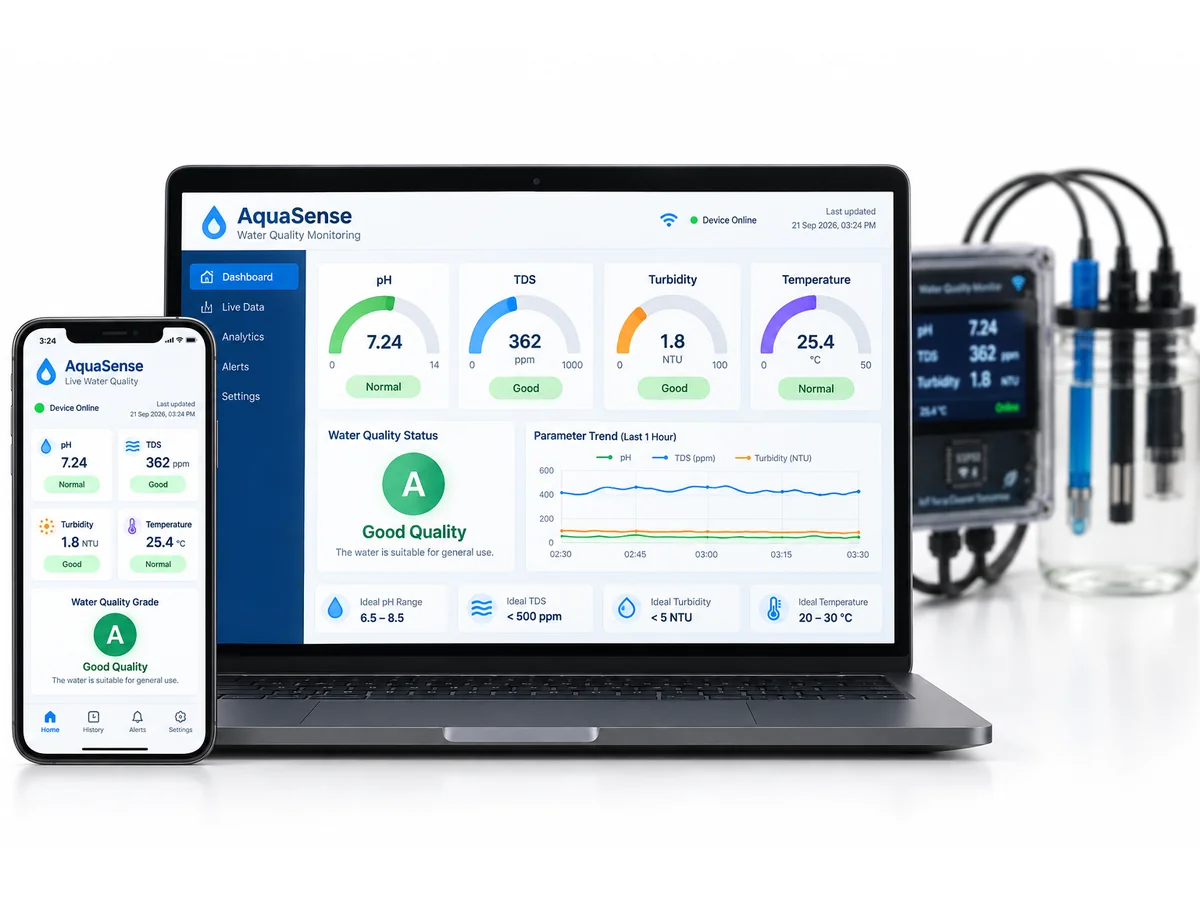
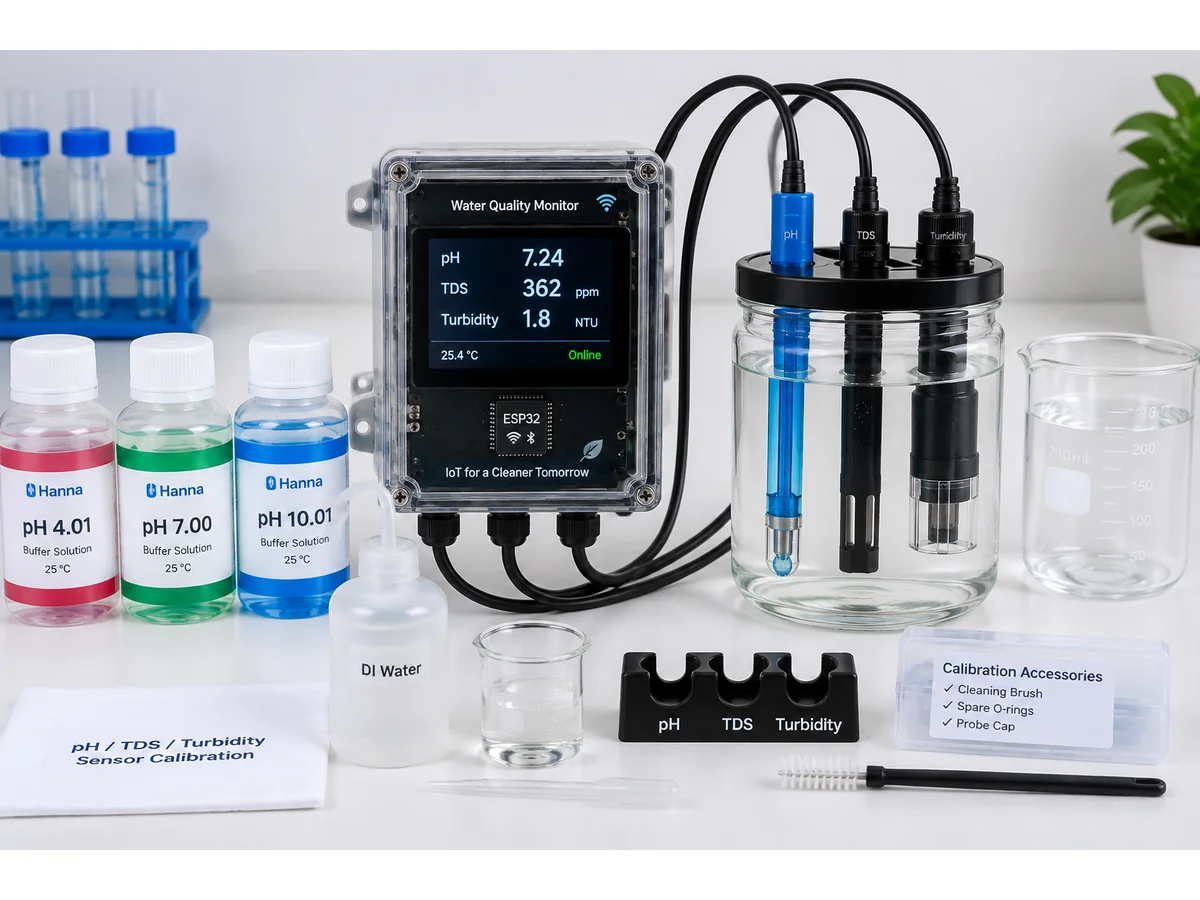
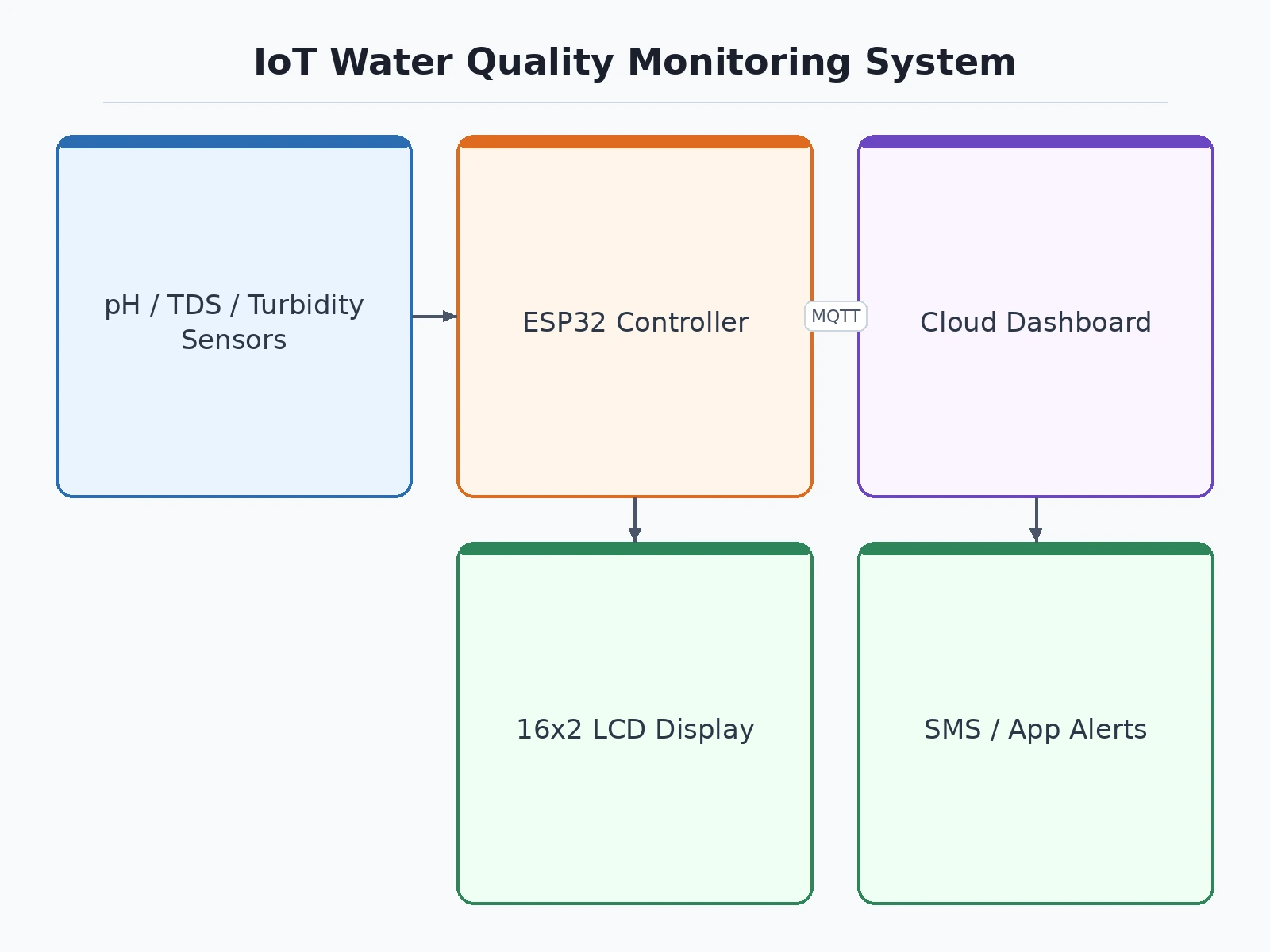
Three sensors are dipped into the water sample and wired to an ESP32 controller. The ESP32 reads the pH, TDS and turbidity values, applies calibration offsets and temperature compensation, and classifies the water quality against standard safe limits (pH 6.5–8.5, TDS under 500 ppm, low turbidity). Every few seconds it publishes the readings over Wi-Fi to a cloud dashboard (MQTT/Blynk), where you see live values, color-coded quality grades and historical trend graphs. If any parameter breaches its threshold, the system fires an immediate alert to your phone so unsafe water is never missed.
Project features
- Live pH measurement with a calibrated probe-style pH sensor, accurate to ±0.1 pH
- TDS (total dissolved solids) sensing to detect dissolved salts and mineral contamination
- Turbidity sensor that detects suspended particles and water cloudiness in NTU
- ESP32 streams all parameters to a cloud dashboard in real time over Wi-Fi
- Automatic water quality grading — Excellent / Good / Poor — based on standard safe-limit thresholds
- Instant alerts (app notification / Telegram) when pH, TDS or turbidity cross WHO/BIS safe limits
- 7-day historical graphs for trend analysis — ideal for report charts and viva demonstrations
- Waterproof sensor housing so the unit can sit in tanks, taps, wells or river samples
- Two-point calibration mode for pH and TDS sensors with temperature compensation
What is included
- Assembled water quality monitoring station with waterproof housing + firmware
- Wiring and connection diagram (clear, report-ready)
- Report PDF (synopsis, methodology, calibration procedure, results, conclusion)
- PPT presentation for review/demo day
- Viva Q&A set covering water-quality standards, sensor calibration and IoT concepts
Advantages
- Three-parameter sensing in one station — live pH measurement accurate to ±0.1 pH, plus TDS and turbidity, instead of separate instruments.
- Automatic water-quality grading (Excellent / Good / Poor) against standard safe-limit thresholds, readable at a glance.
- Instant alerts by app notification or Telegram the moment pH, TDS or turbidity cross WHO/BIS safe limits.
- 7-day historical graphs for trend analysis — ready-made charts for the project report and viva demonstrations.
- Waterproof sensor housing with two-point calibration and temperature compensation, so the unit works in tanks, taps, wells and river samples.
Disadvantages
- Designed for fresh water (tanks, taps, wells, samples) — not calibrated for seawater salinity or industrial effluents.
- pH probes need recalibration every few weeks for best accuracy; buffers are provided in the calibration guide.
- The cloud dashboard needs a Wi-Fi connection; offline mode stores only the last few readings locally.
- Sensor probes must be cleaned and kept wet per the maintenance guide to avoid drift.
Limitations & prerequisites
- Designed for fresh water (tanks, taps, wells, samples); not calibrated for seawater salinity or industrial effluents
- pH probes need recalibration every few weeks for best accuracy — buffers provided in the calibration guide
- Cloud dashboard needs a Wi-Fi connection; offline mode stores only the last few readings locally
- Sensor probes must be cleaned and kept wet per the maintenance guide to avoid drift
Components & software requirements
- ESP32 microcontroller (built-in Wi-Fi + Bluetooth)
- pH sensor probe with signal conditioning module
- TDS sensor (EC-based) with analog output
- Turbidity sensor module (NTU-based optical sensor)
- Waterproof housing / sealed sensor enclosure
- 5V regulated power supply with cable management
- Supporting electronics: jumper set, breadboard/perfboard, voltage divider parts
Download free synopsis (PDF)
Enter your name and WhatsApp number — the synopsis PDF downloads immediately. We may send occasional project updates on WhatsApp; no spam.