
More project photos (3)

The problem
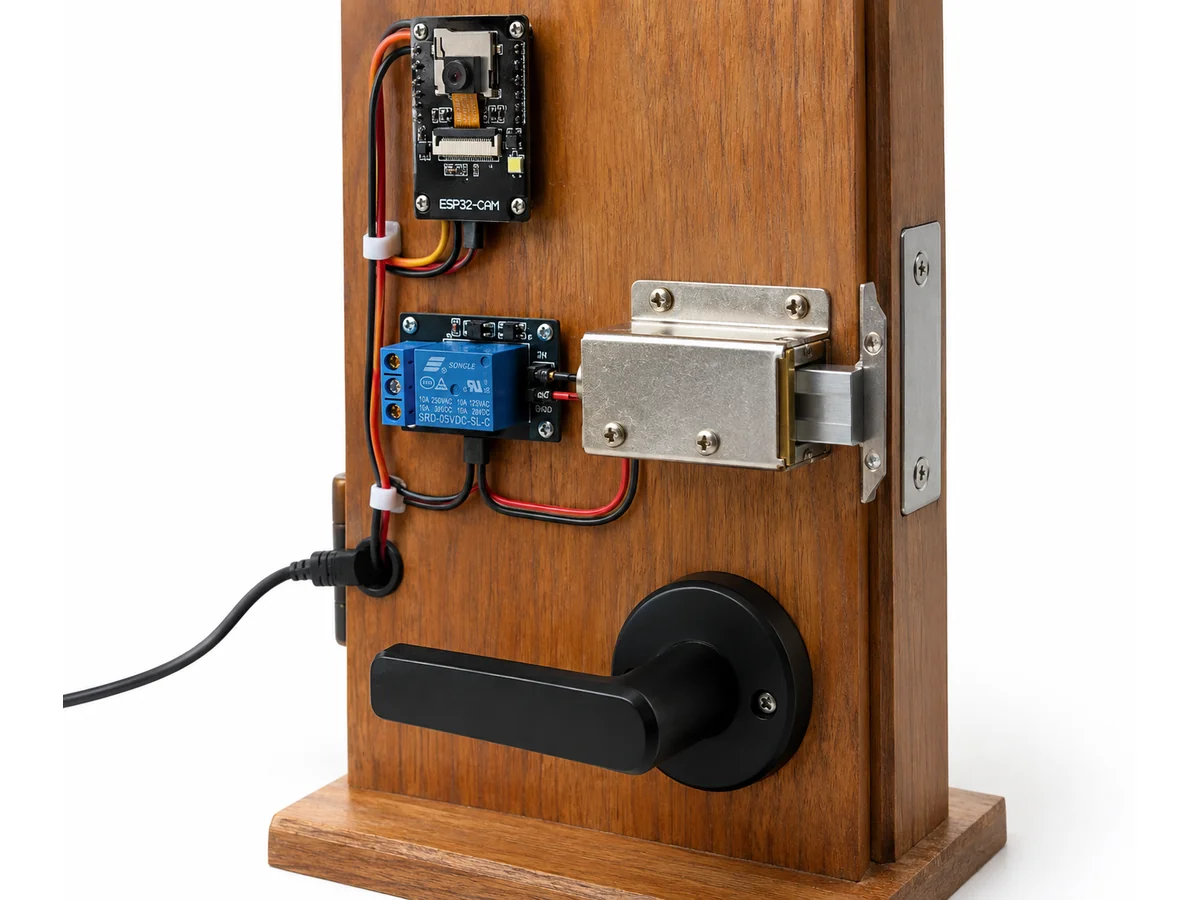
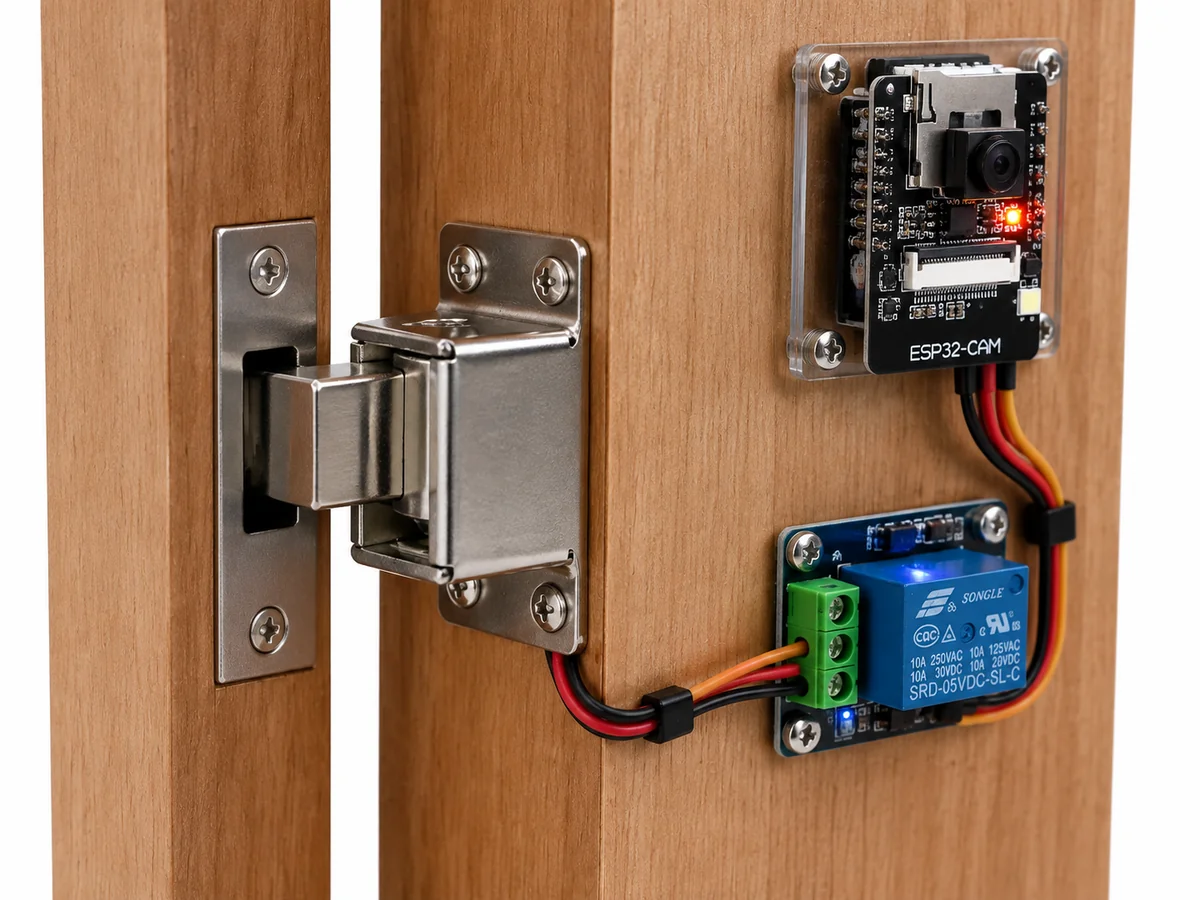
Face recognition door lock project using ESP32-CAM — a smart access-control system that replaces keys with faces. The ESP32-CAM captures a visitor's face, matches it against enrolled templates, and energizes a solenoid lock through a relay only for recognized users. An enrollment web page, an entry log with timestamps, and a keypad override round out a complete, viva-ready final year project build.
userResident
Stands at the door for face recognition or enters the keypad PIN as fallback.
Follow the working sequence
How it works
- The ESP32-CAM continuously monitors the door area and detects faces in frame.
- A detected face is compared against enrolled face templates stored on the device.
- On a match, the ESP32-CAM drives the relay module, energizing the solenoid lock to release the latch.
- After a configurable timeout, the lock re-engages automatically.
- Every attempt — granted or denied — is logged with a timestamp; new faces are enrolled via the web page or keypad PIN.
Project features
- Face detection and recognition running on the ESP32-CAM module
- Enrollment web page — capture and store authorized faces over Wi-Fi
- Relay-driven solenoid lock for secure actuation
- Keypad override for fallback access and enrollment PIN
- Entry log with timestamps viewable from the web interface
- Status LED indications for locked, recognized, and denied states
- Compact, door-mountable prototype
What is included
- Assembled lock unit + tested firmware
- Wiring diagram
- Report PDF
- PPT presentation
- Viva Q&A set
Advantages
- Keyless, contactless entry — the door unlocks for enrolled faces, so no keys or cards to carry or lose.
- Face detection and recognition runs on the ESP32-CAM itself, so the system works without a PC or server in the loop.
- Self-service enrollment via a web page over Wi-Fi — capture and store authorized faces without touching the device.
- Keypad override with an enrollment PIN keeps access available even when face recognition fails or fails to enroll a user.
- Timestamped entry log viewable from the web interface gives basic access auditing for the installation.
- Compact, door-mountable prototype; the lock keeps working offline once faces are enrolled.
Disadvantages
- Recognition accuracy drops in poor lighting or with extreme face angles.
- On-device storage for enrolled faces is limited to roughly 10 users.
- Not spoof-proof against high-quality photos — positioned as a prototype, not a high-security lock.
- A stable Wi-Fi connection is required for the enrollment web page (locking itself works offline once enrolled).
Limitations & prerequisites
- Recognition accuracy drops in poor lighting or with extreme face angles
- Limited on-device storage for enrolled faces (~10 users)
- Not spoof-proof against high-quality photos — position it as a prototype, not a bank vault
- Requires stable Wi-Fi for the enrollment web page (locking works offline once enrolled)
Components & software requirements
- ESP32-CAM module (with camera)
- FTDI programmer (for flashing firmware)
- Relay module (5V)
- Solenoid lock (12V)
- 4x4 matrix keypad
- 12V power supply + 5V regulation for logic
- Connecting wires, mounting hardware
Download free synopsis (PDF)
Enter your name and WhatsApp number — the synopsis PDF downloads immediately. We may send occasional project updates on WhatsApp; no spam.
Susilo, Chandra, Kurniawan & Subagyo (2024), Proceedings of iCAST-ES 2023 (Atlantis Press)