
More project photos (3)
The problem
Factories lose crores to unplanned machine breakdowns — a bearing fails without warning and the whole line stops. Industry 4.0's answer is the digital twin: a live virtual replica of the physical machine, fed by sensors, that predicts failures before they happen. This project builds exactly that on a demo motor: vibration and temperature sensors stream via ESP32 into a 3D dashboard twin, and an ML anomaly model flags bearing degradation days in advance. It's the only credible Industry 4.0 kit topic for mechanical and mechatronics students, it captures the "predictive maintenance using ML" search volume too, and no kit seller on the internet has a purchasable digital-twin page.
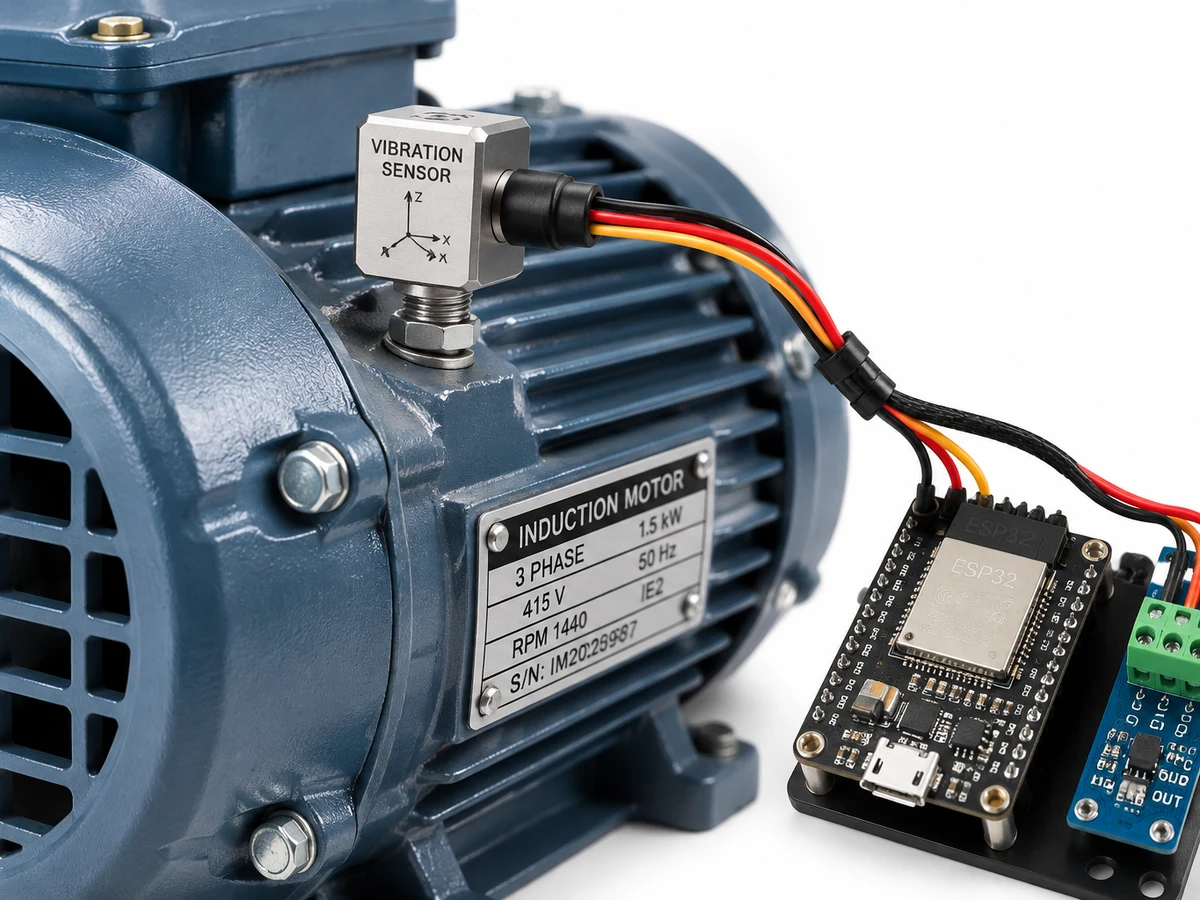
Streams vibration from the demo motor at 100+ Hz.
Follow the working sequence
How it works
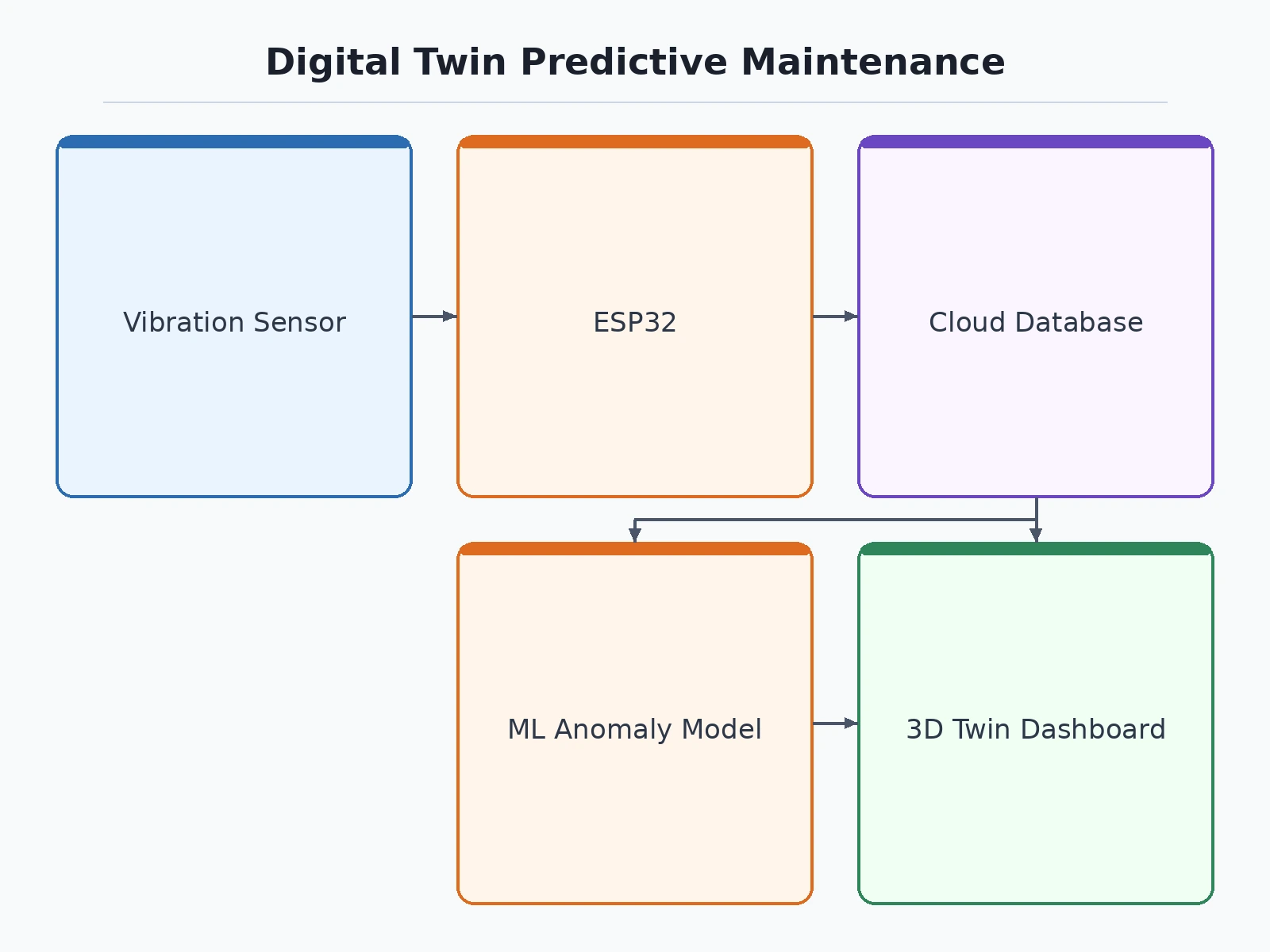
- An accelerometer and temperature sensor mounted on the demo motor stream data to the ESP32.
- The ESP32 publishes vibration windows and temperature readings to the cloud via MQTT.
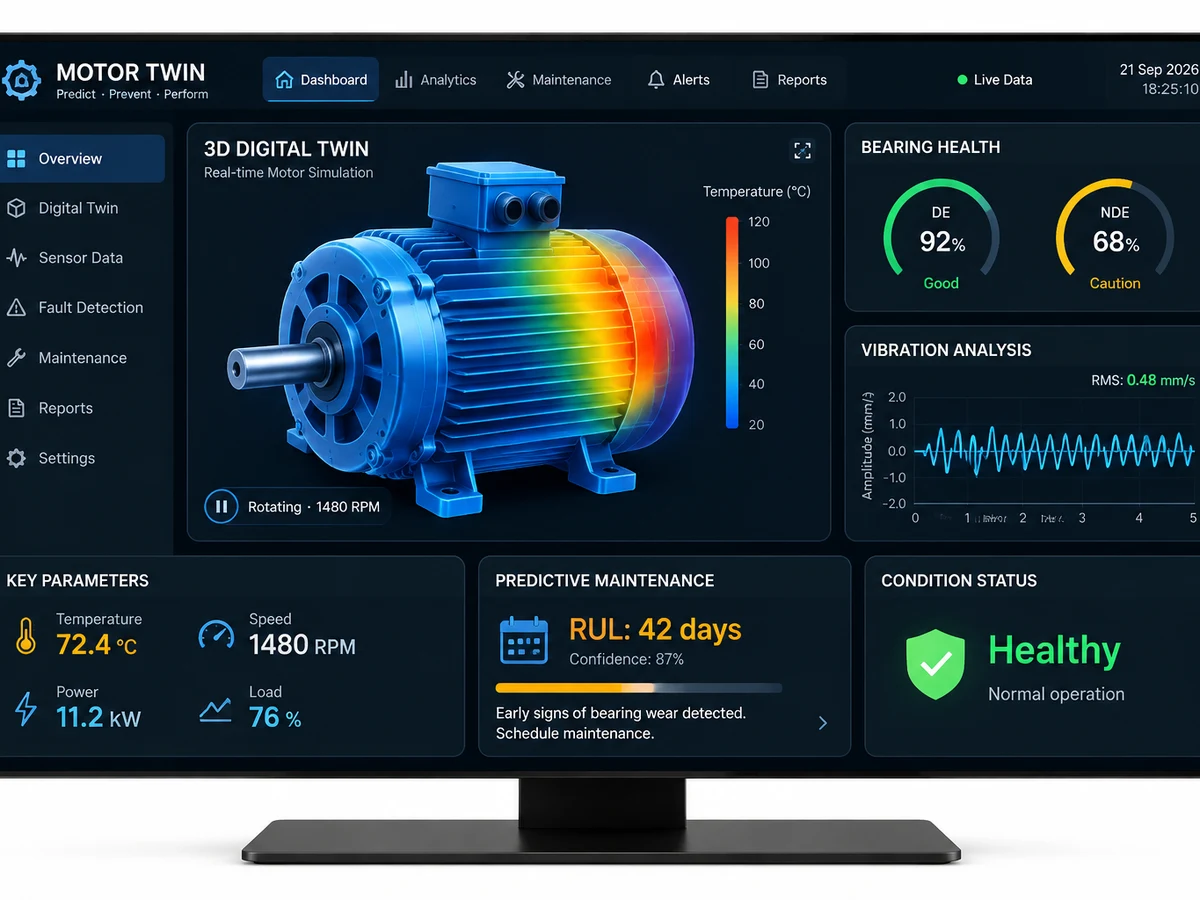
- The dashboard renders the 3D motor twin, updating rotation, heat tint, and vibration gauges in real time.
- The ML model (autoencoder trained on healthy-run data) scores each vibration window; rising reconstruction error signals developing faults.
- When the health score crosses warning/critical thresholds, alerts fire and the twin highlights the suspect bearing — days before a real failure.
Project features
- Live 3D dashboard twin of the demo motor (Three.js) mirroring real sensor state
- Vibration (accelerometer) + temperature sensing via ESP32 at 100+ Hz sampling
- ML anomaly detection: autoencoder trained on healthy vibration signatures flags degradation
- Remaining-useful-life estimate with trend charts as vibration drifts from baseline
- Threshold alerts (SMS/dashboard) when vibration or temperature crosses safe limits
- Historical playback: scrub back through the twin's recorded states
- Fault-injection demo: introduce imbalance to watch the twin and model react live
- Exportable health reports with FFT spectra for the project report
What is included
- ESP32 firmware + dashboard + ML pipeline source code
- Sensor mounting rig and demo motor assembly
- Pre-trained anomaly model + healthy-baseline dataset
- Project report PDF (synopsis, digital-twin literature, methodology, results, conclusion)
- Presentation PPT for review/demo day
- Viva Q&A sheet covering digital twins, vibration analysis, FFT, and autoencoders
- Demo script: fault injection and prediction walkthrough
Advantages
- A live 3D digital twin of the demo motor (Three.js) that mirrors the real sensor state — students can watch the virtual machine vibrate, heat and spin in sync with the physical rig.
- Vibration (accelerometer) plus temperature sensing on the ESP32 at 100+ Hz sampling, streamed into the cloud dashboard for the ML model to work on.
- ML anomaly detection: an autoencoder trained on healthy vibration signatures flags degradation days before bearing failure becomes audible.
- Remaining-useful-life estimate with trend charts as vibration drifts from the healthy baseline — a genuine predictive-maintenance metric for the report.
- Threshold alerts over SMS/dashboard when vibration or temperature crosses safe limits, plus historical playback to scrub back through recorded states.
- Fault-injection demo (introduce imbalance and watch the twin and model react live) and exportable health reports with FFT spectra for the project report.
Disadvantages
- Demonstrates the digital-twin concept on a single demo motor — a full factory twin with SCADA integration is enterprise scope, not included here.
- Prediction is anomaly-based (deviation from a healthy baseline), not a physics-based crack-growth model — stated honestly in the report.
- Vibration signatures vary with how the motor is mounted; the calibration procedure in the guide must be followed or the model flags false alarms.
- The cloud dashboard needs Wi-Fi at the demo location; local twin views are not a documented fallback.
Limitations & prerequisites
- Demonstrates the digital-twin concept on a single demo motor; a full factory twin with SCADA integration is enterprise scope
- Prediction is anomaly-based (deviation from healthy baseline), not a physics-based crack-growth model — stated honestly in the report
- Vibration signatures vary with mounting; the calibration procedure in the guide must be followed
- Cloud dashboard needs WiFi at the demo location
- This is a built-to-order project — delivery time depends on component availability
Components & software requirements
- ESP32 microcontroller
- ADXL345/MPU6050 accelerometer (vibration sensing)
- DS18B20 temperature sensor
- Demo DC motor with mounting rig (imbalance fault-injection kit)
- MQTT broker + cloud database
- Three.js 3D dashboard (web)
- Python ML pipeline (autoencoder training and inference)
Download free synopsis (PDF)
Enter your name and WhatsApp number — the synopsis PDF downloads immediately. We may send occasional project updates on WhatsApp; no spam.
A Review of Digital Twinning for Rotating Machinery, Sensors 24(15), 5002 (MDPI)