
More project photos (3)
The problem
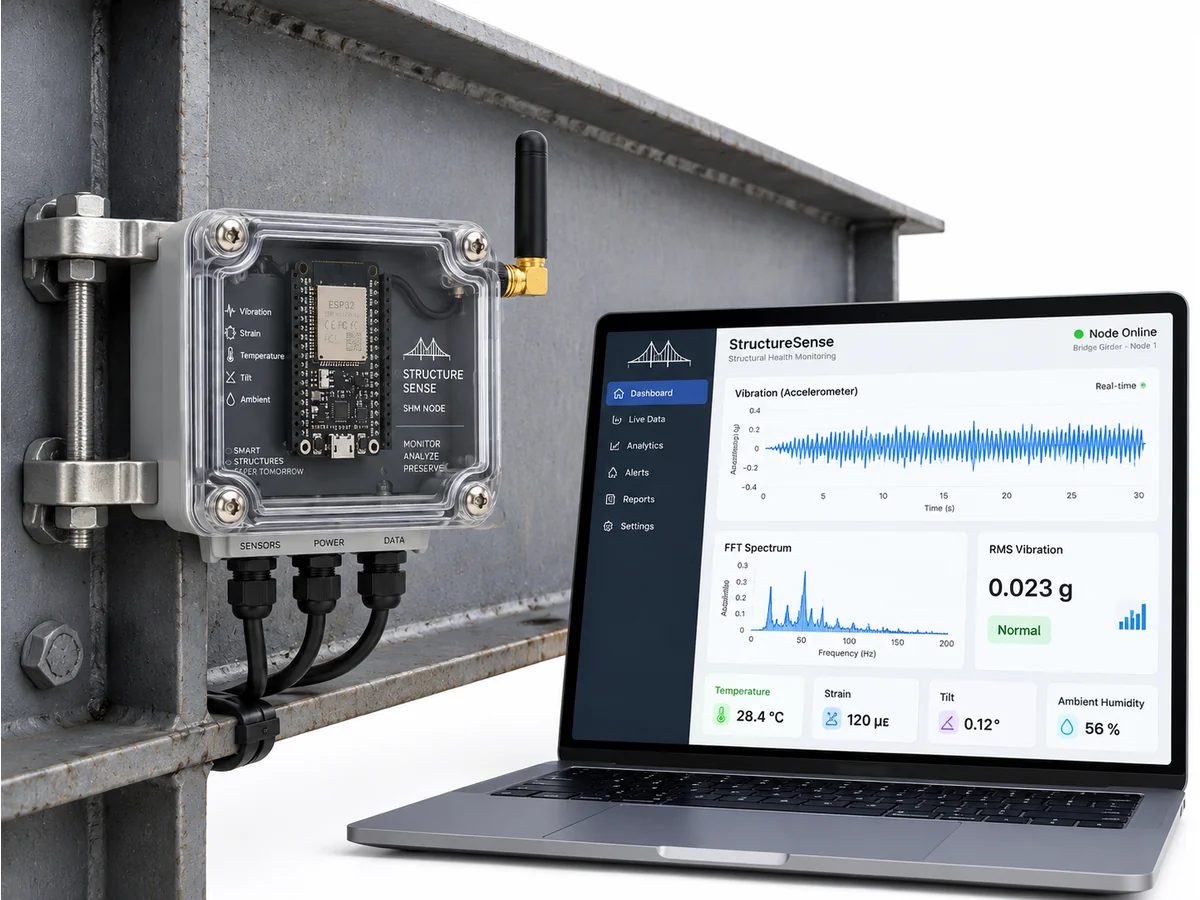
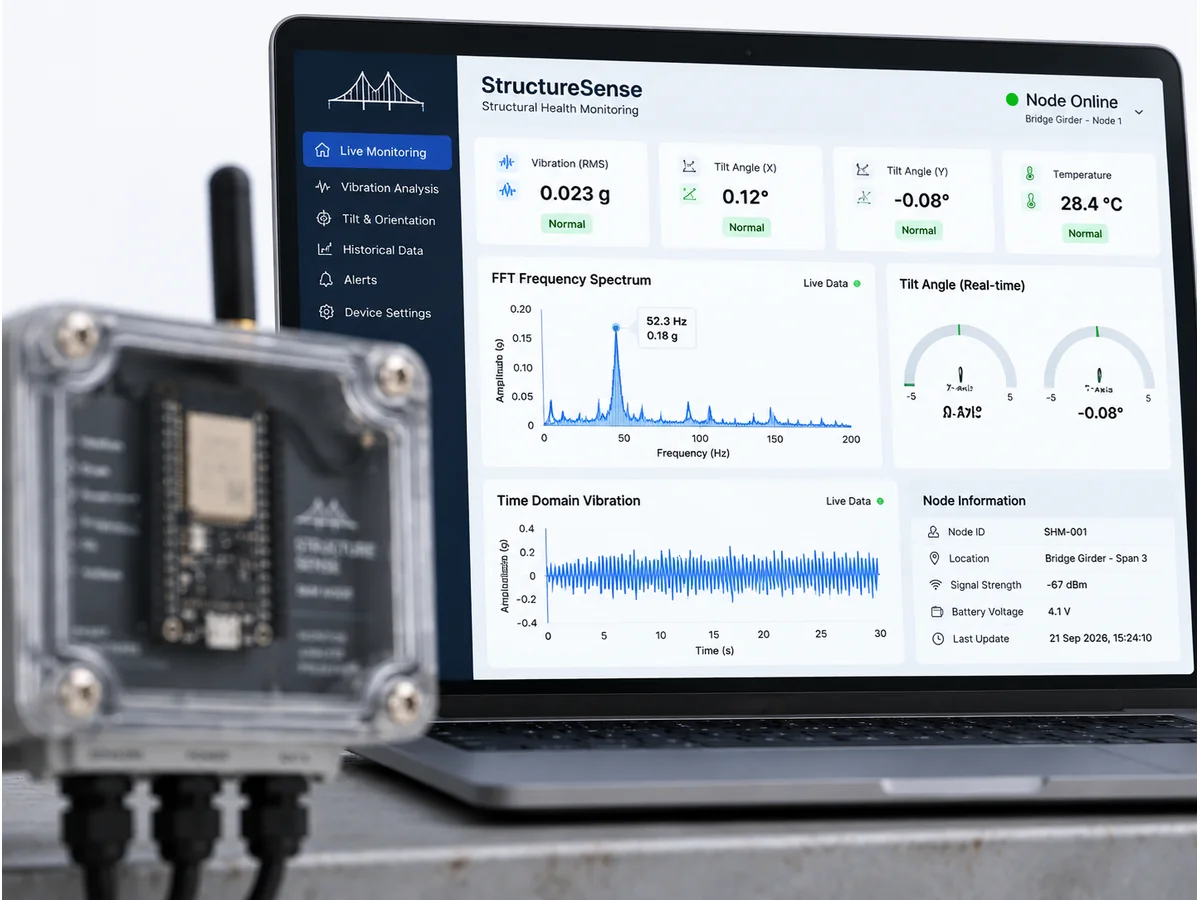
Structural Health Monitoring Using IoT Project — Detect Damage Before It Fails. Bridges, buildings, and beams develop cracks and fatigue long before visible failure. This IoT-based structural health monitoring system mounts a compact sensor node on any structure, continuously measures vibration and tilt, and streams the data to a cloud dashboard where FFT frequency analysis flags abnormal signatures automatically. It brings civil engineering's biggest safety concern into the IoT world — a rare and high-value final-year project topic with very little existing competition.
Samples vibration at up to 500 Hz in timed windows.
Follow the working sequence
How it works
- The sensor node is clamped or bonded to the structure (beam, bridge girder, column, or lab demo frame).
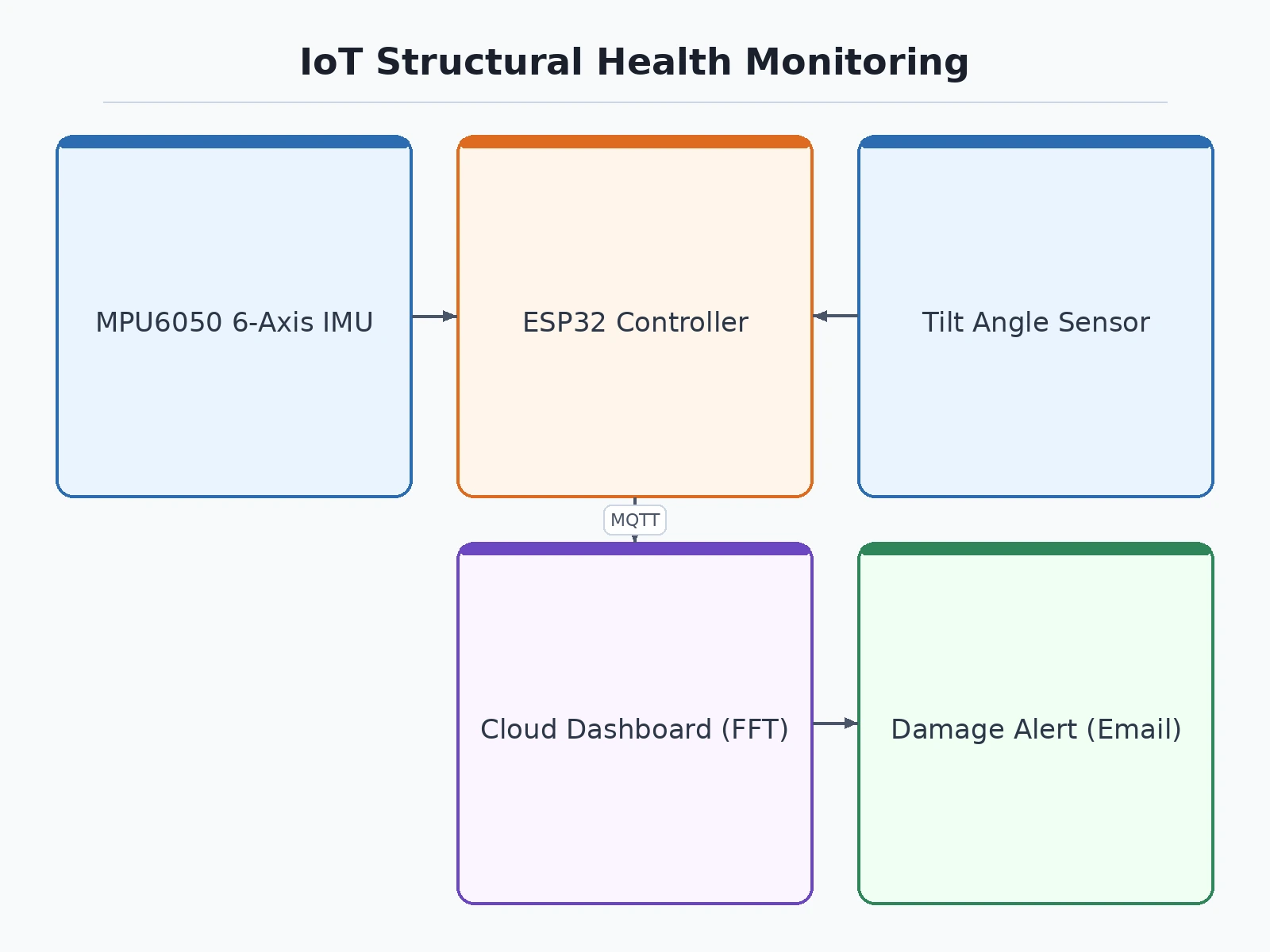
- The ESP32 samples vibration from the MPU6050 at up to 500 Hz in timed windows and reads tilt from the inclinometer.
- Raw data is streamed to the cloud over WiFi; on-device buffering protects against connectivity gaps.
- The dashboard runs FFT on each vibration window and tracks the dominant natural frequency over time.
- If the frequency shifts significantly or tilt exceeds limits, the system raises a damage/deterioration alert — the same principle used in real infrastructure monitoring.
Project features
- Real-time vibration sensing using the MPU6050 6-axis accelerometer/gyroscope mounted directly on the structure
- Tilt angle monitoring to detect settlement, bending, or progressive deformation of beams and columns
- Cloud dashboard with live vibration waveforms, tilt history, and device health status
- FFT (Fast Fourier Transform) frequency analysis on sampled data — shifts in dominant frequency indicate stiffness loss or developing cracks
- Automatic damage alerts via dashboard notification and email when vibration signature or tilt crosses set thresholds
- Rugged, weather-resistant enclosure designed for long-term outdoor mounting on concrete and steel
- Battery-friendly design with adjustable sampling intervals for weeks of continuous monitoring
- Mounting guide with recommended placement points for beams, bridges, building columns, and lab demo frames
What is included
- Assembled sensor node with flashed ESP32 firmware (source code provided)
- Mounting and placement guide for beams, bridges, and building columns
- Complete project report (PDF) covering infrastructure safety, vibration theory, and FFT basics
- Presentation PPT for project review/demo
- Viva Q&A sheet with expected questions and model answers
- Circuit diagram and wiring documentation
Advantages
- Single node carries both vibration sensing (MPU6050 6-axis accelerometer/gyroscope) and tilt monitoring — vibration for cracks, tilt for settlement or bending.
- FFT frequency analysis on sampled data — shifts in dominant frequency indicate stiffness loss or developing cracks, real engineering diagnostics.
- Cloud dashboard with live vibration waveforms, tilt history and device health status, plus automatic damage alerts by dashboard notification and email.
- Rugged, weather-resistant enclosure designed for long-term outdoor mounting on concrete and steel.
- Battery-friendly design with adjustable sampling intervals gives weeks of continuous monitoring; mounting guide covers beams, bridges, columns and lab demo frames.
Disadvantages
- Wi-Fi connectivity is required at the installation point; the cellular gateway is optional and not included.
- One node monitors one location — large structures need multiple nodes.
- FFT-based damage detection indicates anomalies; it is not a substitute for certified structural inspection, and sensor accuracy is academic/demo grade.
- Outdoor deployment needs the sealed enclosure; the lab demo can run in the basic housing.
Limitations & prerequisites
- WiFi connectivity is required at the installation point; cellular gateway is optional and not included
- FFT-based damage detection indicates anomalies, not a substitute for certified structural inspection
- Node is suitable for monitoring one location per device; large structures need multiple nodes
- Sensor accuracy is adequate for academic and demonstration use, not certified safety-critical applications
- Outdoor deployment needs the sealed enclosure; the lab demo can run in the basic housing
Components & software requirements
- ESP32 WiFi microcontroller board
- MPU6050 6-axis accelerometer + gyroscope (vibration sensing)
- Digital tilt/inclinometer sensor module
- Rugged IP-rated enclosure with mounting brackets
- Rechargeable Li-ion battery + charging module
- Mounting hardware (clamps, adhesive pads, screws)
- Jumper wires, headers, and connectors
Download free synopsis (PDF)
Enter your name and WhatsApp number — the synopsis PDF downloads immediately. We may send occasional project updates on WhatsApp; no spam.