
More project photos (3)

The problem
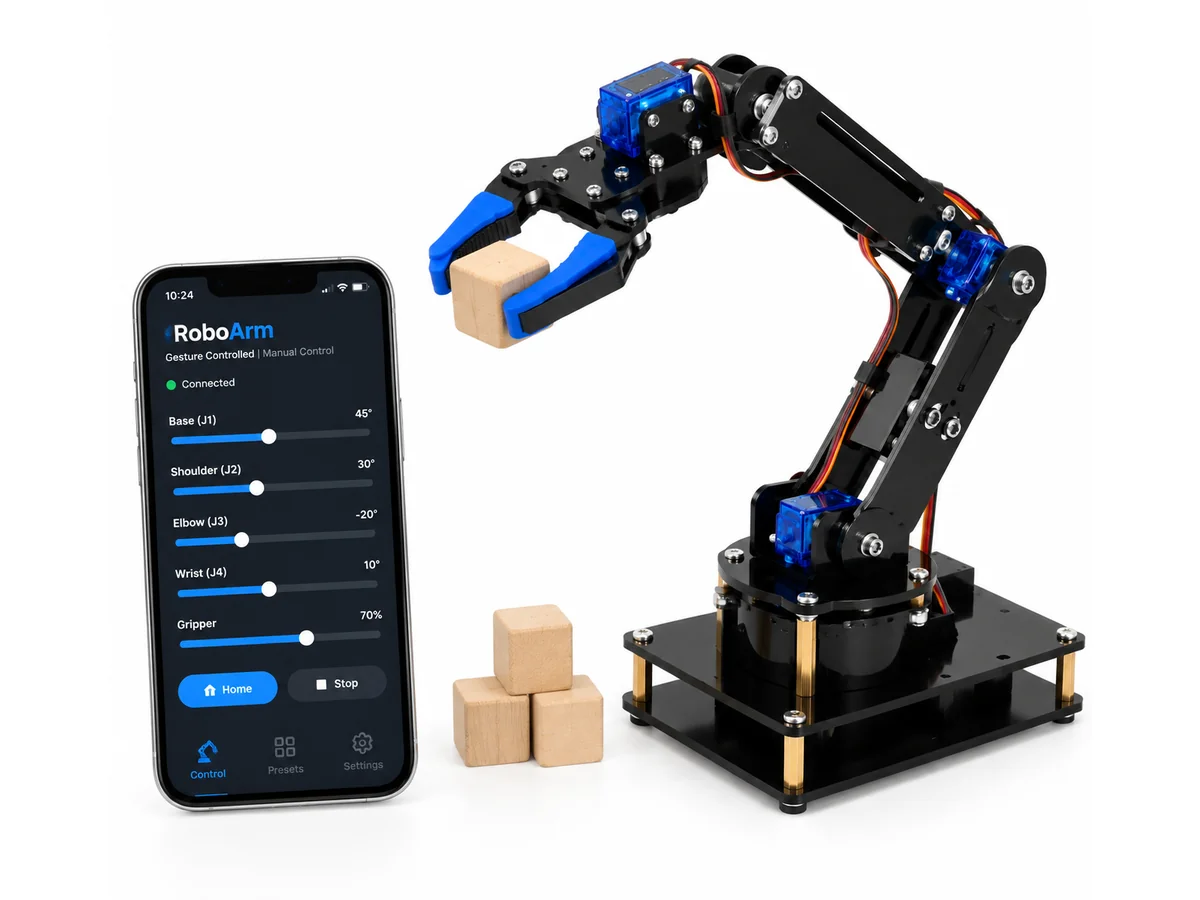
A gesture-controlled robotic arm project where your hand becomes the controller. Wear the gesture glove, move your wrist and fingers, and watch the 4-DOF robotic arm mirror your motions in real time — flex, rotate, grab, and release objects without touching a single button. Built around two ESP32 boards (one in the glove, one at the arm), an MPU6050 motion sensor, and high-torque MG996R servos communicating over a Bluetooth link, with a companion app for manual joystick-style control when you want precision. It's the perfect final year project for mechanical, mechatronics, and electronics students: real servo kinematics, real sensor fusion, and a demo that stops people in their tracks.
Captures wrist acceleration and angular velocity from the gesture glove.
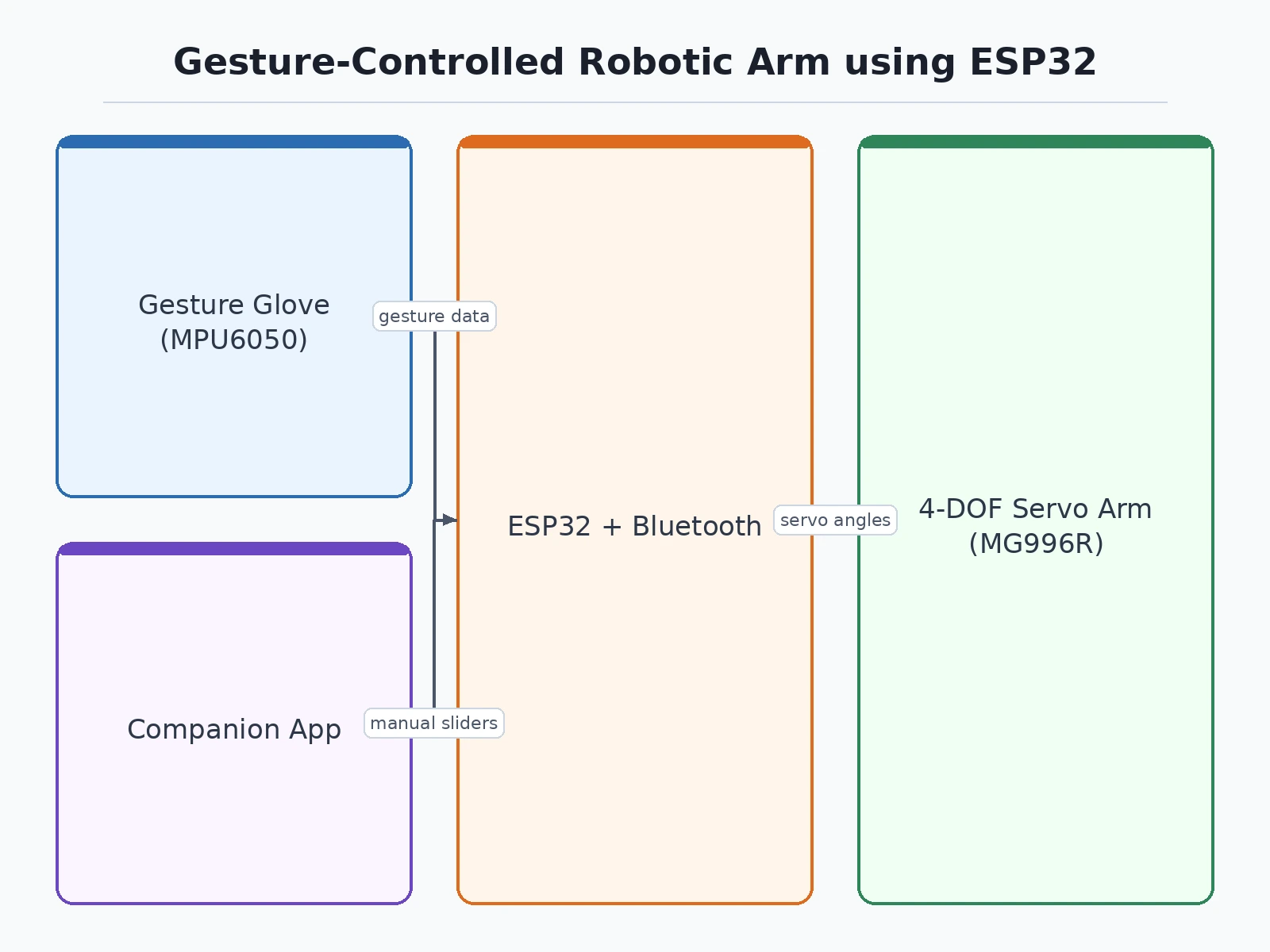
Follow the working sequence
How it works
The MPU6050 sensor on the glove captures your wrist's acceleration and angular velocity. The glove's ESP32 fuses this data into stable orientation angles, maps them to servo positions, and transmits them over Bluetooth to the arm's ESP32. The arm ESP32 drives four MG996R servos — base, shoulder, elbow, and wrist — so the arm mirrors your hand gestures in real time. A finger flex sensor (optional) controls the gripper to pick and place objects. When you need fine control, the companion app switches the arm to manual mode, letting you drive each servo individually with sliders. Sensor smoothing and angle clamping keep motion fluid and protect the servos from over-travel.
Project features
- Real-time gesture mirroring — arm tracks your wrist and hand motion with minimal lag
- MPU6050 gesture glove with 6-axis accelerometer + gyroscope motion capture
- 4 degrees of freedom (base rotation, shoulder, elbow, wrist/gripper) using MG996R high-torque servos
- Bluetooth wireless link between glove and arm — no cables, no tether
- Companion app for manual slider/joystick control of every servo, plus gesture mode toggle
- Flex-sensor finger control for gripper open/close (optional build)
- Live servo angle readout on the app for precise positioning
- Smooth motion filtering to remove hand-tremor jitter
- Rechargeable battery powered — fully portable demo setup
- Adjustable gesture sensitivity and servo speed limits
What is included
- Fully assembled and tested robotic arm + gesture glove with firmware
- Wiring diagram and connection guide
- Complete project report PDF (synopsis, design, implementation, testing, results)
- Project PPT for final demonstration
- Viva Q&A preparation document
- Source code (glove firmware, arm firmware, app) with comments
- Calibration and demo-day setup guide
Advantages
- Real-time gesture mirroring — the 4-DOF arm tracks wrist and hand motion with minimal lag, driven by an MPU6050 gesture glove with 6-axis accelerometer and gyroscope.
- Wireless Bluetooth link between glove and arm — no cables or tether.
- High-torque MG996R servos across all four degrees of freedom (base, shoulder, elbow, wrist/gripper).
- Companion app with manual slider/joystick control of every servo plus a gesture-mode toggle.
- Smooth motion filtering removes hand-tremor jitter; live servo-angle readout in the app enables precise positioning.
- Optional flex-sensor finger control for gripper open/close; rechargeable battery power keeps the demo fully portable.
Disadvantages
- Gesture control has small latency (~200 ms) — not suited to high-speed precision tasks.
- Payload is limited to light objects (a few hundred grams).
- MPU6050 orientation can drift over long sessions, so periodic re-centering is recommended.
- Bluetooth range is limited to about 10 m, with line-of-sight giving the best performance.
- Servo current spikes require a properly rated battery — weak power causes jitter.
Limitations & prerequisites
- Gesture control has small latency (~200 ms) — not suited for high-speed precision tasks
- Payload limited to light objects (a few hundred grams)
- MPU6050 orientation can drift over long sessions; periodic re-centering recommended
- Bluetooth range limited to ~10 m with line-of-sight best performance
- Servo current spikes require a properly rated battery — weak power causes jitter
Components & software requirements
- ESP32 development boards ×2 (one for gesture glove, one for arm controller)
- MPU6050 6-axis accelerometer + gyroscope module
- MG996R high-torque metal-gear servos ×4–5 (base, shoulder, elbow, wrist, gripper)
- Robotic arm mechanical kit (laser-cut/acrylic or 3D-printed frame, brackets, fasteners)
- Finger flex sensor for gripper control
- Bluetooth link (ESP32 onboard Bluetooth)
- Rechargeable battery pack + voltage regulation for servos
- Companion control app (Bluetooth)
Download free synopsis (PDF)
Enter your name and WhatsApp number — the synopsis PDF downloads immediately. We may send occasional project updates on WhatsApp; no spam.