
More project photos (2)

The problem
Firefighting robots are one of the most-demanded final year projects in mechanical, mechatronics and electronics engineering — and for good reason. This autonomous fire-fighting robot patrols on its own, detects flames using infrared flame sensors, steers itself toward the fire, and extinguishes it with a pump-driven water nozzle. Everything is orchestrated by an ESP32 microcontroller, making the build modern, wireless-capable and easy to explain in a viva. The live demo — a robot racing toward a candle and putting it out — is one of the most dramatic project demos you can stage, and examiners remember it. Whether you're looking for a fire fighting robot project for a final year submission, a mechatronics mini project, or a competition entry, this build delivers: autonomous navigation, sensor-based fire detection, servo-controlled extinguishing and a complete documentation package with report, PPT and viva Q&A.
How it works
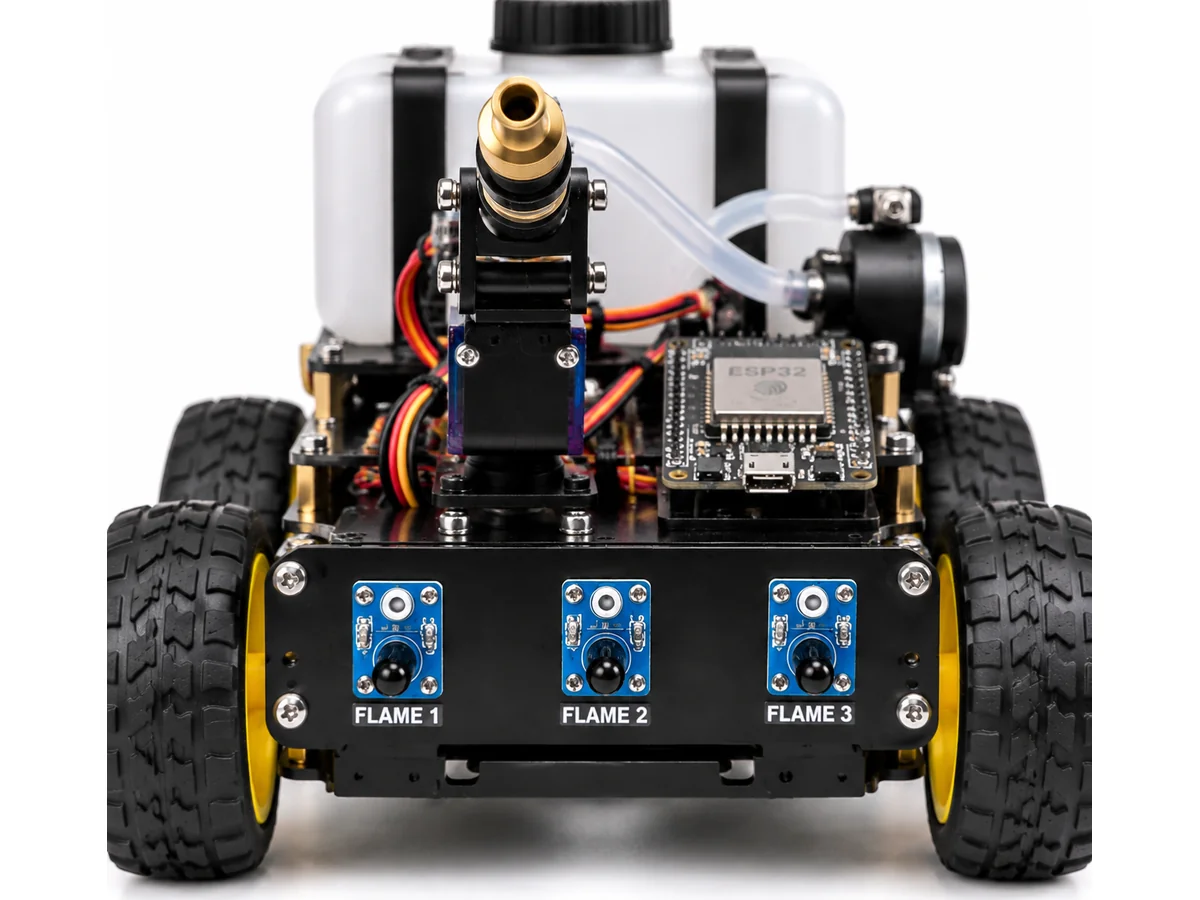
- Patrol mode: The robot drives forward, scanning its surroundings with the three flame sensors mounted on the front turret.
- Fire detection: When a flame enters range, the sensor facing the fire registers the strongest IR signal. Comparing the three readings gives the fire's direction.
- Approach: The ESP32 steers the chassis toward the strongest signal, advancing until the centre sensor reports the flame is directly ahead and within range.
- Obstacle check: The ultrasonic sensor scans for obstacles during approach; if blocked, the robot sidesteps and re-acquires the flame signal.
- Extinguish: At close range the robot stops, aims the nozzle with the servo, and runs the water pump. The servo sweeps the spray across the flame zone until the sensors confirm the fire is out.
- Resume: Once the flame reading drops to ambient, the pump cuts off and the robot resumes patrolling.
- Safety interlocks: If water runs out, the pump is disabled immediately. If the flame persists beyond a timeout, the robot retreats and sounds the buzzer.
Project features
- Autonomous patrolling — the robot roams a room or arena on its own without any remote control
- Triple flame-sensor detection — 3 IR flame sensors (left, centre, right) pinpoint the fire's direction
- Self-navigation toward fire — differential-drive steering homes in on the strongest flame signal
- Pump + servo nozzle extinguishing — water pump activates and a servo sweeps the nozzle side to side to cover the flame area
- Obstacle avoidance — ultrasonic sensor keeps the robot from colliding while it approaches the fire
- Smart safety logic — pump interlock prevents dry-run, fire timeout triggers retreat, and water-level cutoff protects the pump
- Wireless control & telemetry (optional) — ESP32's built-in Wi-Fi enables a manual-override web dashboard
- Rechargeable battery pack — runs untethered for the full demo session
What is included
- Assembled & tested robot — chassis built, wiring done, firmware flashed, tuned for your demo
- Complete firmware source code — commented ESP32 (Arduino framework) code: patrol, detection, navigation, extinguishing, safety interlocks
- Wiring diagram & circuit schematic — clear pin-level connection map for the viva
- Report PDF — full documentation: synopsis, design, calculations, results, conclusion, references
- PPT presentation — ready-to-present slide deck for your project review
- Viva Q&A sheet — likely examiner questions with model answers (sensor working, navigation logic, safety, limitations)
- Component list with purchase guidance — every part used, with specs
Limitations & prerequisites
- Designed for small, contained flames (candle, small paper fire) — it is a demonstration platform, not industrial firefighting equipment.
- Flame sensors detect IR from open flame; they do not detect smoke, heat-soaked surfaces or smouldering material.
- Outdoor use is limited: strong sunlight contains IR and can raise ambient sensor readings — best demoed indoors or in shaded areas.
- Water tank capacity supports a few extinguishing cycles per fill; refilling is needed for extended demos.
- The robot moves at modest speeds — prioritising safe approach over rapid response.
Components & software requirements
- ESP32 development board — main controller (fire detection logic, navigation, pump & servo control, optional Wi-Fi dashboard)
- Robot chassis kit + 4 DC gear motors — mobile platform
- 3x IR flame sensors — directional fire detection (left / centre / right)
- L298N (or equivalent) motor driver — H-bridge drive for the chassis motors
- Mini water pump + onboard water tank — extinguishing medium
- Servo motor (SG90/MG995) — aims and sweeps the water nozzle
- Ultrasonic sensor (HC-SR04) — obstacle avoidance during approach
- Buzzer + indicator LEDs — fire alert and status signalling
- Rechargeable Li-ion/Li-Po battery pack — untethered operation
- Water-level sensor — dry-run protection for the pump