
More project photos (3)

The problem
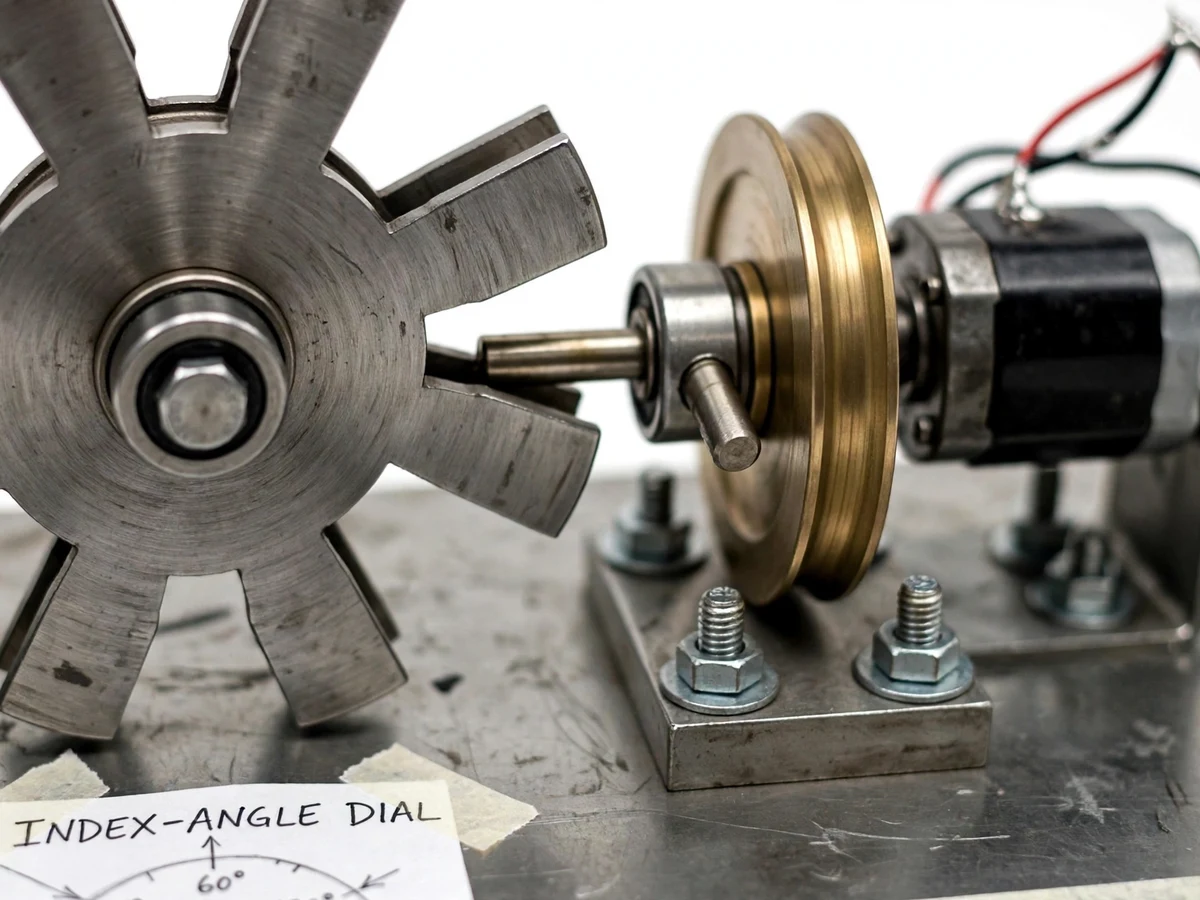
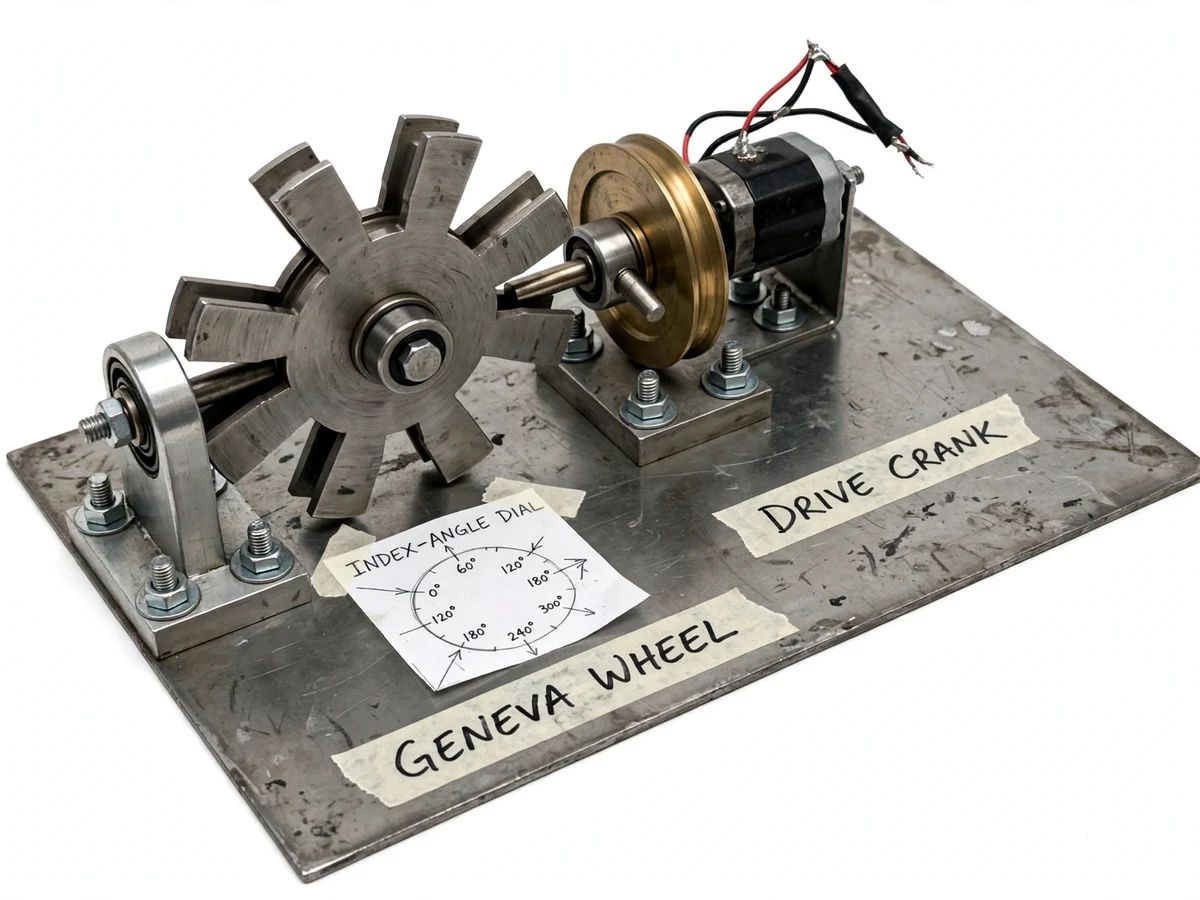
Many machines need motion that stops and starts: indexing tables, tool changers and packaging conveyors all rely on intermittent drive. The Geneva mechanism converts smooth continuous rotation into stepped, dwell-separated rotary motion with nothing but geometry — a crank pin drops into a slot, sweeps the driven wheel through one index, and exits while a locking disc clamps the wheel still until the next cycle. Students meet it as a diagram in theory of machines, but the diagram never shows the shock at pin entry or how positively the locking disc holds the wheel against disturbance. This project closes that gap with a motor-driven bench-top model: a 6-slot star wheel on a bearing block, a crank wheel with a single drive pin, a locking disc that engages the wheel's concave faces during dwell, and a printed index-angle dial for timing measurement. The student measures motion versus dwell angles from the dial, compares the timing ratio with the theoretical external-Geneva relation for a 6-slot wheel, and documents the engagement effects that textbook geometry omits.
Sets the center distance, zeroes the dial and times the motion and dwell.
Follow the working sequence
How it works
- The Geneva star wheel and the crank/locking-disc assembly are set on the base plate at the design center distance and checked for smooth pin entry into the slots.
- The index dial is zeroed with the pointer aligned to a slot center, and the motor speed controller is set to the test rpm.
- The motor turns the crank continuously; once per revolution the crank pin drops into a slot, sweeps the wheel through exactly 60°, and exits.
- Between pin engagements the locking disc engages the concave faces of the wheel, holding it positively stationary — the dwell phase of the cycle.
- The student counts indexes over a fixed number of crank revolutions from the dial and records the motion angle (crank travel while the wheel moves) versus dwell angle.
- Measured timing is compared with the theoretical external-Geneva relation (motion fraction = (180° − 360°/n)/360° ≈ 1/3 for n = 6), and the deviation is discussed.
- Optional: the student repeats the timing run at a higher rpm and documents how engagement shock and pin-clearance chatter change the feel and sound of indexing.
Tech stack:
- Mild-steel base plate with slotted bearing blocks
- Machined/laser-cut 6-slot steel Geneva star wheel
- Steel crank wheel with hardened drive pin and locking disc
- DC geared motor with PWM speed controller
- Printed index-angle degree dial with pointer
- Hex fasteners, bearings and mounting hardware
| Parameter | Value |
|---|---|
| Geneva wheel slots | 6 (design target) |
| Index per crank revolution | 60° (theoretical, by geometry) |
| Crank motion angle per index | Approximately 120° of crank rotation (design target) |
| Dwell per cycle | Approximately 240° of crank rotation (design target) |
| Timing ratio (motion : cycle) | Approximately 1:3 (design target for n = 6) |
| Drive motor | 12 V DC geared motor, approximately 15–45 rpm adjustable (expected) |
| Geneva wheel diameter | Approximately 160 mm across flats (design target) |
| Crank wheel diameter | Approximately 90 mm (design target) |
| Base plate | Approximately 420 × 220 mm MS fabrication (design target) |
| Power | 12 V DC adapter (expected) |
Project features
- [6-slot Geneva star wheel] Laser-cut/machined steel indexing wheel with six radial slots; each crank revolution indexes it exactly one step of 60°, the geometry students can verify on the dial.
- [Drive crank with crank pin] Steel crank wheel carrying a single hardened drive pin that engages each slot in turn — the heart of the intermittent drive, visible in action.
- [Locking disc for positive dwell] The crank assembly's blocking disc rides the wheel's concave faces between indexes, holding the wheel rigidly stationary through the 240° dwell portion of every cycle.
- [Index-angle measurement dial] Printed degree dial fixed under the Geneva wheel with a pointer, so motion angle, dwell angle and index count are measured, not assumed.
- [Constant-speed motor drive] A DC geared motor with a speed controller turns the crank at a steady, adjustable rate for repeatable timing measurements.
- [Adjustable center distance] Slotted mounting on the base plate lets the student set and measure the crank-to-wheel center distance and confirm the design relation crank radius ≈ C·sin(π/n) for n = 6.
- [Timing-ratio workbook] Observation tables and a worked procedure for deriving the motion/dwell timing ratio from measured dial readings and comparing it with theory.
What is included
- Complete Geneva mechanism demonstration model (assembled and tested)
- Machined 6-slot Geneva star wheel + crank pin + locking disc assembly
- DC geared motor with speed controller
- Index-angle dial, pointer and timing workbook with observation tables
- Fabrication/assembly drawings of the model
- Project report PDF (theory, geometry calculations, procedure, sample readings, analysis)
- PPT presentation for final review
- Viva Q&A preparation document (intermittent motion, Geneva geometry, dwell, locking)
Limitations & prerequisites
- This is a demonstration model, not a production indexing drive: it carries no payload and is rated for demo-duty cycling only.
- Pin-to-slot clearance needed for smooth entry causes a small, audible indexing error at slot engagement — the workbook treats this as an observed effect, not a defect.
- Timing measurements are manual (dial readings per revolution), with typical ±2–3° human reading error; it is not an instrumented motion-capture study.
- The geometry is fixed at 6 slots; other slot counts or internal-Geneva variants are not included in the base build.
- At higher rpm the engagement shock increases noticeably; prolonged fast running wears the pin and slot faces, so speed is limited by the controller.
Frequently Asked Questions
What exactly does a Geneva mechanism do?
It converts continuous rotary motion into intermittent rotary motion. A crank pin engages slots in a star wheel once per revolution, indexing the wheel one fixed step (60° for six slots), then a locking disc holds the wheel stationary until the next pin entry.
What does the student measure on this model?
Indexes per crank revolution, the crank rotation angle spent in motion versus dwell (from the index-angle dial), and the motion/dwell timing ratio, which is then compared with the theoretical external-Geneva relation.
Why is the locking disc important?
During the dwell phase the pin is out of the slots, so without the disc the wheel could drift. The disc's convex face mates with the wheel's concave faces and locks it positively — the student can try to turn the wheel by hand during dwell and feel it hold.
Is there any electronics or programming in this project?
Only a DC motor with a PWM speed controller. This is a pure mechanical-kinematics project; the analysis is geometric and graphical, done in the workbook and report.
How is this different from a gear or belt drive?
Gears and belts give continuous motion. The Geneva gives stepped motion with built-in dwells from pure geometry — that is why indexing tables and classic film projectors used it, and the model makes the difference tangible.
Is this project suitable for a final-year project?
Yes — for Mechanical, Mechatronics and Automobile programs. It demonstrates intermittent-motion theory, precision mechanism fabrication, and theory-versus-measurement analysis on real hardware. Suitable for B.E./B.Tech final-year projects in Mechanical, Mechatronics and Automobile Engineering.
Components & software requirements
- Mild-steel base plate with slotted bearing blocks
- Machined/laser-cut 6-slot steel Geneva star wheel
- Steel crank wheel with hardened drive pin and locking disc
- DC geared motor with PWM speed controller
- Printed index-angle degree dial with pointer
- Hex fasteners, bearings and mounting hardware
Delivery information
Built-to-order project. Delivery timeline is shared after order confirmation based on current queue.
Support terms
Complete documentation, setup guide, and viva preparation included. Support for setup and explanation provided.
Download free synopsis (PDF)
Enter your name and WhatsApp number — the synopsis PDF downloads immediately. We may send occasional project updates on WhatsApp; no spam.