
More project photos (2)
The problem
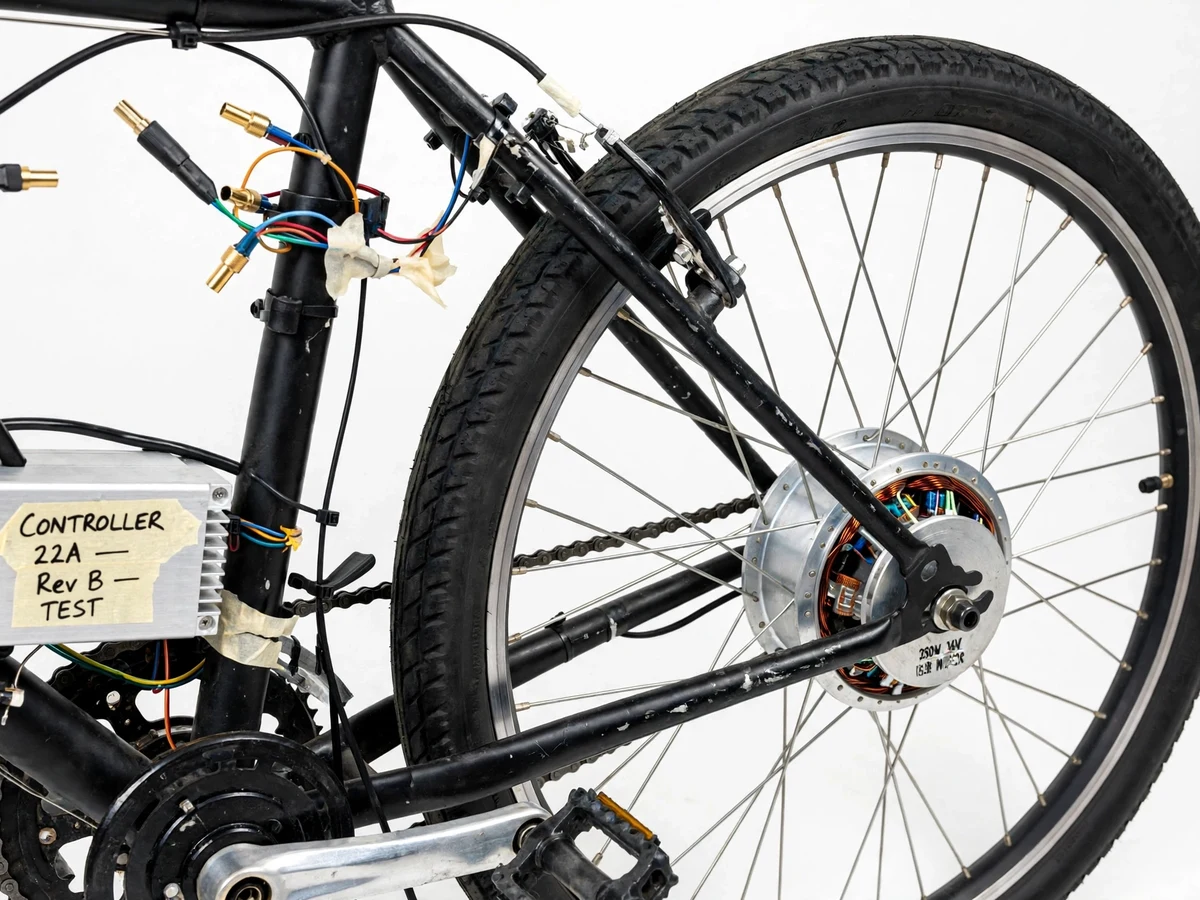
Buying a factory e-bike is expensive, and most engineering students already own a bicycle. A hub-motor conversion kit bridges that gap: it electrifies the bicycle the student already has instead of fabricating a vehicle from the ground up. The engineering challenge is not bolting on parts — it is sizing the system correctly. The battery capacity must match the motor's rated current and the rider's expected range, the controller's current limit must be matched to both the motor and the battery's continuous discharge rating, the pedal-assist sensor must be timed to the crank, and the brake cut-offs must interrupt drive power reliably. Get any of these wrong and the result is a hot motor, a BMS that trips under load, or an e-bike that dies halfway to college. This project works through the full retrofit on a real donor bicycle: wheel replacement with a 250 W geared hub motor, downtube battery mounting, controller placement and wiring, PAS and throttle integration, and parameter tuning on the display unit.
36 V 10 Ah Li-ion pack of 18650 cells with BMS protection, mounted on the downtube.
Follow the working sequence
How it works
- The donor bicycle's rear wheel is replaced with the 250 W hub motor wheel, matched to the wheel size (26–28 in) and rear dropout spacing (135–142 mm, typical).
- The 36 V 10 Ah battery pack is mounted on the downtube and connected to the controller through the main power leads with an inline fuse.
- The controller's three phase wires and five hall-sensor wires are connected to the hub motor; correct phase/hall pairing is verified by a smooth no-load spin.
- The pedal-assist sensor disc is fitted at the crank; each magnet passing the sensor generates a cadence pulse that tells the controller how hard the rider is pedalling.
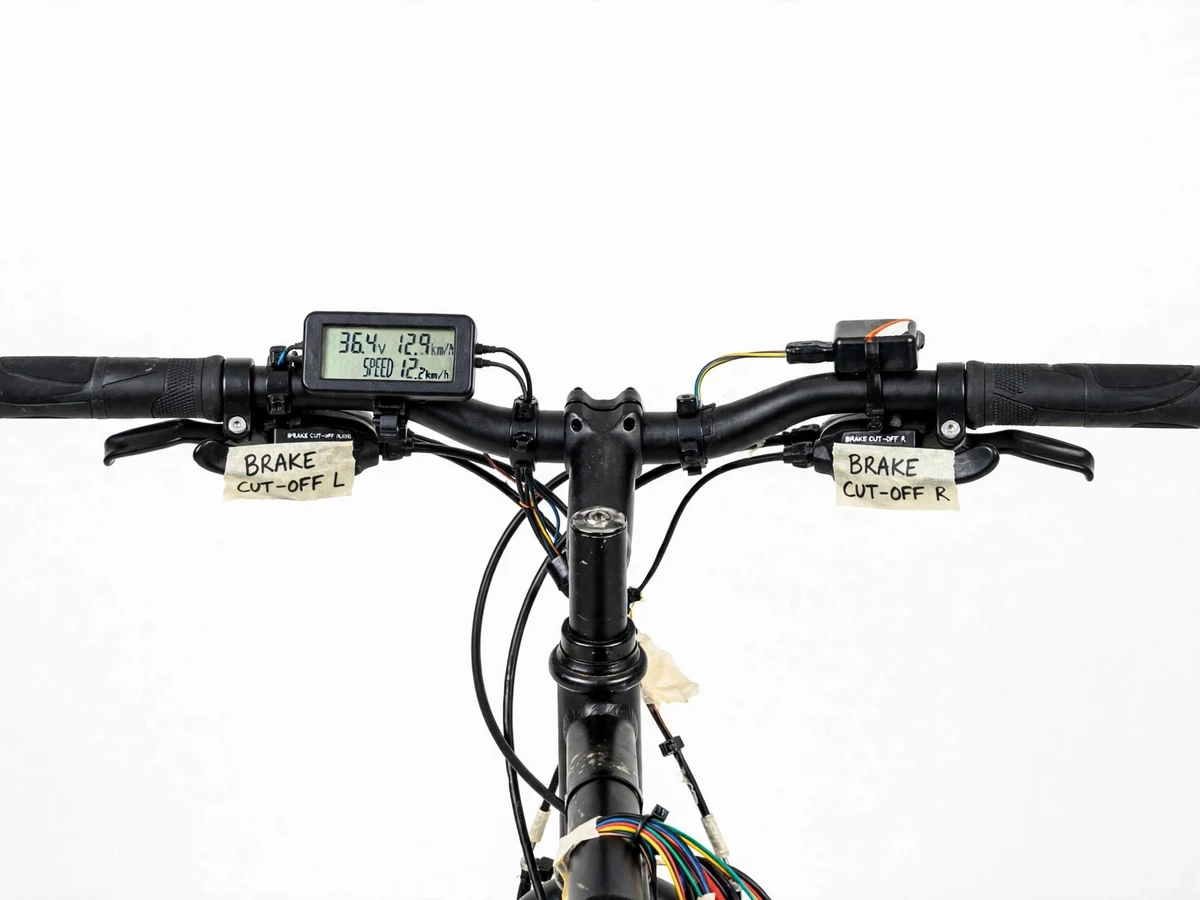
- Assist level, current limit and speed cap are set through the LCD display, matching the controller's maximum current to the battery's continuous discharge rating.
- On the road, the controller converts battery DC into three-phase AC for the BLDC motor, blending rider pedalling with motor torque; pulling either brake lever triggers the cut-off switch and stops the motor instantly.
- Range and speed are verified on a test ride, and the battery sizing calculation is reconciled with the observed consumption (reconciled, not claimed as a measured spec).
Tech stack:
- 250 W 36 V BLDC geared hub motor (rear wheel)
- 36 V BLDC motor controller · 22 A max current
- 36 V · 10 Ah Li-ion battery pack with BMS
- Pedal-assist sensor · thumb throttle · brake cut-offs
- LCD display (speed · voltage · assist level)
- Wiring harness · connectors · inline fuse
- Standard donor bicycle (retrofit, not built from scratch)
| Parameter | Value |
|---|---|
| Motor | 250 W, 36 V geared BLDC hub motor, rear wheel (rated current <8.6 A, datasheet value) |
| Controller | 36 V, maximum current 22 A (design target), 3-phase 120° BLDC |
| Battery pack | 36 V, 10 Ah Li-ion (18650 cells) with BMS (design target) |
| Nominal energy | Approximately 360 Wh |
| Top speed | Approximately 25 km/h (design target, legal-limit class) |
| Range | Approximately 30–45 km on pedal assist (design target, terrain and assist-level dependent) |
| Assist levels | 5 (design target) |
| Wheel compatibility | 26–28 in wheels, 135–142 mm rear dropout (typical) |
| Added weight | Approximately 8–10 kg including battery (approximate) |
Project features
- [250 W Rear Hub Motor Wheel] A geared brushless hub motor laced into the rear wheel (36 V, rated current under 8.6 A per the manufacturer datasheet) replaces the bicycle's stock rear wheel — the core of the conversion, driving the bike without any chain modification.
- [36 V 10 Ah Li-ion Battery Pack with BMS] A custom-built 18650-cell pack with a battery management system providing over-charge, over-discharge and short-circuit protection, mounted on the downtube in a lockable case.
- [BLDC Motor Controller] A 36 V brushless motor controller with a 22 A maximum current limit (design target), matched to the motor's rated current and the pack's discharge capability, with hall-sensor and phase wiring.
- [5-Level Pedal Assist] A crank-mounted pedal-assist sensor detects pedalling cadence and switches the motor through five assist levels, so motor power scales with rider effort instead of replacing it.
- [Throttle + Brake Cut-Off Safety] A handlebar thumb throttle for on-demand power, wired with brake cut-off switches on both levers that cut motor drive instantly when either brake is pulled.
- [LCD Handlebar Display] Shows live battery voltage, speed, assist level and trip data, and is used to set the controller's current limit, speed cap and assist-level parameters during tuning.
- [Retrofit Wiring Harness] A complete labelled wiring harness with connectors, zip-tie routing and a wiring diagram, so every connection (phase, hall, PAS, throttle, cut-off, display) is documented for the viva.
What is included
- Complete conversion kit: hub motor rear wheel, 36 V controller, 36 V 10 Ah battery pack with BMS and charger
- Pedal-assist sensor, thumb throttle, brake cut-off levers, LCD display
- Kit assembled, wired and fitted on the donor bicycle, demonstrated on a test ride
- Wiring diagram and connection schedule for every harness
- Battery sizing and range calculation sheet (Wh/km method, labelled as design targets)
- Project report PDF (background, component selection, wiring, tuning, results)
- PPT presentation for final review
- Viva Q&A preparation document (BLDC control, battery sizing, BMS protection, PAS tuning)
Limitations & prerequisites
- The battery pack is the costliest part of the build — Li-ion cells dominate the bill of materials, which is stated honestly in the cost estimate.
- Range is a design target, not a measured claim: it varies with rider weight, terrain, assist level and headwind; the report shows the calculation, not a test number.
- Top speed is capped at the legal-limit class (~25 km/h) — this is a compliant commuter conversion, not a high-speed build.
- The converted bike carries roughly 8–10 kg of extra hardware; handling and braking distances change, and brakes should be serviced before the conversion.
- Li-ion packs demand care: charging must use the supplied charger, and a damaged pack must not be used — these are stated as safety prerequisites.
- Not all donor bicycles fit: rear dropout spacing, wheel size and frame clearance are checked before the build, and some frames are rejected.
- The prototype is not weather-sealed or road-certified like a factory e-bike; it is an academic conversion build.
Frequently Asked Questions
How is this different from building an e-bike or a go-kart from scratch?
Nothing is fabricated from raw stock: the project starts with a complete working bicycle and electrifies it with a hub motor, controller, battery and sensors. The engineering is in system sizing, electrical integration and tuning — not in chassis fabrication.
What donor bicycle do I need?
Any standard bicycle with 26–28 inch wheels and a rear dropout spacing of about 135–142 mm, with working brakes. Frame clearance for the downtube battery case is checked before the build; unsuitable frames are flagged early.
Does the converted bicycle need registration or a driving licence?
In India, low-speed electric bicycles (250 W motor, top speed capped at 25 km/h) are generally exempt from registration and licensing — but rules can change and vary by state, so the report advises confirming the current local position before road use.
Can the project be customized?
Yes — realistic options include a larger-capacity battery pack, a front-wheel hub motor variant, torque-sensor pedal assist instead of cadence sensing, or a USB charging port off the pack. These are optional additions, not part of the base build.
What is the future scope?
Regenerative braking (needs a direct-drive motor variant), GPS trip logging, a battery state-of-health monitor, and a solar trickle charger — all listed as future work, not implemented features.
Is this project suitable for a final-year project?
Yes — for Electrical and Electronics engineering programs. It demonstrates BLDC motor drives, battery pack design with BMS protection, power wiring and system-level integration and tuning on a real vehicle.
Components & software requirements
- 250 W 36 V BLDC geared hub motor (rear wheel)
- 36 V BLDC motor controller · 22 A max current
- 36 V · 10 Ah Li-ion battery pack with BMS
- Pedal-assist sensor · thumb throttle · brake cut-offs
- LCD display (speed · voltage · assist level)
- Wiring harness · connectors · inline fuse
- Standard donor bicycle (retrofit, not built from scratch)
Delivery information
Built-to-order project. Delivery timeline is shared after order confirmation based on current queue.
Support terms
Complete documentation, setup guide, and viva preparation included. Support for setup and explanation provided.
Download free synopsis (PDF)
Enter your name and email — the synopsis PDF downloads immediately. We may send occasional project updates; no spam, unsubscribe anytime.