
More project photos (3)
The problem
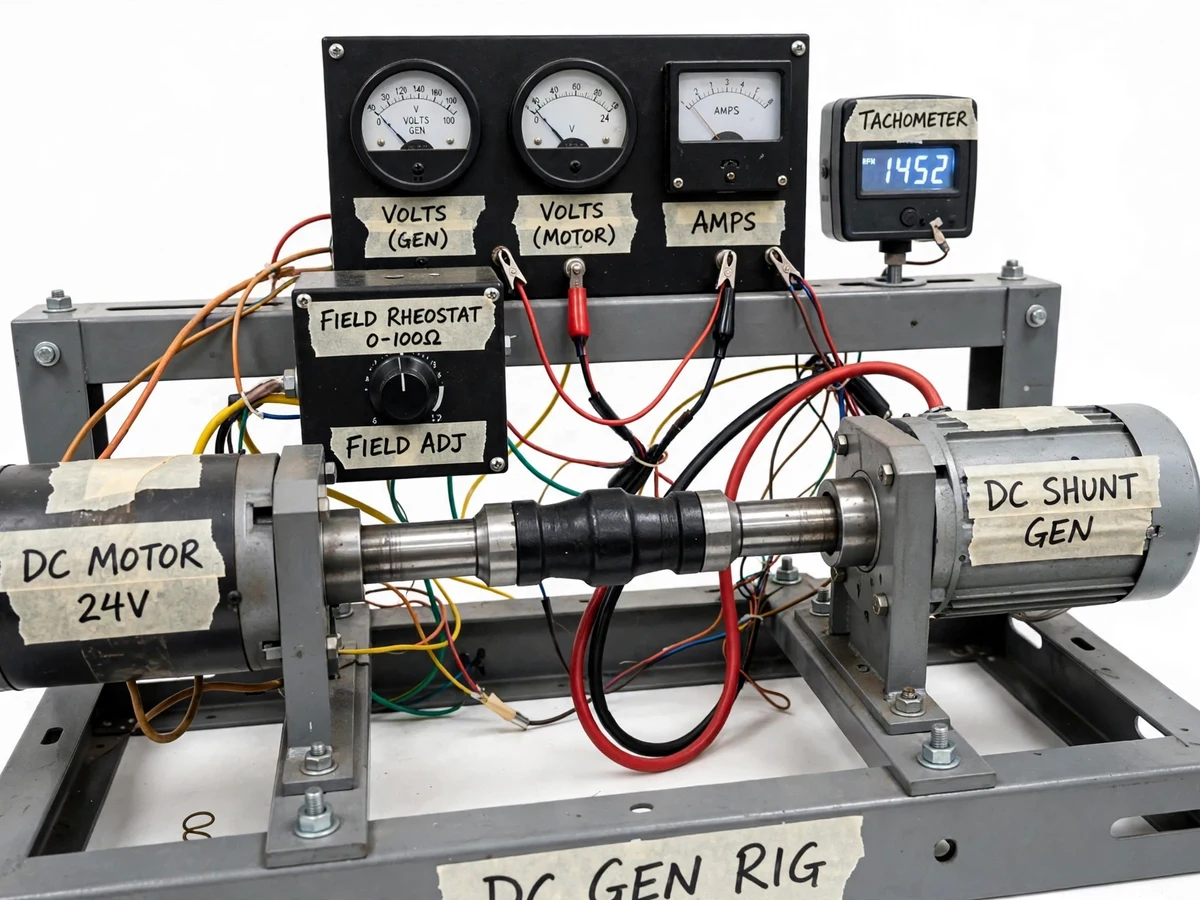
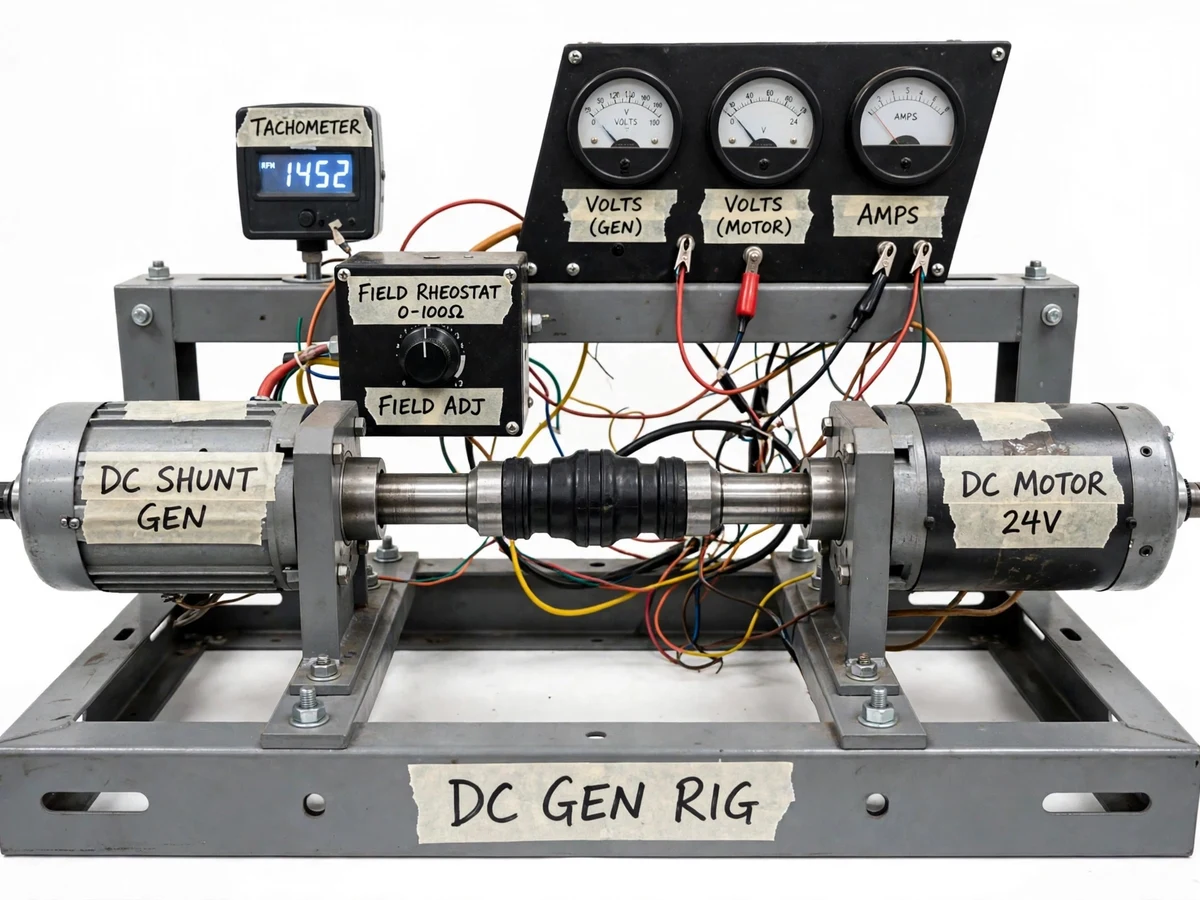
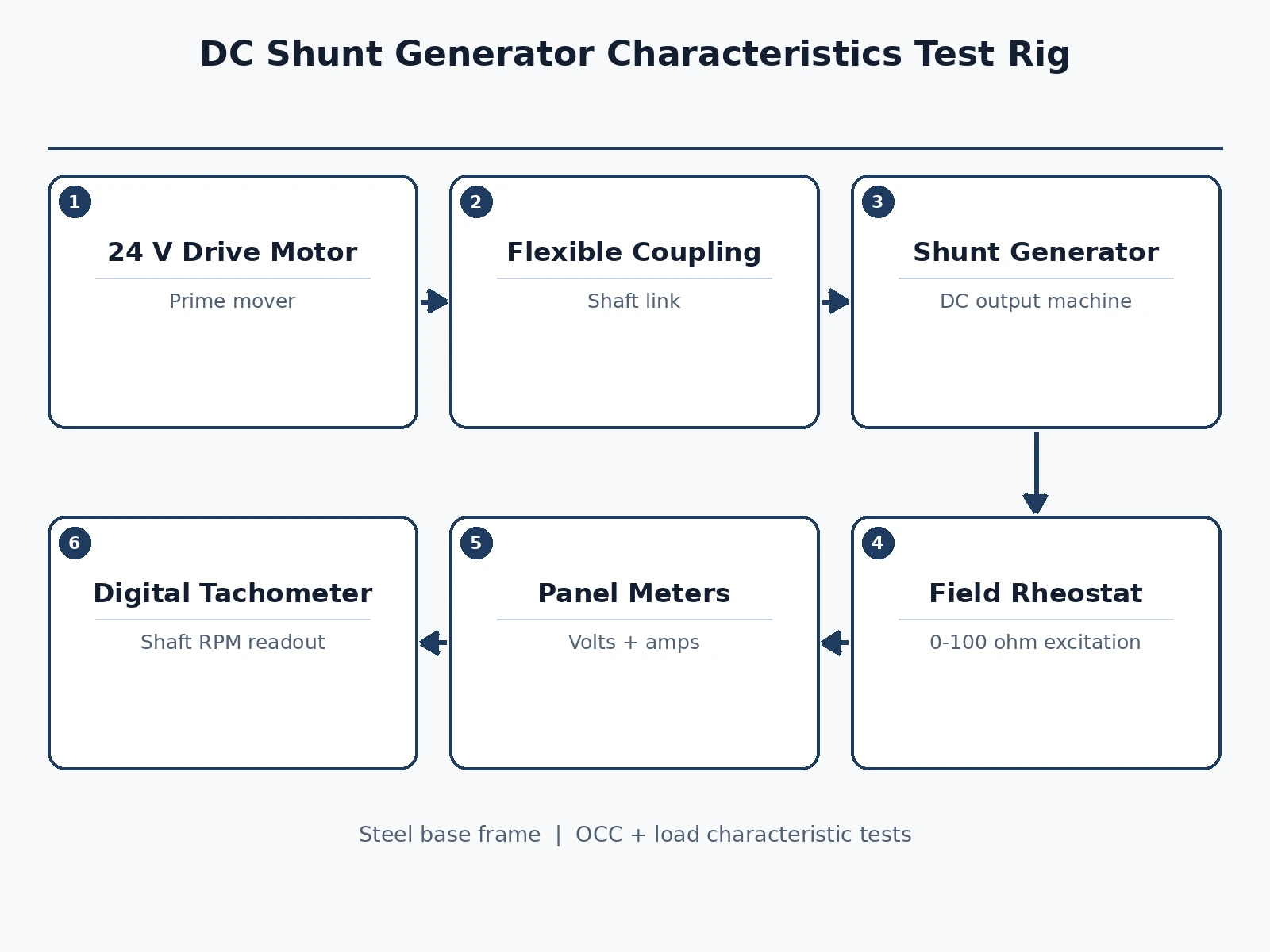
The DC shunt generator is a cornerstone of the electrical machines laboratory: its open-circuit characteristic, load characteristic and voltage regulation are standard experiments, yet many students run them on aging shared lab sets with little understanding of what each instrument is doing. This project gives the student their own dedicated rig. A 24 V DC motor is coupled shaft-to-shaft with a DC shunt generator on a fabricated steel frame. A field rheostat adjusts generator excitation, analog panel meters read generator voltage, motor voltage and current, and a digital tachometer reads shaft speed. With this instrumentation the student runs the open-circuit test, builds the load characteristic, and computes voltage regulation — every data point taken by hand and plotted in the report.
Runs the tests, records voltage, current, and RPM readings, and plots curves.
Follow the working sequence
How it works
- The DC motor is powered and brought up to the test speed, verified on the digital tachometer.
- With the generator on open circuit, the student varies the field rheostat and records generator voltage at each setting, building the open-circuit characteristic (OCC).
- A load is connected to the generator terminals; terminal voltage is recorded as load current is stepped up, building the load characteristic.
- Armature reaction and the IR drop show up naturally in the drooping load curve, which the student plots from their own readings.
- Voltage regulation is computed from the no-load and full-load voltages using the standard formula, in the included calculation template.
- Motor voltage and current meters let the student account for the drive side of the set during every test.
Tech stack:
- 24 V DC drive motor
- DC shunt generator machine
- Flexible shaft coupling
- Fabricated steel base frame
- Field rheostat (0-100 ohm class)
- Analog panel voltmeters and ammeter
- Digital tachometer
- Calculation and reading templates
| Parameter | Value |
|---|---|
| Drive motor | 24 V DC (nameplate rating) |
| Generator | DC shunt type, demo scale (design target) |
| Field control | Rheostat, approximately 0-100 ohm class (design target) |
| Speed readout | Digital tachometer, RPM (design target: four-digit class) |
| Metering | Analog panel voltmeters and ammeter |
| Speed reference | Approximately 1450 RPM class for tests (buyer-set and verified) |
| Frame | Fabricated steel base with bearing pedestals |
| Experiments | Open-circuit, load characteristic, regulation (buyer-run) |
Project features
- [Motor-generator set] A 24 V DC motor coupled to a DC shunt generator through a flexible coupling on a fabricated steel frame — the classic machines-lab test configuration.
- [Field rheostat control] A 0-100 ohm field adjustment box varies generator excitation so the student can trace the open-circuit characteristic point by point.
- [Analog panel instrumentation] Panel voltmeters for generator and motor voltage plus an ammeter give the period-correct machines-lab reading experience the experiments were designed around.
- [Digital tachometer] A digital tachometer reads shaft RPM so speed is known and held constant during each characteristic test.
- [Buyer-run experiment procedures] Documented procedures for the open-circuit test, load characteristic and voltage-regulation calculation, with blank reading tables for the student's own data.
- [Wired and labeled assembly] All machines, rheostat and meters are wired with labeled leads, so the circuit is traceable for the viva.
- [Complete viva kit] Report covering DC generator theory, OCC, armature reaction and regulation, plus PPT and viva Q&A.
What is included
- Coupled DC motor and DC shunt generator on steel frame
- Field rheostat adjustment box
- Analog panel meters (generator volts, motor volts, amps)
- Digital tachometer
- Complete labeled wiring
- Experiment procedure manual with blank reading tables
- Calculation template for voltage regulation
- Project report PDF (DC machine theory, characteristics, procedures)
- PPT presentation for final review
- Viva Q&A preparation document
Limitations & prerequisites
- All characteristic curves are plotted by the student from their own readings; no curves or data points are claimed on the page.
- The machines are demo-scale, not industrial kW-class machines; regulation figures will differ from textbook large-machine examples.
- Analog meters have reading parallax and class tolerance; the report discusses measurement error honestly.
- Speed must be held constant by the student during the OCC; drift shows up in the data and is a documented error source.
- No electronic data logging is included; readings are taken manually per the standard lab procedure.
Frequently Asked Questions
Which experiments can I run on this rig?
The open-circuit (magnetization) characteristic, the load (external) characteristic, and the voltage-regulation calculation — the standard DC shunt generator lab set, with procedures and blank tables included.
Do you provide the characteristic curves?
No — the curves are the student's own experimental work. The rig provides the machines and instruments; the procedures and templates guide the student to produce and plot their own data.
Why analog meters instead of digital?
The standard machines-lab experiments were designed around analog panel instruments, and reading them is itself part of the lab skill. A digital tachometer is included where precision matters (speed).
How is speed kept constant?
The student sets the motor supply to hold the tachometer reading steady during each test; the procedure explains how to check and correct for drift between readings.
What does the field rheostat do?
It varies the generator's field current, which varies the flux and hence the generated EMF — that is exactly what traces the open-circuit characteristic.
Is this project suitable for a final-year project?
Yes — for Electrical engineering programs. It is a genuine experimental project: the student builds the rig, takes real data, and defends real curves in the viva. Suitable for B.E./B.Tech final-year projects in Electrical engineering.
Components & software requirements
- 24 V DC drive motor
- DC shunt generator machine
- Flexible shaft coupling
- Fabricated steel base frame
- Field rheostat (0-100 ohm class)
- Analog panel voltmeters and ammeter
- Digital tachometer
- Calculation and reading templates
Delivery information
Built-to-order project. Delivery timeline is shared after order confirmation based on current queue.
Support terms
Complete documentation, setup guide, and viva preparation included. Support for setup and explanation provided.
Download free synopsis (PDF)
Enter your name and WhatsApp number — the synopsis PDF downloads immediately. We may send occasional project updates on WhatsApp; no spam.