
More project photos (3)
The problem
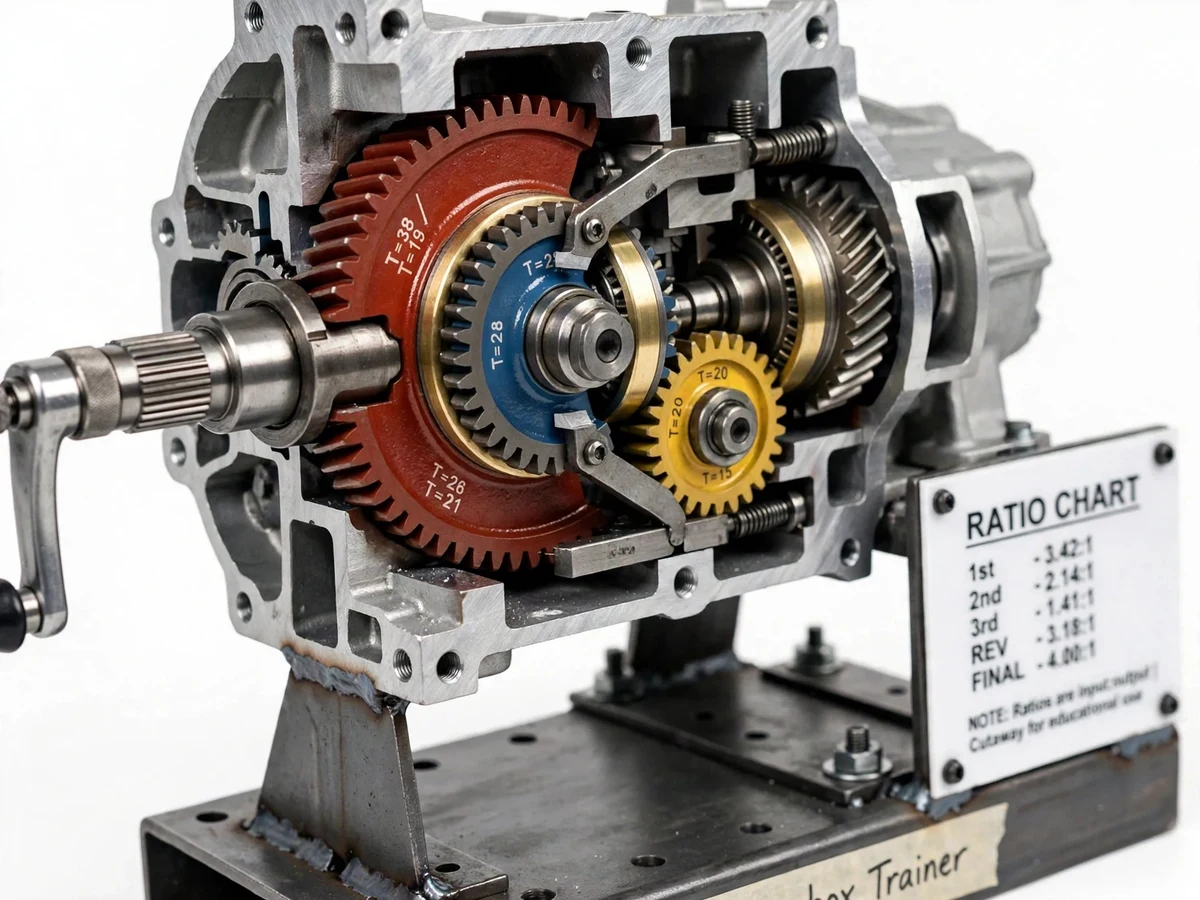
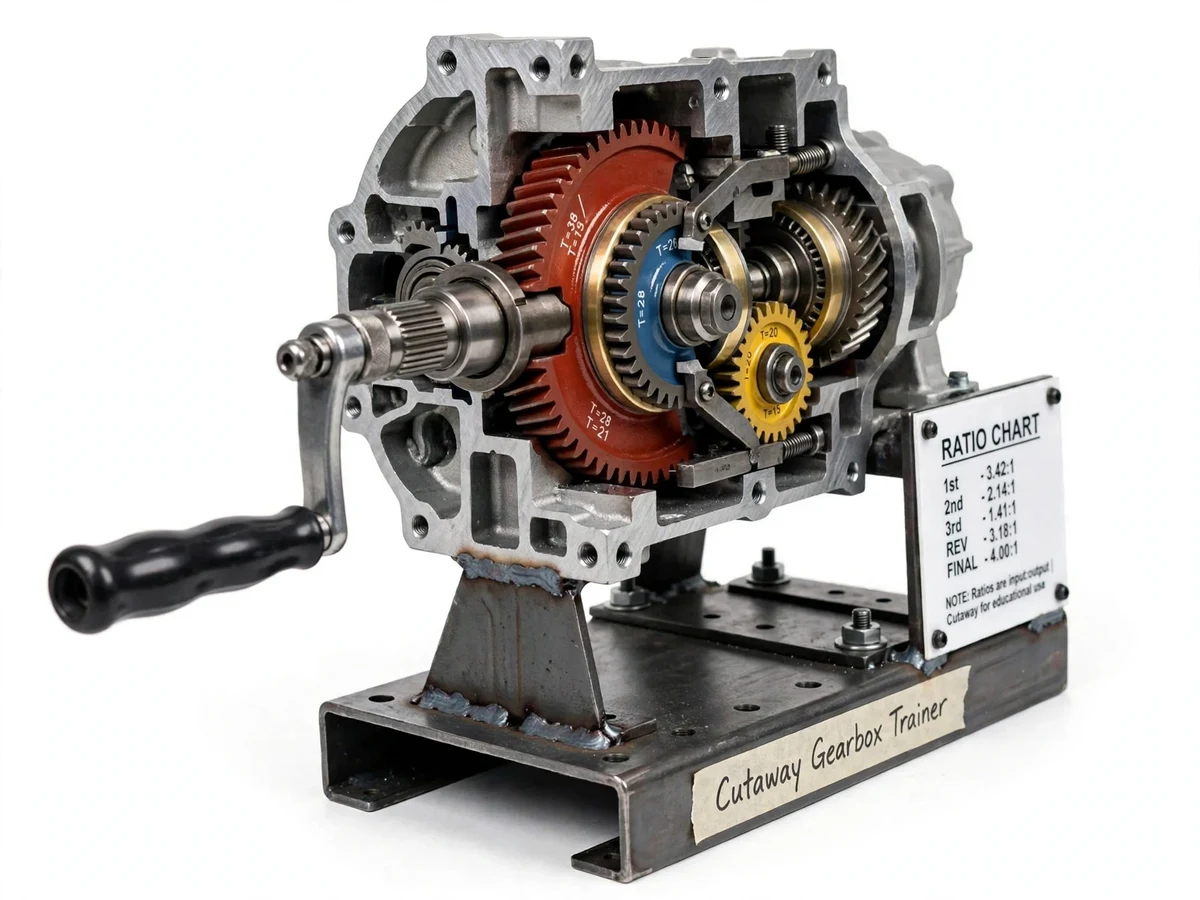
Gearboxes are usually taught with flat diagrams: students memorize ratio numbers without ever seeing a synchromesh sleeve slide, a shift fork select a gear, or an idler reverse the output direction. A cutaway of a real constant-mesh manual transmission makes all of it visible — the input shaft, layshaft and mainshaft gears in permanent mesh, the sliding dog clutches that actually engage each ratio, and the linkage that moves them. With a hand crank on the input shaft turning the geartrain at demonstration speed, students can trace power flow gear by gear, count input versus output revolutions to verify the ratio chart, and feel how torque multiplication steps down toward direct drive. The build itself is genuine fabrication: sectioning the casing, deburring and finishing, color-coding the gear pairs, and welding a rigid display stand. It serves machine-design, theory-of-machines and automotive lab coursework as a permanent demonstration rig.
Turns the crank and selects gears with the shift lever.
How it works
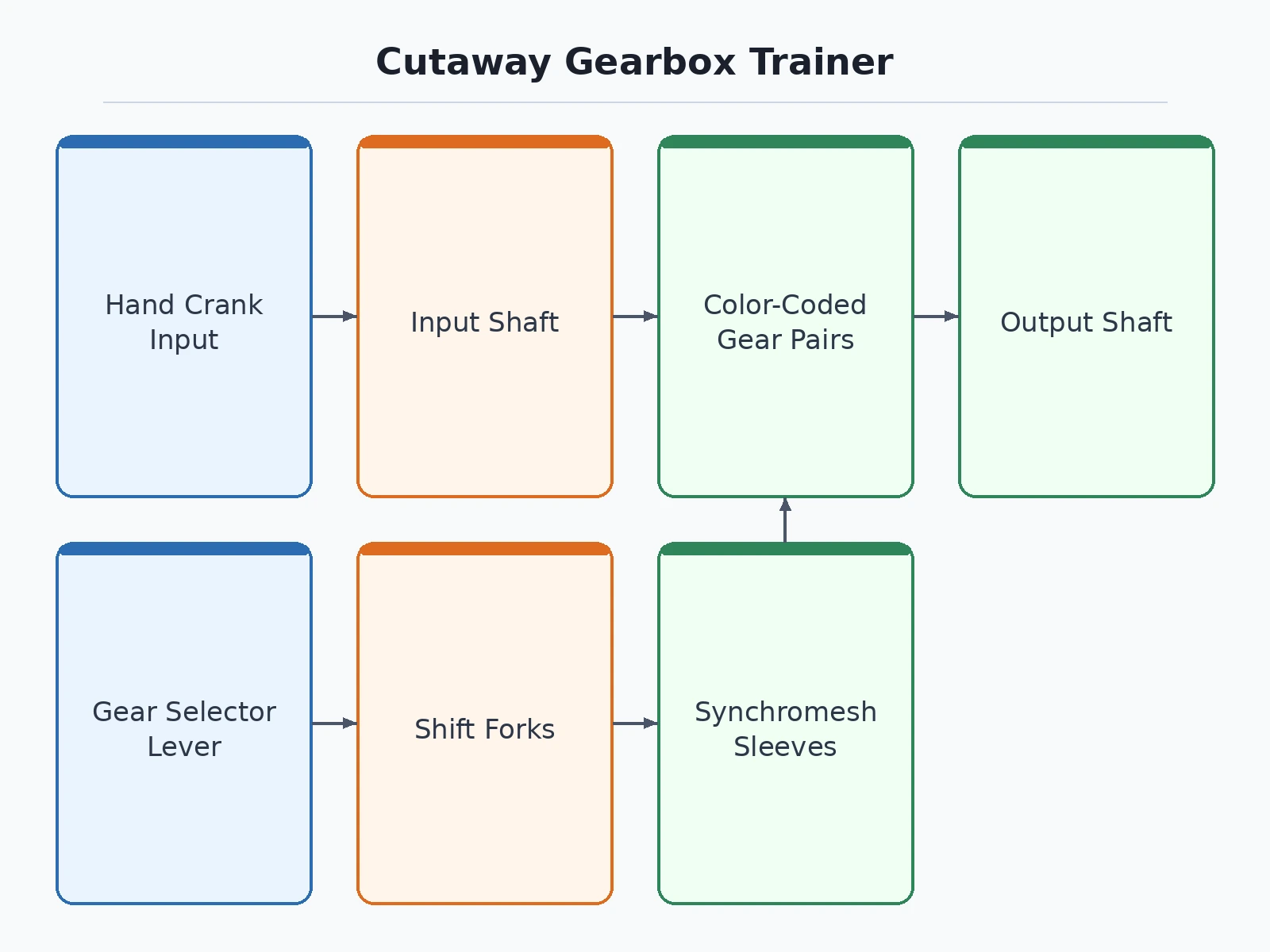
- A gear is selected with the shift lever; the linkage slides the synchromesh sleeve onto that gear's dog teeth.
- The hand crank turns the input shaft, which drives the layshaft through the constant-mesh input gear pair.
- Power flows from the layshaft to the selected mainshaft gear, then along the mainshaft to the output flange.
- Input versus output revolutions are counted to verify the ratio on the chart (first gear near 3.4:1 on a typical 4-speed unit).
- Shifting through the gears shows the ratios stepping down toward direct drive; students feel torque multiplication fall with each shift.
- Engaging reverse routes power through the idler gear, visibly reversing the output direction.
Tech stack:
- Donor 4/5-speed constant-mesh manual transmission with synchromesh
- MS angle and box-section welded stand with floor-anchor holes
- Hand crank fitted to the input shaft
- Tooth-count ratio chart panel measured per donor unit
- Deburring, rust-proofing and enamel paint finishing
- Mesh safety guards over crank and rotating zones
| Parameter | Value |
|---|---|
| Donor unit | 4/5-speed constant-mesh manual transmission (synchromesh) |
| Sectioning | Casing milled open on the parting plane; edges deburred and sealed |
| Drive | Manual hand crank on the input shaft (demonstration speed) |
| Gear ratios | Per donor-unit tooth counts; typical 4-speed spread approx. 3.4 / 1.9 / 1.3 / 0.9, charted per unit |
| Stand | Welded MS frame with floor-anchor holes |
| Finish | Degreased, rust-proofed, color-coded enamel paint |
| Guards | Mesh guards over crank and exposed rotating zones |
| Demonstration | Power-flow tracing and ratio verification by revolution counting |
Project features
- Sectioned Transmission Casing: a donor 4/5-speed manual gearbox is milled open along the parting plane so the complete geartrain is visible from the outside.
- Hand-Crank Input Drive: a crank on the input shaft rotates the geartrain at demonstration speed — no motor and no power supply needed.
- Visible Synchromesh Action: sliding sleeves, dog teeth and shift forks are fully exposed, so students watch engagement happen as each gear is selected.
- Color-Coded Gears: each ratio's gear pair is painted in a distinct color with tooth counts marked for ratio-verification exercises.
- Gear Ratio Chart: a panel-mounted chart lists every gear's ratio as measured from the donor unit's actual tooth counts.
- Welded MS Stand: a rigid mild-steel stand holds the gearbox at working height, with anchor holes for bolting to the lab floor.
- Safety Guards: mesh guards cover the crank zone and exposed rotating parts; all cut edges are deburred and sealed.
What is included
- Sectioned gearbox mounted on the welded MS stand with hand crank fitted
- Ratio chart panel and mesh safety guards installed
- Stand fabrication drawings with dimensions and weld notes
- Sectioning and finishing procedure document
- Maintenance guide (greasing schedule, rust prevention, storage)
- Project report PDF, PPT presentation and viva Q&A document
Advantages
- A real 4/5-speed manual gearbox milled open along the parting plane makes the complete geartrain, synchromesh sleeves and shift forks visible from outside, turning gear-train math into something students trace by hand.
- The hand crank drives the input shaft at demonstration speed with no motor and no power supply, so the trainer works in any lab corner.
- Sliding sleeves, dog teeth and shift forks are fully exposed, so students watch engagement happen as each gear is selected.
- Each ratio's gear pair is painted in a distinct color with tooth counts marked, supporting ratio-verification exercises against the panel-mounted ratio chart measured from the donor unit's actual tooth counts.
- The rigid welded mild-steel stand holds the gearbox at working height with anchor holes for bolting to the lab floor, and mesh guards cover the crank zone and exposed rotating parts.
Disadvantages
- Demonstration speeds only, by hand crank: the sectioned casing cannot take powered loads or high RPM, so this is a visual trainer, not a working transmission.
- Gear ratios are those of the specific donor unit and are measured and charted per unit, not a standardized ratio set.
- The sectioned casting still demands careful handling, and the assembly is heavy and needs a two-person lift per the safety guide.
- The trainer is grease-packed for display rather than pressure-lubricated, so extended cranking sessions need re-greasing per the maintenance guide.
- Donor-unit availability varies, and an equivalent 4/5-speed synchromesh unit may be substituted, with the ratio chart re-measured for that unit.
Limitations & prerequisites
- Demonstration speeds only, by hand crank: the sectioned casing cannot take powered loads or high RPM — this is a visual trainer, not a working transmission.
- Gear ratios are those of the specific donor unit and are measured and charted per unit, not a standardized ratio set.
- Cut edges are deburred and sealed, but the sectioned casting still demands careful handling; the assembly is heavy and needs a two-person lift per the safety guide.
- The trainer is grease-packed for display rather than pressure-lubricated; extended cranking sessions need re-greasing per the maintenance guide.
- Donor-unit availability varies; an equivalent 4/5-speed synchromesh unit may be substituted, with the ratio chart re-measured for that unit.
Frequently Asked Questions
Is this project suitable for a final-year project?
Yes — for Mechanical and Automobile programs. It demonstrates gear-train kinematics, synchromesh function, the ratio-versus-torque trade-off and real fabrication (sectioning, welding, finishing), with viva material on why constant-mesh replaced sliding-mesh and what the synchromesh actually synchronizes.
Which gearbox is used?
A 4/5-speed constant-mesh synchromesh manual transmission of the small-car class; the exact ratios are measured from the donor unit's tooth counts and printed on the chart.
Can it run under power?
No — demonstration speeds only, by hand crank. The sectioned casing is not rated for powered loads.
How are the ratios verified?
Tooth counts are marked on the color-coded gears; students count input versus output revolutions and match the result against the chart.
What will I receive with the project?
The sectioned gearbox on its stand with crank, ratio chart and guards, fabrication drawings, the finishing-procedure document, maintenance guide, report, PPT and viva Q&A. Suitable for B.E./B.Tech final-year projects in Mechanical and Automobile Engineering.
Components & software requirements
- Donor 4/5-speed constant-mesh manual transmission with synchromesh
- MS angle and box-section welded stand with floor-anchor holes
- Hand crank fitted to the input shaft
- Tooth-count ratio chart panel measured per donor unit
- Deburring, rust-proofing and enamel paint finishing
- Mesh safety guards over crank and rotating zones
Delivery information
Built-to-order project. Delivery timeline is shared after order confirmation based on current queue.
Support terms
Complete documentation, setup guide, and viva preparation included. Support for setup and explanation provided.
Download free synopsis (PDF)
Enter your name and WhatsApp number — the synopsis PDF downloads immediately. We may send occasional project updates on WhatsApp; no spam.