
More project photos (2)
The problem
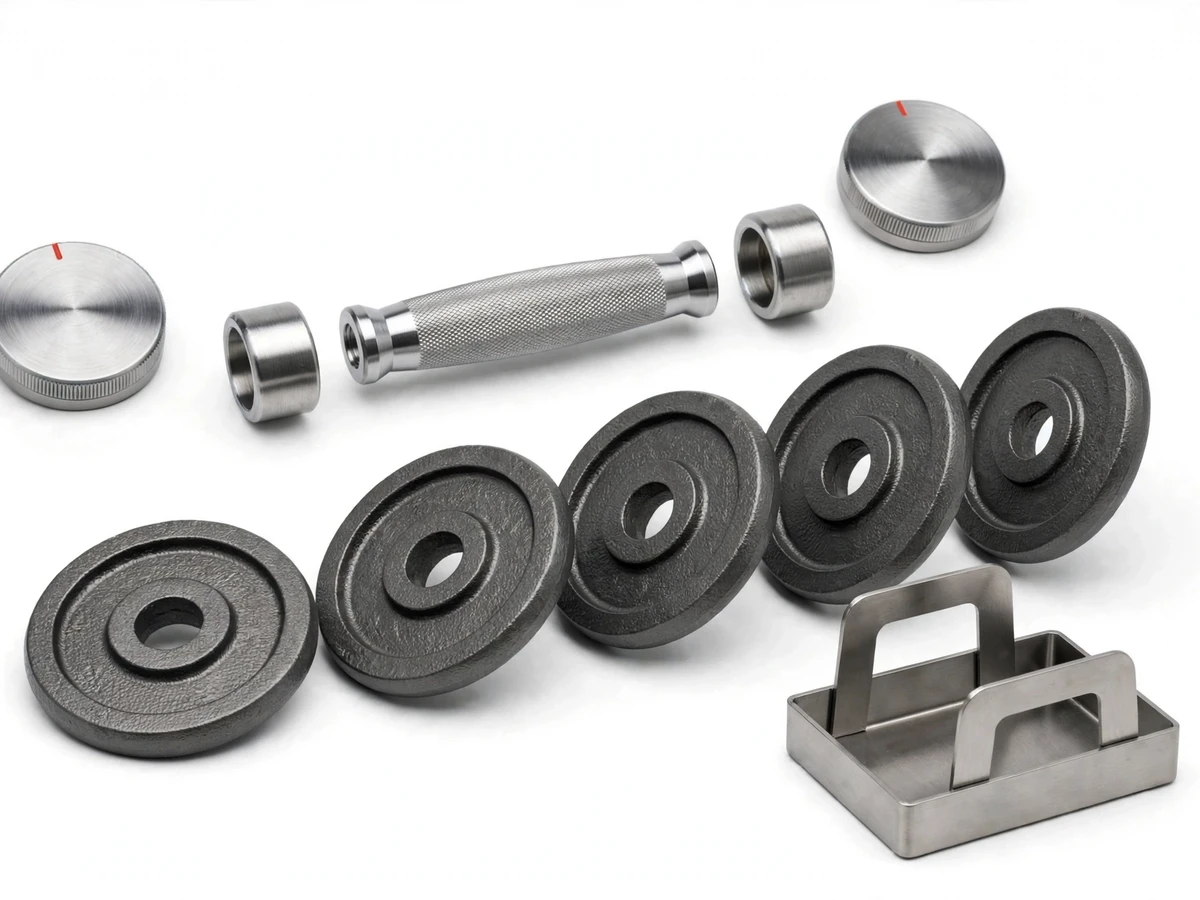
The adjustable weight dumbbell set with quick-lock plates is a home-gym tool that replaces a rack of fixed dumbbells with one pair whose weight changes at the turn of a dial. Each dumbbell pairs a knurled steel handle with a stack of slotted cast-iron plates and a dial-driven locking mechanism that engages or releases plates in seconds. Home gyms face a space problem: a range of fixed dumbbells needs a long rack and a floor area, while spin-collar adjustable sets need collars unscrewed and plates swapped by hand between every exercise, which breaks workout flow and leaves loose collars to lose. The quick-lock design answers both problems by keeping all plates parked in a steel cradle and selecting weight with one dial turn, so change-over takes seconds and no loose part leaves the set. This project builds that mechanism as a prototype, with the dial, cam, locking pins, plate slots and cradle designed, fabricated and demonstrated as one set.
This is a built-to-order hardware project: the dumbbell pair, steel cradles, locking mechanisms and the complete documentation kit (report, drawings, PPT, Q&A) are prepared fresh for you.
| Option | Weight change | Space needed | Loose parts |
|---|---|---|---|
| Fixed dumbbell rack | None — one weight per dumbbell | One full rack | None |
| Spin-collar adjustable set | Minutes — collars unscrewed, plates swapped by hand | One pair plus spare plates | Collars and plates |
| Quick-lock dial set (this project) | Seconds — one dial turn per end | One pair in cradles | None — plates stay parked in the cradle |
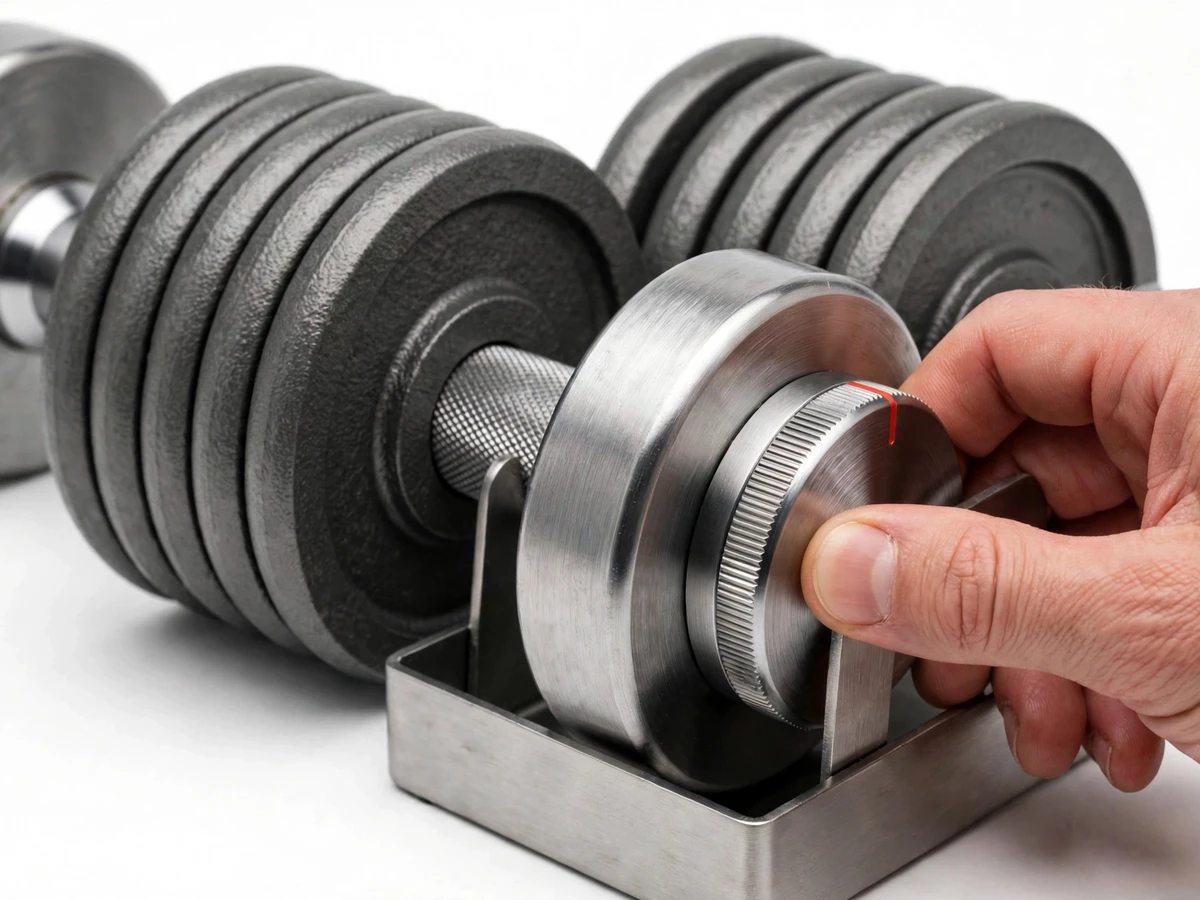
Dumbbell rests in its steel cradle.
Follow the working sequence
How it works
The mechanism works as a chain from cradle to lift. With the dumbbell resting in its cradle, the user turns the dial at each end to the wanted weight; inside the handle, the dial rotates a cam that pushes two locking pins outward into the slots of those plates inside the selected range, while plates beyond the range stay in the cradle. A detent ball drops into a notch at each setting, giving a click that confirms seating, and the red indicator line aligns with the collar mark only at full engagement. The user then lifts the dumbbell up out of the cradle: the locked plates travel with the handle, the unselected plates stay parked, and the pins carry the plate load in shear during the lift. Setting the dumbbell down and turning the dial the other way retracts the pins and frees the plates for the selection, so change-over needs no collars, no tools and no loose parts.
- Place the dumbbell in its steel cradle so the handle sits level and the plates rest in the cradle fingers.
- Turn the dial at one end to the wanted weight, feeling for the detent click and checking that the red indicator line meets the collar mark.
- Repeat the dial turn at the other end, so both ends select the same weight and the load stays balanced.
- Confirm both indicator lines sit on their marks, which shows the locking pins are fully engaged in the plate slots.
- Lift the dumbbell straight up out of the cradle; the selected plates travel with the handle while the rest stay parked.
- Train with the set weight, keeping the grip centred on the knurled section so the load stays even across both ends.
- Return the dumbbell to the cradle, turn both dials back, and watch the pins retract before the next weight selection.
Tech stack:
- EN8 medium-carbon steel handle · turned and knurled
- Cast-iron weight plates · slotted for pin engagement
- Mild steel cradle · welded fabrication
- Cam and locking-pin mechanism · milled steel
- Detent ball and spring · off-the-shelf hardware
- Lathe · milling machine · drilling operations
- Fusion 360 · part drawings and assembly model
- Workshop measuring tools · vernier caliper and dial gauge
| Parameter | Value |
|---|---|
| Weight range per dumbbell | 2.5 kg to 22.5 kg (design target) |
| Weight steps | 2.5 kg increments (design target) |
| Plates per dumbbell | 10 plates (design target) |
| Plate masses | 1.25 kg and 2.5 kg plates (design targets) |
| Handle mass | 2.5 kg (design target) |
| Handle length | 350 mm (design target) |
| Grip diameter | 35 mm (design target) |
| Knurl depth | 0.8 mm (design target) |
| Plate diameter | 180 mm (design target) |
| Plate bore clearance | 0.5 mm (design target) |
| Locking pins per end | 2 pins (design target) |
| Pin engagement depth | 6 mm at full lock (design target) |
| Cradle material | 3 mm mild steel sheet (design target) |
| Set contents | 2 dumbbells with 2 cradles (design target) |
Project features
The set is built around four capabilities that matter most to a home-gym user and to a mechanical design review. First, the quick-lock dial changes weight in seconds: one turn per end engages or releases plates, with a detent click that confirms the setting by feel and a red indicator line that shows the locked position at a glance. Second, the slotted plate stack keeps every plate aligned and captive, so plates slide onto the handle in a fixed order and cannot rotate out of position during a lift. Third, the steel cradle parks each dumbbell and holds the unselected plates in place, so change-over happens with the dumbbell resting safely and no plate ever sits loose on the floor. Fourth, the knurled steel handle gives a secure grip across the full weight range, with the grip diameter and knurl depth chosen for comfortable single-hand use at every setting.
- [Quick-lock dial mechanism] A detent dial at each end of the handle drives an internal cam that slides two locking pins into the slots of the selected plates, so weight changes with one turn per end and no tools. The detent click and red indicator line confirm engagement by feel and sight.
- [Slotted plate stack] Ten plates per dumbbell ride on the handle in a fixed order, each plate carrying slots that accept the locking pins, so plates stay aligned and captive through every lift. Plate order and orientation are fixed by the slot pattern, removing assembly guesswork.
- [Steel cradle with plate parking] Each dumbbell rests in a fabricated steel cradle that holds the unselected plates in place during change-over, so weight selection happens with the dumbbell supported and no plate sits loose on the floor.
- [Knurled steel handle] A knurled steel handle gives a secure single-hand grip across the full weight range, with a grip diameter of 35 mm (design target) and a knurl depth of 0.8 mm (design target) for hold without abrasion.
- [2.5 kg weight steps] Weight adjusts in steps of 2.5 kg from 2.5 kg to 22.5 kg per dumbbell (design targets), covering light warm-up work through heavy pressing with one pair. Steps come from mixing plates of 1.25 kg and 2.5 kg (design targets) on each side.
- [Visible lock check] The red indicator line on each dial sits against a fixed mark on the handle collar only when the pins are fully engaged, giving a one-glance pre-lift check. A dial that stops short of the mark means the lock is not set.
- [Workshop-fabricated build] Plates, handle, dials and cradles are produced with standard workshop processes — turning, milling, drilling and welding — so the full fabrication route is documented and reproducible in a college workshop. Optional scope: a powder-coated finish on the cradle and plates, offered as an add-on, not part of the base build.
What is included
- Adjustable dumbbell pair with quick-lock dials and steel cradles, fabricated to the design
- Complete set of slotted cast-iron plates for the full weight range
- Engineering drawings for handle, plates, dial, cam, pins and cradle
- Fusion 360 part and assembly models
- Project report PDF (background, mechanism design, fabrication route, testing notes)
- PPT presentation for final review
- Viva Q&A preparation document (mechanism, materials, manufacturing processes, safety checks)
Limitations & prerequisites
- The set is a prototype demonstration build, not a certified commercial fitness product, and carries no fitness-equipment safety certification.
- The design-target maximum load is 22.5 kg per dumbbell; loading beyond that target is outside the design and must not be attempted.
- The lock must be inspected before every lift: both red indicator lines must sit on their collar marks, and any dial that stops short means the set must not be lifted.
- Plate-stack tolerance is held to a 0.5 mm bore clearance (design target); wear over long use can increase play in the stack, so the pins and slots need periodic inspection.
- The cradle must sit on a flat, level surface; on an uneven surface the dumbbell may not seat fully and the pins may not engage.
- The build is sized for home-gym demonstration and light training use, not for commercial gym traffic or drop training.
- Finish quality depends on workshop processes available at build time; a powder-coated finish is optional scope, not part of the base build.
Frequently Asked Questions
How does the quick-lock mechanism actually work?
Turning the dial rotates an internal cam that slides two locking pins into slots cut in the selected plates, so those plates are captured on the handle while the rest stay parked in the cradle. A spring-loaded detent ball clicks into a notch at each setting, and the red indicator line meets the collar mark only when the pins are fully engaged. The first-principles point is simple: the pins carry the plate load in shear, and the cam only positions them — it never carries the weight itself.
What weight range does one dumbbell cover?
One dumbbell covers 2.5 kg to 22.5 kg in steps of 2.5 kg, using a 2.5 kg handle plus ten plates in 1.25 kg and 2.5 kg sizes, all stated as design targets. That range covers light warm-up sets through heavy pressing work with a single pair, and both ends must always be set to the same weight so the load stays balanced.
Is the set safe to lift?
The set is safe to lift only within its stated limits and only after the pre-lift lock check: both red indicator lines must sit on their collar marks before every lift, and the load must never exceed the 22.5 kg design target per dumbbell. It is a prototype demonstration build, not a certified commercial fitness product, so it must not be dropped, overloaded, or used on an uneven surface.
Why is this better than a spin-collar adjustable dumbbell?
A spin-collar set needs collars unscrewed and plates swapped by hand between exercises, which takes minutes and leaves loose collars to lose, while this set changes weight with one dial turn per end in seconds and no loose parts. The cradle also parks unselected plates, so nothing sits loose on the floor, and the indicator line gives a visible lock confirmation that a spin collar cannot offer.
Can the weight range or plate sizes be changed?
Yes, within the mechanism: the dial, cam and slot pattern can be re-cut for different plate masses or a different maximum load, since the design is parametric in plate count and plate mass. Any change is agreed before fabrication, because plates and cradle fingers are cut to match the chosen range, and the quotation covers the agreed configuration only.
Is this project suitable for a final-year project?
Yes, for Mechanical Engineering programmes, because it combines mechanism design, material selection, manufacturing processes and a working demonstration in one build. The report documents the cam-and-pin calculations, the fabrication route and the limitations honestly, so the work stands up to technical questioning.
For a quotation, message on WhatsApp with the scope wanted — dumbbell pair with cradles as specified, or with the optional powder-coated finish — and the price is quoted for that scope on a built-to-order basis, with the delivery timeline confirmed in the quotation itself. No fixed price is listed because plate configuration and finish choices change the fabrication cost.
Components & software requirements
- EN8 medium-carbon steel handle · turned and knurled
- Cast-iron weight plates · slotted for pin engagement
- Mild steel cradle · welded fabrication
- Cam and locking-pin mechanism · milled steel
- Detent ball and spring · off-the-shelf hardware
- Lathe · milling machine · drilling operations
- Fusion 360 · part drawings and assembly model
- Workshop measuring tools · vernier caliper and dial gauge
Delivery information
Built-to-order project. Delivery timeline is shared after order confirmation based on current queue.
Support terms
Complete documentation, setup guide, and viva preparation included. Support for setup and explanation provided.
Download free synopsis (PDF)
Enter your name and WhatsApp number — the synopsis PDF downloads immediately. We may send occasional project updates on WhatsApp; no spam.