
More project photos (2)
The problem
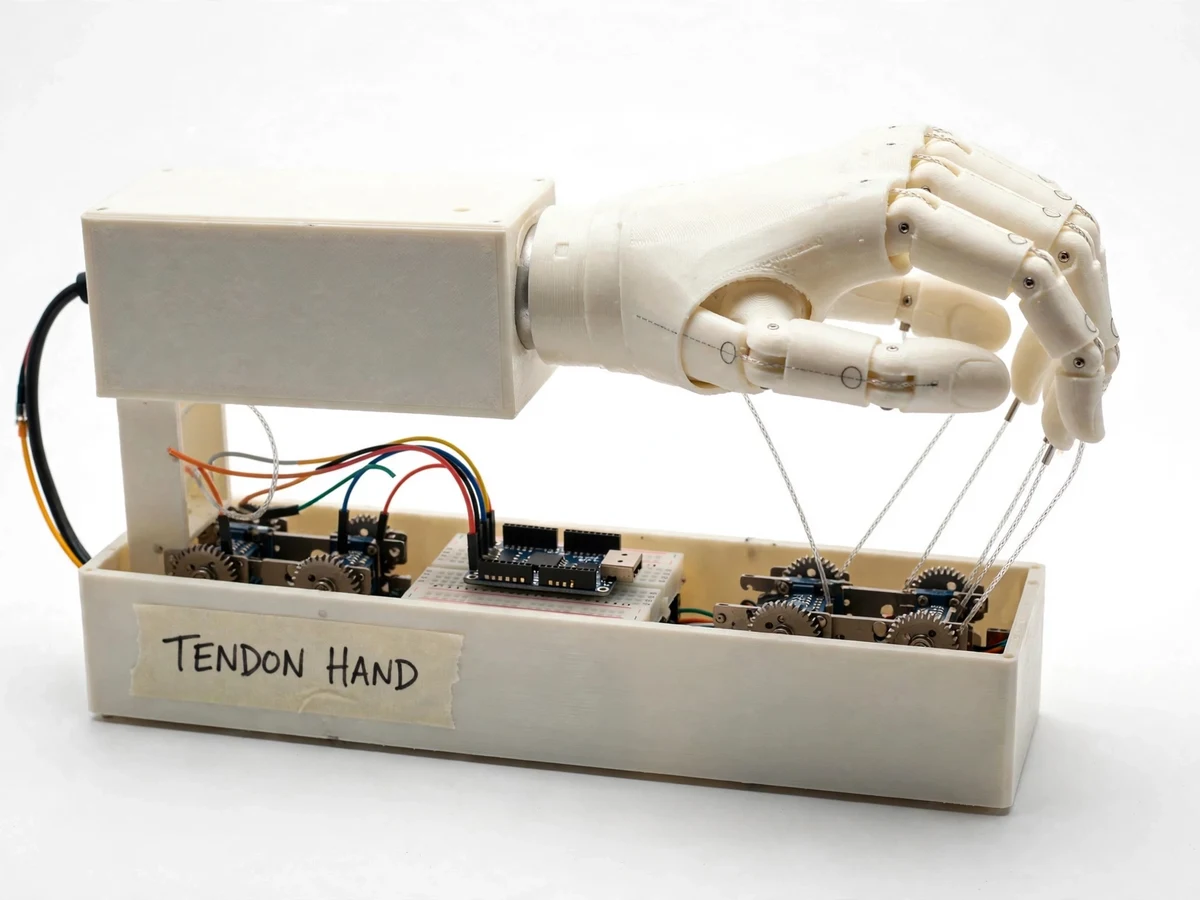
Commercial prosthetic hands cost several lakh rupees, putting even basic myoelectric devices out of reach for most amputees in India, while 3D printing has quietly made mechanical hands buildable in a college lab for a fraction of that. This project builds a working tendon-driven prosthetic hand: FDM-printed PLA finger segments joined by pinned hinge joints, braided tendon lines routed through printed guide rings and PTFE Bowden tubes, and servo winches in a forearm box that pull the tendons to curl the fingers — the same mechanical principle as human flexor tendons. An Arduino Nano drives the servos through open, power-grip, pinch and tripod presets from pushbuttons, a joystick or serial commands. It is an honest educational prototype: grip force is bounded by servo datasheet torque, it carries no medical certification, and the deliverables say so plainly. The build teaches real mechanism design — tendon routing geometry, winch sizing, joint pinning, tendon tensioning and embedded control — with every part printable on a standard FDM machine.
How it works
- Each finger is FDM-printed in PLA (0.2 mm layers, 40–60% infill at joints) as two or three segments joined by pinned hinge joints using M3 bolts or printed pins; the thumb is angled for opposition.
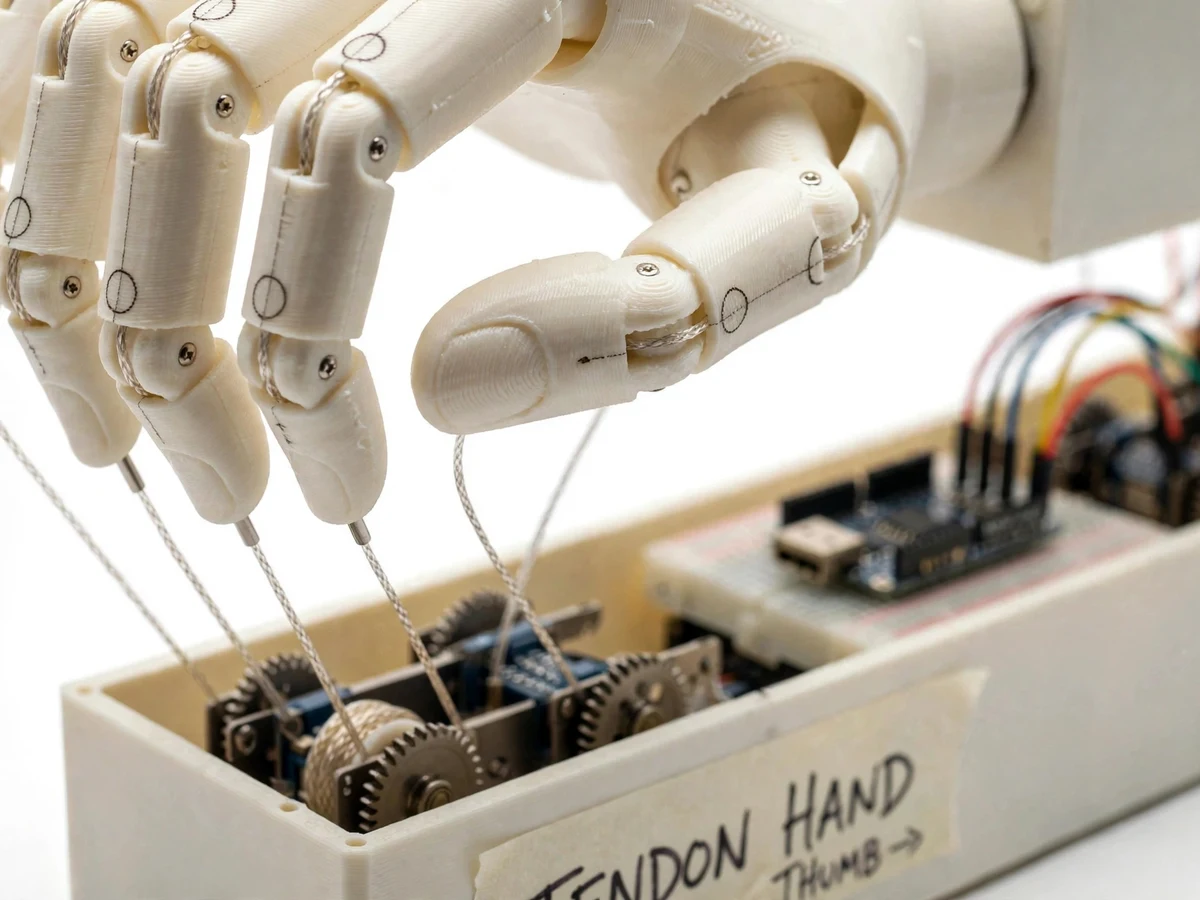
- A braided Dyneema tendon is anchored at each fingertip, threaded through printed guide rings along the finger's underside and fed through a PTFE Bowden tube to the forearm box.
- Inside the box, each tendon wraps two turns on a printed winch drum fitted to a servo horn; when the Arduino commands the servo to rotate, the drum reels the tendon in and the finger curls.
- Releasing a tendon lets the dorsal elastic cord pull the finger back to the open position — a one-way drive with passive return, like a real hand.
- The Arduino Nano runs four pushbutton grip presets (open, power grip, pinch, tripod), joystick-proportional curl of all fingers or a selected finger, and a serial protocol for scripted demos from a laptop.
- Tendon tension is set with printed tensioning screws during assembly and servo angle limits are calibrated per finger, so curl is repeatable without stalling the servos.
- The buyer verifies the build with the included test procedure: fingertip-lift of known masses and a full grip-sequence demo.
Tech stack:
- FDM 3D printing · PLA
- Fusion 360 / Tinkercad CAD + STL
- Arduino Nano (ATmega328P)
- MG90S metal-gear servos
- Dyneema braided line · PTFE Bowden tubes
- Embedded C++ firmware
- Cura / PrusaSlicer profiles
- Pushbutton · joystick · serial control
| Parameter | Value |
|---|---|
| Overall hand length | Approximately 190 mm (design target) |
| Finger segments | FDM PLA, 0.2 mm layers, 40–60% infill (build parameters) |
| Actuation | 5 braided-Dyneema tendon lines, servo-winch pull (implemented) |
| Servos | 5 × MG90S metal gear; stall torque ≈ 2.2 kg·cm at 4.8 V (datasheet value, not measured) |
| Max tendon tension | Approximately 2.7 kgf per line theoretical (derived from datasheet torque ÷ drum radius, not measured) |
| Tendon travel | Approximately 18–22 mm per finger (design target) |
| Finger curl | Approximately 0–90° at knuckle joints (design target) |
| Return | Dorsal elastic cord, passive (implemented) |
| Grip strength | Not claimed as measured — buyer-run fingertip-lift test with known masses included |
| Print time | Approximately 16–20 h total (build parameter) |
| Filament usage | Approximately 160–200 g PLA (build parameter) |
| Controller | Arduino Nano, ATmega328P, 5 V logic |
| Power | 5 V, approximately 2 A peak for servo bank (expected) |
Project features
- [Tendon-driven finger mechanism] Braided Dyneema tendons anchored at each fingertip, routed through printed guide rings and PTFE Bowden tubes down to servo winches — pull-to-curl like human flexor tendons, with smooth release.
- [Five servo-winch actuators] Metal-gear MG90S servos mounted in a 3D-printed forearm box; each tendon wraps on a printed winch drum sized from the servo's datasheet stall torque.
- [Elastic-cord finger return] Dorsal elastic lines reopen each finger when the tendon releases — no antagonistic motors or return servos needed.
- [Four grip presets + proportional mode] Pushbutton presets for open, power grip, pinch and tripod; a joystick gives proportional all-finger or selected-finger curl.
- [Arduino Nano control] ATmega328P firmware with grip sequencing, per-finger servo calibration constants and a serial command interface for PC control or demos.
- [Complete CAD + STL package] Finger segments, palm, forearm box and winch drums as editable CAD plus print-ready STLs with tested 0.2 mm-layer slicer profiles.
- [Buyer-run test procedure] A fingertip-lift test with known masses and a tendon-tension calibration checklist, so performance is verified on the student's own build rather than claimed.
What is included
- Complete STL files for hand, fingers, forearm box and winch drums
- Editable CAD files (STEP) for the mechanism
- Tested Cura/PrusaSlicer profiles (0.2 mm layers, joint infill settings)
- Printed assembly guide with tendon-routing diagrams and tensioning procedure
- Arduino firmware (grip presets, joystick mode, serial protocol)
- Wiring diagram for servos, buttons, joystick and power
- Buyer-run test & calibration procedure (fingertip-lift with known masses)
- Project report PDF (background, tendon-mechanism theory, design calculations, methodology)
- PPT presentation for final review
- Viva Q&A preparation document (mechanism design, servo sizing, PLA limits, control modes)
Advantages
- Tendon-driven fingers like human flexor tendons: braided Dyneema lines anchored at each fingertip, routed through printed guide rings and PTFE Bowden tubes to servo winches in a forearm box — pull-to-curl with smooth release.
- Five MG90S metal-gear servos drive printed winch drums sized from the servo's datasheet stall torque (approximately 2.2 kg·cm at 4.8 V); dorsal elastic cords reopen the fingers passively, so no antagonistic motors are needed.
- Four grip presets (open, power grip, pinch, tripod) from pushbuttons, proportional curl from a joystick, plus a serial command interface for PC-controlled demos — with per-finger calibration constants.
- Complete CAD+STL package: editable STEP files plus print-ready STLs with tested 0.2 mm-layer slicer profiles; prints on any standard FDM machine using roughly 160–200 g of PLA.
- Honest validation built in: a buyer-run test procedure — fingertip-lift of known masses with a tendon-tension calibration checklist — measures the build's own performance rather than claiming one.
Disadvantages
- An educational prototype, NOT a medical device — no clinical, FDA or CE certification; never presented as a clinical prosthesis.
- PLA creeps under sustained tendon load, so tendons need re-tensioning after heavy demo use; FDM tolerances (approximately ±0.2 mm) mean hinge joints need light hand-fitting and deburring during assembly.
- Grip force is bounded by the servo's datasheet stall torque — enough for demonstration objects, not sustained heavy lifting — and grips are open-loop with no force feedback, so a wrong preset can crush delicate objects.
- Braided tendons wear at the guide rings and are a listed consumable with a replacement procedure; EMG/myoelectric control is documented future scope, not in this build.
Limitations & prerequisites
- An educational prototype, NOT a medical device — no clinical, FDA or CE certification; never presented as a clinical prosthesis.
- PLA creeps under sustained tendon load: tendons need re-tensioning after heavy demo use; the tensioning procedure is documented.
- FDM tolerances are approximately ±0.2 mm, so hinge joints need light hand-fitting and deburring during assembly.
- Grip force is bounded by the servo's datasheet stall torque — strong enough for demonstration objects, not for sustained heavy lifting.
- No proprioceptive or force feedback; grips are open-loop, so delicate objects can be crushed if the preset is wrong.
- EMG / myoelectric control is documented future scope, not in this build — control is pushbutton, joystick and serial commands.
- Braided tendons wear at guide rings over time; they are a listed consumable with a replacement procedure.
Frequently Asked Questions
Why tendon-driven instead of putting a small motor in each finger?
Five motors in the fingers would make the hand heavy, fragile and hard to wire. Tendons move all actuation into the forearm box — the hand stays light and printable, the mechanism mirrors human anatomy, and servicing is a matter of re-threading a line.
How strong is the grip?
No grip force is claimed as measured. The theoretical tendon tension is derived from the servo's datasheet stall torque and the winch-drum radius; the included test procedure has the buyer lift known masses with the fingertips on their own build and record the result.
Which servos are used and why?
MG90S metal-gear servos — metal gears survive the shock loads of tendon stalls that strip plastic-gear servos, and the winch drum radius is sized from the servo's datasheet stall torque of approximately 2.2 kg·cm at 4.8 V.
Can it be controlled by muscle signals (EMG)?
Not in this build — that is documented future scope. The firmware exposes a serial command interface precisely so an EMG front-end can be added later without changing the mechanism.
What printer and material does it need?
Any standard FDM printer with a 180 × 180 mm bed and PLA filament. Finger segments print at 0.2 mm layers with 40–60% infill at the joints; the guide lists support and orientation for every part.
Is this project suitable for a final-year project?
Yes — for Mechanical, Mechatronics and Robotics programs. It covers CAD and mechanism design, FDM manufacturing, tendon actuation, embedded control and honest experimental validation. Suitable for B.E./B.Tech final-year projects in Mechanical, Mechatronics and Robotics Engineering.
Components & software requirements
- FDM 3D printing · PLA
- Fusion 360 / Tinkercad CAD + STL
- Arduino Nano (ATmega328P)
- MG90S metal-gear servos
- Dyneema braided line · PTFE Bowden tubes
- Embedded C++ firmware
- Cura / PrusaSlicer profiles
- Pushbutton · joystick · serial control
Delivery information
Built-to-order project. Delivery timeline is shared after order confirmation based on current queue.
Support terms
Complete documentation, setup guide, and viva preparation included. Support for setup and explanation provided.
Download free synopsis (PDF)
Enter your name and email — the synopsis PDF downloads immediately. We may send occasional project updates; no spam, unsubscribe anytime.