
More project photos (3)
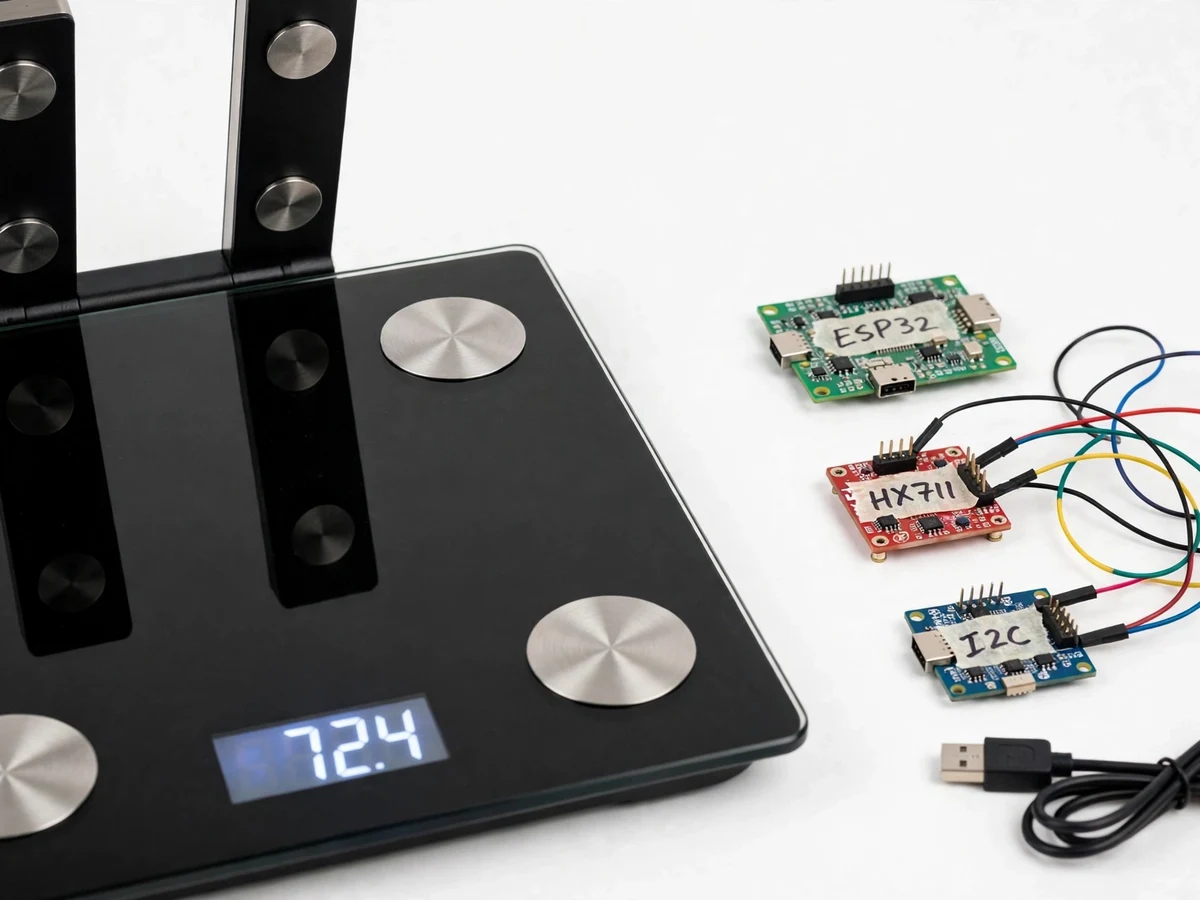
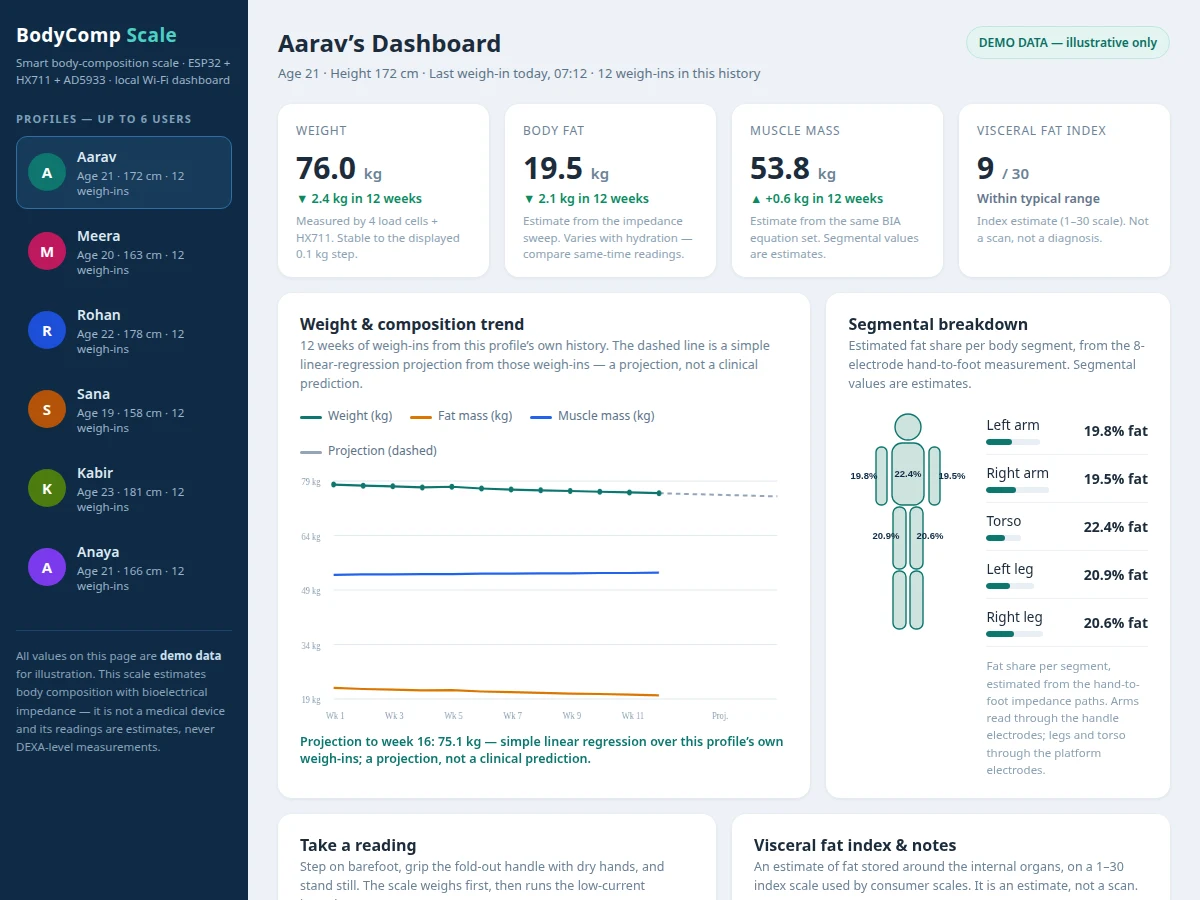
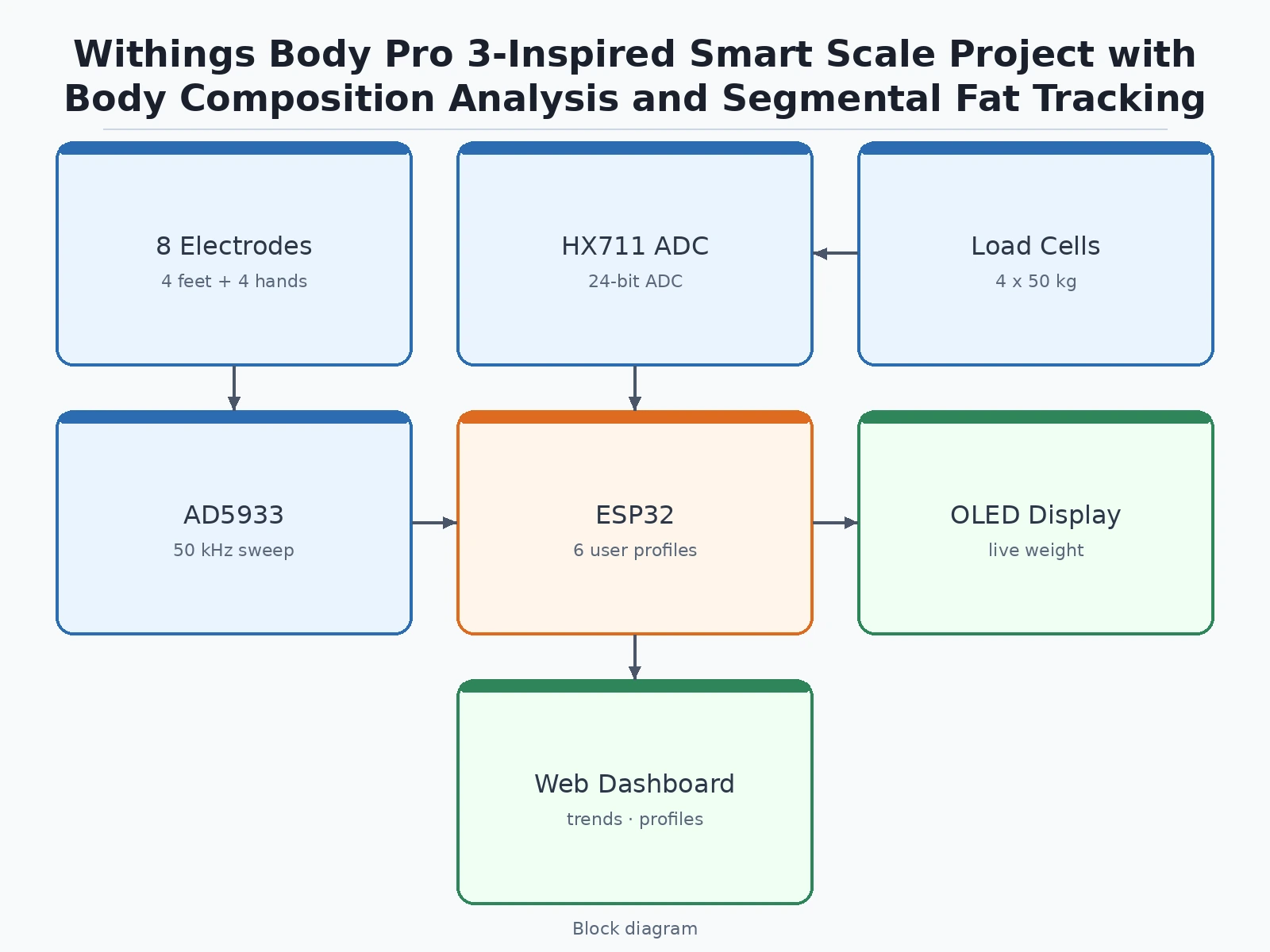
The problem
This project builds a Withings Body Pro 3-inspired smart body-composition scale: a bathroom scale that weighs the user with four 50 kg load cells and estimates body fat, muscle mass and visceral fat with an 8-electrode bioelectrical impedance measurement, then shows per-user trends on a local web dashboard. Withings Health Solutions announced Body Pro 3 in Paris on 12 November 2026 as a cellular-connected device for weight-management programmes, with a retractable handle that enables segmental readings for each arm, each leg and the torso. The student build translates that headline device into a safe lab-scale version: an ESP32 reads the load cells through an HX711 24-bit ADC, an AD5933 impedance-analyser chip runs a low-current sweep through stainless-steel electrodes on the platform and a fold-out handle, and the dashboard keeps up to 6 user profiles with a trend projection computed from each profile's own weigh-in history. Every composition figure is an estimate, never a clinical measurement.
| This student build | Withings Body Pro 3 (reported figures) | Smart Weighing Scale for Retail Shops with Billing Integration and Cloud Records (ESP32) | |
|---|---|---|---|
| What it weighs | People: four 50 kg half-bridge load cells under a tempered-glass platform · HX711 24-bit ADC at 10 samples per second | People: cellular-connected scale for weight-management programmes · measurements auto-transmit after each weigh-in (reported) | Loose goods at a shop counter: single-point strain-gauge load cell under a steel platform · HX711 amplifier |
| Body composition | Bioelectrical impedance estimates: fat mass, muscle mass and a visceral fat index · labelled estimates throughout | Segmental readings: estimated fat and muscle mass for each arm, each leg and the torso, plus a visceral fat index (reported) | No body composition: the scale weighs goods and prices them per kilogram |
| Segmental readings | 8 stainless-steel electrodes: 4 on the platform for the feet, 4 on a fold-out handle for the hands, mirroring the reported handle | Retractable handle enables segmental readings for each arm, each leg and the torso (reported) | No electrodes · no segmental readings · one whole weight per item |
| Weighing display | 0.96-inch OLED on the platform plus the web dashboard · weight step 0.1 kg (design target) | Display not detailed in the launch reports | 16x2 LCD shows weight, per-kg rate and bill amount · 4x4 keypad selects the product |
| Connectivity | Wi-Fi to a local web dashboard · readings stay on the device · no cloud account | Cellular connection · needs no Wi-Fi or Bluetooth pairing (reported) | Wi-Fi to cloud records · offline hold with auto-sync when the connection returns |
| Profiles | Up to 6 user profiles stored on the ESP32, each with its own trend history | Built for programmes, not households: healthcare organisations, remote patient monitoring providers and clinical weight-management programmes (reported) | One shop counter · running bill per customer · cloud record of every weighing |
| Trend projection | Linear regression over the profile's own weigh-in history · labelled a projection, never a clinical prediction (design target) | Program Trajectory Prediction built from tens of thousands of GLP-1 journeys · Goal Probability Score and Off-Track Alerts · predictions are estimates (reported) | No trend projection · the dashboard shows the day's sales, total weight sold and sync status |
| Blood pressure | None: this scale does not measure blood pressure and has no hypertension feature of any kind | Hypertension Notification Feature analyses weigh-in data, does NOT measure blood pressure, is pending regulatory clearance and is NOT available (reported) | None · not a health device |
| Price | Built-to-order · quotation | Price not reported · available early 2027 for healthcare organisations, not a consumer launch (reported) | Built-to-order · quotation |
| Honesty line | BIA gives estimates, never DEXA-level accuracy · the reported 0.99 / 0.98 DEXA correlations belong to Withings' 2025 validation study, not to this build | Withings claims a 2025 validation study vs DEXA correlated 0.99 (fat mass) and 0.98 (lean / muscle mass) (reported) | Honest calibration: a tare key zeroes the empty platform and a known-weight check verifies the scale |
The user steps onto the platform barefoot and grips the fold-out handle with dry hands.
Follow the working sequence
How it works
The user steps onto the platform barefoot and grips the fold-out handle with dry hands. The four 50 kg half-bridge load cells under the platform bend a fraction under the load, their Wheatstone bridge outputs a few millivolts, and the HX711 amplifies that signal at a gain of 128 and converts it with its 24-bit ADC at 10 samples per second, giving the ESP32 a stable weight. The ESP32 then runs the impedance sweep: the AD5933 sends a low-current alternating signal at 50 kHz through the eight stainless-steel electrodes, measures the body's impedance along the hand-to-foot paths, and converts the result into fat-mass, muscle-mass and visceral-fat-index estimates with a standard bioelectrical impedance equation set. The ESP32 saves the reading to the selected profile, updates the local web dashboard over Wi-Fi, and draws the trend with a projection line fitted to that profile's own weigh-in history.
- The builder assembles the scale: the tempered-glass platform on four 50 kg half-bridge load cells, the HX711 board, the AD5933 board, 8 stainless-steel electrodes, the fold-out handle, the OLED display, the ESP32 and the Li-ion cell, wired with no mains anywhere in the build.
- The builder calibrates the weight path: a known standard weight is placed on the platform and the counts-per-kilogram factor is set from the HX711 reading, then checked again with a second known weight.
- The builder calibrates the impedance path: a precision resistor of known value (1 kΩ, design target) is measured through the AD5933 so the gain factor is set before any body measurement is attempted.
- The builder creates the user profiles: up to 6 profiles are set up on the dashboard with age and height, since the bioelectrical impedance equations need both to turn impedance into fat and muscle estimates.
- The user takes a reading: barefoot on the platform, dry hands gripping the handle electrodes, standing still while the scale weighs first and then runs the impedance sweep, which takes approximately 4 s (design target).
- The builder tests repeatability honestly: the same person weighs in at the same time on consecutive mornings, and the report records how much the readings move with hydration and time of day instead of claiming a single fixed accuracy.
- The builder records the results honestly: the report states the calibration procedure, the repeat-weigh-in spread, the limits of the estimates and everything the scale does not measure, with no clinical claim anywhere.
Tech stack:
- ESP32 · dual-core controller + Wi-Fi dashboard
- HX711 · 24-bit load-cell ADC at 10 samples per second
- AD5933 · impedance analyser for bioelectrical impedance
- 4× 50 kg half-bridge load cells · tempered-glass platform
- 8 stainless-steel electrodes · fold-out handle
- 0.96-inch OLED display · 128 × 64 pixels
- HTML · CSS · JavaScript web dashboard
- Arduino IDE · ESP32 firmware
Body composition & safety note
- Estimates, not measurements: Weight is measured precisely by the load cells; fat mass, muscle mass and the visceral fat index are estimates computed from impedance, and the page, the dashboard and the report all label them as estimates.
- No blood pressure, no hypertension feature: This scale does not measure blood pressure and has no hypertension notification of any kind — the reported Body Pro 3 feature analyses weigh-in data, does not measure blood pressure, is pending regulatory clearance and is not available.
- Not a medical device: This is an academic prototype, not a certified medical device, and must never be presented as a diagnostic or clinical tool.
- Small excitation current: The impedance sweep uses the AD5933's lowest excitation range (200 mV peak-to-peak, design target) at 50 kHz, so the current through the body stays small; the sweep is a design-target setting, not a measured safety certification.
- Dry hands matter: The handle electrodes must be gripped with dry hands — wet or sweaty palms lower the skin contact resistance and shift the impedance reading, which is why the reading procedure says so explicitly.
| Parameter | Value |
|---|---|
| Build type | Hybrid scale plus web dashboard (design target) |
| Controller | ESP32 · dual-core Xtensa LX7 up to 240 MHz · 520 KB SRAM · Wi-Fi 802.11 b/g/n · Bluetooth 5 LE (Datasheet value) |
| Load cells | 4 × 50 kg half-bridge load cells · sensitivity 1.0 mV/V ±0.1 mV/V (Typical value for this part class — confirm against the supplied cells' datasheet during the build) · combined rated load 200 kg (4 × 50 kg) |
| Weight ADC | HX711 · 24-bit sigma-delta ADC · Channel A gain 128 · full-scale input ±20 mV at 5 V AVDD · output rate 10 SPS or 80 SPS · supply 2.6–5.5 V · input noise 50 nV rms at gain 128 and 10 Hz (Datasheet value) |
| Impedance analyser | AD5933 · 12-bit 1 MSPS ADC · frequency generator to 100 kHz maximum · 27-bit frequency resolution under 0.1 Hz · excitation 2 V / 1 V / 400 mV / 200 mV peak-to-peak · impedance range 1 kΩ to 10 MΩ · system accuracy 0.5% · supply 2.7–5.5 V · I2C interface · 1024-point DFT (Datasheet value) |
| BIA sweep | Single frequency 50 kHz · lowest excitation range 200 mV peak-to-peak · sweep time approximately 4 s (design target) |
| Electrodes | 8 stainless-steel electrodes · 4 on the platform for the feet · 4 on the fold-out handle for the hands (design target) |
| Display | 0.96-inch OLED · 128 × 64 pixels (design target) |
| User profiles | Up to 6 profiles stored on the ESP32 (design target) |
| Weight display step | 0.1 kg (design target) |
| Maximum user weight | 150 kg (design target) |
| Trend projection | Linear regression over the selected profile's own weigh-in history · labelled a projection, never a clinical prediction (design target) |
| Power | 5 V USB charging · 3.7 V 18650 Li-ion cell 2600 mAh (design target) · no mains wiring anywhere in the build |
| Impedance calibration | Precision resistor of known value 1 kΩ measured through the AD5933 before body measurements (design target) |
| Trend reference | Withings Body Pro 3 reported figures only: cellular-connected · no Wi-Fi or Bluetooth pairing · retractable handle · segmental estimated fat and muscle mass per arm, per leg and torso plus visceral fat index · 2025 validation study vs DEXA correlated 0.99 (fat mass) and 0.98 (lean / muscle mass) · Program Trajectory Prediction with Goal Probability Score and Off-Track Alerts · Hypertension Notification Feature analyses weigh-in data, does NOT measure blood pressure, pending regulatory clearance, NOT available · available early 2027 for healthcare organisations, remote patient monitoring providers and clinical weight-management programmes, not a consumer launch · announced Paris 12 November 2026 (reported) · shares no parts or software with this build |
| GLP-1 context | Reported context for weight-management programmes: approximately 25% of weight lost can be lean mass (2025 Acta Diabetologica review, reported) · approximately 65% discontinued treatment within a year (JAMA Network Open, 125,474 US adults, reported) |
| Builder note | The HX711 is read at 10 samples per second while the impedance sweep runs, not at 80 samples per second: the 80 SPS setting widens the ADC filter and lets more supply noise into the weight reading while the AD5933 is exciting the electrodes, so the slower rate is the stable one for this build. The handle electrodes must be gripped with dry hands — wet palms lower skin contact resistance and shift the impedance reading — and the platform electrodes need bare feet, since socks add an insulating layer the sweep cannot see through. The AD5933 measures 100 Ω to 1 kΩ only with additional circuitry, so body paths below 1 kΩ are outside the base build's range. |
Project features
Four ideas carry this build. First, honest two-part measurement: the load cells measure weight precisely while the impedance sweep only estimates composition, and the page, the report and the dashboard all say so in the same words. Second, segmental readings: the fold-out handle adds four hand electrodes to the four foot electrodes, so the scale estimates fat and muscle for each arm, each leg and the torso instead of one whole-body number. Third, per-user tracking: the ESP32 keeps up to 6 profiles and draws each person's weight, fat-mass, muscle-mass and visceral-fat-index trends, with a projection line computed from that person's own weigh-ins. Fourth, a local dashboard with nothing to install: the ESP32 serves the dashboard over Wi-Fi, readings stay on the device, and the scale works without any cloud account or subscription.
- [Four load cells with HX711 weighing] Four 50 kg half-bridge load cells under the tempered-glass platform feed an HX711 24-bit ADC at a gain of 128, so the weight the dashboard shows comes from a real bridge measurement, not a single bathroom-scale module — implemented in the base build.
- [8-electrode bioelectrical impedance analysis] An AD5933 impedance-analyser chip runs a low-current alternating-current sweep at 50 kHz through 8 stainless-steel electrodes — 4 under the feet and 4 on the fold-out handle — and the ESP32 turns the measured impedance into fat-mass, muscle-mass and visceral-fat-index estimates — implemented in the base build.
- [Segmental fat and muscle estimates] The hand-to-foot electrode paths let the scale estimate fat and muscle separately for the left arm, right arm, torso, left leg and right leg, shown on a body diagram in the dashboard — implemented in the base build.
- [Per-user profiles with trend history] Up to 6 user profiles are stored on the ESP32, each with its own weigh-in history, so a household or a hostel room can share one scale without mixing readings — implemented in the base build.
- [Trend projection from the user's own history] The dashboard draws a projection line fitted by simple linear regression to the selected profile's own weigh-ins, labelled as a projection and never as a clinical prediction — implemented in the base build.
- [Local web dashboard] The ESP32 serves the dashboard over Wi-Fi, so any phone or laptop on the same network can view trends and switch profiles without installing an app or creating an account — implemented in the base build.
- [OLED readout on the scale] A 0.96-inch OLED on the platform shows the weight immediately after stepping on, so the scale is usable without opening the dashboard — implemented in the base build.
- [Calibration with known references] Weight is calibrated with a known standard weight and the impedance path with a precision resistor of known value, and both procedures are written in the setup guide so a reviewer can repeat them — implemented in the base build.
What is included
- Complete scale prototype (tempered-glass platform, 4 load cells, HX711 board, AD5933 board, 8 stainless-steel electrodes, fold-out handle, OLED display, ESP32, Li-ion cell with USB charging)
- Firmware (load-cell weighing and calibration, AD5933 impedance sweep, segmental estimates, up to 6 user profiles, Wi-Fi dashboard, trend projection)
- Setup and calibration guide (known-weight calibration, impedance calibration resistor, electrode care, the dry-hands reading procedure)
- Project report PDF (Body Pro 3 background with reported figures labelled as reported, scale design, bioelectrical impedance design, repeat-weigh-in results, honest measurement limits)
- PPT presentation for final review
- Viva Q&A preparation document (how bioelectrical impedance works, why the figures are estimates, why there is no blood-pressure feature, load-cell and AD5933 limits)
Limitations & prerequisites
- Not Withings Body Pro 3: this build shares no parts, software or performance with Withings' device — it is a student scale inspired by the 12 November 2026 announcement, and must never be presented as the Withings device.
- Body composition figures are estimates: bioelectrical impedance estimates fat and muscle; it never reaches DEXA-level accuracy, and Withings' reported 0.99 / 0.98 DEXA correlations belong to their 2025 validation study, not to this build.
- No blood-pressure measurement and no hypertension feature of any kind: the scale measures weight and impedance only.
- Not a medical device: the scale is an academic prototype, not certified medical equipment, and must not be used for diagnosis, treatment or clinical decisions.
- Readings move with the body: hydration, skin and electrode contact, food intake and time of day all shift impedance readings, so readings should be compared at the same time each morning rather than chased one by one.
- Segmental values are estimates: the per-arm, per-leg and torso figures come from the same impedance paths and carry the same limits as the whole-body estimate.
- Dry hands and bare feet are required: wet palms or socks change the electrode contact and shift the reading, and the handle must be gripped firmly for the full sweep.
- Local network only: the dashboard works over local Wi-Fi; there is no cellular link like the reported Body Pro 3, so remote viewing needs a network setup that is an optional extension, not part of the base build.
Frequently Asked Questions
Is this project suitable for a final-year project?
Yes, for IoT, Electronics and Embedded Systems programmes, because it combines load-cell weighing, bioelectrical impedance analysis, segmental estimation and a web dashboard into one testable build. The report documents the calibration, the repeat-weigh-in tests and the honest limits of every estimate, so the work reads as engineering rather than a copy of an announcement. The project shows how a headline health device is translated into a safe lab-scale version.
Is this the Withings Body Pro 3?
No, this is a student scale inspired by Withings Body Pro 3, announced on 12 November 2026, not the Withings device: it uses an ESP32, an HX711 ADC, an AD5933 impedance-analyser chip and 8 stainless-steel electrodes, while Body Pro 3 is Withings' cellular-connected device for weight-management programmes. This build shares no parts, software or performance with Withings' device, and its composition figures are estimates, not validated figures.
How accurate is the body composition reading?
The weight is precise because four load cells and a 24-bit ADC measure it directly, but the fat-mass, muscle-mass and visceral-fat-index figures are estimates computed from impedance, never DEXA-level measurements. Readings move with hydration, skin contact and time of day, so the honest way to use the scale is to compare readings taken at the same time each morning. The report states these limits plainly, and Withings' reported 0.99 / 0.98 DEXA correlations belong to their 2025 validation study, not to this build.
How do the handle electrodes give segmental readings?
The scale measures impedance along several paths: the four foot electrodes on the platform and the four hand electrodes on the fold-out handle let the AD5933 probe arm, leg and torso paths separately instead of one whole-body path. The ESP32 turns each path's impedance into a fat and muscle estimate for that segment, which the dashboard shows on a body diagram. Segmental values are estimates with the same limits as the whole-body figure, and the handle must be gripped with dry hands for the full sweep.
Does it measure blood pressure?
No, and it has no hypertension feature of any kind. The scale measures weight with load cells and impedance with the AD5933 — nothing in the build senses blood pressure, and no hypertension notification is implemented or claimed in any form. The reported Body Pro 3 Hypertension Notification Feature analyses weigh-in data, does not measure blood pressure, is pending regulatory clearance and is not available, so even the headline device does not offer blood-pressure measurement.
What will I receive with the project?
You receive the scale prototype with its platform, load cells, HX711 and AD5933 boards, electrodes and fold-out handle, the firmware with weighing, impedance sweep, segmental estimates, profiles and dashboard, the setup and calibration guide, the report, presentation and Q&A document. A phone or laptop on the same Wi-Fi network is needed for the dashboard, and a known standard weight for the calibration step, both covered in the setup guide.
Components & software requirements
- ESP32 · dual-core controller + Wi-Fi dashboard
- HX711 · 24-bit load-cell ADC at 10 samples per second
- AD5933 · impedance analyser for bioelectrical impedance
- 4× 50 kg half-bridge load cells · tempered-glass platform
- 8 stainless-steel electrodes · fold-out handle
- 0.96-inch OLED display · 128 × 64 pixels
- HTML · CSS · JavaScript web dashboard
- Arduino IDE · ESP32 firmware
Body composition & safety note
- Estimates, not measurements: Weight is measured precisely by the load cells; fat mass, muscle mass and the visceral fat index are estimates computed from impedance, and the page, the dashboard and the report all label them as estimates.
- No blood pressure, no hypertension feature: This scale does not measure blood pressure and has no hypertension notification of any kind — the reported Body Pro 3 feature analyses weigh-in data, does not measure blood pressure, is pending regulatory clearance and is not available.
- Not a medical device: This is an academic prototype, not a certified medical device, and must never be presented as a diagnostic or clinical tool.
- Small excitation current: The impedance sweep uses the AD5933's lowest excitation range (200 mV peak-to-peak, design target) at 50 kHz, so the current through the body stays small; the sweep is a design-target setting, not a measured safety certification.
- Dry hands matter: The handle electrodes must be gripped with dry hands — wet or sweaty palms lower the skin contact resistance and shift the impedance reading, which is why the reading procedure says so explicitly.
Delivery information
Built-to-order project. Delivery timeline is shared after order confirmation based on current queue.
Support terms
Complete documentation, setup guide, and viva preparation included. Support for setup and explanation provided.
Download free synopsis (PDF)
Enter your name and WhatsApp number — the synopsis PDF downloads immediately. We may send occasional project updates on WhatsApp; no spam.