
More project photos (3)
The problem
By the time a potted plant looks thirsty, it has already been stressed for days: leaves lose chlorophyll, reflect more red light and less near-infrared, and run hotter than the air around them — all invisible to the eye until the leaf wilts. This project builds a KAUST-inspired plant monitoring system that catches invisible stress early: a 3D-printed leaf clip holds an AS7341 spectral sensor against a basil leaf, an ESP32 computes a leaf stress index from the red (680 nm) and near-infrared (910 nm) reflectance, soil moisture and leaf temperature, and a TinyML classifier trained on the student's own plants flags drought stress with a dashboard and alerts. KAUST researchers published a coin-sized microneedle sensor on 12 November 2026 that samples fluid from inside the leaf and measures hydrogen peroxide, the plant's own stress signal. The student build does not copy that chemistry — it measures light, not leaf fluid — and says so in the report.
| This student build | KAUST microneedle plant-stress sensor (reported figures) | Automatic Plant Watering System using Arduino and Soil Moisture Sensor | |
|---|---|---|---|
| What it measures | Leaf reflectance in 11 spectral bands, soil moisture, leaf temperature, air temperature and humidity, light — combined into a leaf stress index | Hydrogen peroxide inside the leaf, sampled through microneedles — the plant's own chemical stress signal | Soil moisture only, through a capacitive probe |
| Sensor | AS7341 spectral sensor in a 3D-printed leaf clip + MLX90614 IR leaf-temperature sensor + capacitive soil probe | Laser-scribed graphene sensor with 0.4 mm microneedles that draw fluid from inside the leaf | Capacitive soil moisture probe, no exposed electrodes |
| What it warns about | Drought stress days before visible wilting, as a design-target behaviour the student tests | Oxidative stress in real time, including heat and bright-light stress | Nothing — it waters when the soil is dry, it does not warn |
| Chemistry involved | None — the index is an optical proxy, never a chemical measurement | Yes — the device measures hydrogen peroxide from leaf fluid | None — soil moisture only |
| Dashboard | ESP32 Wi-Fi dashboard with a 7-day stress-index trend, thresholds and alerts, plus an OLED readout | Research device — no dashboard or product reported | None — a deliberately local Arduino system, optional 16x2 LCD only |
| Actuation | None — it monitors and alerts; watering stays manual or an optional pump extension | None — a measurement device, not an irrigation system | Relay-driven 5 V submersible pump waters automatically around ~35% / ~45% thresholds |
| Availability | Built-to-order · quotation | Research prototype — not a product, not farm-ready, needs testing on more plant species (reported) | Built-to-order · quotation |
| Honesty line | The stress index is a proxy built from light, moisture and temperature — it never claims to measure hydrogen peroxide or any leaf chemistry | Tested on Aloe vera in a greenhouse; bright light spiked hydrogen peroxide almost immediately at 19 °C and worse at 28 °C, falling back after about an hour (reported) | Moisture thresholds are soil-dependent and the buyer's own dry/wet calibration is mandatory before the numbers mean anything |
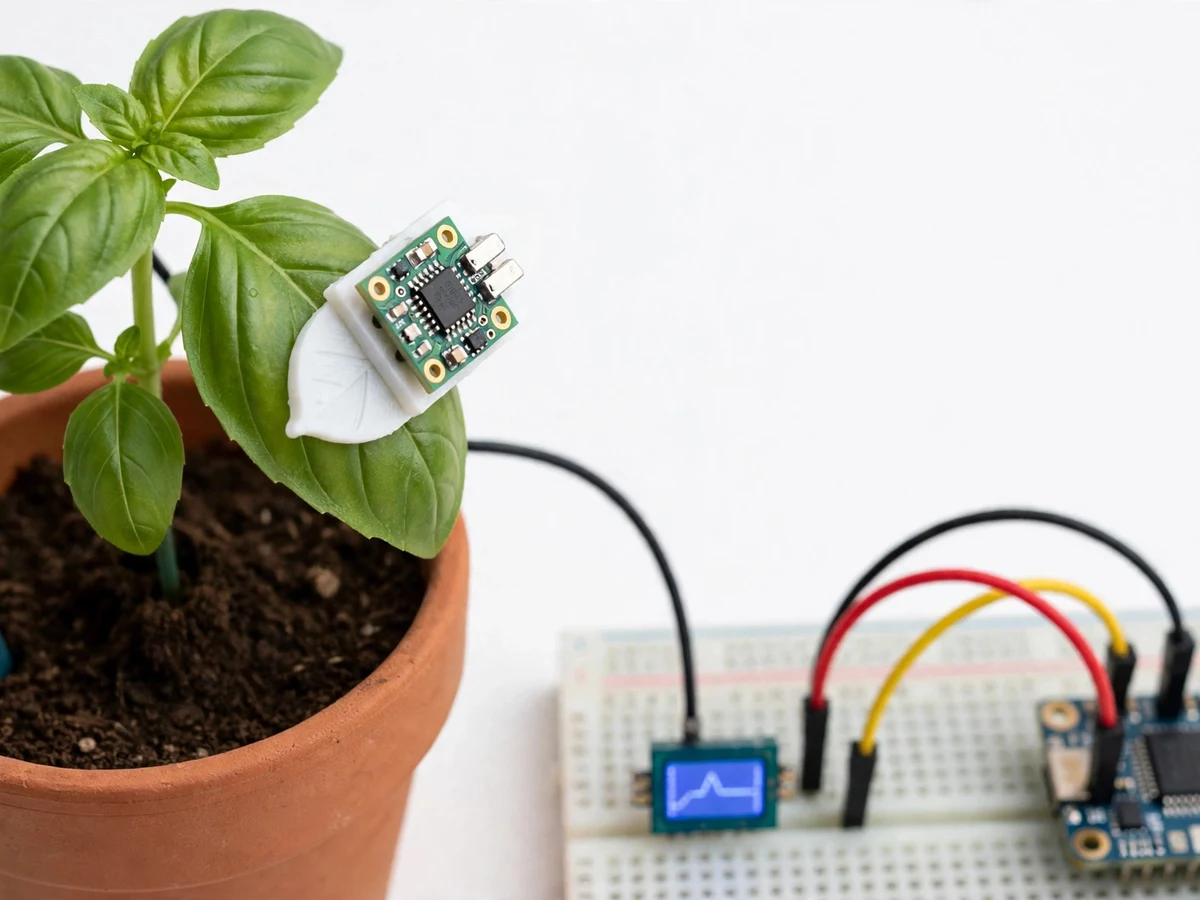
Reads the leaf's reflected light in 11 bands from 415 to 910 nm under a white LED, shaded by the clip's hood.
Follow the working sequence
How it works
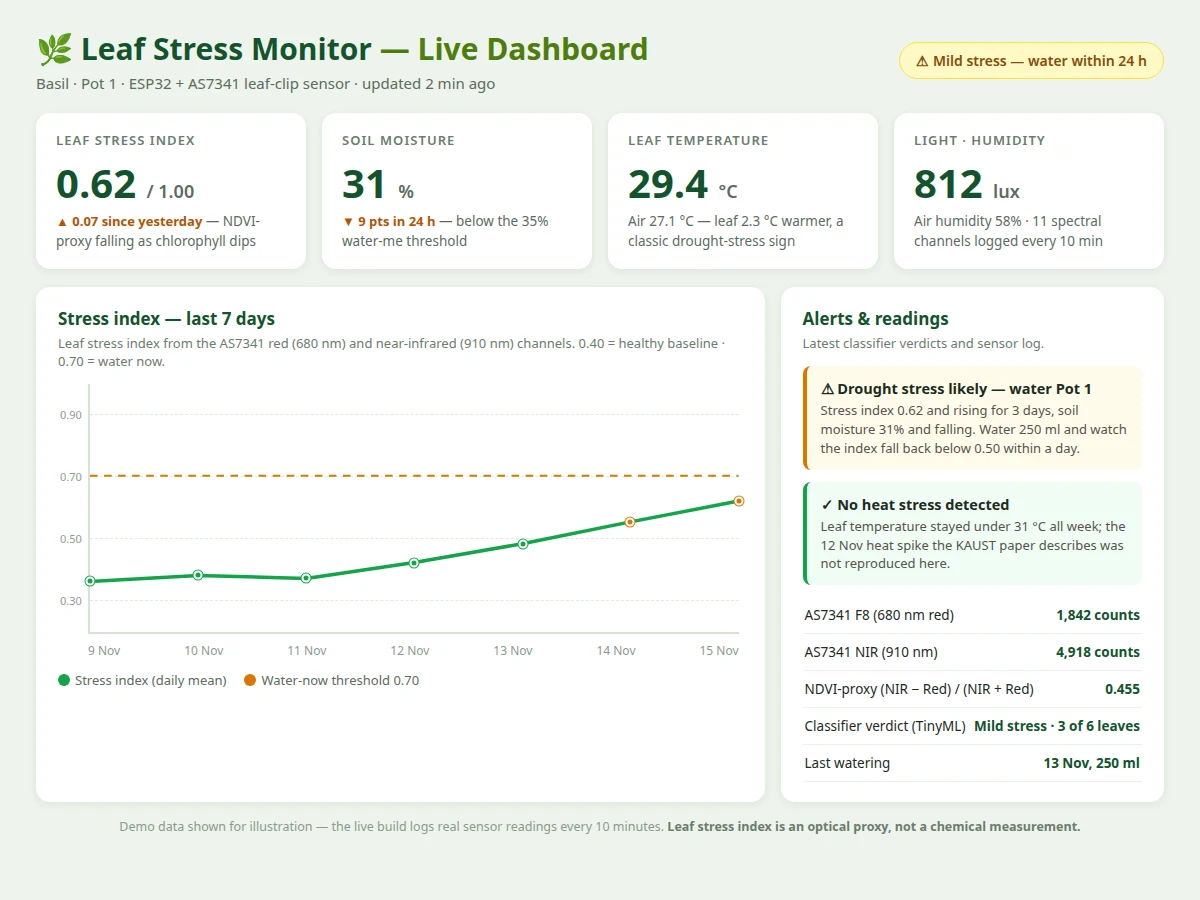
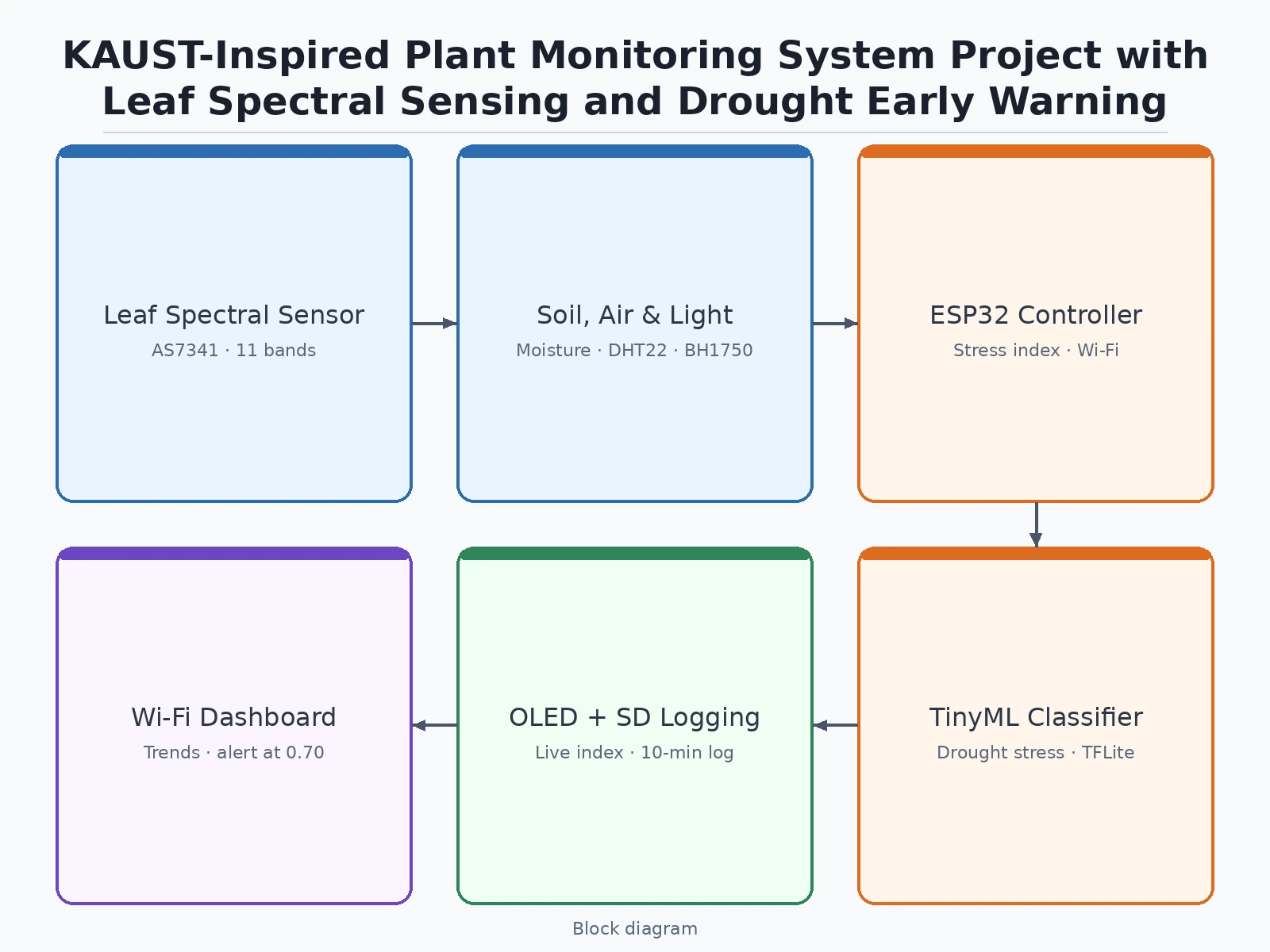
The clip goes on a healthy leaf first, so the system learns what the plant looks like unstressed. The AS7341 reads the leaf's reflected light in 11 bands under its white LED while the MLX90614 reads the leaf's temperature without touching it, and the capacitive probe, DHT22 and BH1750 log the soil and the air around the plant. Every 10 minutes the ESP32 computes the NDVI-proxy from the red and near-infrared channels, combines it with soil moisture and the leaf-air temperature difference into the 0–1 stress index, and feeds the same readings to the TinyML classifier, which votes healthy, mild stress or severe stress. The dashboard draws the 7-day trend with the 0.40 and 0.70 lines, the OLED shows the current index, and an alert fires when the index crosses 0.70. The student then runs the two-plant validation test and records whether the index warned before the leaf wilted.
- The builder assembles the prototype: the ESP32 on a breadboard, the AS7341 breakout in the 3D-printed leaf clip, the MLX90614 aimed at the leaf, the capacitive soil probe in the pot, the DHT22 and BH1750 on the board, the OLED display, and the Li-ion cell with USB charging.
- The builder clips the sensor to a healthy leaf: the clip's foam pads hold the leaf gently without crushing it, the hood shades the sensor from direct sunlight, and the white LED gives the AS7341 a stable light source for every reading.
- The builder calibrates the soil probe: readings are recorded in bone-dry soil and fully-watered soil from the student's own pot, and the percentage scale is set from those two points, since a moisture number means nothing without the soil it was measured in.
- The builder records the healthy baseline: the system logs the leaf for 3 days while the plant is watered normally, and the NDVI-proxy and stress index from those days become the 0.40 healthy baseline for this plant.
- The builder trains the classifier: labelled readings are collected from well-watered leaves and from leaves of a plant left dry, the decision-tree model is trained on that labelled set, and its confusion matrix is recorded from a held-out test set the training never saw.
- The system runs: every 10 minutes the ESP32 reads all sensors, computes the NDVI-proxy and the stress index, runs the classifier, updates the dashboard and the OLED, and logs the row to the microSD card.
- The builder runs the validation test: two basil plants, one watered normally and one left dry for 5 days, with the index logged daily, and the report records the day the index crossed 0.70 against the day the first leaf visibly wilted — the honest answer to whether the system warns early.
Tech stack:
- ESP32 · dual-core controller + Wi-Fi dashboard
- AS7341 spectral sensor · 11 channels 415–910 nm
- MLX90614 IR temperature sensor · leaf temperature
- Capacitive soil moisture probe · DHT22 air sensor
- BH1750 light sensor · 1–65535 lux
- TensorFlow Lite Micro · on-device TinyML classifier
- Arduino IDE · ESP32 firmware
- HTML · CSS · JavaScript web dashboard
How the KAUST sensor works — and what this build does instead
- The KAUST device measures chemistry: A team at KAUST (first author Mufeeda Mundummal, senior author Khaled Salama) published the sensor on 12 November 2026 in Cell Reports Physical Science (DOI 10.1016/j.xcrp.2026.103630). The coin-sized device sits on a leaf, and 0.4 mm microneedles draw tiny amounts of fluid from inside the leaf to a laser-scribed graphene sensor that measures hydrogen peroxide — the molecule plants produce in a surge when heat or bright light stresses them.
- What the KAUST team observed: On Aloe vera in a greenhouse, bright light made hydrogen peroxide spike almost immediately at 19 °C, and the spike was worse at 28 °C; in both cases the levels fell back after about an hour. The team says the device is not farm-ready and still needs testing on more plant species.
- What this build does instead: No microneedles, no graphene, no chemistry. The student build measures reflected light: healthy leaves absorb red light for photosynthesis and reflect near-infrared, so as drought stress drops chlorophyll, red reflectance rises and near-infrared reflectance falls — the NDVI-proxy captures that shift. Soil moisture and the leaf-air temperature difference are added because light alone cannot tell drought from a hot day.
- Why the proxy is honest: A proxy is not a measurement of the thing itself, and the page, the dashboard and the report all say so. The index is useful because it is comparable day to day on the same leaf under the same light, and because the two-plant validation test checks it against a real outcome — visible wilting — instead of against another proxy.
- Shade the clip from direct sun: The AS7341 reads reflected light, so a sunbeam falling on the clip changes the reading more than the leaf does; the 3D-printed clip has a hood for exactly this reason, and readings are only compared within the same lighting window. Leaf reflectance also shifts with sun angle, so the daily reading is taken at the same time of day.
| Parameter | Value |
|---|---|
| Build type | Hybrid leaf-clip sensor plus web dashboard (design target) |
| Controller | ESP32 · dual-core Xtensa LX6 up to 240 MHz · 520 KB SRAM · Wi-Fi 802.11 b/g/n · Bluetooth 5 LE (Datasheet value) |
| Spectral sensor | AS7341 · 11 channels: 8 visible F1–F8 at 415 / 445 / 480 / 515 / 555 / 590 / 630 / 680 nm · NIR 910 nm · Clear · flicker detection · 16-bit ADC · I2C address 0x39 (Datasheet value, ams DS000504) |
| Leaf temperature | MLX90614 non-contact IR sensor · ±0.5 °C accuracy over 0–50 °C object temperature · I2C interface (Datasheet value) |
| Soil moisture | Capacitive probe v1.2 · 3.3–5.5 V supply · analogue output · calibrated on the student's own soil (Typical value — confirm against the supplied probe during the build) |
| Air temperature and humidity | DHT22 · temperature ±0.5 °C · humidity ±2% RH · range −40 to 80 °C · 0–100% RH (Datasheet value) |
| Light | BH1750 · 1–65535 lux · I2C interface (Datasheet value) |
| Display | 0.96-inch OLED · 128 × 64 pixels (design target) |
| NDVI-proxy | (NIR 910 nm − Red 680 nm) / (NIR 910 nm + Red 680 nm) · standard definition · demo values F8 1,842 counts and NIR 4,918 counts give 0.455 (labelled demo values) |
| Leaf stress index | Composite 0–1 score from NDVI-proxy trend, soil moisture and leaf-air temperature difference · 0.40 healthy baseline · 0.70 water-now threshold (design targets, set from the student's own calibration) |
| Classifier | Small decision-tree model · TensorFlow Lite Micro on the ESP32 · trained by the student on their own labelled leaves · confusion matrix recorded from the student's own held-out test set · no accuracy claimed before those runs |
| Logging interval | Every 10 minutes to microSD card and dashboard (design target) |
| Clip | 3D-printed PLA leaf clip with foam pads and a sun hood · fits leaves approximately 4–10 cm wide · gentle spring pressure, no crushing (design target) |
| Power | 5 V USB charging · 3.7 V 18650 Li-ion cell 2600 mAh (design target) · optional 5 W solar top-up as an extension |
| Validation test | Two basil plants · one watered normally, one left dry for 5 days · index logged daily · crossing of 0.70 recorded against first visible wilting (buyer-run procedure, no result claimed in advance) |
| Trend reference | KAUST microneedle plant-stress sensor reported figures only: coin-sized device · laser-scribed graphene hydrogen-peroxide sensor · 0.4 mm microneedles · tested on Aloe vera in a greenhouse · bright light spiked hydrogen peroxide almost immediately at 19 °C, worse at 28 °C, falling back after about an hour · not farm-ready, needs testing on more species · published 12 November 2026 in Cell Reports Physical Science · DOI 10.1016/j.xcrp.2026.103630 · shares no parts or method with this build |
| Builder note | Shade the clip from direct sunlight — the AS7341 reads reflected light, so a sunbeam on the clip changes the reading more than the leaf does, and the clip's hood exists for exactly this reason. Take the daily reading at the same time of day, because leaf reflectance shifts with sun angle and readings are only comparable within the same lighting window. |
Project features
Five ideas carry this build. First, leaf-level sensing instead of soil-only sensing: the AS7341 reads the leaf itself in 11 spectral bands, so the system sees the plant, not the pot. Second, an honest proxy, labelled as one: the leaf stress index combines the NDVI-proxy with soil moisture and leaf-air temperature difference, and every page calls it an optical proxy, never a chemical measurement. Third, a classifier the student trains: a small decision-tree model learns healthy versus drought-stressed leaves from the student's own labelled plants, and the report records its confusion matrix, with no accuracy claimed in advance. Fourth, a dashboard that explains itself: the 7-day trend, the 0.40 healthy baseline and the 0.70 water-now threshold share one chart, so a reviewer sees why it fired. Fifth, a validation test built into the project: two basil plants, one watered and one left dry for 5 days, so the student measures whether the index warns before the leaf wilts.
- [Leaf-clip spectral sensing (AS7341)] A 3D-printed clip holds the AS7341 spectral sensor against one leaf, reading 11 channels from 415 nm violet to 910 nm near-infrared under a small white LED, so the build measures the leaf's own reflectance instead of guessing from the soil — implemented in the base build.
- [NDVI-proxy leaf stress index] The ESP32 computes an NDVI-proxy from the red (680 nm) and near-infrared (910 nm) channels as (NIR − Red) / (NIR + Red), then combines it with soil moisture and the leaf-air temperature difference into a 0–1 stress index with a 0.40 healthy baseline and a 0.70 water-now threshold (design targets) — implemented in the base build.
- [TinyML drought classifier on the ESP32] A small decision-tree classifier runs on the ESP32 with TensorFlow Lite Micro, trained by the student on their own labelled leaves — well-watered versus drought-stressed — and the report records its confusion matrix from the student's own test set, with no accuracy claimed before those runs — implemented in the base build.
- [Soil, air and light context] A capacitive soil moisture probe, a DHT22 air temperature and humidity sensor and a BH1750 light sensor log the conditions around the plant every 10 minutes, so a stress reading can be checked against dry soil, hot air or bright light instead of standing alone — implemented in the base build.
- [Non-contact leaf temperature (MLX90614)] An infrared temperature sensor aimed at the clipped leaf measures leaf temperature without touching it, so the leaf-air temperature difference — a classic drought-stress sign as the plant closes its stomata — is a real input, not an assumption — implemented in the base build.
- [Wi-Fi dashboard with alerts] The ESP32 serves a dashboard over Wi-Fi with the 7-day stress-index trend, the threshold lines, soil moisture, leaf temperature and light, and an alert when the index crosses 0.70, so any phone or laptop on the same network can check the plant without installing an app — implemented in the base build.
- [OLED readout and SD logging] A 0.96-inch OLED on the breadboard shows the current stress index and soil moisture at a glance, and readings are logged to a microSD card every 10 minutes, so the build keeps working and keeps its data even without Wi-Fi — implemented in the base build.
- [Two-plant validation test] The project includes a built-in experiment: two basil plants, one watered normally and one left dry for 5 days, with the index logged daily, so the student records when the index crosses 0.70 against the first visible wilting — a real result from the student's own run, not a claimed lead time — implemented in the base build.
What is included
- Complete leaf-clip sensor prototype (3D-printed clip with foam pads and sun hood, AS7341 breakout, MLX90614, capacitive soil probe, DHT22, BH1750, OLED display, ESP32, Li-ion cell with USB charging, microSD card)
- Firmware (11-channel spectral reads, NDVI-proxy and stress-index computation, soil and climate reads, dashboard, alerts, SD logging)
- TinyML classifier (decision-tree model trained on the student's own labelled leaves, with the training and test-set procedure documented)
- Setup and calibration guide (soil dry/wet calibration, healthy-baseline recording, classifier training, the two-plant validation test)
- Project report PDF (KAUST background with reported figures labelled as reported, spectral sensing design, NDVI-proxy method, classifier method, validation results, honest limits)
- PPT presentation for final review
- Viva Q&A preparation document (how spectral leaf sensing works, NDVI, why the index is a proxy, what the KAUST sensor measures, classifier training, validation test, limitations)
Work plan & timeline
Total work plan: 100 hours, split across six phases. Phase 1, background study and parts: 12 hours — reading the KAUST paper and the AS7341 datasheet, sourcing the sensor boards, and printing the leaf clip. Phase 2, hardware build: 20 hours — assembling the clip, wiring the AS7341, MLX90614, soil probe, DHT22, BH1750 and OLED to the ESP32, and the USB charging circuit. Phase 3, firmware: 22 hours — spectral reads, NDVI-proxy and stress-index computation, soil and climate reads, dashboard, alerts and SD logging. Phase 4, classifier: 18 hours — collecting labelled readings from well-watered and drought-stressed leaves, training the decision-tree model, and recording the confusion matrix on a held-out test set. Phase 5, validation test: 16 hours — the two-plant 5-day trial with daily index logging, the crossing-of-0.70 record against first visible wilting, and the results write-up. Phase 6, presentation and viva preparation: 12 hours — PPT, demo walkthrough, and the viva Q&A document.
Support
Support covers setup help for the delivered prototype and firmware, a walkthrough of the sensor, the dashboard and the classifier, and fixes for defects in the delivered code. Guidance is also provided for adapting the report and presentation to the student's college format and for answering guide questions about spectral sensing, NDVI, the KAUST sensor, the stress index, TinyML on the ESP32, and the validation test. Support does not cover re-running the validation test on the student's personal plants beyond the setup walkthrough, and it does not invent results for experiments that were not run.
Limitations & prerequisites
- Not the KAUST sensor: this build shares no parts, method or performance with KAUST's device — it measures reflected light, not hydrogen peroxide from leaf fluid, and must never be presented as the KAUST sensor or as a chemical measurement.
- The stress index is a proxy: it combines light, moisture and temperature into one number, and a proxy can be fooled — a hot day, a dusty leaf or a changed light angle all move it, which is why the dashboard shows the raw channels beside the index.
- No accuracy is claimed for the classifier before the student's own runs: the decision-tree model is trained on the student's own labelled leaves, and its confusion matrix comes only from the student's own held-out test set.
- The validation test measures one thing: whether the index crosses 0.70 before the leaf visibly wilts on the student's own plants — it does not prove the system works on other species, other soils or other climates.
- The clip fits leaves approximately 4–10 cm wide: thick succulent leaves such as Aloe vera do not fit the clip, and very small or hairy leaves give noisy reflectance readings.
- Readings are only comparable in the same light: direct sun on the clip and a different time of day both shift the reflectance, so the daily reading must be taken at the same time under the same light, with the hood in place.
- Local network only: the dashboard works over local Wi-Fi; there is no cloud link, so remote viewing needs a network setup that is an optional extension, not part of the base build.
- Not an agronomic diagnostic: the system is an academic prototype for student study, not a farm advisory tool, and must not be used to make irrigation or crop decisions beyond the student's own pots.
Frequently Asked Questions
Is this project suitable for a final-year project?
Yes, for IoT, Electronics and Embedded Systems programmes, because it combines spectral sensing, a real index built from the student's own calibration, on-device TinyML and a validation experiment the student runs and reports. The report documents the KAUST background with reported figures labelled as reported, the proxy design, the classifier training and the two-plant trial, so the work reads as engineering rather than a copy of a news story.
Is this the KAUST sensor?
No — this is a student plant monitor inspired by the KAUST microneedle sensor published on 12 November 2026, not the KAUST device. The KAUST sensor draws fluid from inside the leaf through 0.4 mm microneedles and measures hydrogen peroxide with a laser-scribed graphene sensor, while this build clips an AS7341 spectral sensor to the outside of a leaf and measures reflected light. This build shares no parts, method or performance with KAUST's device, and its stress index is an optical proxy, never a chemical measurement.
How does the leaf stress index work, and what does it actually measure?
The index is built from three inputs: the NDVI-proxy, computed from the AS7341 red (680 nm) and near-infrared (910 nm) channels as (NIR − Red) / (NIR + Red); the soil moisture percentage; and the leaf-air temperature difference from the MLX90614 and DHT22. Healthy leaves absorb red light and reflect near-infrared, so drought stress shows up as a falling NDVI-proxy, drying soil and a leaf running hotter than the air. The index is a composite proxy score from 0 to 1, not a measurement of any single chemical.
How accurate is the drought warning?
No accuracy is claimed before the student's own runs, and the report prints the full confusion matrix from a held-out test set the training never saw. The decision-tree classifier is trained on the student's own labelled leaves — well-watered versus drought-stressed — and the two-plant validation test then checks whether the index crosses the 0.70 water-now threshold before the first leaf visibly wilts. The report records that lead time honestly, on the student's own plants, and the classifier must be retrained with new labelled readings for a different species.
What will I receive with the project?
You receive the sensor prototype with the AS7341 board, MLX90614, soil probe, DHT22, BH1750, OLED display, ESP32, Li-ion cell and microSD card, the firmware with spectral reads, stress-index computation, dashboard, alerts and logging, the TinyML classifier, the setup and calibration guide, the report, presentation and Q&A document. A basil or similar potted plant with leaves 4–10 cm wide is needed for the validation test, covered in the setup guide.
Can I use it on any plant?
The clip fits leaves approximately 4–10 cm wide, so basil, tulsi, money plant and similar potted plants work well. Thick succulent leaves such as Aloe vera — the plant KAUST tested on — do not fit the clip, and very small or hairy leaves give noisy reflectance readings. The classifier is trained on the student's own plant, so moving to a different species means collecting new labelled readings and retraining, which the guide covers.
Components & software requirements
- ESP32 · dual-core controller + Wi-Fi dashboard
- AS7341 spectral sensor · 11 channels 415–910 nm
- MLX90614 IR temperature sensor · leaf temperature
- Capacitive soil moisture probe · DHT22 air sensor
- BH1750 light sensor · 1–65535 lux
- TensorFlow Lite Micro · on-device TinyML classifier
- Arduino IDE · ESP32 firmware
- HTML · CSS · JavaScript web dashboard
How the KAUST sensor works — and what this build does instead
- The KAUST device measures chemistry: A team at KAUST (first author Mufeeda Mundummal, senior author Khaled Salama) published the sensor on 12 November 2026 in Cell Reports Physical Science (DOI 10.1016/j.xcrp.2026.103630). The coin-sized device sits on a leaf, and 0.4 mm microneedles draw tiny amounts of fluid from inside the leaf to a laser-scribed graphene sensor that measures hydrogen peroxide — the molecule plants produce in a surge when heat or bright light stresses them.
- What the KAUST team observed: On Aloe vera in a greenhouse, bright light made hydrogen peroxide spike almost immediately at 19 °C, and the spike was worse at 28 °C; in both cases the levels fell back after about an hour. The team says the device is not farm-ready and still needs testing on more plant species.
- What this build does instead: No microneedles, no graphene, no chemistry. The student build measures reflected light: healthy leaves absorb red light for photosynthesis and reflect near-infrared, so as drought stress drops chlorophyll, red reflectance rises and near-infrared reflectance falls — the NDVI-proxy captures that shift. Soil moisture and the leaf-air temperature difference are added because light alone cannot tell drought from a hot day.
- Why the proxy is honest: A proxy is not a measurement of the thing itself, and the page, the dashboard and the report all say so. The index is useful because it is comparable day to day on the same leaf under the same light, and because the two-plant validation test checks it against a real outcome — visible wilting — instead of against another proxy.
- Shade the clip from direct sun: The AS7341 reads reflected light, so a sunbeam falling on the clip changes the reading more than the leaf does; the 3D-printed clip has a hood for exactly this reason, and readings are only compared within the same lighting window. Leaf reflectance also shifts with sun angle, so the daily reading is taken at the same time of day.
Delivery information
Built-to-order project. Delivery timeline is shared after order confirmation based on current queue.
Support terms
Complete documentation, setup guide, and viva preparation included. Support for setup and explanation provided.
Download free synopsis (PDF)
Enter your name and WhatsApp number — the synopsis PDF downloads immediately. We may send occasional project updates on WhatsApp; no spam.