
More project photos (2)
The problem
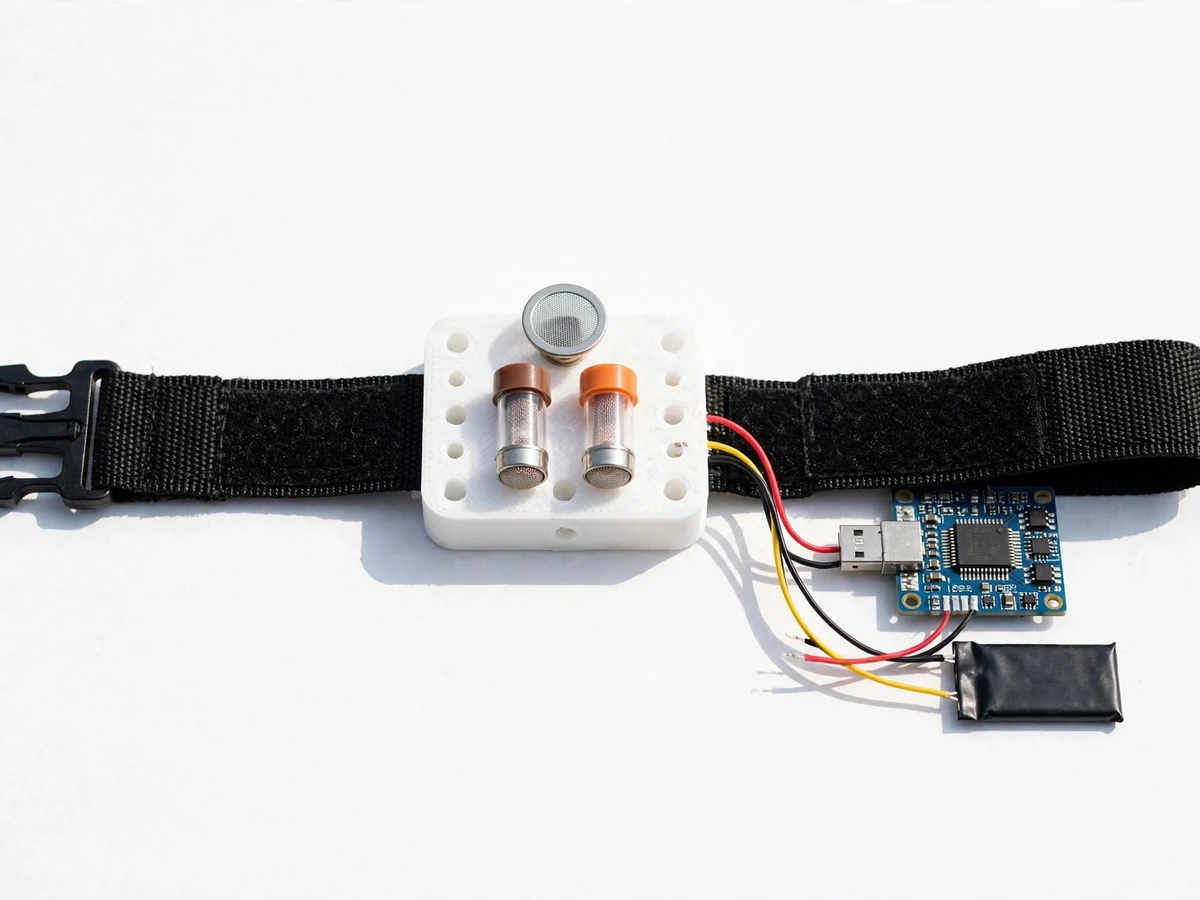
Phones carry pictures, sound and video, but nothing for the nose: a friend can send a photo of their coffee and the smell stays in the kitchen. Ohio State's Scentronic, reported on 16 November 2026, closes that gap: an electronic nose names a food from its fumes and a wearable puffs the matching scent to a friend — only the word "coffee" travels, the smell is released from a liquid the receiver already holds. This project builds the student-scale version of that idea: six MQ gas sensors sniff a sample, an ESP32 classifies the six-channel fingerprint with a small k-NN model trained on five scents, and only the scent label crosses the Wi-Fi to a wristband that mists the matching scent from a 110 kHz disc. The build teaches gas-sensor arrays, pattern recognition, MQTT messaging and wearables, and states plainly that it reproduces a scent category from a pre-loaded liquid, never the original sample's chemistry.
| This student build | Scentronic, Ohio State (reported figures) | Alcohol Breath Analyzer using MQ-3 Gas Sensor with LCD Readout (Arduino) | |
|---|---|---|---|
| What it senses | A scent fingerprint from 6 different gas sensors read together | A scent fingerprint from 6 heated tin-dioxide gas sensors in a ring | Alcohol vapour from one MQ-3 sensor only |
| What it recognises | 5 scents the student trains: coffee, orange, lemon, mint, vanilla | 5 foods: beer, cake, coffee, orange, red wine | Nothing — it reports an indicative alcohol level band, not a substance |
| Classifier | Small k-NN model (k = 3, design target) on the ESP32, trained on the student's own recordings | Pattern-matching program trained on 250 recordings (50 per food, 200 seconds each) | No classifier — one sensor, one threshold, one indicative band |
| What travels over the network | Only the scent label (one word) over MQTT | Only the scent label, via a cloud server in about 65 ms (reported) | Nothing — local LCD readout only, no network |
| Receiver | Wristband with 2 scent cartridges (coffee, orange) and a 110 kHz class ultrasonic mist disc | Wristband holding 2 smells, necklace holding 5, piezoelectric disk vibrating about 110,000 times per second (reported) | None — a 16x2 LCD and a buzzer |
| Intensity control | 10 levels on the dashboard (design target) | 10 strength levels tested on volunteers (reported) | None — a fixed student-set buzzer threshold |
| Dashboard | Scent Console: live 6-channel fingerprint bars, label, confidence, transmission log | Research device — no dashboard reported | None — serial monitor stream only |
| Validation | Blind smell test: classmates name the scent from the wristband, hit rate recorded honestly | 14 volunteers named single scents about 73% of the time (reported) | Blow-sample routine with indicative bands, no identification test |
| Availability | Built-to-order · quotation | Research prototype — laboratory only, years from commercial use (reported) | Built-to-order · quotation |
| Honesty line | Reproduces a scent category from a pre-loaded food-grade liquid; it never claims to send the chemistry of the original sample | Reproduces a category, coffee rather than this particular coffee, from a liquid chosen in advance (reported) | Readings are relative and indicative only; never an evidential-grade breathalyzer |
How it works
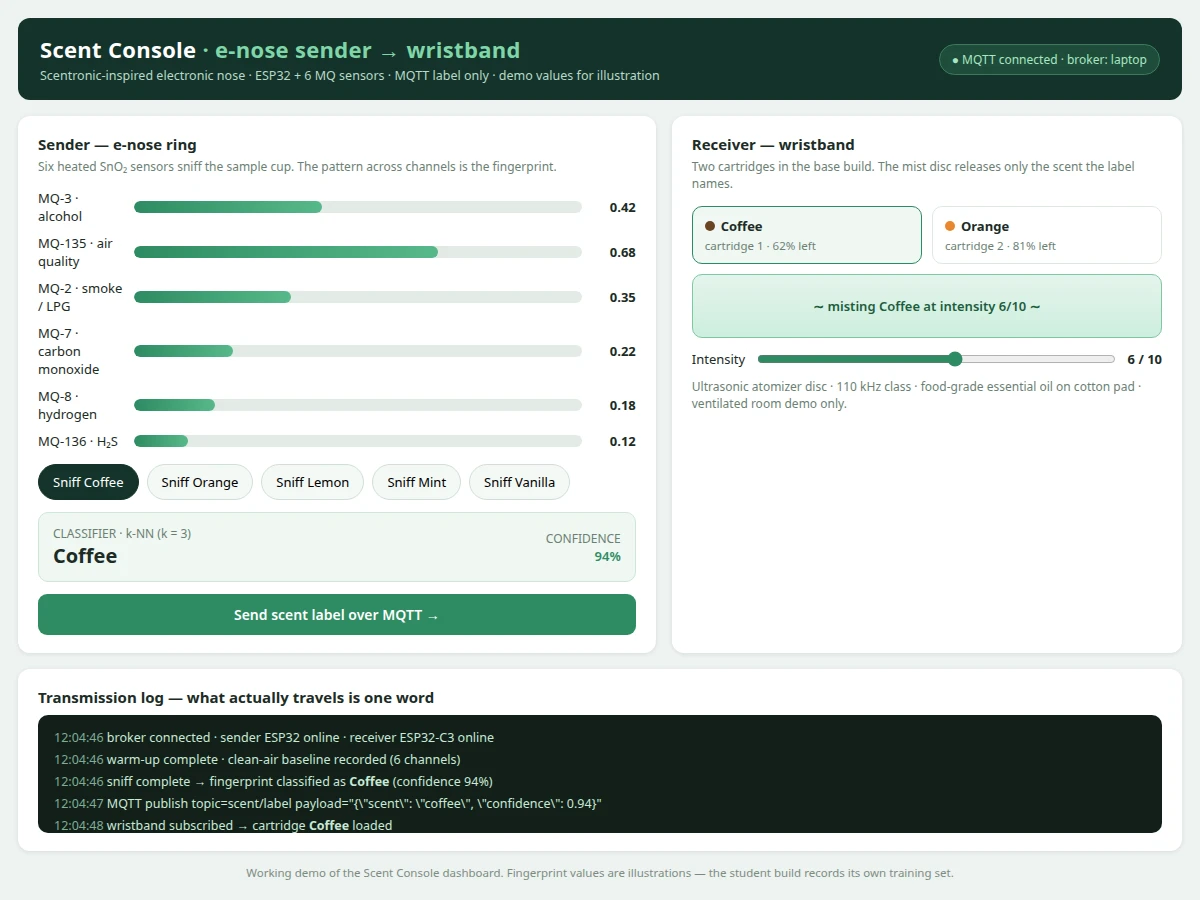
The sample goes in the cup first, and the six heated tin-dioxide sensors around it change resistance as vapour molecules reach their surfaces. A 16-channel multiplexer reads all six sensors into the ESP32, which normalises the six voltages into one fingerprint — six numbers that differ for coffee, orange, lemon, mint and vanilla. The on-device k-NN classifier compares that fingerprint with the student's labelled recordings, picks the nearest scent and its confidence, and the sender publishes only that word over MQTT to the laptop broker. The wristband subscribes to the same topic, checks which cartridge holds the matching scent, and switches on the ultrasonic mist disc at the chosen intensity, turning the scented liquid on its cotton pad into a fine mist. The Scent Console dashboard draws the live fingerprint bars, the label, the confidence and the transmission log, and the student finishes by running the blind smell test and recording how often classmates name the scent correctly.
- The builder assembles the sender: the ESP32 on a breadboard, the six MQ sensor modules in the 3D-printed ring around the sample cup, the CD74HC4067 multiplexer, the OLED display, and a 5 V 2 A supply, since six heated sensors draw about 900 mA together and a laptop USB port cannot feed them stably.
- The builder assembles the receiver: the ESP32-C3 board, the two scent cartridges with cotton pads and food-grade essential oil, the ultrasonic mist disc, the intensity driver and the Li-ion pouch cell, all mounted on the wrist strap.
- The builder warms up and calibrates: the sensors run through the warm-up countdown, then a clean-air baseline is recorded in the empty cup, because every reading is relative to the air in the room that day.
- The builder records the training set: each of the five scents is placed in the cup for 20 recordings of 30 seconds (design target), the six-channel fingerprint of each recording is saved, and the set is split into training recordings and a held-out test set.
- The builder trains the classifier: the k-NN model is fitted on the training recordings, its confusion matrix is computed on the held-out test set, and the report prints that matrix with no accuracy claimed before those runs.
- The system runs: the sender sniffs a sample, classifies it, publishes the label over MQTT, the wristband releases the matching scent at the chosen intensity, and the Scent Console draws the fingerprint, the label, the confidence and the transmission log.
- The builder runs the blind smell test: a classmate wears the wristband in another room while the sender sniffs samples, and the report records how often the classmate names the scent correctly — the honest answer to whether the system sends a smell a person can actually recognise.
Tech stack:
- ESP32 · Wi-Fi MQTT + e-nose classifier
- MQ gas sensor array · 6 channels SnO2
- CD74HC4067 multiplexer · 16-channel analogue
- k-NN classifier · on-device scent recognition
- Ultrasonic atomizer disc · 110 kHz class scent mist
- ESP32-C3 wristband receiver · 2 scent cartridges
- Arduino IDE · ESP32 firmware
- HTML · CSS · JavaScript scent console
How Scentronic works — and what this build does instead
- The Scentronic device sniffs with six sensors: A team at Ohio State University (first author Chunyu Yang, Jinghua Li's group, with Zhejiang Laboratory) published the system in Science Advances, reported on 16 November 2026. The sniffing end is a ring of six gas sensors around a spot where the food sits; each sensor is a heated chip of tin dioxide, and vapours change how easily electricity flows through it. No single sensor can tell coffee from cake — the six together produce a pattern, and the team trained a pattern-matching program on it.
- What the Scentronic team recorded: They recorded each of five foods — beer, cake, coffee, orange and red wine — 50 times, for 200 seconds at a stretch, making 250 recordings. On recordings the program had not seen before, the best version named all five foods correctly. Coffee gave the faintest signal, and the authors wrote that many of the compounds behind its aroma may not be the kind these sensors detect well.
- Only a label travels: Once the program decides on coffee, that word is all that travels — to a program on a cloud server and on to the wearable, a trip that took about 65 thousandths of a second in the team's tests. Recognising the food takes longer, from several seconds to a few tens of seconds.
- The wearable puffs a pre-loaded scent: The wearable is built around a thin disk that vibrates about 110,000 times a second. A cotton pad feeds it scented liquid from a small chamber, and the vibration pushes that liquid through tiny holes as a fine mist. A wristband version holds two smells; a necklace holds five. Run flat out, a cartridge empties in under five minutes, and at the lowest setting it lasts more than 35 minutes. After an hour of continuous use, the warmest spot measured 96.4 °F (35.8 °C), below body temperature.
- Volunteers named most scents: Sixteen volunteers held their noses 20 cm from a device while orange rose through ten strength levels. Fourteen volunteers then identified single scents from the device about 73 percent of the time, named both parts of a two-scent mixture about 71 percent of the time, and ranked five strengths of an alcohol scent about 59 percent of the time. The authors focus on medicine: an adjustable device could let a clinician raise an odour step by step over the internet until a patient notices it, finding the smell threshold without an office visit.
- What this build does instead: No beer, no wine, no alcohol-based scents — the student build uses food-grade essential oils and real kitchen samples (coffee beans, orange peel, lemon peel, mint leaves, vanilla) because alcohol near a heated sensor and a wearable is a safety risk a student build must not take. The classifier is a small k-NN model instead of the paper's pattern matcher, the label travels over local MQTT instead of a cloud server, and the wristband holds two cartridges instead of five. The paper's device is a laboratory prototype, years from commercial use, and this build shares no parts, method or performance with it.
| Parameter | Value |
|---|---|
| Build type | Hybrid e-nose sender plus wristband receiver and web console (design target) |
| Sender controller | ESP32 · dual-core Xtensa LX6 up to 240 MHz · 520 KB SRAM · Wi-Fi 802.11 b/g/n · Bluetooth 5 LE (Datasheet value) |
| Sensor array | 6 MQ modules in a ring: MQ-3 alcohol · MQ-135 air quality · MQ-2 smoke and LPG · MQ-7 carbon monoxide · MQ-8 hydrogen · MQ-136 hydrogen sulphide · heated SnO2 elements · analogue output (module composition, design target) |
| MQ-3 alcohol sensor | Detection 0.05–10 mg/L alcohol · heater 5 V ±0.1 V · heater resistance 33 Ω ±5% · heater consumption less than 750 mW · sensing resistance 1–8 MΩ · preheat over 24 hours for full stability (Datasheet value, Hanwei MQ-3) |
| Multiplexer | CD74HC4067 · 16-channel analogue multiplexer/demultiplexer · 2–6 V supply (Datasheet value) |
| ADC | ESP32 12-bit SAR ADC · 0–4095 steps · 6 channels read through the multiplexer (Datasheet value) |
| Classifier | k-nearest-neighbours · k = 3 · 6 normalised channel values · trained on the student's own recordings · confusion matrix from a held-out test set · no accuracy claimed before those runs (design target) |
| Training set | 5 scents × 20 recordings × 30 seconds per recording (design target) · scents: coffee, orange, lemon, mint, vanilla |
| Recognition time | Several seconds to a few tens of seconds per sample (design target, matching the paper's reported recognition time) |
| Label travel | MQTT publish to a laptop broker · local Wi-Fi only · label plus confidence plus timestamp (design target) |
| Receiver controller | ESP32-C3 · single-core RISC-V up to 160 MHz · Wi-Fi 802.11 b/g/n · Bluetooth 5 LE (Datasheet value) |
| Mist disc | 5 V ultrasonic atomizer disc · 110 kHz class (design target, matching the paper's reported about 110,000 vibrations per second) · cotton pad feed from a scent cartridge |
| Scent cartridges | 2 in the base build (coffee, orange) · food-grade essential oil on a cotton pad · 5-cartridge necklace as an extension (design target) |
| Intensity levels | 10 levels on the dashboard slider (design target, matching the paper's reported 10 strength levels) |
| Display | 0.96-inch OLED · 128 × 64 pixels (design target) |
| Sender power | 5 V 2 A supply · 6 heaters draw about 900 mA together at about 150 mA each (derived from the MQ-3 datasheet heater resistance of 33 Ω at 5 V) · a laptop USB port is not a sufficient supply |
| Receiver power | 3.7 V Li-ion pouch cell 1000 mAh · 5 V USB charging (design target) |
| Validation test | Blind smell test · classmate wears the wristband in another room · hit rate recorded honestly (buyer-run procedure, no result claimed in advance) |
| Trend reference | Scentronic reported figures only: Ohio State University, Jinghua Li's group, first author Chunyu Yang, with Zhejiang Laboratory · published in Science Advances, reported 16 November 2026 · 6 heated tin-dioxide sensors · 5 foods (beer, cake, coffee, orange, red wine) · 250 recordings of 200 seconds · best version named all five correctly on unseen recordings · label travel about 65 ms via a cloud server · disk vibrates about 110,000 times per second · wristband 2 smells, necklace 5 · cartridge under 5 minutes flat out, over 35 minutes at the lowest setting · warmest spot 96.4 °F (35.8 °C) after 1 hour · 14 volunteers named single scents about 73% of the time · laboratory prototype, years from commercial use · shares no parts or method with this build |
| Builder note | Six heated MQ sensors draw about 900 mA together, so a 5 V 2 A supply is mandatory — the single most common cause of a drifting fingerprint is an under-powered heater rail, and a laptop USB port sags under that load. Warm the sensors for at least 10 minutes before any recording, and re-record the clean-air baseline at the start of every session, because the baseline drifts with the room's temperature and humidity. |
Project features
Six ideas carry this build. First, a real electronic nose instead of a single gas alarm: six different MQ sensors read the same sample together, so the pattern across channels — not one threshold — identifies the scent. Second, a classifier the student trains: a small k-NN model learns five scents from the student's own recordings, and the report prints its confusion matrix from a held-out test set. Third, only a label travels: the sender publishes one word over MQTT, as in Scentronic's cloud hop, so the network carries a label, never a smell. Fourth, a wearable that answers: the wristband releases the matching scent through an ultrasonic mist disc at ten intensity levels, as in the paper. Fifth, a console that explains itself: the dashboard shows the live fingerprint, the label and the transmission log on one screen. Sixth, a validation test the student runs: a blind smell test with classmates, scored like the paper's volunteer trials.
- [Six-sensor e-nose ring] Six MQ gas sensors (MQ-3, MQ-135, MQ-2, MQ-7, MQ-8, MQ-136) sit in a 3D-printed ring around a sample cup, so the build reads a six-channel vapour fingerprint instead of a single gas threshold — implemented in the base build.
- [k-NN scent classifier on the ESP32] A small k-nearest-neighbours classifier (k = 3, design target) compares the live fingerprint with the student's labelled recordings and returns the nearest scent with a confidence score, running entirely on the sender ESP32 — implemented in the base build.
- [Only a label travels (MQTT)] The sender publishes one word — the scent label — over MQTT to a broker on the student's laptop, and the wristband subscribes to the same topic, so the network carries a label, never a smell, exactly like Scentronic's reported cloud hop — implemented in the base build.
- [Wristband scent receiver with mist disc] The receiver wristband holds 2 scent cartridges (coffee and orange in the base build) and a 110 kHz class ultrasonic atomizer disc that turns the scented liquid on a cotton pad into a fine mist at 10 intensity levels — implemented in the base build.
- [Scent Console dashboard] The laptop dashboard shows the live six-channel fingerprint bars, the detected scent and confidence, the transmission log and the intensity slider, so a reviewer sees the whole chain from vapour to mist on one screen — implemented in the base build.
- [OLED readout and warm-up countdown] A 0.96-inch OLED on the sender shows the current fingerprint bars and the detected scent, and the firmware locks the readout behind a warm-up countdown, because heated tin-dioxide sensors must stabilise before their output means anything — implemented in the base build.
- [Student-trained scent library] The student records their own training set — 20 recordings of 30 seconds per scent (design target) — for coffee, orange, lemon, mint and vanilla, and the report records the confusion matrix from a held-out test set the training never saw — implemented in the base build.
- [Blind smell-test validation] The project includes a built-in experiment: a classmate wears the wristband in another room while the sender sniffs a sample, and the report records how often the classmate names the scent correctly — a real result from the student's own run, not a claimed hit rate — implemented in the base build.
What is included
- Complete e-nose sender prototype (6 MQ sensor modules in a 3D-printed ring, CD74HC4067 multiplexer, ESP32, OLED display, sample cup, 5 V 2 A supply)
- Complete wristband receiver prototype (ESP32-C3, 2 scent cartridges with cotton pads and food-grade essential oil, ultrasonic mist disc, Li-ion pouch cell with USB charging, wrist strap)
- Firmware (6-channel reads through the multiplexer, fingerprint normalisation, k-NN classifier, MQTT publish and subscribe, mist-disc intensity driver, warm-up countdown, OLED readout)
- Scent Console dashboard (live fingerprint bars, detected scent and confidence, transmission log, intensity slider, cartridge levels)
- Setup and calibration guide (warm-up, clean-air baseline, training-set recording, classifier training, the blind smell test)
- Project report PDF (Scentronic background with reported figures labelled as reported, e-nose design, k-NN method, MQTT design, validation results, honest limits)
- PPT presentation for final review
- Viva Q&A preparation document (how an electronic nose works, SnO2 sensing, k-NN classification, MQTT messaging, ultrasonic atomisation, validation test, limitations)
Work plan & timeline
Total work plan: 100 hours, split across six phases. Phase 1, background study and parts: 12 hours — reading the Scentronic coverage and the MQ-3 and CD74HC4067 datasheets, sourcing the six sensor modules, and printing the sensor ring and wristband case. Phase 2, hardware build: 20 hours — assembling the sender ring and multiplexer wiring, the receiver wristband with cartridges and mist disc, and the 5 V power circuit. Phase 3, firmware: 22 hours — six-channel reads, fingerprint normalisation, k-NN classifier, MQTT publish and subscribe, mist-disc driver, warm-up countdown and OLED readout. Phase 4, classifier training: 18 hours — recording the training set for five scents, fitting the k-NN model, and computing the confusion matrix on the held-out test set. Phase 5, validation test: 16 hours — the blind smell test with classmates, the hit-rate record, and the results write-up. Phase 6, presentation and viva preparation: 12 hours — PPT, demo walkthrough, and the viva Q&A document.
Support
Support covers setup help for the delivered prototypes and firmware, a walkthrough of the sensor ring, the classifier, the MQTT link and the wristband, and fixes for defects in the delivered code. Guidance is also provided for adapting the report and presentation to the student's college format and for answering guide questions about electronic noses, SnO2 sensing, k-NN classification, MQTT, ultrasonic atomisation and the blind smell test. Support does not cover re-running the blind smell test beyond the setup walkthrough, and it does not invent results for experiments that were not run.
Limitations & prerequisites
- Not Scentronic: this build shares no parts, method or performance with Ohio State's device — it is a student e-nose inspired by the reported system, and must never be presented as Scentronic or as a reproduction of its results.
- It reproduces a scent category, never a chemistry: the wristband releases a pre-loaded food-grade liquid that smells like coffee or orange in general, not the chemistry of the particular sample the sender sniffed — the same limit the Scentronic authors state for their own device.
- No accuracy is claimed for the classifier before the student's own runs: the k-NN model is trained on the student's own recordings, and its confusion matrix comes only from the student's own held-out test set.
- The vocabulary is five scents: coffee, orange, lemon, mint and vanilla. A sixth scent means new recordings, a retrained model and a new cartridge — the build does not generalise to smells it was never trained on.
- No alcohol-based scents: beer and wine were in the paper's five foods, but this build deliberately excludes them — alcohol near a heated sensor and a wearable is a safety risk, and the student build uses food-grade essential oils and kitchen samples only.
- Warm-up and drift are real: the MQ sensors need at least 10 minutes of warm-up before a recording, the clean-air baseline drifts with room temperature and humidity, and the datasheet specifies over 24 hours of preheat for full stability — readings taken cold or without a fresh baseline are meaningless.
- Local network only: the MQTT link works over local Wi-Fi; there is no cloud link, so sending a smell to another city needs a network setup that is an optional extension, not part of the base build.
- Not a medical device: the build is an academic prototype for student study, not a clinical smell test, and must not be used to assess anyone's sense of smell or any health condition.
- Allergy note: the wristband releases real scented mist, so the wearer must check for allergies to the essential oils used, and the demo runs in a ventilated room.
Frequently Asked Questions
Is this project suitable for a final-year project?
Yes, for IoT, Electronics and Embedded Systems programmes, because it combines a real sensor array, a classifier the student trains, an MQTT link and a wearable in one build, and the report documents the Scentronic background with reported figures labelled as reported, the fingerprint method, the classifier training and the blind smell test, so the work reads as engineering rather than a copy of a news story.
Is this Scentronic?
No — this is a student e-nose inspired by Ohio State's Scentronic system, reported on 16 November 2026, not the Scentronic device. Scentronic uses six heated tin-dioxide sensors, a pattern-matching program trained on 250 recordings of five foods, a cloud server and a piezoelectric disk vibrating about 110,000 times per second, while this build uses six MQ modules, a small k-NN classifier, local MQTT and a 110 kHz class atomizer disc. This build shares no parts, method or performance with the Ohio State device, and it reproduces a scent category from a pre-loaded liquid, never the chemistry of the original sample.
How does the electronic nose tell scents apart?
No single sensor can tell coffee from orange, because each MQ sensor responds to many vapours. The six sensors together produce a pattern — six numbers that rise and fall differently for each scent — and the k-NN classifier compares that live pattern with the labelled recordings the student collected, returning the nearest scent and a confidence score. The pattern is the measurement; one sensor alone is only a gas alarm.
Does the smell itself travel over the internet?
No — only the word travels. The sender publishes one label, such as "coffee", over MQTT, and the wristband releases coffee scent from a cartridge it already holds. That is exactly how Scentronic works: the paper's authors state that what crosses the internet is a label rather than the smell itself, and the device reproduces a category from a liquid chosen in advance.
How accurate is the scent recognition?
No accuracy is claimed before the student's own runs, and the report prints the full confusion matrix from a held-out test set the training never saw. The k-NN classifier is trained on the student's own recordings — 20 recordings of 30 seconds per scent — and the blind smell test then checks whether a classmate wearing the wristband in another room names the scent correctly. The report records that hit rate honestly, on the student's own scents, and the classifier must be retrained with new labelled recordings for a different scent or a different brand of the same scent.
What will I receive with the project?
You receive the sender prototype with six MQ modules, the multiplexer, ESP32, OLED and sample cup, the wristband receiver with two scent cartridges, mist disc and battery, the firmware with six-channel reads, the classifier, MQTT messaging and the mist driver, the Scent Console dashboard, the setup and calibration guide, the report, presentation and Q&A document. Coffee beans, orange peel, lemon peel, mint leaves, vanilla and food-grade essential oils for the five scents are needed for the training set, covered in the setup guide.
Components & software requirements
- ESP32 · Wi-Fi MQTT + e-nose classifier
- MQ gas sensor array · 6 channels SnO2
- CD74HC4067 multiplexer · 16-channel analogue
- k-NN classifier · on-device scent recognition
- Ultrasonic atomizer disc · 110 kHz class scent mist
- ESP32-C3 wristband receiver · 2 scent cartridges
- Arduino IDE · ESP32 firmware
- HTML · CSS · JavaScript scent console
How Scentronic works — and what this build does instead
- The Scentronic device sniffs with six sensors: A team at Ohio State University (first author Chunyu Yang, Jinghua Li's group, with Zhejiang Laboratory) published the system in Science Advances, reported on 16 November 2026. The sniffing end is a ring of six gas sensors around a spot where the food sits; each sensor is a heated chip of tin dioxide, and vapours change how easily electricity flows through it. No single sensor can tell coffee from cake — the six together produce a pattern, and the team trained a pattern-matching program on it.
- What the Scentronic team recorded: They recorded each of five foods — beer, cake, coffee, orange and red wine — 50 times, for 200 seconds at a stretch, making 250 recordings. On recordings the program had not seen before, the best version named all five foods correctly. Coffee gave the faintest signal, and the authors wrote that many of the compounds behind its aroma may not be the kind these sensors detect well.
- Only a label travels: Once the program decides on coffee, that word is all that travels — to a program on a cloud server and on to the wearable, a trip that took about 65 thousandths of a second in the team's tests. Recognising the food takes longer, from several seconds to a few tens of seconds.
- The wearable puffs a pre-loaded scent: The wearable is built around a thin disk that vibrates about 110,000 times a second. A cotton pad feeds it scented liquid from a small chamber, and the vibration pushes that liquid through tiny holes as a fine mist. A wristband version holds two smells; a necklace holds five. Run flat out, a cartridge empties in under five minutes, and at the lowest setting it lasts more than 35 minutes. After an hour of continuous use, the warmest spot measured 96.4 °F (35.8 °C), below body temperature.
- Volunteers named most scents: Sixteen volunteers held their noses 20 cm from a device while orange rose through ten strength levels. Fourteen volunteers then identified single scents from the device about 73 percent of the time, named both parts of a two-scent mixture about 71 percent of the time, and ranked five strengths of an alcohol scent about 59 percent of the time. The authors focus on medicine: an adjustable device could let a clinician raise an odour step by step over the internet until a patient notices it, finding the smell threshold without an office visit.
- What this build does instead: No beer, no wine, no alcohol-based scents — the student build uses food-grade essential oils and real kitchen samples (coffee beans, orange peel, lemon peel, mint leaves, vanilla) because alcohol near a heated sensor and a wearable is a safety risk a student build must not take. The classifier is a small k-NN model instead of the paper's pattern matcher, the label travels over local MQTT instead of a cloud server, and the wristband holds two cartridges instead of five. The paper's device is a laboratory prototype, years from commercial use, and this build shares no parts, method or performance with it.
Delivery information
Built-to-order project. Delivery timeline is shared after order confirmation based on current queue.
Support terms
Complete documentation, setup guide, and viva preparation included. Support for setup and explanation provided.
Download free synopsis (PDF)
Enter your name and WhatsApp number — the synopsis PDF downloads immediately. We may send occasional project updates on WhatsApp; no spam.