
More project photos (3)
The problem
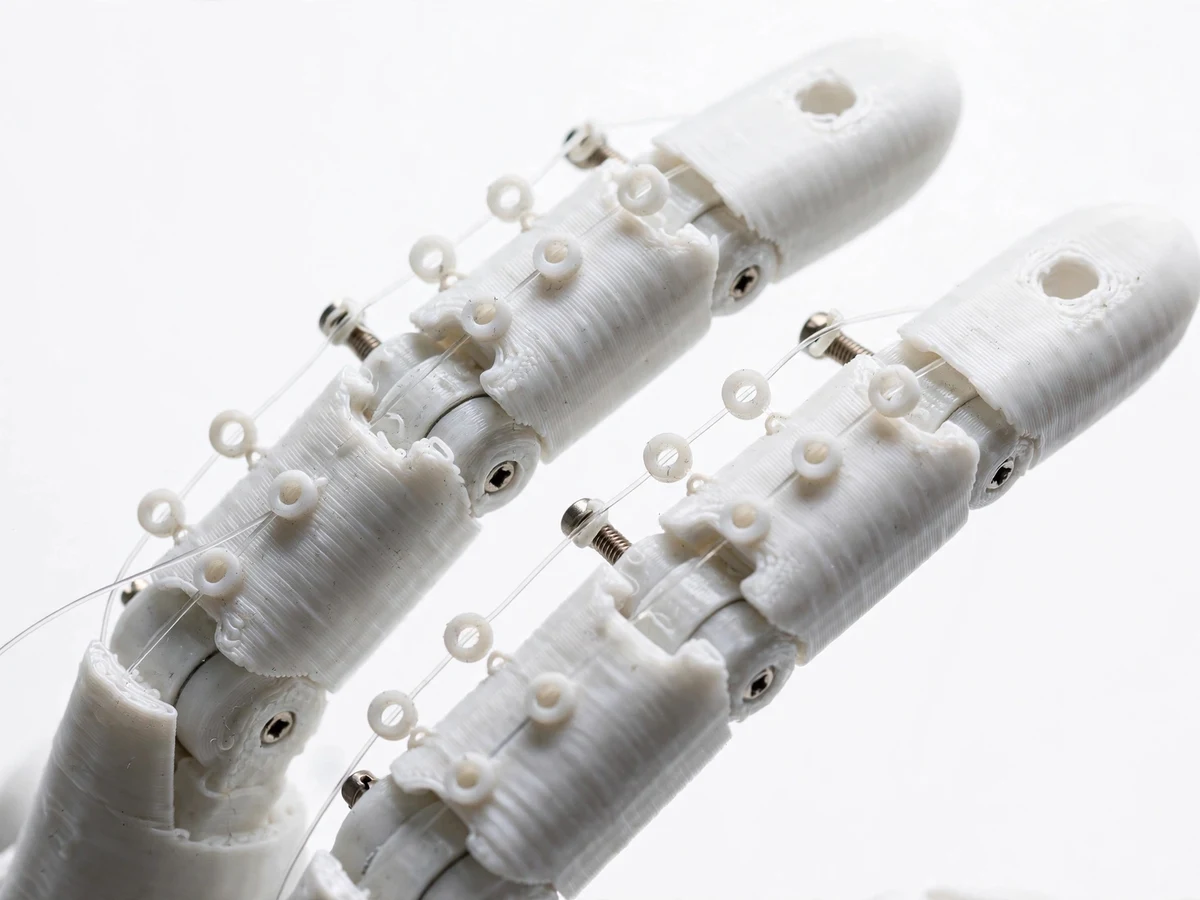
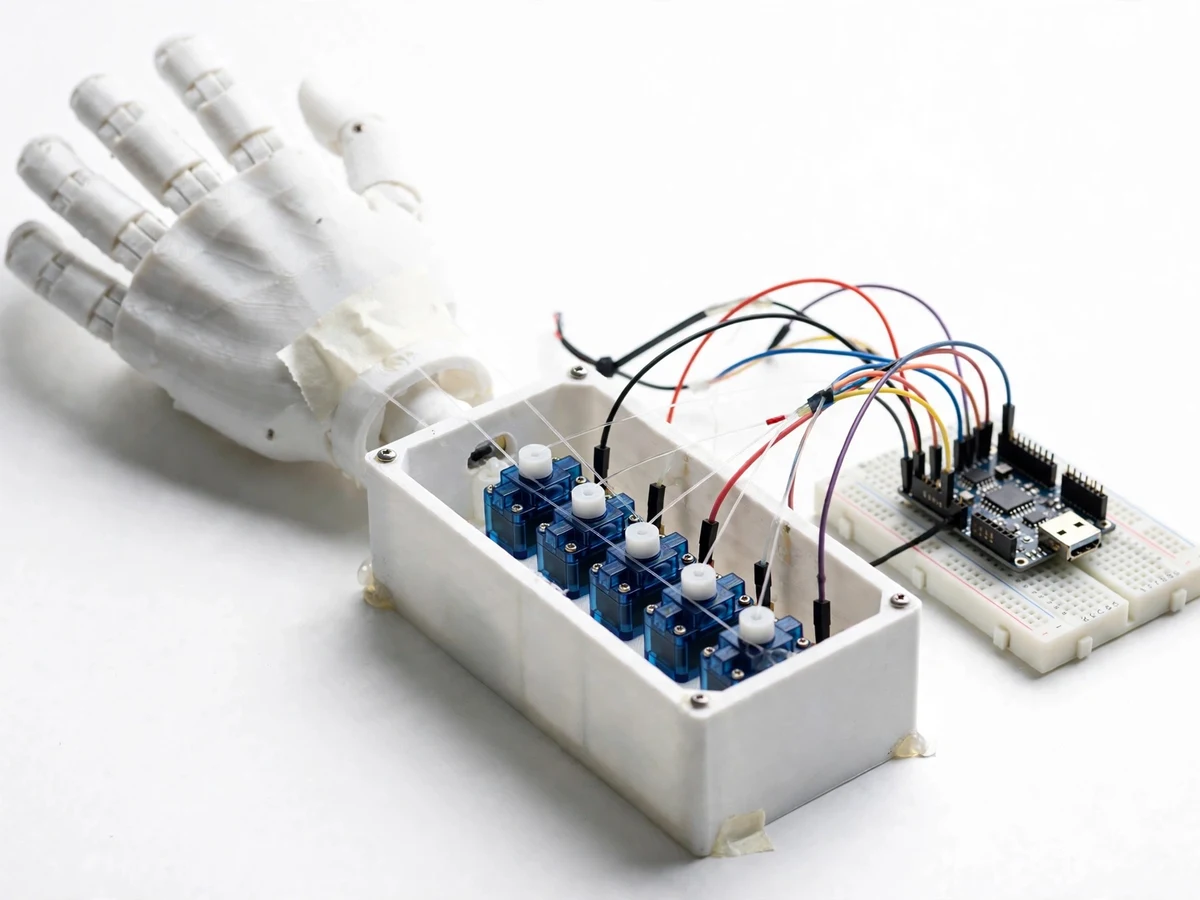
The human hand moves its fingers with tendons — cords that muscles pull from the forearm — and robotic hands copy that architecture for the same reason: it keeps the heavy actuators out of the fingers and lets each joint stay small and light. Industrial grippers are usually rigid two-finger devices, but a tendon hand can curl, pinch and wrap, which makes it the standard student platform for studying grasping. This project builds one end to end: a 3D-printed hand with five jointed fingers, fishing-line tendons threaded through printed guide rings, and five servo motors in a forearm housing pulling the lines. Control comes from a glove with flex sensors — bend your finger, the matching servo pulls the tendon's line, and the robotic finger curls. The student designs the tendon routing, calibrates each sensor-to-servo map, and tests the hand on pinch, wrap and point grips.
Wears the glove; finger bends and straightens drive the robotic hand.
Follow the working sequence
How it works
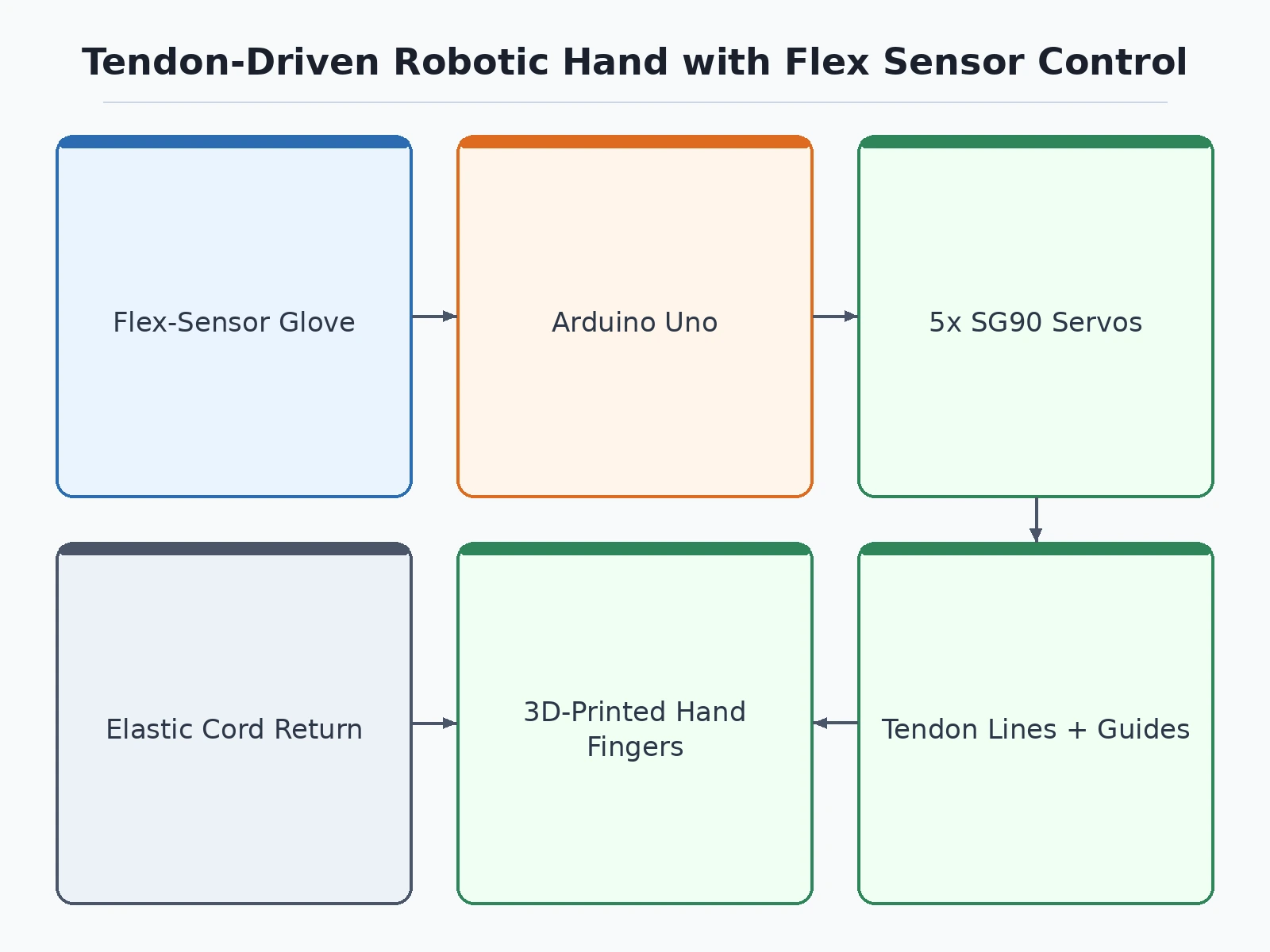
- The operator wears the glove; bending a finger changes that finger's flex sensor resistance.
- The Arduino reads the five flex sensors through voltage dividers and converts each reading to a bend angle using the per-finger calibration.
- Each bend value maps to a servo position: more bend means the servo horn rotates further, pulling the tendon line.
- The tendon runs from the servo horn through guide rings to the fingertip, so the pull curls each joint in sequence.
- When the operator straightens the finger, the servo releases and the elastic return reopens the robotic finger.
- The student calibrates each pair (record sensor min/max, set servo endpoints) so motion mirrors the operator's range.
- Grip tests — picking up a foam ball, holding a pen, pinching a card — validate the build.
Tech stack:
- 3D-printed hand (finger segments, palm) and forearm housing
- 5x SG90 servo motors (one per finger)
- 5x flex sensors on a control glove
- Fishing-line tendons with printed guide rings
- Elastic cord for finger return
- Arduino Nano / Uno
- Arduino IDE (C/C++ firmware)
- 5 V servo power supply
| Parameter | Value |
|---|---|
| Fingers | 5, each with 2-3 printed joints (design) |
| Actuation | 1 tendon line per finger, pulled by 1 SG90 servo |
| Control input | 5 flex sensors on operator glove |
| Controller | Arduino Nano/Uno, per-finger calibration map |
| Return mechanism | Elastic cord (passive reopening) |
| Grips demonstrated | Pinch, cylindrical wrap, point (design targets) |
| Servo travel | Configurable endpoints set during buyer calibration |
| Power | 5 V DC servo supply + USB/logic supply |
Project features
- [Five tendon-driven fingers] Each finger has articulated joints with fishing-line tendons threaded through printed guide rings to a servo horn — human-tendon architecture.
- [Flex-sensor glove control] Five flex sensors on a glove read operator finger bends; the Arduino maps each to its servo for mirrored motion.
- [3D-printed hand and forearm] Printed finger segments, palm and forearm housing keep the build light and fully customizable.
- [Per-finger calibration] Each sensor-servo pair is calibrated independently (min/max bend) so the hand mirrors the operator's actual range of motion.
- [Grip pattern demos] The hand demonstrates pinch, cylindrical wrap and pointing — the standard grasp taxonomy used in robotics teaching.
- [Elastic return] Return springs or elastic cord reopen the fingers when the servo releases, so each finger needs only one tendon per joint group.
- [Tendon tension adjustment] Servo horn hole selection and line anchors let the student set tendon travel and pretension during assembly.
What is included
- Working tendon-driven robotic hand with forearm housing and flex-sensor glove
- Complete firmware source code (sensor read, calibration, servo mapping)
- 3D print files / part list for hand and forearm components
- Tendon routing and tensioning guide
- Per-finger calibration procedure
- Project report PDF (tendon kinematics, sensor theory, methodology, grip tests)
- PPT presentation for final review
- Viva Q&A preparation document (tendon drives, flex sensors, servo control, grasp types)
- Setup and demonstration guide
Limitations & prerequisites
- Grip force is limited by SG90 servo torque — the hand demonstrates grasping shapes, not heavy lifting; no force rating is claimed.
- Flex sensors drift and need re-calibration; the procedure is documented but the glove is not a precision input device.
- No individual joint control within a finger — one tendon curls the whole finger as a unit, which is the standard simplification.
- 3D-printed joints wear with use; tendon lines are a consumable and the guide covers re-stringing.
- Motion mirrors the operator with a small lag; this is a teleoperation demo, not an autonomous grasping system.
Frequently Asked Questions
How is this different from a pick-and-place robotic arm?
An arm positions a gripper in space; this project is the hand itself — five articulated fingers with tendon actuation and sensor-glove teleoperation. The mechanism and the control problem are completely different.
Why tendons instead of a servo per joint?
Tendons copy the human hand: actuators sit in the forearm and light cords do the pulling, so the fingers stay small and light. One servo per finger drives the whole curl.
How does the glove control work?
Flex sensors change resistance when bent. The Arduino reads each, converts it to a bend value with that finger's calibration, and drives the matching servo to pull the tendon by a proportional amount.
How strong is the grip?
Enough to hold light objects (foam ball, pen, card) for demonstration. SG90 torque limits it — grip force is a design observation from the student's tests, not a claimed rating.
What are the main limitations?
Low grip force, flex-sensor drift needing re-calibration, no per-joint control, printed parts wear, and tendon lines need periodic re-stringing.
Is this project suitable for a final-year project?
Yes — for Mechatronics, Mechanical and IoT programs. It demonstrates tendon kinematics, sensor calibration, servo control and grasping, all strong viva material. Suitable for B.E./B.Tech final-year projects in Mechatronics, Mechanical and IoT engineering.
Components & software requirements
- 3D-printed hand (finger segments, palm) and forearm housing
- 5x SG90 servo motors (one per finger)
- 5x flex sensors on a control glove
- Fishing-line tendons with printed guide rings
- Elastic cord for finger return
- Arduino Nano / Uno
- Arduino IDE (C/C++ firmware)
- 5 V servo power supply
Delivery information
Built-to-order project. Delivery timeline is shared after order confirmation based on current queue.
Support terms
Complete documentation, setup guide, and viva preparation included. Support for setup and explanation provided.
Download free synopsis (PDF)
Enter your name and WhatsApp number — the synopsis PDF downloads immediately. We may send occasional project updates on WhatsApp; no spam.