
More project photos (2)
The problem
The mmWave radar presence sensor with ESP32 and web dashboard solves a gap ordinary motion sensors leave open: a PIR sensor only fires when someone moves across its view, so a person reading, writing or working at a screen is soon treated as absent, and lights switch off around someone still in the room. This project replaces that heat-and-motion guess with a 24 GHz radar measurement. The Hi-Link HLK-LD2410 module transmits a frequency-modulated continuous-wave chirp and reads the reflection, reporting a person who walks in, a person who sits still, and the distance in 0.75 m gates, while the ESP32 serves the result on a live web dashboard. That matters for smart rooms, energy saving and occupancy counting, where the useful question is not whether someone moved in the last minute but whether anyone is still there. Building it teaches radar sensing, UART communication, embedded web servers and threshold tuning — skills that transfer directly to smart-home and building-automation work.
Transmits a frequency-modulated chirp and listens for the reflection.
Follow the working sequence
How it works
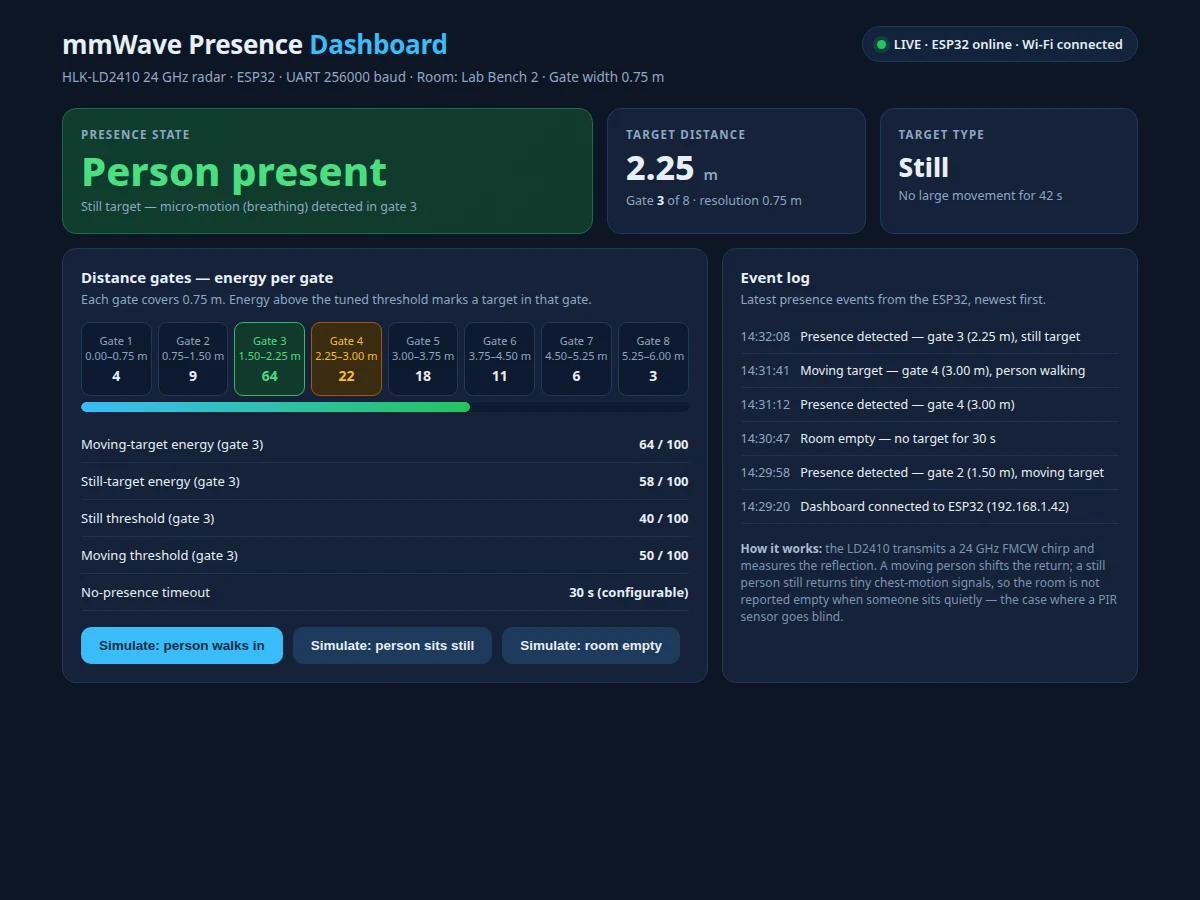
The LD2410 radar module transmits a 24 GHz frequency-modulated continuous-wave chirp and listens for the reflection from the room. A moving person changes the reflected signal, while a still person still returns the tiny rhythmic movement of breathing, so the module can report presence in both cases and place the target in one of eight 0.75 m distance gates. The ESP32 reads those readings over a 256000-baud UART link, decides whether the room is occupied, and serves a web page over Wi-Fi that shows presence state, target distance, still-or-moving status, per-gate energy and a timestamped event log. When presence ends and the configurable no-presence timeout expires, the ESP32 switches the relay output off, so a connected light or fan follows the room instead of a timer. Every step runs locally on the ESP32, so the dashboard works on the room's own Wi-Fi with no cloud service in the loop.
- The LD2410 transmits a 24 GHz FMCW chirp and measures reflections from the room.
- The module separates moving and still targets and assigns each target to a 0.75 m distance gate.
- The ESP32 reads target state, distance and per-gate energy over UART at 256000 baud.
- Firmware compares each gate's energy with its tuned still and moving thresholds.
- The ESP32 serves the web dashboard over Wi-Fi, updating presence, distance and the event log.
- The relay output switches on when presence is detected and off after the no-presence timeout expires.
- Thresholds are re-tuned for the room during setup using the empty-room baseline shown on the dashboard.
Tech stack:
- ESP32
- HLK-LD2410 24 GHz radar
- Arduino IDE
- C++ firmware
- HTML · CSS · JavaScript dashboard
- UART 256000 baud
- Wi-Fi web server
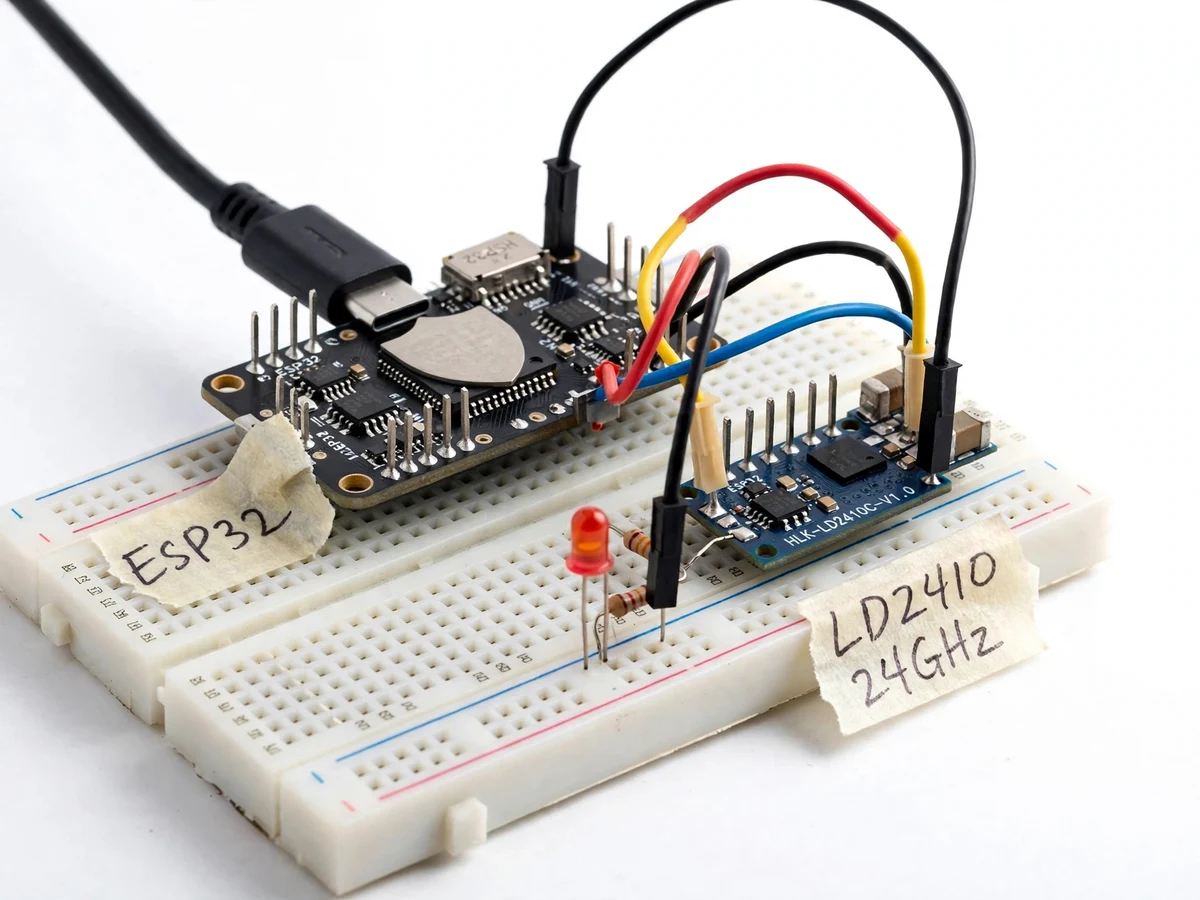
- Breadboard prototype
| Parameter | Value |
|---|---|
| Radar module | Hi-Link HLK-LD2410 (24 GHz FMCW) |
| Operating frequency | 24.01–24.245 GHz (datasheet value) |
| Detection range | 0.75–6 m, adjustable (datasheet value) |
| Farthest sensing distance | Up to 5 m (datasheet value) |
| Distance resolution | 0.75 m per gate (datasheet value) |
| Detection angle | ±60° (datasheet value) |
| Sensor interface | UART, 256000 baud, 8N1, 3.3 V logic (datasheet value) |
| Controller | ESP32 dual-core Xtensa LX6, up to 240 MHz (datasheet value) |
| Wireless | Wi-Fi 802.11 b/g/n, 2.4 GHz (datasheet value) |
| Supply | 5 V, above 200 mA recommended (datasheet value) |
| Output | Web dashboard plus relay output (configurable) |
| No-presence timeout | 30 s default (configurable, design target) |
Project features
The build's strongest capabilities are still-person detection, distance-gated presence, and a live web dashboard with an event log. The LD2410 radar reports both moving and still targets, so a seated person keeps the room marked occupied, and each detection carries a distance in 0.75 m gates that the dashboard shows as per-gate energy bars. The ESP32 hosts the dashboard itself over Wi-Fi, so any phone or laptop on the same network sees presence state, target distance, still-or-moving status and a timestamped event log without any cloud account. A relay output turns the presence decision into action, switching a light or fan on when the room is occupied and off after a configurable no-presence timeout. Thresholds for every gate are tuned during the build, which is where the project earns its marks: an empty-room baseline is recorded first, then still and moving thresholds are set just above the room's background reflections.
- [Still-person detection] (Implemented) The radar reports a seated or standing-still person from micro-motion, so the room stays marked occupied without large movement.
- [Distance-gated presence] (Implemented) Eight 0.75 m gates report how far away the target is, shown on the dashboard as per-gate energy bars.
- [Live web dashboard] (Implemented) The ESP32 hosts a dashboard over Wi-Fi showing presence state, distance, still-or-moving status and an event log — no cloud account needed.
- [Relay output for automation] (Implemented) A relay switches a light or fan from the presence state, with a configurable no-presence timeout.
- [Per-gate threshold tuning] (Implemented) Still and moving thresholds for each gate are tuned against an empty-room baseline recorded during setup.
- [UART sensor link] (Implemented) The LD2410 streams target data to the ESP32 over a 256000-baud UART connection, with a digital OUT pin as a simple presence fallback.
- [Cloud logging and alerts] (Optional customization) Historical occupancy charts and phone alerts can be added on request; they are not part of the base build.
- [Multi-room occupancy counting] (Future scope) Counting people across several rooms with multiple radar modules is a possible extension, not included in the base build.
What is included
- Working ESP32 and HLK-LD2410 prototype on breadboard with wiring documentation
- Complete firmware (Arduino IDE, C++)
- Web dashboard served by the ESP32 (single-file HTML)
- Gate and threshold tuning guide with the empty-room baseline procedure
- Project abstract PDF
- Project report, PPT presentation and viva Q&A preparation document
- Demonstration guidance
Limitations & prerequisites
- Detection range is a datasheet value (farthest sensing distance up to 5 m); real range depends on room layout, furniture and threshold tuning.
- Radar passes through thin non-metallic partitions, so a person in the next room can be detected if gates are set too wide — gate limits must be tuned per room.
- Pets and large moving objects can trigger presence; the build has no person-versus-pet classification.
- The dashboard is served on local Wi-Fi; remote access from outside the network needs additional setup and is not part of the base build.
- Still-person detection relies on micro-motion; a fully motionless target behind a metal obstruction may not be detected.
- The prototype is an academic bench build, not a certified occupancy or safety system.
Frequently Asked Questions
How is this different from a Wi-Fi CSI human-presence detector?
This project uses radar, not Wi-Fi sensing. The LD2410 transmits its own 24 GHz chirp and measures the reflection, so it reports distance in 0.75 m gates and works with no Wi-Fi traffic, while a Wi-Fi CSI detector only infers presence from disturbances in Wi-Fi signals, which gives no distance reading and depends on Wi-Fi devices being active nearby. Radar is the more direct measurement for a room-presence build.
Can it really detect a person sitting still?
Yes — that is the point of using radar instead of PIR. The LD2410 reads the tiny rhythmic chest movement of breathing, so a seated person keeps the room marked occupied even with no large movement, and no accuracy figure is claimed because real performance depends on seating position, room reflections and gate-threshold tuning. The tuning procedure is part of the deliverables.
Is this project suitable for a final-year project?
Yes — for IoT & Embedded, Electronics/E&TC and Computer Science programmes. It demonstrates radar sensing, UART communication, embedded web servers, threshold tuning and a working automation output in one build, and each of those maps to a clear viva discussion. The dashboard and relay output give examiners something live to see rather than a simulation.
Does it need internet to work?
No. The ESP32 serves the dashboard on the room's own Wi-Fi network, so presence, distance and the event log are visible on any phone or laptop connected to that network, with no cloud account and no internet connection — internet is only needed if remote access from outside the network is added later as a customization.
What power supply does it need?
A 5 V USB supply that can deliver above 200 mA, as the LD2410 datasheet recommends — a standard phone charger or laptop USB port is enough for the bench prototype. The ESP32 runs from the same 5 V supply, and the relay output switches a separate mains-rated load only through a properly rated relay module. Mains wiring is kept separate from the low-voltage prototype board.
Can it switch a light or fan automatically?
Yes. A relay output follows the presence state: it switches on when the radar reports a person and off after the configurable no-presence timeout expires, so a light or fan follows the room instead of a timer, with the timeout set during the build — 30 s is the default in the supplied firmware. Larger loads need a relay module rated for that load.
Components & software requirements
- ESP32
- HLK-LD2410 24 GHz radar
- Arduino IDE
- C++ firmware
- HTML · CSS · JavaScript dashboard
- UART 256000 baud
- Wi-Fi web server
- Breadboard prototype
Delivery information
Built-to-order project. Delivery timeline is shared after order confirmation based on current queue.
Support terms
Complete documentation, setup guide, and viva preparation included. Support for setup and explanation provided.
Download free synopsis (PDF)
Enter your name and WhatsApp number — the synopsis PDF downloads immediately. We may send occasional project updates on WhatsApp; no spam.