
More project photos (3)
The problem
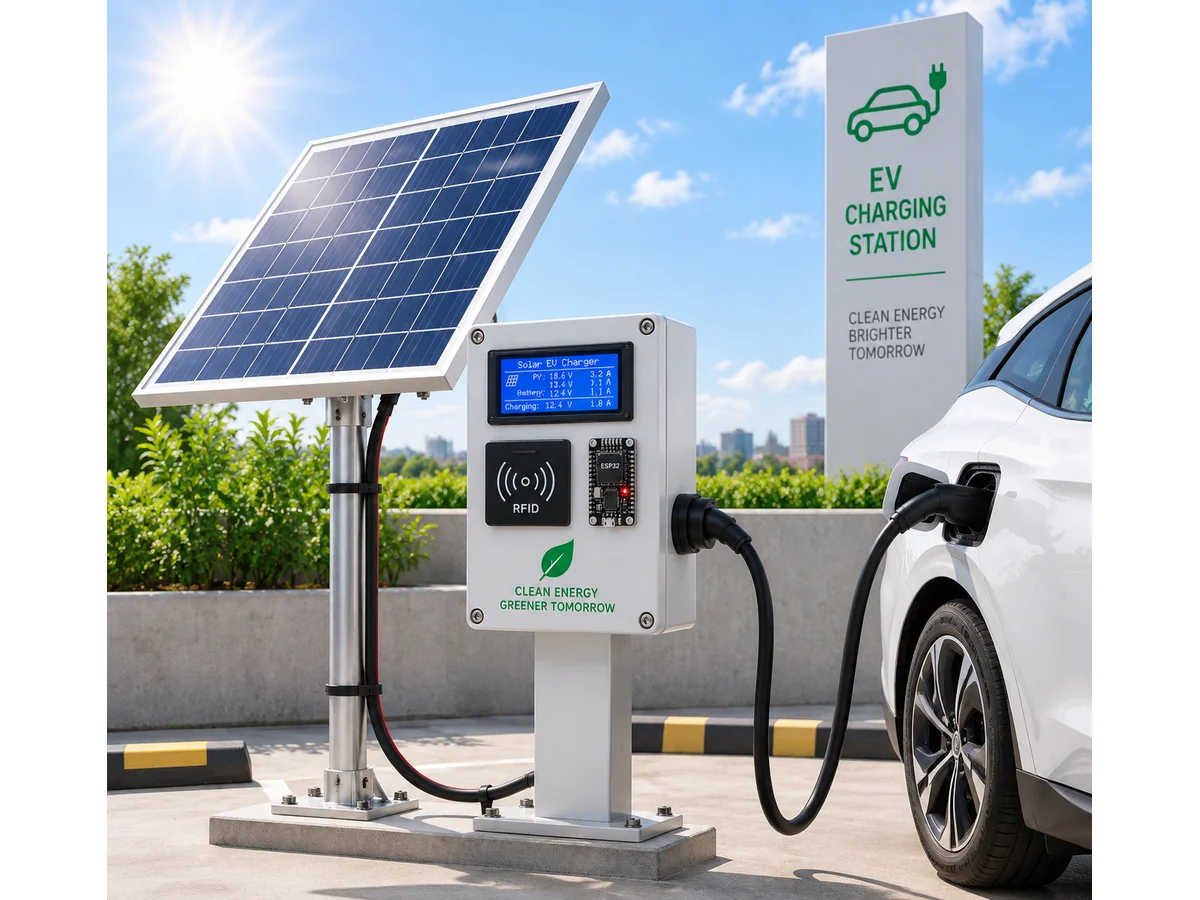
Build a working solar-powered EV charging station prototype — the perfect final year project for EEE students that combines solar energy, EV charging infrastructure, and IoT monitoring in one demo-ready build. This solar EV charging station project uses a solar panel with an MPPT charge controller, an ESP32 that monitors voltage, current, and power in real time, RFID-based session start/stop, and cloud logging of every charging session. It's a timely, viva-friendly build that rides India's EV push with a green-energy story examiners love.
Harvests sunlight and feeds DC power to the charge controller.
Follow the working sequence
How it works
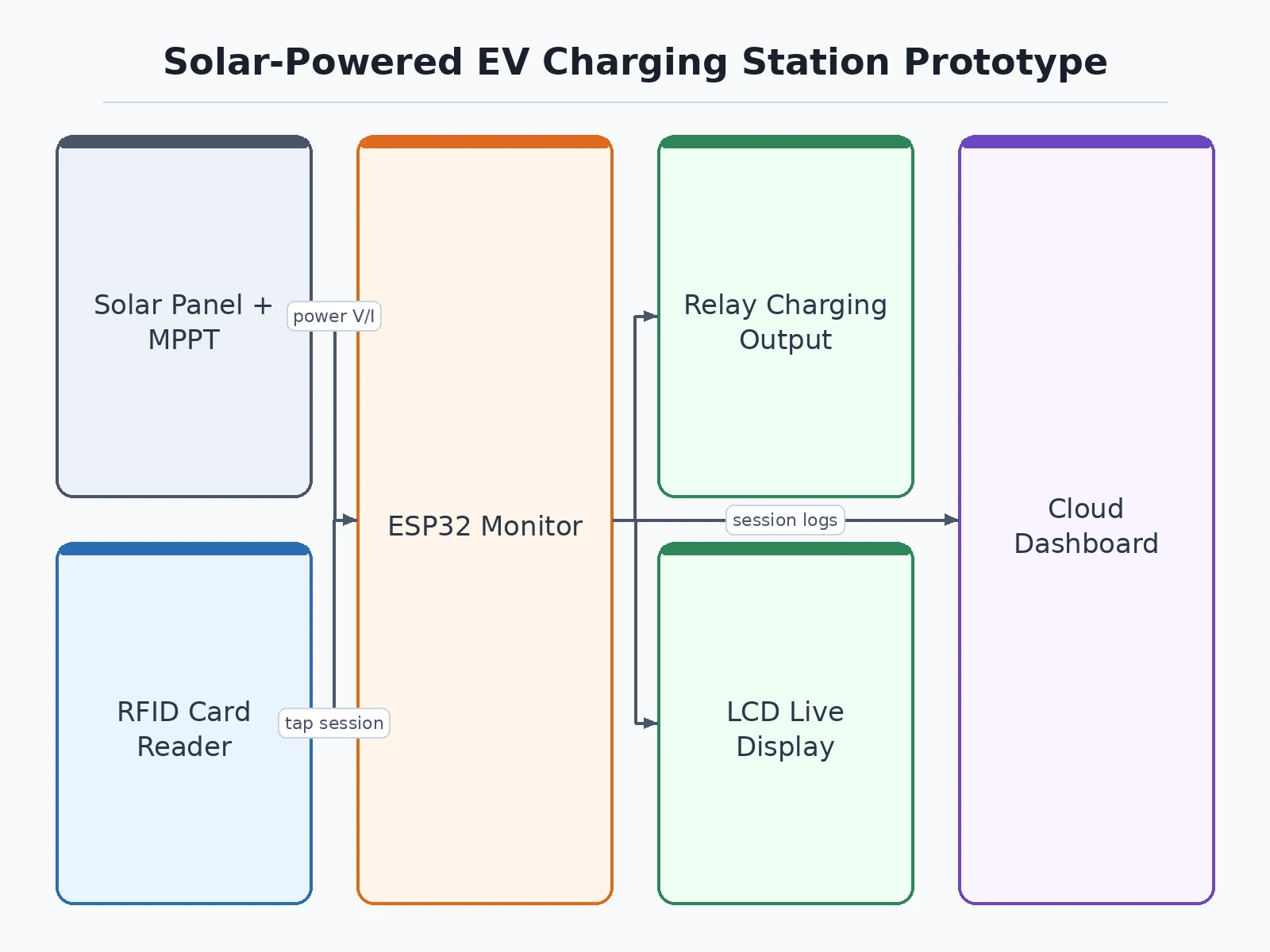
- The solar panel feeds a battery bank through an MPPT module that keeps the panel operating at its maximum power point, harvesting the most energy from available sunlight.
- To start charging, the user taps an authorized RFID card on the reader. The ESP32 validates the card and closes the relay, connecting the charging output.
- While charging, voltage and current sensors feed readings to the ESP32, which computes instantaneous power and accumulates energy delivered (Wh).
- Every reading is pushed to the cloud over Wi-Fi, and the session — start time, end time, total energy, peak power — is stored in the session log.
- Tapping the card again (or hitting a current/time limit) ends the session: the relay opens, the session summary is logged, and the dashboard updates.
Project features
- Solar panel with MPPT charge control for maximum energy harvest from sunlight
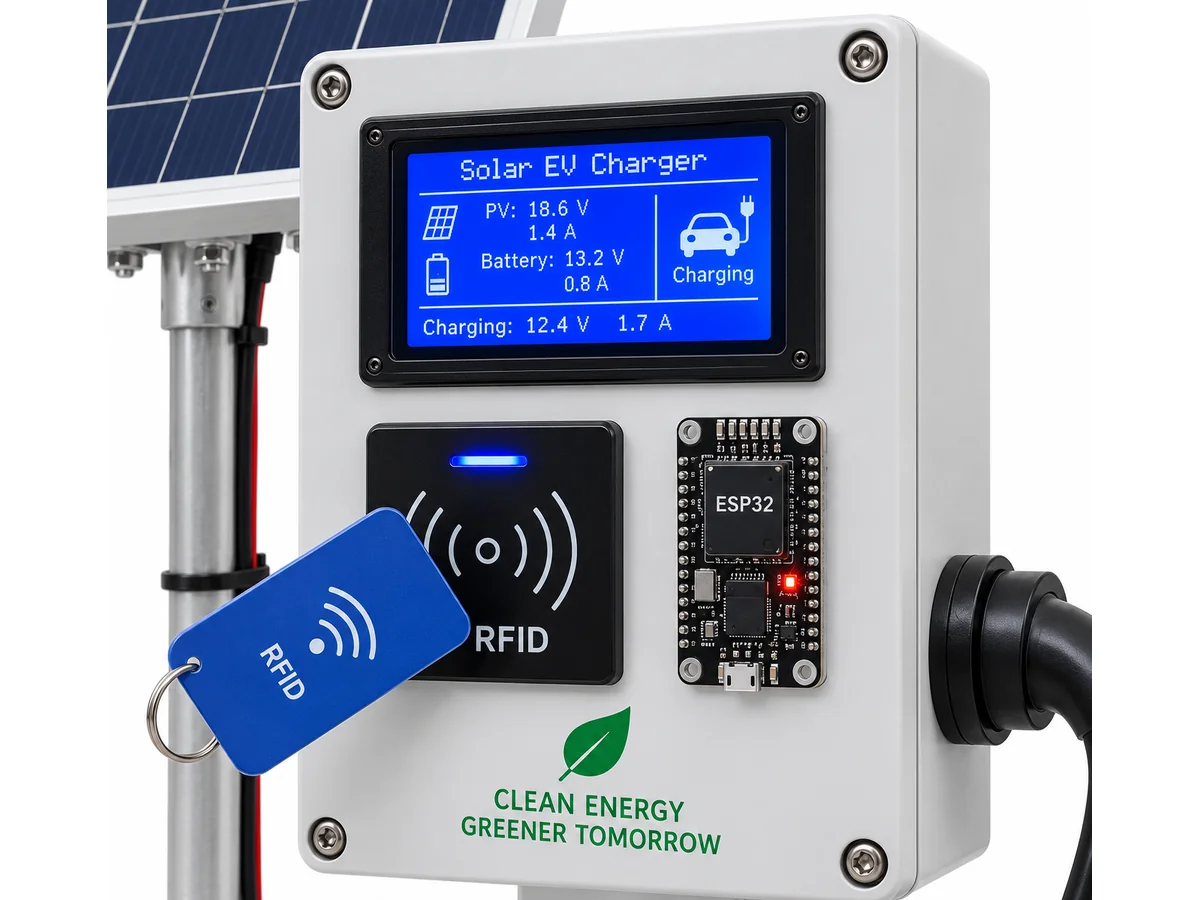
- ESP32-based monitoring of voltage, current, and power during every charging session
- RFID card reader for session start/stop — tap to charge, tap to end
- Relay-controlled charging output that cuts power when the session ends or limits are hit
- Cloud dashboard with session logs: start time, end time, energy delivered (Wh), and peak power
- Live LCD display on the station showing panel voltage, battery voltage, and charging current
- Low-voltage and over-current protection for safe demo operation
- Mobile-friendly web dashboard to view sessions from any device
What is included
- Fully assembled and tested station prototype
- Complete ESP32 firmware source code (Arduino IDE)
- Cloud dashboard setup with session logging
- Wiring diagram and circuit schematic
- Project report PDF (synopsis, design, implementation, testing, results, conclusion)
- Project PPT for demo and viva presentation
- Viva Q&A document covering EV charging, MPPT, and IoT concepts
Advantages
- Solar panel with MPPT charge control extracts maximum energy harvest from sunlight for every charging session.
- ESP32-based monitoring of voltage, current and power throughout each session.
- RFID session start-stop — tap a card to charge, tap again to end — with relay-controlled output that cuts power when the session ends or limits are hit.
- Cloud dashboard with session logs: start time, end time, energy delivered (Wh) and peak power.
- Live LCD display on the station shows panel voltage, battery voltage and charging current; the web dashboard is mobile-friendly.
- Low-voltage and over-current protection keeps demo operation safe.
Disadvantages
- Prototype-scale: it charges a demo DC load or small battery bank, not a real EV — it demonstrates the charging-station concept, not full-scale EV charging.
- Solar output depends on sunlight; cloudy conditions reduce charging power during demos.
- The cloud dashboard needs Wi-Fi access at the demo venue.
- Designed as an academic final-year project; not certified for commercial EV-charging use.
Limitations & prerequisites
- Prototype-scale: charges a demo DC load / small battery bank, not a real EV — it demonstrates the charging-station concept, not full-scale EV charging
- Solar output depends on sunlight; cloudy conditions reduce charging power during demos
- Cloud dashboard needs Wi-Fi access at the demo venue
- Designed as an academic final year project; not certified for commercial EV charging use
Components & software requirements
- Solar panel (PV module) — primary energy source
- MPPT charge controller module — maximum power point tracking for efficient solar charging
- ESP32 development board — monitoring, RFID handling, and cloud connectivity
- Voltage sensor (e.g., voltage divider / INA219) — panel and battery voltage
- Current sensor (e.g., ACS712 / INA219) — charging current
- RFID reader (RC522) with tags — session authentication
- Relay module — charging output switching
- Battery bank / EV-load (DC load for demo purposes)
- LCD display (16x2 I2C) — live station readouts
- Enclosure, wiring, connectors, fuses, and mounting hardware
Download free synopsis (PDF)
Enter your name and WhatsApp number — the synopsis PDF downloads immediately. We may send occasional project updates on WhatsApp; no spam.
Sahoo, Sahoo & Panda (2023), IEEE Transactions on Industrial Electronics, vol. 70, no. 5