
More project photos (2)
The problem
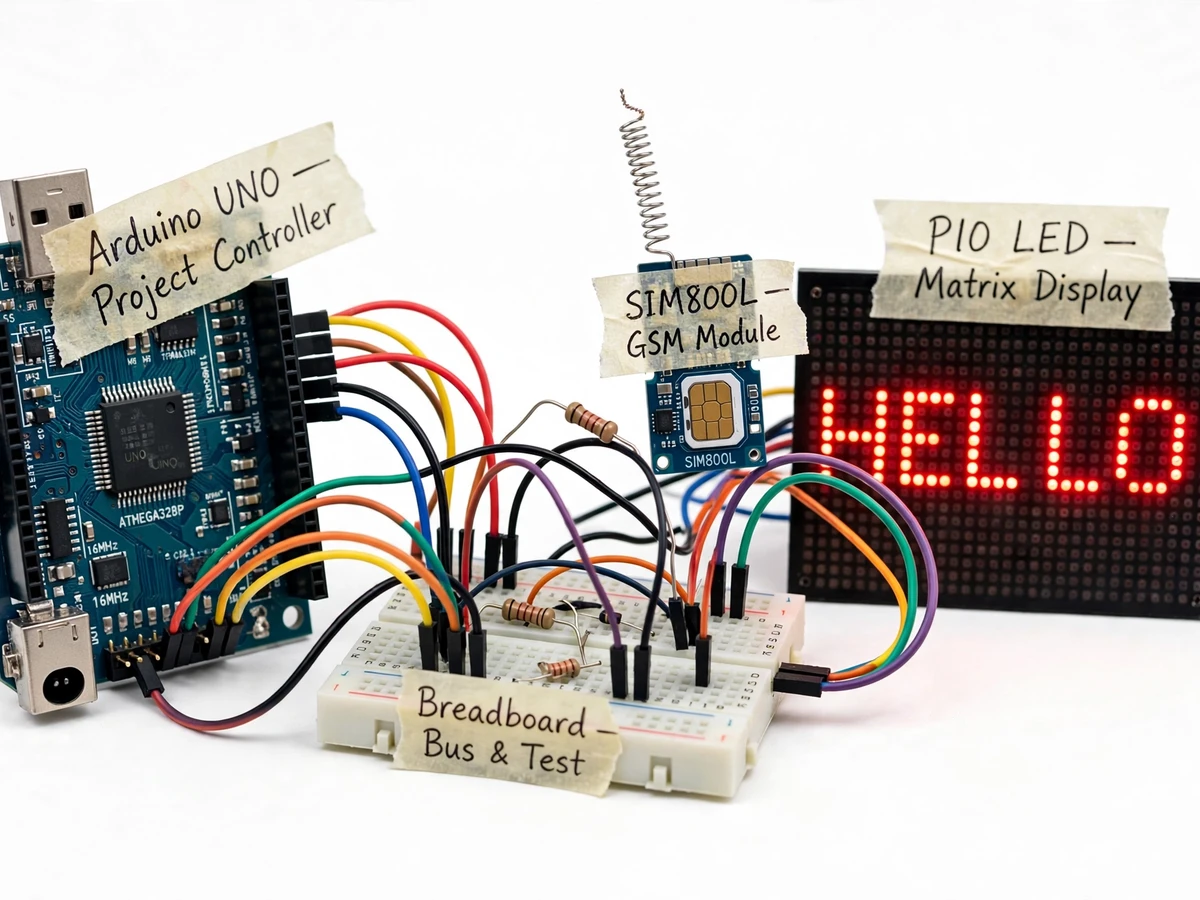
College departments, hostels and offices still rely on paper notice boards that someone must walk up to, pin a sheet on, and replace by hand — updates reach people late and old notices stay up long after they expire. Existing electronic boards either need a PC kept running next to them, a Bluetooth connection at close range, or internet and a cloud account, none of which suits a small department that just wants to flash a notice from a phone. This project removes that bottleneck: a GSM-based wireless notice board that accepts the announcement as an ordinary text message. The sender types the message on any basic mobile phone and sends it to the board's SIM number; within seconds the text is scrolling on the LED panel. No smartphone app, no internet connection, no computer on site. The build demonstrates real embedded skills — UART communication with a GSM modem, AT-command SMS handling, driving a large LED matrix, and managing the bursty power a 2G module demands — while solving a genuinely useful, visible problem.
Any mobile phone that texts the board's SIM with the new notice, up to 160 characters.
Follow the working sequence
How it works
- The SIM800L registers on the 2G GSM network and the firmware puts it in SMS text mode (AT+CMGF=1) at 9600 baud over software serial.
- When a text arrives, the module raises a +CMTI notification; the firmware reads the stored message with AT+CMGR.
- The sender's number is extracted and compared with the authorised number stored in EEPROM; unauthorised messages are deleted and ignored.
- An accepted message (up to 160 characters) is saved to EEPROM, then rendered as a pixel stream for the LED panel.
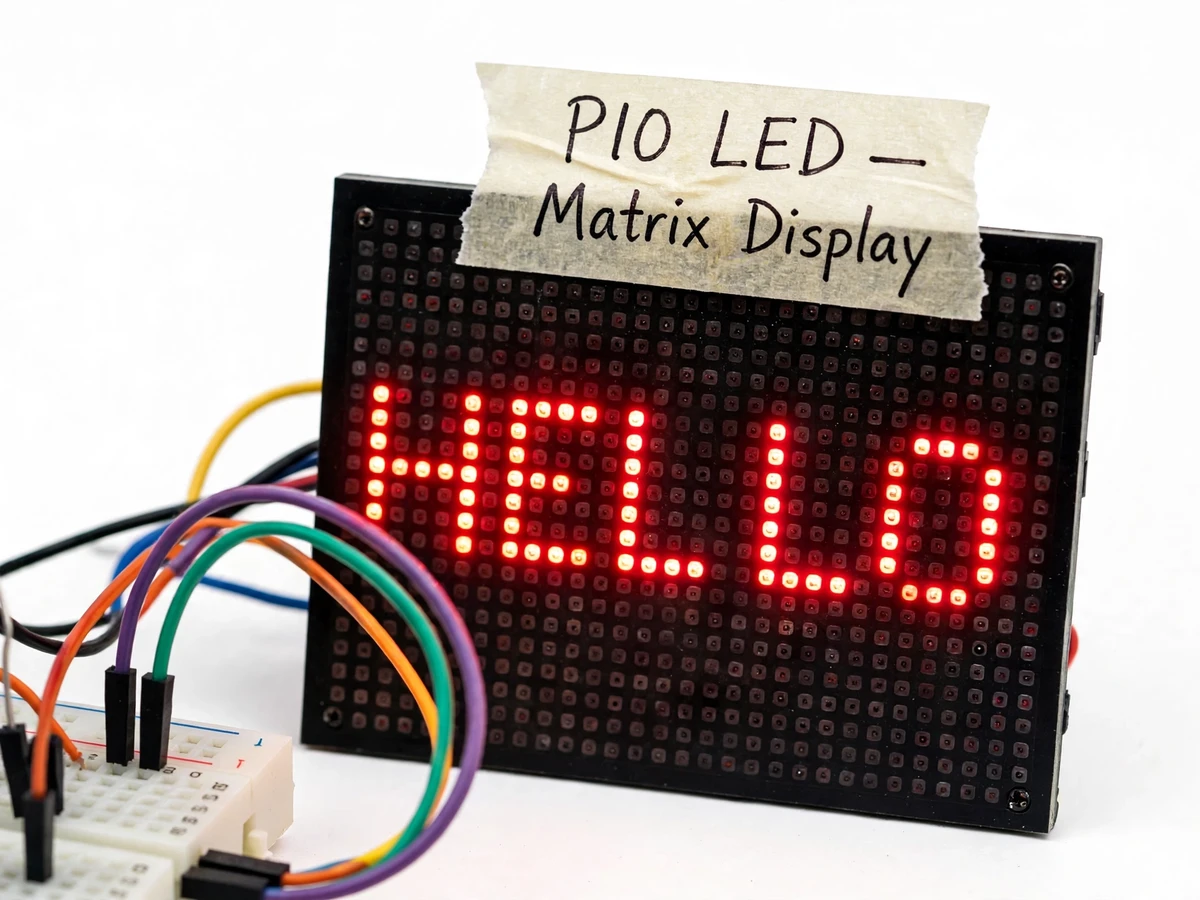
- The panel driver shifts the pixel stream across the 32x16 matrix continuously, producing a smooth right-to-left scroll at the configured speed.
- A 5V SMPS feeds the LED panel while a dedicated regulator gives the SIM800L the 3.4–4.4 V it needs for its 2 A transmission bursts (datasheet values).
Tech stack:
- Arduino Uno (ATmega328P)
- SIM800L GSM module (2G)
- P10 LED dot-matrix panel (32x16)
- Arduino IDE (C/C++ firmware)
- AT command set (SMS text mode)
- UART (software serial, 9600 baud)
- 5V SMPS (panel power)
- EEPROM (message storage)
| Parameter | Value |
|---|---|
| Display panel | P10 LED dot matrix, 32×16 pixels per panel (design target; panels chainable) |
| Message length | Up to 160 characters per SMS (GSM 7-bit text-mode limit) |
| Network | 2G GSM only — SIM800L is a 2G module (datasheet); operator 2G coverage required |
| GSM power | 3.4–4.4 V supply, up to 2 A bursts during transmission (datasheet; dedicated regulator in the build) |
| Controller | Arduino Uno, ATmega328P, 16 MHz |
| GSM interface | UART at 9600 baud (typical), AT command set |
| Scroll speed | Several configurable steps (design target) |
| Readable distance | A few metres in normal indoor light (approximate; brightness-dependent) |
| Message persistence | Last message kept in EEPROM, restored after power loss (implemented) |
| Update latency | Typically seconds after SMS delivery (network-dependent; no measured figure claimed) |
Project features
- [SMS-driven updates] Send a text to the board's SIM and the message appears on the display; the firmware polls the SIM800L with AT commands and reads each new message together with its sender number.
- [Authorised-sender filter] Only the phone number stored in the firmware can update the board; messages from any other number are ignored, so prank or junk texts never reach the display.
- [Scrolling P10 LED display] The message scrolls continuously across a 32x16 P10 LED dot-matrix panel, bright red and readable from a few metres in normal indoor light.
- [160-character message support] Each update is a single SMS, so messages follow the GSM 7-bit text limit of 160 characters; the firmware truncates safely if a longer message arrives.
- [Configurable scroll speed] Scroll speed is set in the firmware with several speed steps, and a tactile button on the prototype cycles through them without re-flashing.
- [Message retention across power cuts] The last accepted message is written to the Arduino's EEPROM and restored to the display automatically when power returns.
- [Network status indication] A status LED on the prototype shows GSM registration and SMS activity, making it easy to diagnose signal or SIM problems during the demo.
What is included
- Working hardware prototype: Arduino Uno, SIM800L with antenna, P10 LED panel, 5V SMPS, wiring
- Firmware source code with detailed comments
- Wiring diagram and connection table
- AT-command reference sheet for the SIM800L
- SMS message-format and authorised-number setup guide
- Project report PDF (background, design, methodology, test procedure)
- PPT presentation for final review
- Viva Q&A preparation document (GSM, AT commands, LED matrices, power design)
Limitations & prerequisites
- The SIM800L is 2G-only: the board needs live 2G network coverage and a SIM with an active plan/balance; where the operator has shut down 2G, SMS reception stops entirely.
- One update equals one SMS — 160 characters in GSM 7-bit text mode; longer notices must be split across multiple messages and scroll as separate items.
- There is no internet, cloud dashboard or mobile app in the base build — SMS is the only remote-update channel.
- The panel is designed for indoor viewing from a few metres; it is not a sunlight-readable outdoor display.
- The SIM800L pulls up to about 2 A in short transmission bursts (datasheet); it must run on its own regulated supply — powering it from the Arduino's 5 V pin browns the module out.
- Messages arrive as fast as the operator delivers SMS; during network congestion the board updates when the SMS lands, with no delivery guarantee from our side.
- There is no battery backup in the base build; on power loss the last message is retained in EEPROM but the panel is dark until power returns.
Frequently Asked Questions
Is this project suitable for a final-year project?
Yes — for Electronics and E&TC programs. It demonstrates UART interfacing, AT-command SMS handling on a real GSM modem, LED matrix driving, EEPROM storage and the power design a 2G module needs, all on hardware you can carry into the viva room and demo live with your own phone. The Q&A document maps every module to its underlying concept.
Will it work on any mobile network?
It works only where the operator still provides 2G GSM service, because the SIM800L is a 2G-only module. Before building, check 2G coverage in your area and use a SIM with an active plan and SMS balance — this is stated as a hard prerequisite, not a footnote.
Can I send a message longer than 160 characters?
Not in one SMS — that is the GSM 7-bit text-mode limit, a network standard rather than a project restriction. Send the notice as two messages and both scroll in sequence. A concatenated-SMS reassembly mode is a realistic optional customization.
Can anyone send a message to the board?
No. The firmware stores one authorised phone number in EEPROM and deletes messages from any other sender without displaying them, so only you can update the board. The number can be changed through a re-flash or a serial configuration step.
What happens if the power goes off?
The panel goes dark until power returns, but the last accepted message is safe in the Arduino's EEPROM and reappears on the display automatically at restart — nothing is lost and nobody needs to resend the notice.
Does it need the internet or a smartphone?
Neither. The update channel is plain SMS, so even a basic feature phone can update the board from anywhere the GSM network reaches. That is the point of the design: updates work without apps, accounts or data packs. Suitable for B.E./B.Tech final-year projects in Electronics, Electrical and IoT.
Components & software requirements
- Arduino Uno (ATmega328P)
- SIM800L GSM module (2G)
- P10 LED dot-matrix panel (32x16)
- Arduino IDE (C/C++ firmware)
- AT command set (SMS text mode)
- UART (software serial, 9600 baud)
- 5V SMPS (panel power)
- EEPROM (message storage)
Delivery information
Built-to-order project. Delivery timeline is shared after order confirmation based on current queue.
Support terms
Complete documentation, setup guide, and viva preparation included. Support for setup and explanation provided.
Download free synopsis (PDF)
Enter your name and email — the synopsis PDF downloads immediately. We may send occasional project updates; no spam, unsubscribe anytime.