
More project photos (2)
The problem
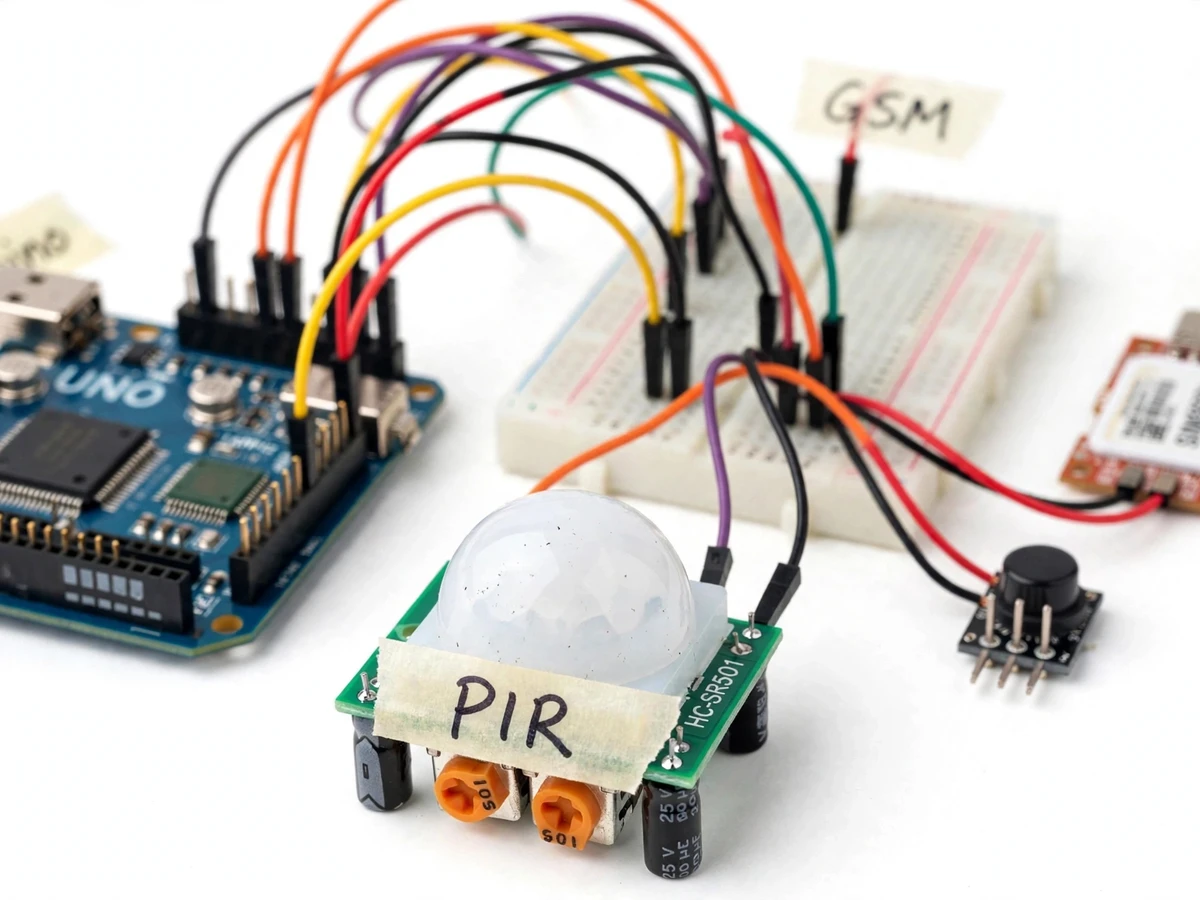
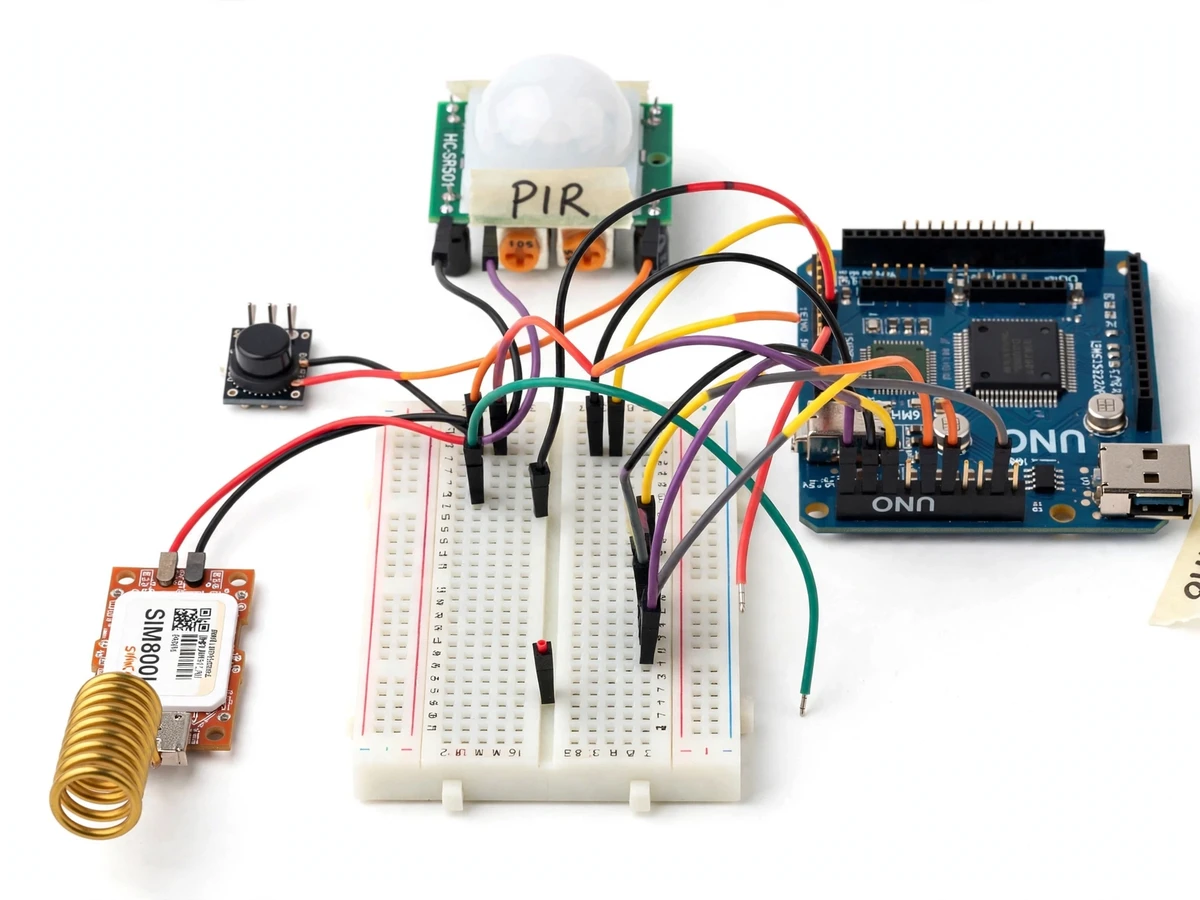
Homes, hostel rooms, small shops and storerooms are frequently left unattended, and a simple break-in during those hours can go unnoticed for a whole day. Conventional alarm systems are either wired, expensive, or tied to an app that needs constant internet — overkill for a student room or a small premises. This project demonstrates a compact, low-cost alternative built from standard modules: a PIR motion sensor watches the protected area, an Arduino Uno processes the trigger, and a SIM800L GSM module sends an SMS alert directly to the owner's mobile phone the moment motion is detected. Because the alert travels over the GSM cellular network, the system works anywhere with mobile coverage — no Wi-Fi, no broadband, no cloud account. A buzzer sounds locally at the same time for on-site deterrence, and an arming delay gives the owner time to leave before detection starts. Every part of the build — sensor interfacing, serial communication with the GSM module, AT commands — is a standard embedded-systems exercise, making the whole system genuinely explainable in a viva.
Owner who arms the system and receives the SMS alert.
Follow the working sequence
How it works
- The system powers up in a disarmed state; pressing the arm button (or on power-up, as configured) starts the arming delay countdown shown on the status LED.
- Once the delay elapses, the Arduino begins polling the HC-SR501 PIR sensor's digital output pin.
- When motion enters the sensor's cone, the PIR output goes HIGH; the Arduino detects the rising edge and registers an intrusion event.
- The firmware starts the local buzzer alarm immediately and wakes the SIM800L over its UART serial connection.
- The Arduino sends the AT command sequence (AT+CMGS) through the serial port, and the GSM module transmits the alert SMS to each configured phone number.
- After a cooldown window, the buzzer stops and the system re-arms itself automatically, ready for the next event.
Tech stack:
- Arduino Uno (ATmega328P)
- SIM800L GSM module (quad-band, SMS via AT commands)
- HC-SR501 PIR motion sensor
- Arduino IDE (C++ firmware)
- 5 V active buzzer module
- Breadboard + jumper-wire wiring
- Regulated power supply (SIM800L needs a stable ~4 V rail)
| Parameter | Value |
|---|---|
| Controller | Arduino Uno (ATmega328P, 16 MHz, 5 V logic) |
| Motion sensor | HC-SR501 PIR module, digital output (3.3 V HIGH) |
| Detection range | Up to approximately 7 m (datasheet max, adjustable via onboard potentiometer) |
| Detection cone | Approximately 110° (datasheet) |
| GSM module | SIM800L, quad-band 850/900/1800/1900 MHz |
| Alert channel | SMS over cellular network; no Wi-Fi or internet needed |
| SMS delivery latency | Design target approximately 10–60 seconds, network-dependent |
| Power supply | 5 V for Arduino/logic; stable 3.4–4.4 V rail for SIM800L (not from the Arduino 5 V pin) |
| SIM requirement | Micro-SIM with active plan and SMS balance, on a carrier with 2G coverage |
| Arming delay | Configurable in firmware; default approximately 30 seconds |
| Alarm output | 5 V buzzer, automatic re-arm after cooldown |
Project features
- [PIR motion detection] The HC-SR501 PIR sensor monitors the protected zone and drives its output pin HIGH when it detects a moving warm body, giving the Arduino a clean digital trigger with adjustable range and retrigger delay.
- [Instant SMS alert over GSM] The SIM800L module sends a text message to the owner's phone via standard AT commands the moment motion is detected — no Wi-Fi, internet or cloud service required.
- [Local buzzer alarm] A 5 V buzzer sounds at the site alongside the SMS for immediate on-site warning; the alarm is silenced and re-armed automatically after a configurable cooldown.
- [Arming delay] A configurable exit delay (e.g. 30 seconds) runs when the system is armed, so the owner can leave the room without triggering the alarm themselves.
- [Multiple alert recipients] Up to three phone numbers can be stored in the firmware, so the alert SMS reaches every configured recipient.
- [Retrigger debounce] The firmware ignores further triggers for a cooldown window after each alert, preventing a burst of duplicate SMS messages from continuous movement.
- [Status indication] An onboard LED and serial-monitor messages show armed, triggered and GSM-network-registration states, so setup and fault-finding are straightforward.
What is included
- Working prototype (Arduino Uno, PIR sensor, SIM800L GSM module, buzzer, breadboard wiring)
- Complete firmware source code (Arduino C++) with comments
- Circuit and wiring diagram with pin-connection table
- Component list with exact module names
- Setup, calibration and SIM800L testing guide
- Project abstract PDF (10 sections)
- Project report PDF (background, design, methodology, results, limitations)
- PPT presentation for final review
- Viva Q&A preparation document (PIR working, GSM AT commands, serial communication, power design)
Limitations & prerequisites
- The PIR sensor detects any moving warm body — it cannot tell a person from a pet or a curtain moved by wind, and it takes no photographs.
- Effective detection range is set by mounting height, lens focus and ambient temperature; sensitivity drops noticeably when room temperature approaches human body temperature.
- The SIM800L is 2G-only; confirm 2G network availability on the buyer's SIM carrier (a 4G-module upgrade is offered as customization).
- SMS delivery time is set by the cellular network, not the prototype — the design target is roughly 10–60 seconds, and delivery is not guaranteed during network congestion.
- The base build has no remote disarm; arming is via the onboard button or at power-up (keypad or RFID disarm can be added on request).
- The prototype is intended for indoor demonstration; it is not weatherproofed, not a certified security product, and does not replace a professional alarm system.
Frequently Asked Questions
Which controller and sensor are used?
An Arduino Uno (ATmega328P) reads the digital output of an HC-SR501 PIR motion sensor; alerts go out through a SIM800L GSM module over its UART serial interface using standard AT commands.
Does the system need Wi-Fi or internet?
No. Alerts travel as SMS over the cellular network, so the system works anywhere with mobile coverage. It does need a micro-SIM with an active plan and SMS balance, on a carrier that still supports 2G.
What are the main limitations?
The PIR cannot distinguish people from pets or moving warm objects, real-world detection range depends on mounting and temperature, SMS timing is network-dependent, and the base build has no remote disarm. The full honest list is in the Limitations section.
Can the project be customized?
Yes. Common additions: keypad or RFID-based arming/disarming, multiple PIR sensors for larger areas, a louder siren instead of the buzzer, battery backup, or a 4G GSM module upgrade for carriers without 2G coverage.
What power supply does it need?
The Arduino and logic run on 5 V; the SIM800L must have its own stable 3.4–4.4 V rail because its transmit bursts draw up to about 2 A — it cannot be powered from the Arduino's 5 V pin. The build guide covers the regulator wiring.
Is this project suitable for a final-year project?
Yes — for Electronics, E&TC and IoT programs. It demonstrates sensor interfacing, serial communication, GSM AT-command control, power design for a radio module, and a complete embedded application with honest, quantified limitations. Suitable for B.E./B.Tech final-year projects in Electronics, E&TC and IoT.
Components & software requirements
- Arduino Uno (ATmega328P)
- SIM800L GSM module (quad-band, SMS via AT commands)
- HC-SR501 PIR motion sensor
- Arduino IDE (C++ firmware)
- 5 V active buzzer module
- Breadboard + jumper-wire wiring
- Regulated power supply (SIM800L needs a stable ~4 V rail)
Delivery information
Built-to-order project. Delivery timeline is shared after order confirmation based on current queue.
Support terms
Complete documentation, setup guide, and viva preparation included. Support for setup and explanation provided.
Download free synopsis (PDF)
Enter your name and email — the synopsis PDF downloads immediately. We may send occasional project updates; no spam, unsubscribe anytime.