
More project photos (3)
The problem
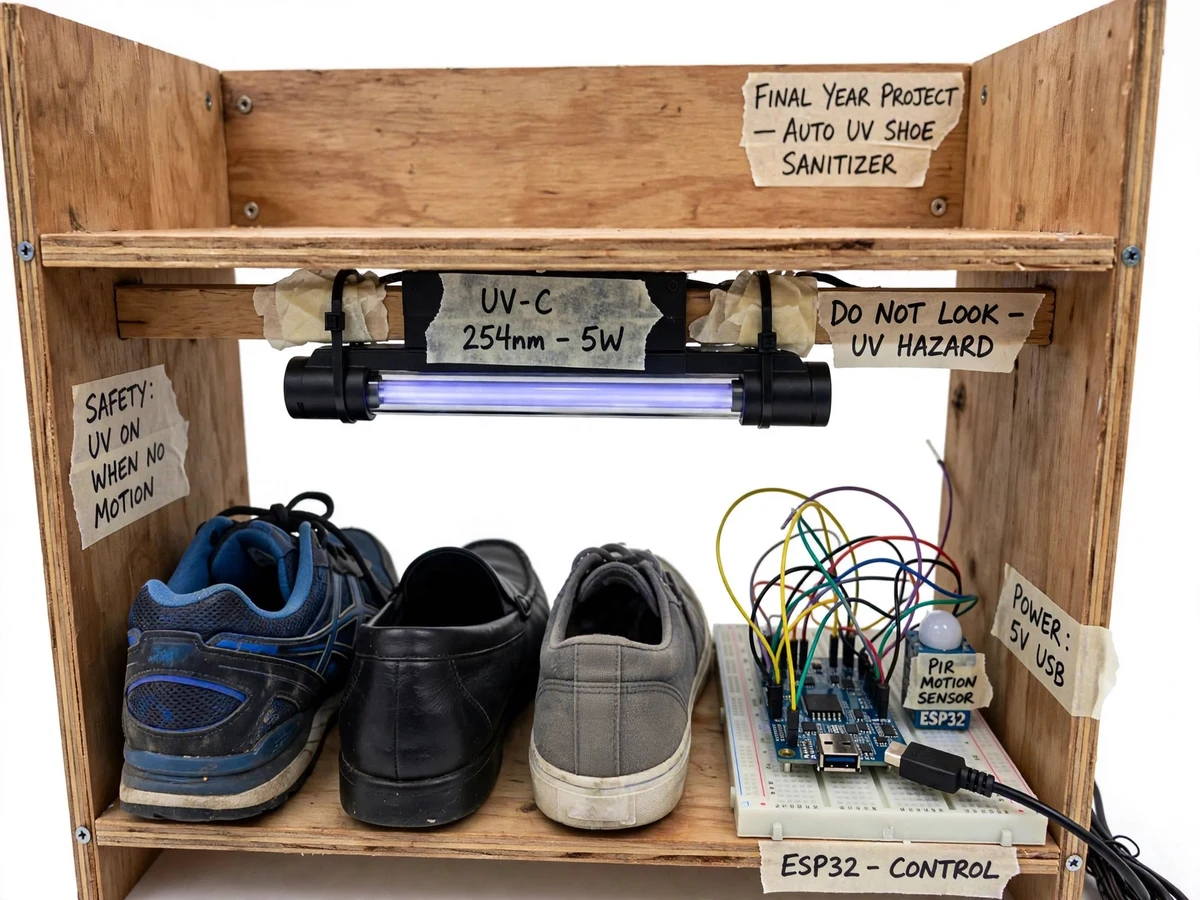
Footwear stored in closed racks stays damp and dark, which lets odour-causing microbes thrive, and most sanitizing solutions are either manual sprays or sealed commercial boxes a student cannot open up and learn from. A UV-C lamp mounted inside a shoe rack can sanitize the storage space on a schedule, but UV-C light must never shine on people or pets, so the control logic matters as much as the lamp. This project builds a student-scale smart shoe rack on an ESP32: a timed sanitizer cycle runs only after the PIR sensor confirms the area is clear, a relay switches the UV-C lamp, the LCD shows the countdown and status, and any motion during a cycle aborts it immediately with a buzzer alert. The cycle duration is configurable through push buttons, so the student can demonstrate and document the timing behaviour in the report.
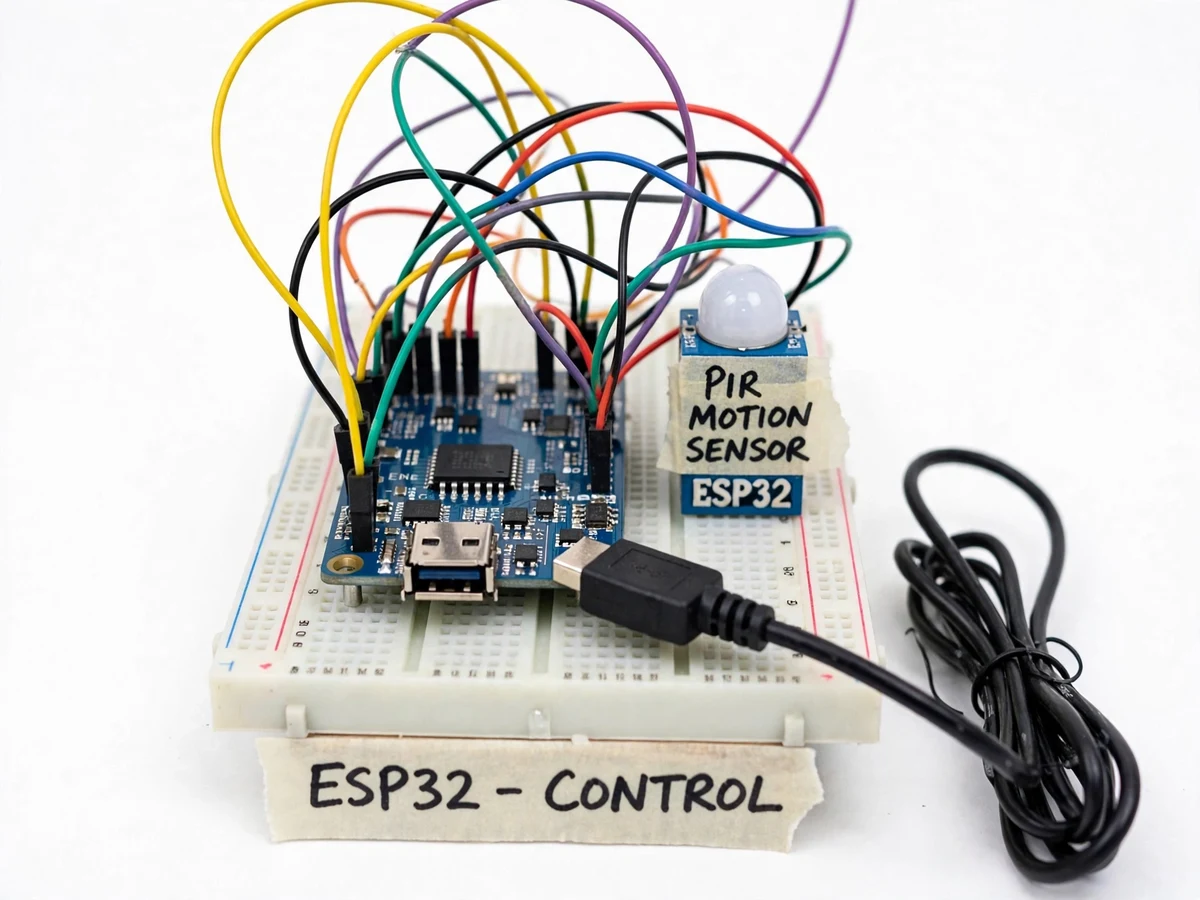
Watches the area in front of the shoe rack.
Follow the working sequence
How it works
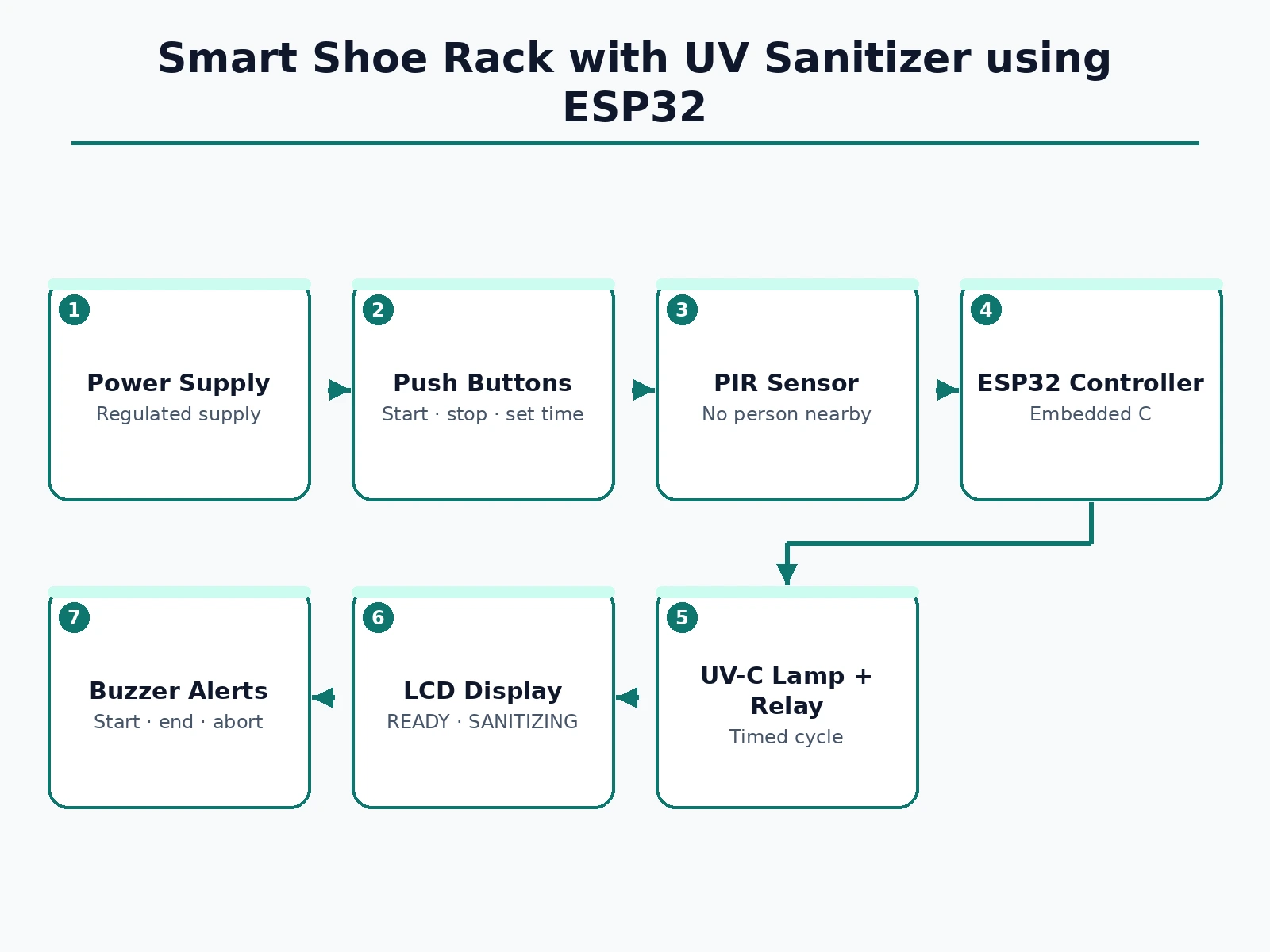
- The PIR sensor continuously watches the area in front of the shoe rack; the ESP32 keeps the UV-C lamp OFF whenever motion is detected.
- When the area is clear, the student presses the start button (or the schedule triggers) and the ESP32 sounds a short warning beep.
- After a brief delay the relay energizes the UV-C lamp inside the rack and the LCD switches to SANITIZING with a live countdown.
- If the PIR sensor detects any motion during the cycle, the firmware cuts the relay instantly, aborts the cycle and shows ABORTED on the LCD.
- When the countdown completes with no interruption, the relay switches the lamp off, the buzzer plays the completion tone and the LCD returns to READY.
- The cycle duration can be changed with the push buttons, and the firmware stores the setting so it survives a power cycle.
Tech stack:
- ESP32 development board
- UV-C sanitizer lamp with relay module
- PIR motion sensor
- 16x2 character LCD
- Buzzer and push buttons
- Arduino IDE (C/C++ firmware)
- 5 V / 12 V regulated power supply
| Parameter | Value |
|---|---|
| Controller | ESP32 development board |
| Sanitizer source | UV-C lamp, relay-switched |
| Cycle duration | Configurable, design default approximately 10 min |
| Safety interlock | PIR motion sensor, cycle aborts on detection |
| Display | 16x2 character LCD (status + countdown) |
| Alerts | Buzzer (start, complete, abort tones) |
| Power | 5 V logic supply + lamp supply per lamp rating (design) |
| Rack capacity | Design: 2-shelf model rack, approximately 4–6 pairs |
Project features
- [Timed UV-C sanitizer cycle] A UV-C lamp inside the rack runs a configurable sanitizer cycle (design default approximately 10 minutes), switched by a relay under ESP32 control.
- [PIR safety interlock] The lamp starts only when the PIR sensor confirms no person is near the rack, and any motion detected mid-cycle aborts the lamp immediately.
- [LCD status display] A 16x2 LCD shows READY, SANITIZING with countdown, and ABORTED states so the operating sequence is visible at all times.
- [Buzzer alerts] Short beeps mark cycle start, cycle completion and safety aborts, giving audible feedback without watching the display.
- [Configurable cycle duration] Push buttons adjust the sanitizer duration in the firmware, so the timing behaviour can be demonstrated and documented.
- [Manual cycle control] A start button begins a cycle on demand and a stop button cancels it, alongside the automatic scheduled mode.
- [Complete build documentation] Wiring diagram, firmware with commented logic, UV safety notes and a calibration-style test procedure are included.
What is included
- Working smart shoe rack prototype with UV-C lamp, ESP32 controller, PIR sensor, LCD and buzzer
- Complete firmware with commented sanitizer-cycle and safety-interlock logic
- Wiring diagram and connection table
- UV safety notes and a buyer-run functional test procedure
- Project report PDF (background, system design, firmware logic, safety analysis)
- PPT presentation for final review
- Viva Q&A preparation document (ESP32, relays, PIR sensing, UV-C safety)
Limitations & prerequisites
- UV-C light is harmful to skin and eyes — the prototype is a demonstration model and the interlock logic must be verified by the buyer before any real use; never look directly at the lit lamp.
- No germicidal efficacy is measured or claimed — the project demonstrates the timed-cycle control and safety interlock, not a certified sanitization result.
- The rack is a small demonstration model, not full-size furniture; lamp coverage is limited to the model interior.
- The PIR sensor needs a clear line of sight and can be triggered by pets or passing movement, which aborts cycles by design.
- Lamp life and replacement follow the lamp manufacturer's datasheet; no lifetime testing is performed.
- Wi-Fi/cloud features are not included in this build — control is fully on-device.
Frequently Asked Questions
How does the safety interlock work?
The PIR sensor watches the area around the rack. The ESP32 starts the UV-C lamp only when the area is clear, and if any motion is detected while the lamp is on, the firmware cuts the relay immediately and marks the cycle aborted on the LCD.
Is the UV-C lamp dangerous?
UV-C light can harm skin and eyes, which is exactly why the project centers on the interlock logic. The abstract and report include UV safety notes, and the buyer verifies the abort behaviour with the included test procedure before any use.
Can the sanitizer duration be changed?
Yes — push buttons adjust the cycle length in firmware and the setting is stored, so different durations can be demonstrated and documented in the report.
Does it connect to Wi-Fi or an app?
No, this build is fully on-device: buttons, LCD and buzzer. Remote scheduling is listed as future scope in the report.
What proves the cycle actually ran?
The LCD countdown, the buzzer completion tone and the firmware's logged state transitions. No microbial kill-rate is claimed — the report documents the control and safety behaviour honestly.
Is this project suitable for a final-year project?
Yes — for Electronics, Electrical and IoT & Embedded programs. It combines embedded C programming, sensor-actuator interfacing, relay control and a genuine safety-engineering problem. Suitable for B.E./B.Tech final-year projects in Electronics, Electrical and IoT & Embedded.
Components & software requirements
- ESP32 development board
- UV-C sanitizer lamp with relay module
- PIR motion sensor
- 16x2 character LCD
- Buzzer and push buttons
- Arduino IDE (C/C++ firmware)
- 5 V / 12 V regulated power supply
Delivery information
Built-to-order project. Delivery timeline is shared after order confirmation based on current queue.
Support terms
Complete documentation, setup guide, and viva preparation included. Support for setup and explanation provided.
Download free synopsis (PDF)
Enter your name and WhatsApp number — the synopsis PDF downloads immediately. We may send occasional project updates on WhatsApp; no spam.