
More project photos (3)
The problem
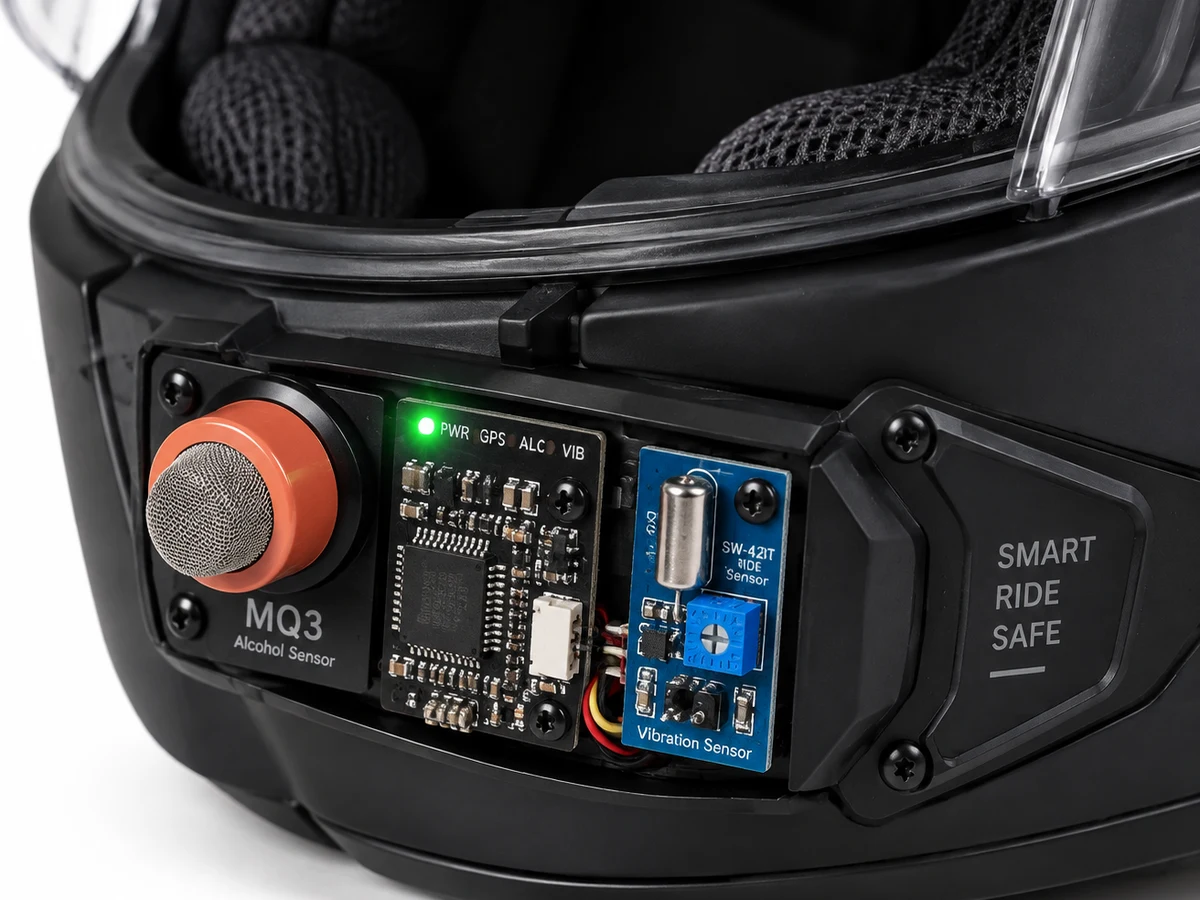
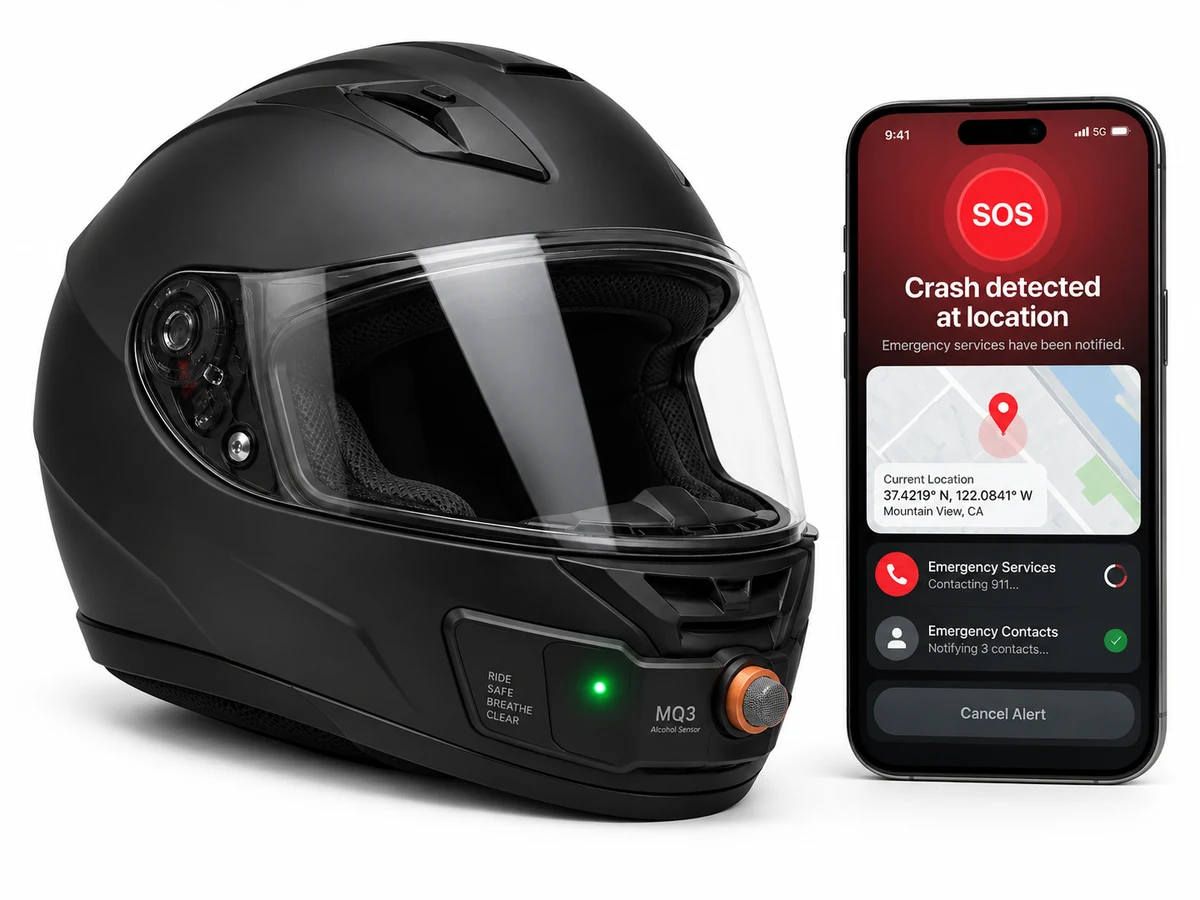
Drunk riding and delayed crash response kill thousands on Indian roads every year. This helmet fights both: an MQ-3 alcohol sensor in the helmet blocks the bike's ignition when alcohol is detected, and an accelerometer watches for crash impacts — on a confirmed crash it texts GPS coordinates to emergency contacts via GSM within seconds. It's an evergreen high-volume student search with permanent road-safety relevance in India. Competitor pages exist but they're old catalog entries; this is the 2026 refresh — ESP32, GPS+GSM live tracking, Blynk/app alerts — with a video-grade demo and a complete report kit.
Samples breath alcohol; trips above the threshold.
Follow the working sequence
How it works
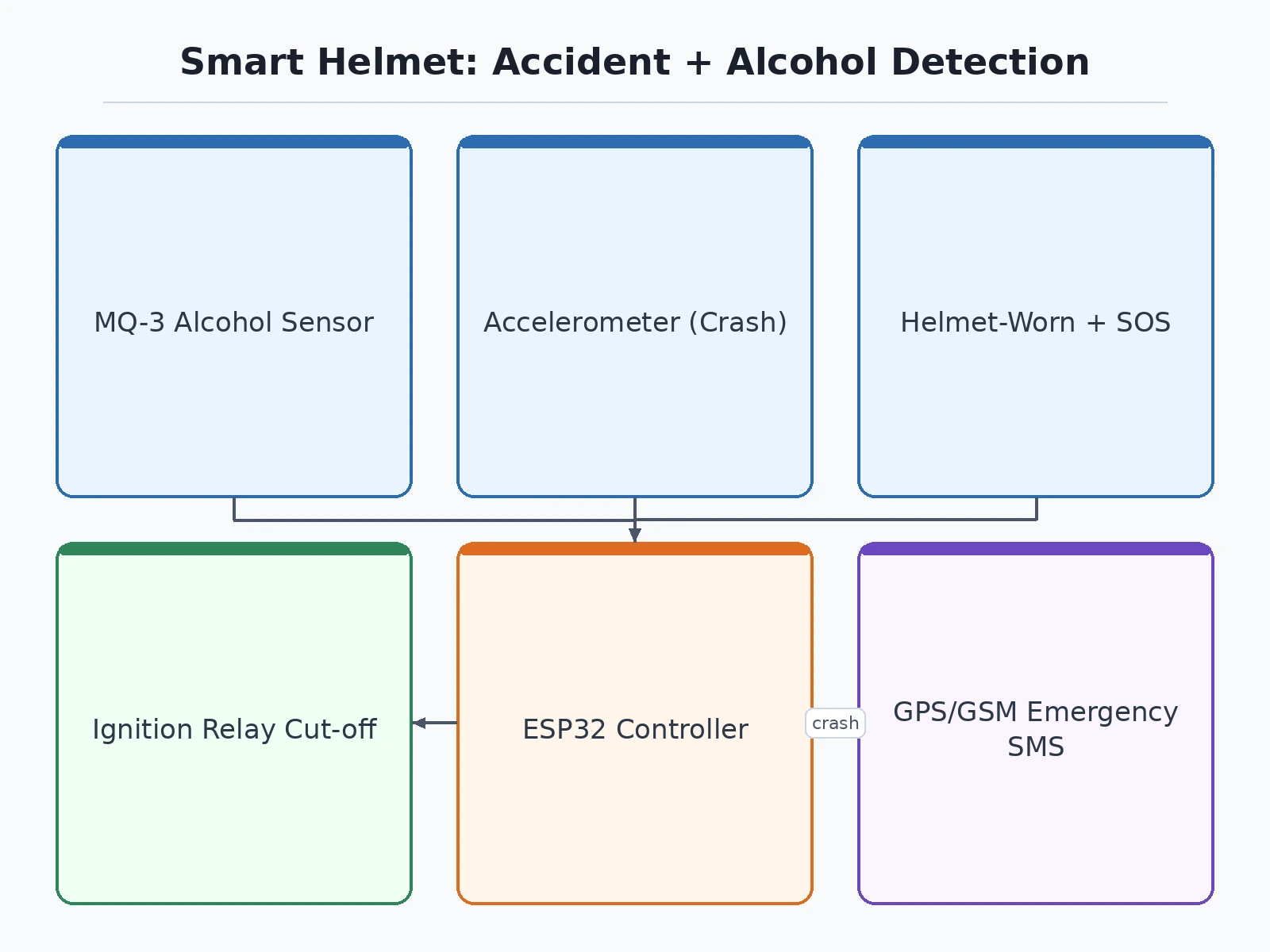
- The rider wears the helmet; the proximity sensor confirms wear and the MQ-3 samples breath alcohol level.
- If alcohol exceeds the threshold, the ESP32 keeps the ignition relay open — the bike cannot start — and the app shows a lockout status.
- On sober start, the relay closes and the ride begins; the accelerometer continuously monitors for crash signatures.
- A detected impact starts the 15-second cancel window; if not cancelled, the GPS fix is attached to an SMS sent via GSM to all emergency contacts.
- The Blynk dashboard logs every event — lockouts, rides, alerts — with timestamps and locations.
Project features
- MQ-3 alcohol sensor: ignition relay stays open (bike won't start) when alcohol is detected
- Crash detection via accelerometer with impact-threshold and fall-confirmation logic
- GPS + GSM: auto-SMS with Google Maps location link to 3 emergency contacts on crash
- Manual SOS button for non-crash emergencies
- Helmet-worn detection: ignition requires the helmet to be worn (IR/proximity check)
- Blynk/app dashboard: live alcohol status, crash alerts, and ride history
- False-trigger guard: 15-second cancel window via button before the alert SMS fires
- Low-battery and GSM-signal status indicators
What is included
- Complete ESP32 firmware with full source code
- Circuit diagram and helmet-mounting/wiring guide
- Blynk dashboard template + alert message formats
- Project report PDF (synopsis, literature on road-safety tech, design, testing, results)
- Presentation PPT for review/demo day
- Viva Q&A sheet covering sensors, GSM/GPS, thresholds, and safety-system design
- Demo script: alcohol lockout and simulated crash-alert walkthrough
Advantages
- MQ-3 alcohol sensor wired to an ignition relay — the bike's ignition stays open and it won't start when alcohol is detected above the threshold.
- Crash detection via accelerometer with an impact threshold and fall-confirmation logic, not just a single shake that could false-trigger.
- GPS + GSM auto-SMS with a Google Maps location link to 3 emergency contacts the moment a crash is confirmed.
- Manual SOS button for non-crash emergencies, plus helmet-worn detection so the ignition interlock requires the helmet to actually be worn (IR/proximity check).
- Blynk/app dashboard showing live alcohol status, crash alerts and ride history, with low-battery and GSM-signal status indicators.
- False-trigger guard: a 15-second cancel window via the button before the alert SMS fires, so dropped-helmet moments don't spam contacts.
Disadvantages
- Alcohol sensing is indicative/educational grade, not evidential breathalyzer accuracy — stated clearly in the report.
- GPS needs open-sky visibility and GSM alerts need cellular coverage plus an active SIM; no signal means no alert.
- The ignition interlock is demonstrated on a demo rig; wiring it into a real bike should be done by a qualified mechanic.
- Crash detection uses threshold logic — extreme off-road riding or rough terrain may need threshold retuning to avoid false positives.
Limitations & prerequisites
- Alcohol sensing is indicative/educational grade, not evidential breathalyzer accuracy — stated clearly in the report
- GPS needs open-sky visibility; GSM alerts need cellular coverage and an active SIM
- The ignition interlock is demonstrated on a demo rig; real-bike wiring should be done by a qualified mechanic
- Crash detection uses threshold logic; extreme off-road riding may need threshold retuning
- This is a built-to-order project — delivery time depends on component availability
Components & software requirements
- ESP32 microcontroller
- MQ-3 alcohol sensor
- MPU6050 accelerometer/gyroscope (crash detection)
- NEO-6M GPS module
- SIM800L GSM module (+ SIM)
- Relay module (ignition interlock)
- IR proximity sensor (helmet-worn detection)
- Push buttons (SOS + alert cancel), buzzer, battery pack, helmet mounting kit
Download free synopsis (PDF)
Enter your name and WhatsApp number — the synopsis PDF downloads immediately. We may send occasional project updates on WhatsApp; no spam.
Dhere et al. (2025), Smart helmet for accident detection and prevention using IoT, IJSRA 15(01)