
More project photos (2)
The problem
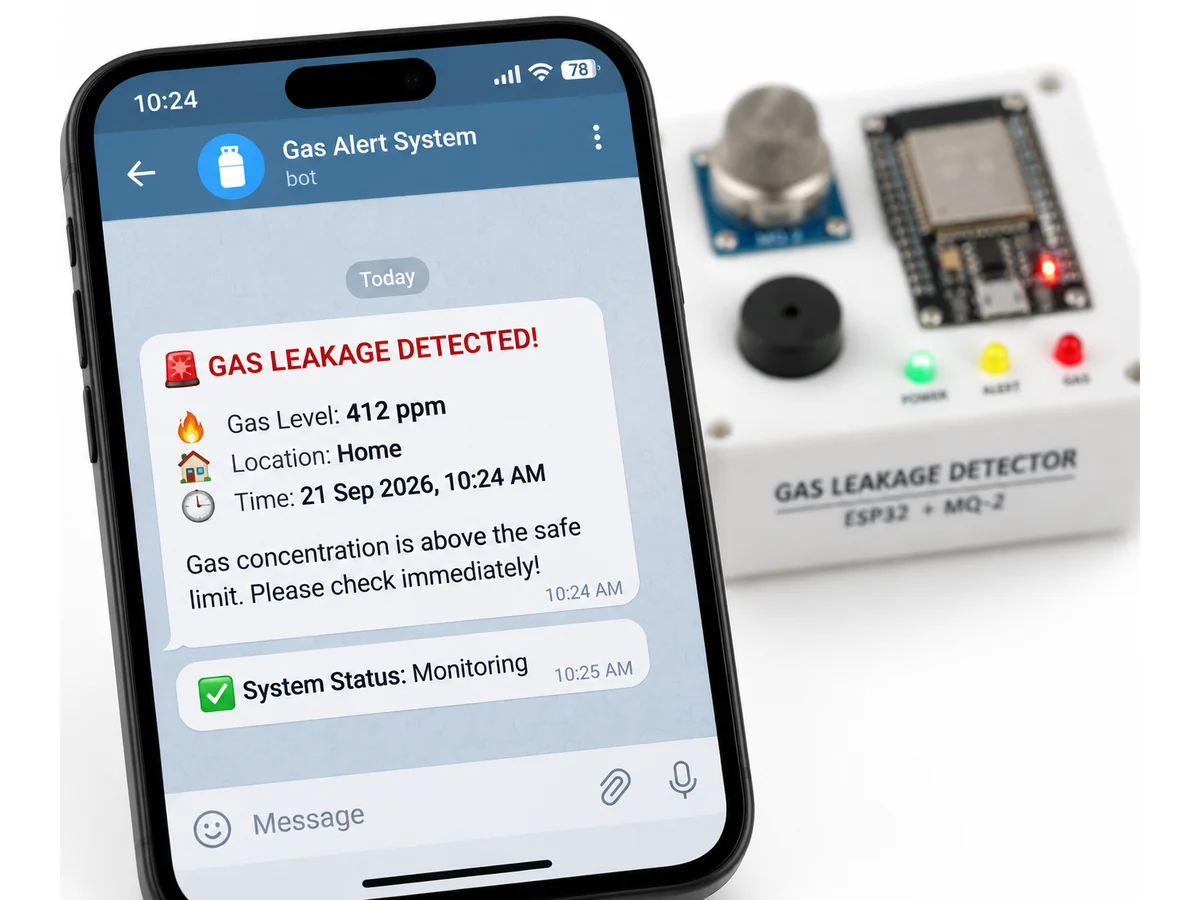
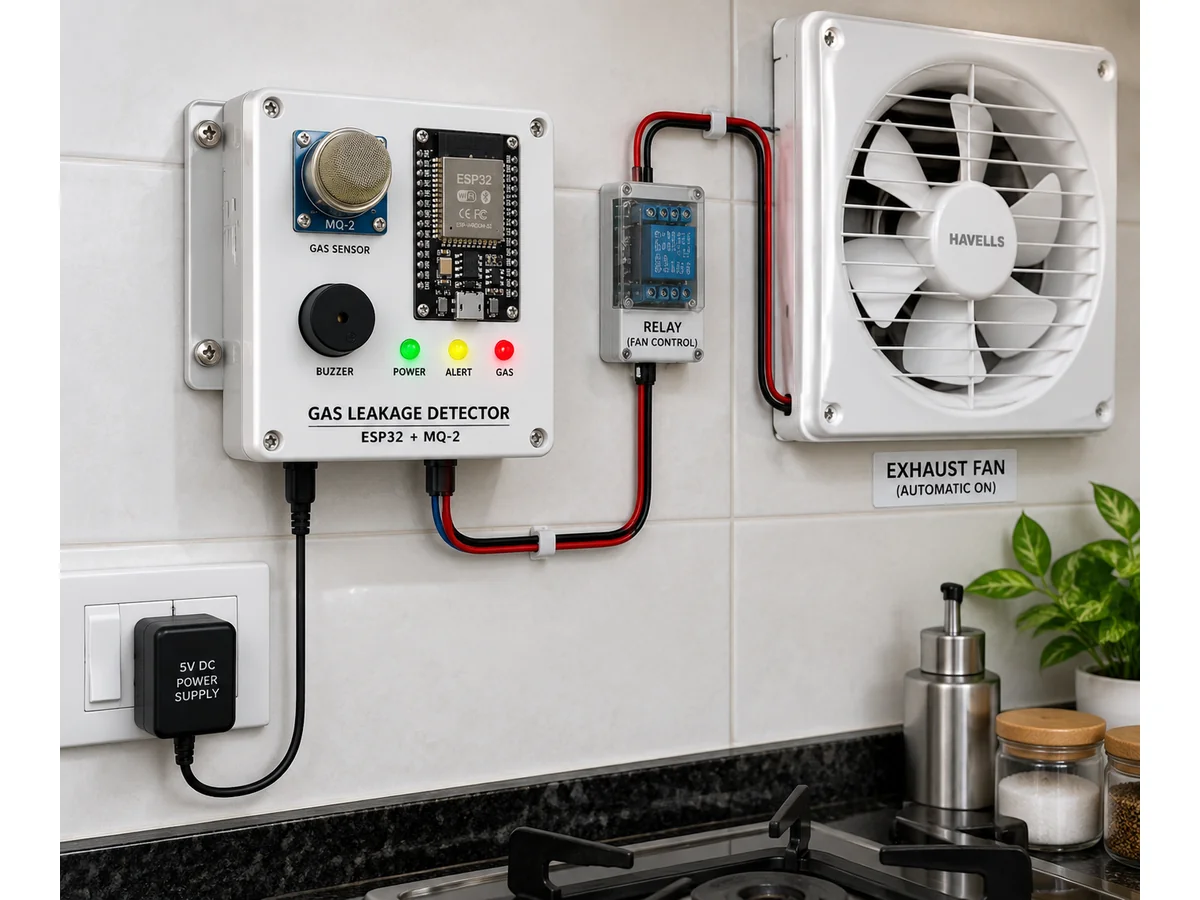
Gas leaks cause some of the most preventable household accidents in India. This gas leakage detector project using ESP32 continuously monitors LPG concentration with an MQ-2 sensor and responds automatically: a local buzzer raises an alarm, a relay switches on an exhaust fan to ventilate the area, and an instant Telegram message reaches your phone wherever you are. Built on the ESP32's built-in Wi-Fi, it needs no extra GSM module and works with any home router. A compact, low-cost, high-safety-relevance build — ideal as a final year project for ECE, EEE, and electronics diploma students, with complete report, source code, and viva support included.
How it works
- The MQ-2 sensor's tin-dioxide sensing element changes resistance in the presence of combustible gases (LPG, methane, propane, smoke).
- The ESP32 samples the sensor's analog output every few seconds, smooths the readings, and maps them to a gas-concentration value.
- When the value crosses the danger threshold: the buzzer sounds, the relay energizes the exhaust fan, and the ESP32 sends a pre-formatted alert to your Telegram bot.
- Once gas levels fall back below the threshold, the system sends an "all clear" message and returns the fan and buzzer to standby.
Project features
- MQ-2 semiconductor gas sensor calibrated for LPG detection with adjustable sensitivity via onboard potentiometer
- ESP32 reads analog gas levels continuously and compares against a configurable danger threshold
- Loud local buzzer alarm triggers the moment the threshold is crossed
- Relay automatically switches on an exhaust fan (or ventilation system) to disperse leaked gas
- Instant Telegram alert messages sent to your phone via Telegram Bot API on leak detection and on all-clear
- Status LED indication for normal, warning, and leak conditions
- Calibration mode with serial monitor readout to set the right baseline for your room
- Low component cost — total hardware under typical academic project budgets
What is included
- Assembled hardware unit (sensor wired and tested)
- Complete firmware source code (Arduino IDE) with configurable thresholds and Wi-Fi/Telegram credentials
- Wiring diagram and circuit explanation
- Report PDF: abstract, block diagram, methodology, results, conclusion
- PPT presentation for project review
- Viva Q&A document with expected questions and answers
Limitations & prerequisites
- Requires a working Wi-Fi connection for Telegram alerts; local buzzer and fan work without internet
- MQ-2 detects gas presence, not exact concentration — readings are indicative, and the sensor needs ~1–2 minutes of warm-up after power-on
- The sensor should be mounted near floor level, since LPG is heavier than air — mounting height affects sensitivity
- This is an academic safety demonstration, not a certified commercial gas-safety product
Components & software requirements
- ESP32 development board (built-in Wi-Fi)
- MQ-2 gas sensor module
- Active buzzer (5V)
- Single-channel relay module
- Exhaust fan (12V DC) or equivalent load
- LEDs and current-limiting resistors
- Breadboard / PCB, jumper wires, 5V power supply