
More project photos (3)
The problem
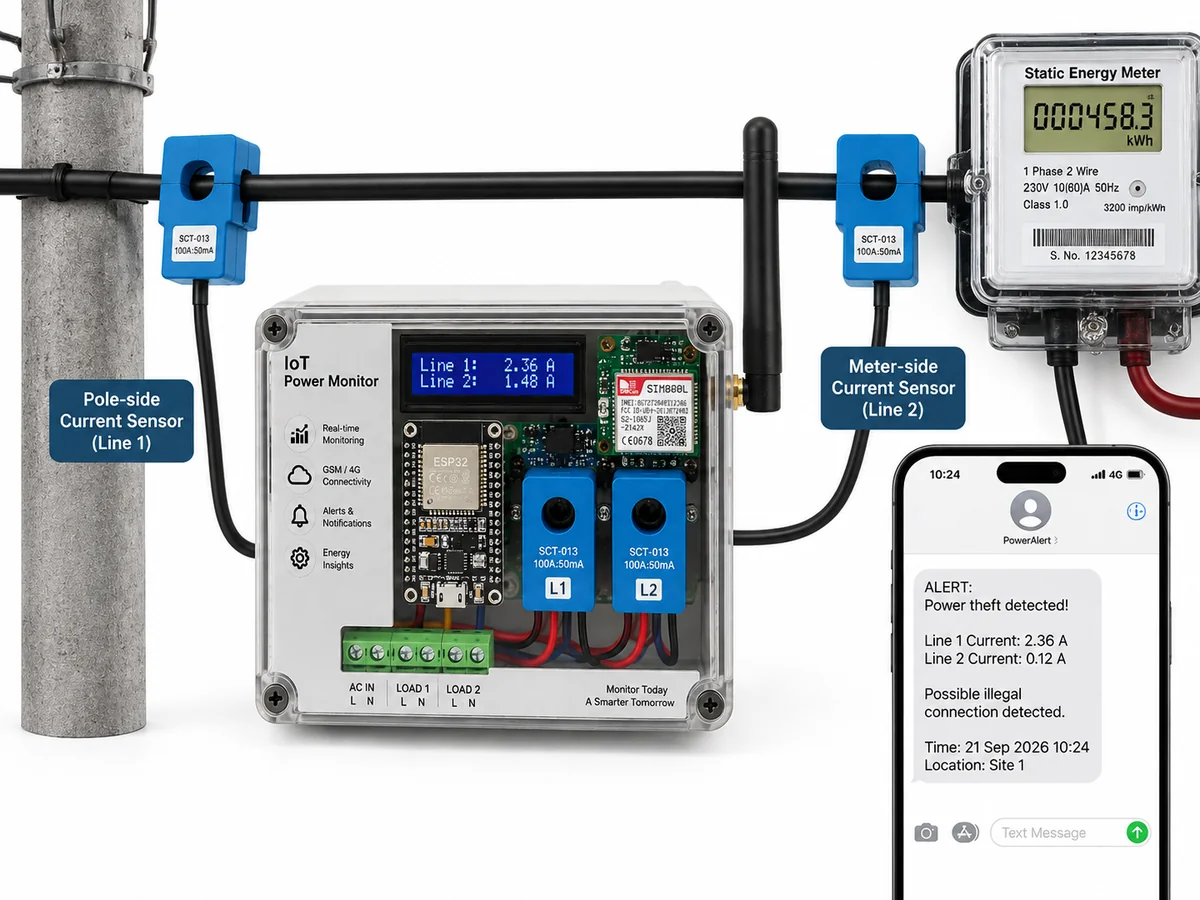
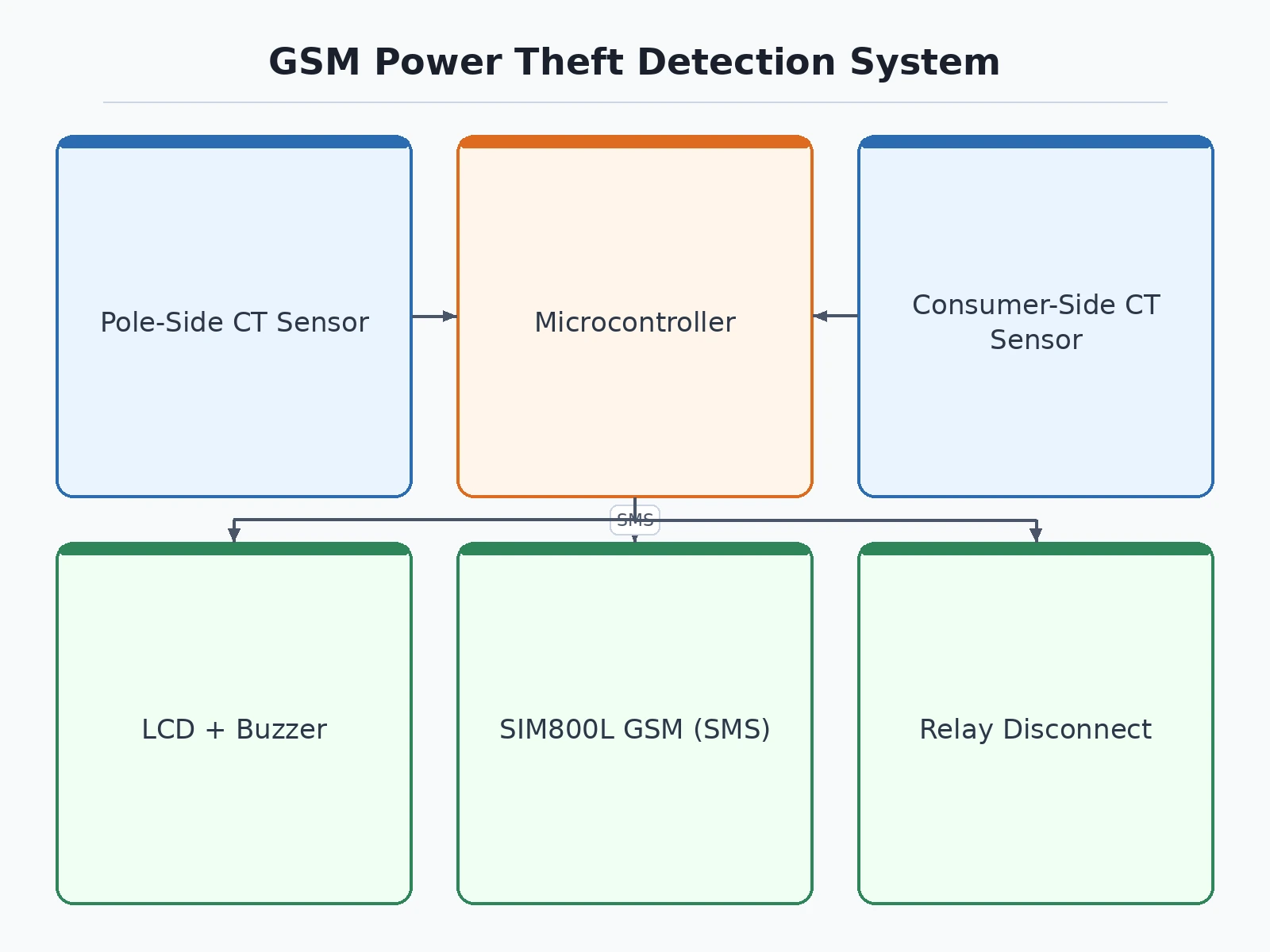
Electricity theft costs distribution utilities crores of rupees every year through meter bypassing, direct line tapping, and meter tampering. This GSM based power theft detection project gives utilities — and you, as a final-year EEE student — a working, field-deployable answer: a differential current-sensing unit that spots theft automatically and reports it by SMS within seconds. No internet, no cloud subscription, no manual inspection rounds needed. The detector sits between the pole and the consumer meter. Two current sensors feed the ESP32 — one on the supply side, one on the load side. When the readings diverge beyond a calibrated tolerance, the unit knows power is being drawn before the meter and raises the alarm. It is a classic power-systems-plus-embedded final year project with strong viva depth: distribution losses, current transformers, differential protection logic, and GSM communication in one build.
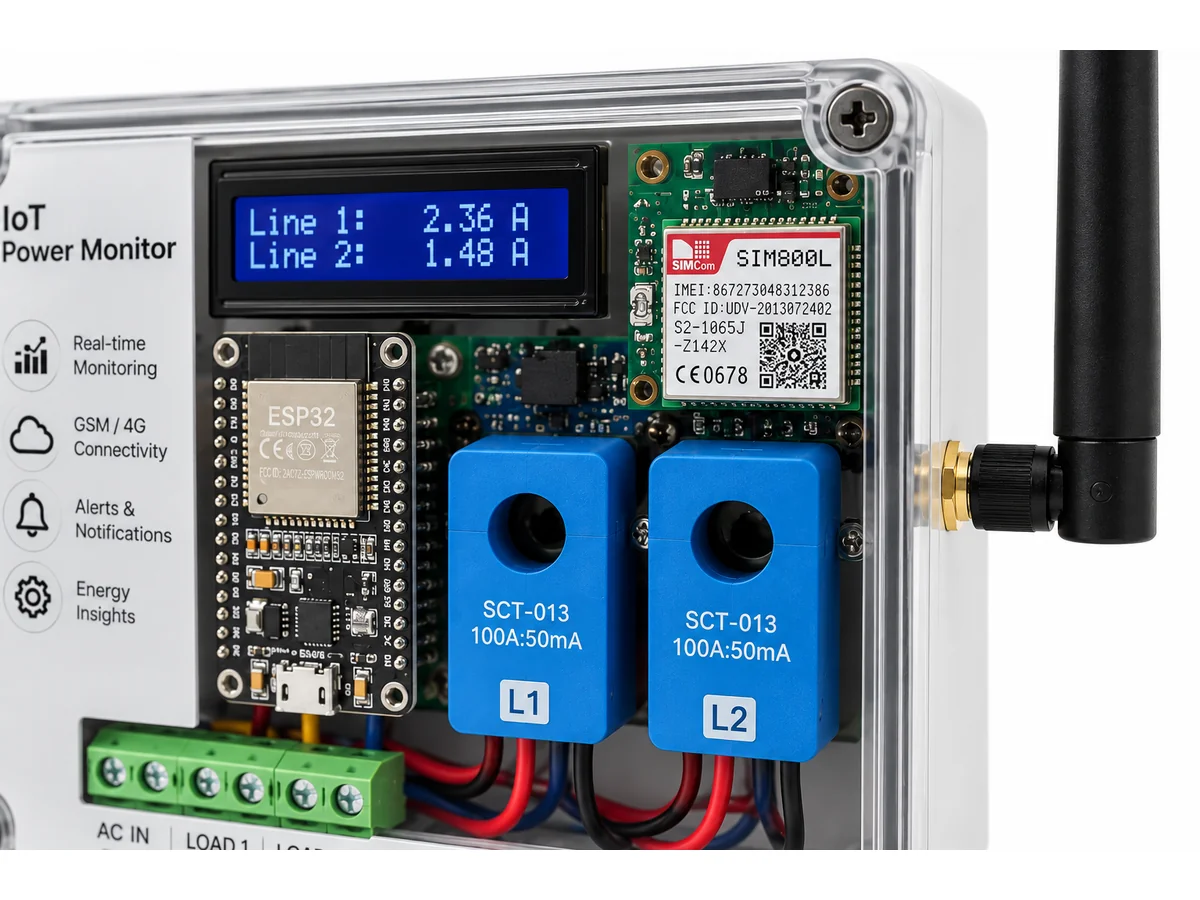
Clamp-on current transformer around the pole-side supply conductor, upstream of the meter.
Follow the working sequence
How it works
- Install the two CT clamp sensors: one around the pole-side supply conductor, one around the consumer-side conductor after the meter.
- The ESP32 samples both sensors several times per second and computes the differential (pole current minus consumer current).
- Legitimate line losses keep the differential inside a calibrated tolerance band — no alarm.
- Meter bypass, direct tapping before the meter, or meter tampering pushes pole-side current above consumer-side current beyond tolerance — the ESP32 flags a theft event.
- Within seconds, the SIM800L sends an SMS to the registered staff numbers: location ID, pole-side amps, consumer-side amps, and time of detection.
- Optionally, the relay trips the feeder connection; the LCD and buzzer raise the alarm on site.
- When the tamper clears (or after a manual reset), monitoring resumes automatically.
Project features
- Dual-CT differential current sensing (pole side vs consumer side) — the core theft-detection principle
- Automatic tamper flag when the current mismatch crosses the set tolerance (default 10%)
- Instant SMS alerts over GSM (SIM800L) to up to 3 registered utility staff numbers
- Location/pole ID, both current readings, and timestamp embedded in every alert SMS
- Optional relay output for automatic supply disconnection on confirmed theft
- Live 16x2 LCD display showing both current values and system status
- Buzzer plus on-device "THEFT DETECTED" indication for field demonstrations
- Works on the cellular network alone — no WiFi or internet required, ideal for rural feeders
- Adjustable theft threshold and alert numbers via simple firmware configuration
What is included
- Assembled & tested detector unit (built to order)
- ESP32 firmware source code (Arduino IDE project)
- Wiring diagram and step-by-step connection guide
- Project report PDF (synopsis, block/circuit diagrams, working principle, test results, conclusion)
- Seminar/demo PPT
- Viva Q&A preparation document
Advantages
- Dual-CT differential current sensing (pole side vs consumer side) — any mismatch beyond the set tolerance (default 10%) flags tampering automatically.
- Instant SMS alerts over GSM to up to 3 registered utility staff numbers, with pole ID, both current readings and timestamp in every message.
- Works on the cellular network alone — no Wi-Fi or internet needed, ideal for rural feeders.
- Optional relay output for automatic supply disconnection on confirmed theft.
- Live 16x2 LCD display, on-device buzzer, and adjustable theft threshold and alert numbers via simple firmware configuration — strong demo material.
Disadvantages
- Requires GSM network coverage at the installation site; SMS delivery speed depends on the carrier.
- Very small theft currents can hide inside the tolerance band — threshold calibration at install time matters.
- The unit flags the feeder section between its two sensors; it does not pinpoint the exact tap point along a long line.
- CT sensors must be rated for the feeder's maximum current; relay auto-disconnection must comply with local utility norms, and battery backup is an optional add-on.
Limitations & prerequisites
- Requires GSM network coverage at the installation site; SMS delivery speed depends on the carrier
- Very small theft currents can hide inside the tolerance band — threshold calibration at install time matters
- The unit flags the feeder section between its two sensors; it does not pinpoint the exact tap point along a long line
- CT sensors must be rated for the feeder's maximum current
- Automatic disconnection via relay is optional and should comply with local utility disconnection norms
- Battery backup for monitoring during outages is an optional add-on
Components & software requirements
- ESP32 development board (fast ADC sampling; Arduino framework firmware)
- Current transformer sensors x2 (e.g., SCT-013 clamp type, 100 A rating)
- SIM800L GSM module with antenna and SIM slot
- Single-channel relay module (for optional auto-disconnect)
- 16x2 LCD with I2C backpack (live dual current readout)
- Active buzzer (tamper alarm)
- DC power supply / buck converter module
- Enclosure, terminal connectors, PCB/vero board, wiring
Download free synopsis (PDF)
Enter your name and WhatsApp number — the synopsis PDF downloads immediately. We may send occasional project updates on WhatsApp; no spam.
"GPS-Based Power Theft Detection and Alert System using GSM" (2023), Proc. IEEE RMKMATE