
More project photos (3)

The problem
A fixed solar panel loses 25–40% of harvestable energy simply because the sun moves. This dual-axis solar tracker follows the sun across both azimuth and elevation using four LDR sensors and two servo motors, while an MPPT charge controller squeezes maximum power out of every watt the panel produces. Built-in voltage/current logging lets you measure and prove the yield gain — fixed vs tracked, side by side, over full days. A proven kit-format final year project with real measured results.
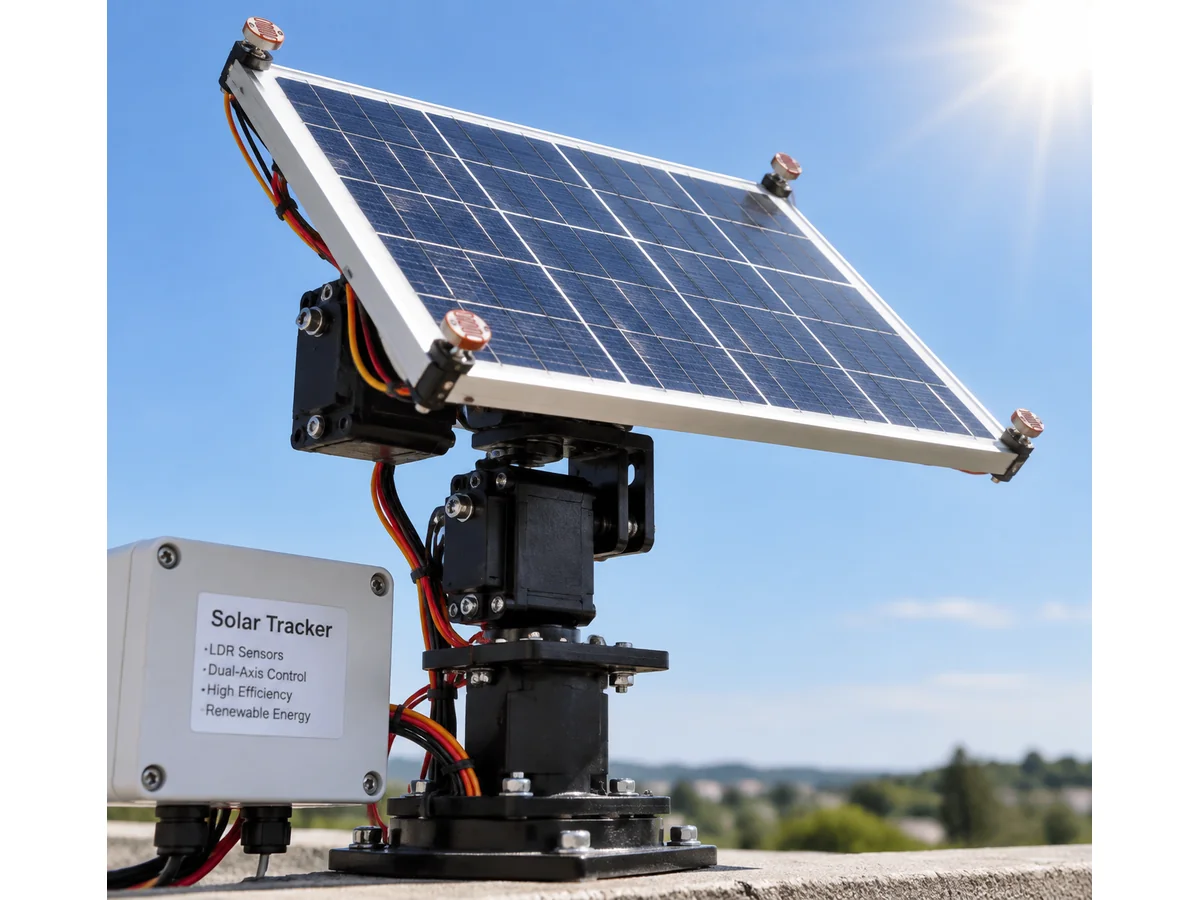
Four LDR sensors in quadrants with a light divider measure sunlight from four directions.
Follow the working sequence
How it works
- Four LDR sensors arranged in quadrants (with a light divider between them) measure sunlight intensity from four directions.
- The microcontroller compares the four readings and drives two servo motors to rotate and tilt the panel toward the brightest point.
- A continuous control loop re-centers the panel as the sun moves through the day.
- The MPPT charge controller continuously finds the panel's maximum power point and charges the 12V battery at peak efficiency.
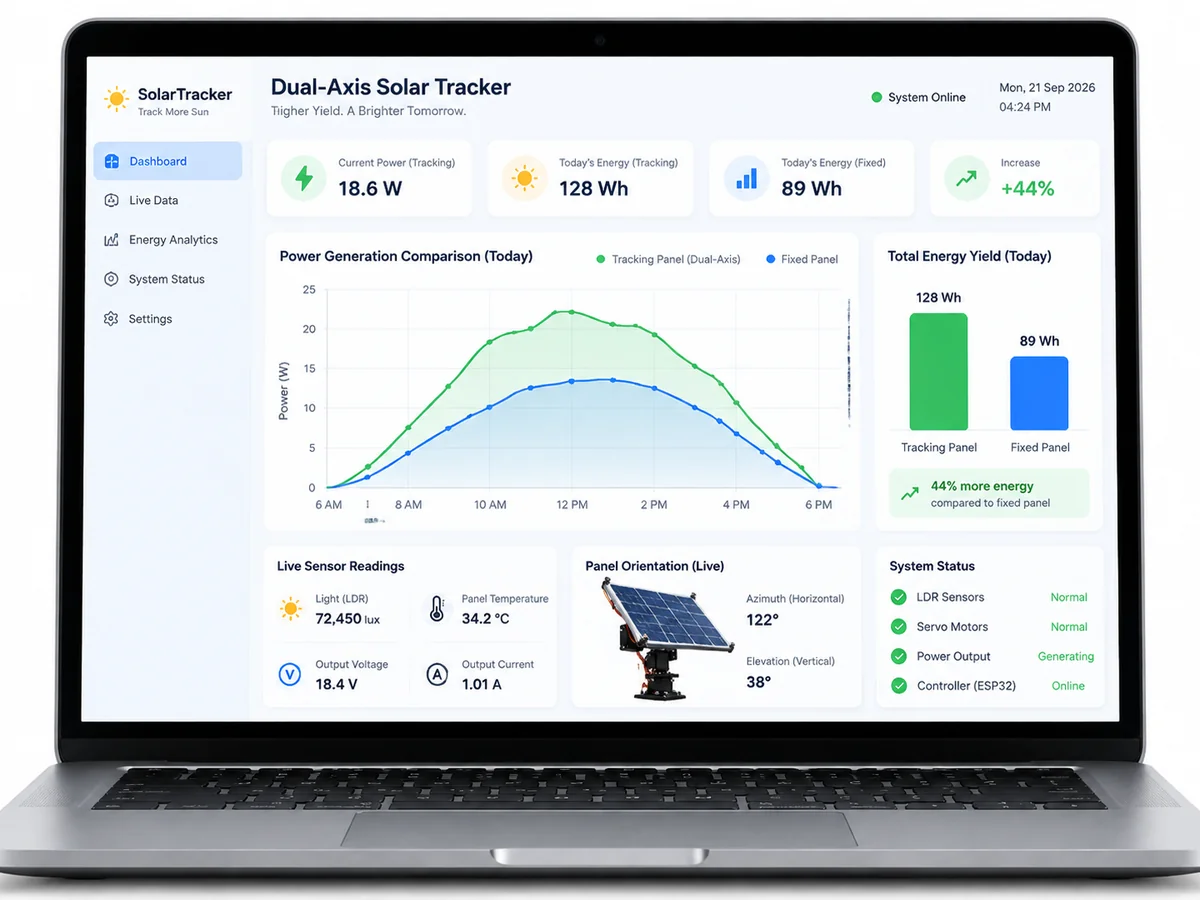
- Voltage and current sensors log power output; a fixed-reference mode lets you quantify exactly how much extra energy tracking delivers.
Project features
- Dual-axis sun tracking (azimuth + elevation) with 4 LDR sensors and 2 servo motors
- MPPT charge controller for up to ~30% higher charging efficiency than PWM
- Real-time voltage, current and power logging (Arduino/ESP32)
- Fixed vs tracked yield-comparison mode — real measured gain data for your report
- Automatic night parking (returns to east position) with manual override
- LCD display plus serial/cloud dashboard of live parameters
- Kit-format build — works with a lamp indoors or real sun outdoors
What is included
- Assembled dual-axis tracker unit (panel + gimbal + control box)
- Firmware source code (Arduino/ESP32) with comments
- Wiring diagram and step-by-step assembly guide
- Project report PDF — abstract, design, circuit details, measured yield data
- PPT presentation for project review
- Viva Q&A preparation document
Advantages
- Dual-axis tracking (azimuth + elevation) with four LDR sensors and two servo motors follows the sun through the day for higher energy harvest than a fixed panel.
- MPPT charge controller delivers up to ~30% higher charging efficiency than PWM controllers.
- Real-time voltage, current and power logging enables a fixed-vs-tracked yield comparison with real measured gain data for the report.
- Automatic night parking returns the panel to the east position, with manual override for setup and demos.
- Kit-format build works indoors with a lamp or outdoors in real sun, so it can be demoed in any venue.
- LCD display plus serial/cloud dashboard shows live parameters during operation.
Disadvantages
- Tracking gain depends on weather — overcast days show smaller improvements over a fixed panel.
- The tracking servos consume power; reported net-gain figures already account for this consumption.
- The MPPT module is sized for small panels (up to ~20W) — it is not meant for rooftop-scale systems.
- Indoor demo mode uses a lamp as the sun; real sunlight gives the best results.
- Continuous outdoor use causes gradual servo wear, so occasional recalibration may be needed.
Limitations & prerequisites
- Tracking gain depends on weather — overcast days show smaller improvements
- The servos consume power; reported net gain already accounts for tracker consumption
- MPPT module is sized for small panels (up to ~20W) — not for rooftop-scale systems
- Indoor demo mode uses a lamp as the "sun"; real sunlight gives the best results
- Continuous outdoor use causes gradual servo wear; occasional recalibration may be needed
Components & software requirements
- Solar panel (12V, 10–20W)
- 4× LDR sensors with quadrant divider housing
- 2× servo motors, pan + tilt (MG996R or equivalent)
- Arduino Uno / ESP32 microcontroller
- MPPT charge controller module (12V)
- Voltage + current sensors (voltage divider + ACS712)
- 12V rechargeable battery
- Pan-tilt gimbal frame, mounting hardware, 16×2 LCD, wiring and connectors
Download free synopsis (PDF)
Enter your name and WhatsApp number — the synopsis PDF downloads immediately. We may send occasional project updates on WhatsApp; no spam.
Solís-Cervantes et al. (2024), Mathematics 12(12), 1913 (MDPI)