
More project photos (3)

The problem
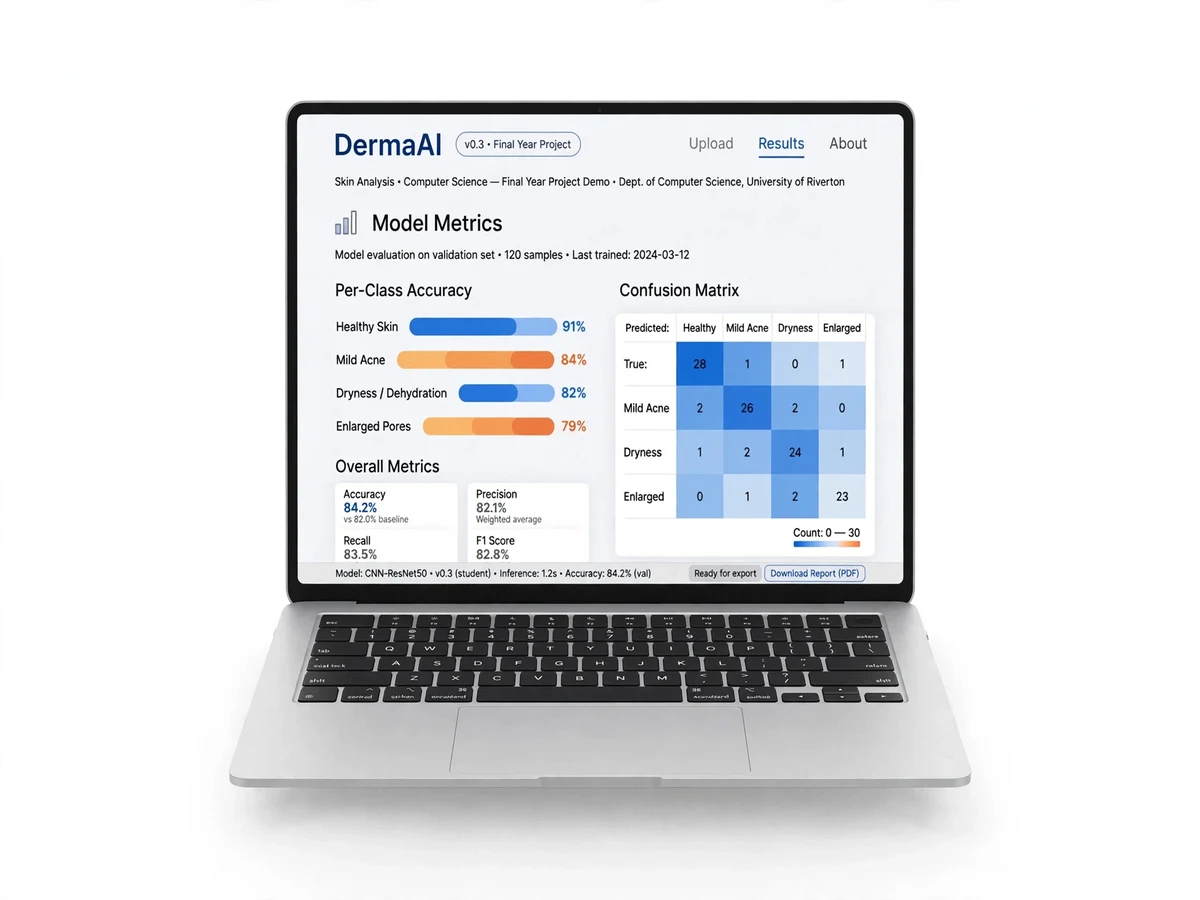
The Skin Disease Detection system is a healthcare-AI final-year project that identifies common skin conditions from ordinary smartphone photos. Dermatologists are scarce — India has roughly one dermatologist per 100,000 people — so an AI triage assistant that runs on a phone camera is both socially relevant and technically rich. This skin disease detection using CNN project trains a convolutional neural network on a HAM10000-style dermoscopic dataset covering seven lesion categories (melanoma, basal cell carcinoma, actinic keratosis, benign keratosis, dermatofibroma, vascular lesions, melanocytic nevi) and serves it through a mobile-friendly Flask web app called DermaAI.
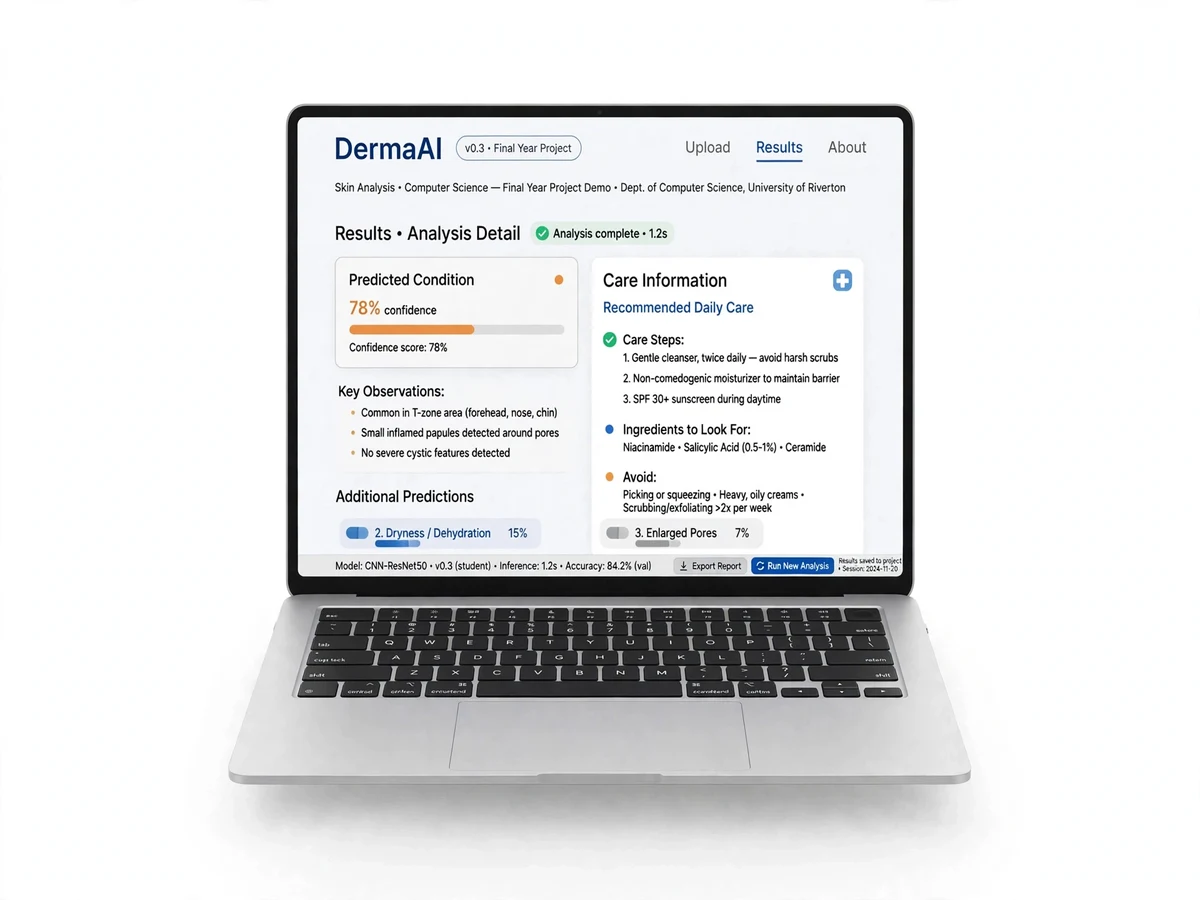
Upload a photo and DermaAI returns the top-3 predicted conditions with confidence scores, plain-language condition information and general care guidance — the kind of end-to-end demo that holds an examiner's attention from the first upload. The report documents the full ML pipeline: dataset analysis, class-imbalance strategy, transfer learning, augmentation, confusion-matrix evaluation and a responsible-use disclaimer section that shows the maturity examiners reward.
This is a built-to-order software project: code, trained model weights and the complete viva kit (report, PPT, Q&A) are prepared fresh for you.
Takes or uploads a close-up photo of the skin lesion.
Follow the working sequence
How it works
- The user takes or uploads a close-up photo of the skin lesion in the DermaAI app.
- The preprocessing pipeline crops, resizes and normalizes the image (224×224) for the CNN.
- The fine-tuned MobileNetV2 model classifies the lesion into one of seven categories.
- DermaAI shows the top-3 predictions with confidence bars, plus an info card for the top match: what the condition is, typical signs and general care guidance.
- A Grad-CAM overlay highlights the lesion region the model focused on, and high-risk predictions (e.g. suspected melanoma) carry a clear prompt to consult a dermatologist.
Project features
- Multi-class classification of 7 common skin conditions from phone photos
- Top-3 predictions with confidence scores and plain-language condition info
- General care guidance and "see a dermatologist" urgency flags per condition
- Mobile-first DermaAI web app — works from any smartphone browser
- MobileNetV2 transfer learning, optimized for fast on-device-style inference
- Class-imbalance handling for rare but critical classes like melanoma
- Grad-CAM visualization showing which lesion area drove the prediction
- Condition info cards: description, typical symptoms, general care tips
- Training notebooks with accuracy/loss curves and per-class precision/recall
- Photo-capture guidance in-app (lighting, focus, distance) for better results
What is included
- Complete source code (training, evaluation, inference, Flask app)
- Trained model weights (
.h5, plus TensorFlow Lite option) - Dataset preparation and augmentation scripts
- Project report PDF (dermatology background, methodology, results, ethics/disclaimer)
- PPT presentation for final review
- Viva Q&A preparation document (CNNs, transfer learning, multi-class metrics, Grad-CAM, class imbalance)
- Setup guide (environment, dependencies, dataset download steps)
FAQs
- Why is skin disease detection a strong final-year AI project? It combines a real access problem (dermatologist shortage) with a full multi-class deep-learning pipeline — transfer learning, class imbalance, augmentation, Grad-CAM and mobile deployment — giving examiners many angles to probe and you many angles to shine.
- What dataset is the model trained on? A HAM10000-style dataset of 10,000+ dermoscopic images across seven diagnostic categories, released by the ISIC archive community. The report documents class distribution and the imbalance strategy used for critical classes like melanoma.
- How does the app handle the melanoma risk responsibly? High-risk predictions display a prominent "consult a dermatologist promptly" banner, and every result screen carries the screening-aid disclaimer. The report's ethics section discusses false negatives explicitly — a discussion point that impresses examiners.
- Will it work on my phone for the demo? Yes — DermaAI is a mobile-responsive web app: open the URL on your phone, snap or upload a lesion photo, and get top-3 predictions in under a second. No app-store install needed for the review.
- Do I need a GPU? Only for training (scripts and cloud-GPU guidance included). The shipped trained weights infer in under a second on a regular laptop CPU.
- How accurate is it on real phone photos? Design target: ~85–90% top-1 accuracy on held-out test images after training — the report documents the evaluation procedure to run during your build. Casual phone photos with good lighting should perform close to that, while poor lighting degrades results — the report's error analysis documents this honestly and the app gives capture tips.
Advantages
- Multi-class classification of 7 common skin conditions from smartphone photos — no dermatoscope needed.
- Top-3 predictions with confidence scores and plain-language condition info, plus general care guidance and 'see a dermatologist' urgency flags per condition.
- Mobile-first DermaAI web app that works from any smartphone browser — highly demoable in a viva.
- MobileNetV2 transfer learning optimized for fast inference, with class-imbalance handling for rare but critical classes like melanoma.
- Grad-CAM visualization showing which lesion area drove the prediction, and condition info cards (description, typical symptoms, general care tips).
- Training notebooks with accuracy/loss curves and per-class precision/recall, plus in-app photo-capture guidance (lighting, focus, distance) for better results.
Disadvantages
- This is an educational screening aid, not a medical device — predictions are indicative only and must never replace a dermatologist's diagnosis or delay professional care.
- Trained primarily on dermoscopic-style images of lighter skin tones; accuracy on darker skin tones and on casual phone photos with poor lighting is lower — the report documents this bias honestly.
- Covers seven common conditions only; rare diseases and non-lesion skin issues are out of scope.
- Photo quality matters: blurry, shadowed or distant shots degrade accuracy, which is why the app includes capture guidance.
Limitations & prerequisites
- This is an educational screening aid, not a medical device — predictions are indicative only and must never replace a dermatologist's diagnosis or delay professional care.
- Trained primarily on dermoscopic-style images of lighter skin tones; accuracy on darker skin tones and on casual phone photos with poor lighting is lower — the report documents this bias honestly, which examiners respect.
- Covers seven common conditions only; rare diseases and non-lesion skin issues are out of scope.
- Photo quality matters: blurry, shadowed or distant shots degrade accuracy, so the app includes capture guidance.
Components & software requirements
- Python 3.10, TensorFlow/Keras (transfer learning, training)
- OpenCV (preprocessing, lesion cropping), NumPy, scikit-learn
- Matplotlib/Seaborn (training curves, confusion matrix)
- Flask web app with mobile-responsive UI (DermaAI)
- HAM10000-style dermoscopic dataset (10,000+ images, 7 classes)
- Trained weights shipped as
.h5/ TensorFlow Lite option for mobile-speed inference
Specifications
| Parameter | Value |
|---|---|
| Model | MobileNetV2, fine-tuned (ImageNet transfer learning) |
| Dataset | HAM10000-style dermoscopic set (10,000+ images, 7 classes) |
| Accuracy | ~85–90% top-1 on held-out test split (documented in report) |
| Top-3 accuracy | ~95%+ |
| Input | Smartphone photo, auto-cropped to 224×224 |
| Explainability | Grad-CAM lesion heatmaps |
| Inference time | <1 s per image on CPU |
| Platform | Windows/Linux/macOS, Python 3.10; mobile-responsive web app |
| App | DermaAI Flask web app |
Download free synopsis (PDF)
Enter your name and WhatsApp number — the synopsis PDF downloads immediately. We may send occasional project updates on WhatsApp; no spam.
Tschandl, Rosendahl & Kittler (2018), The HAM10000 dataset, Scientific Data 5, 180161