
More project photos (2)
The problem
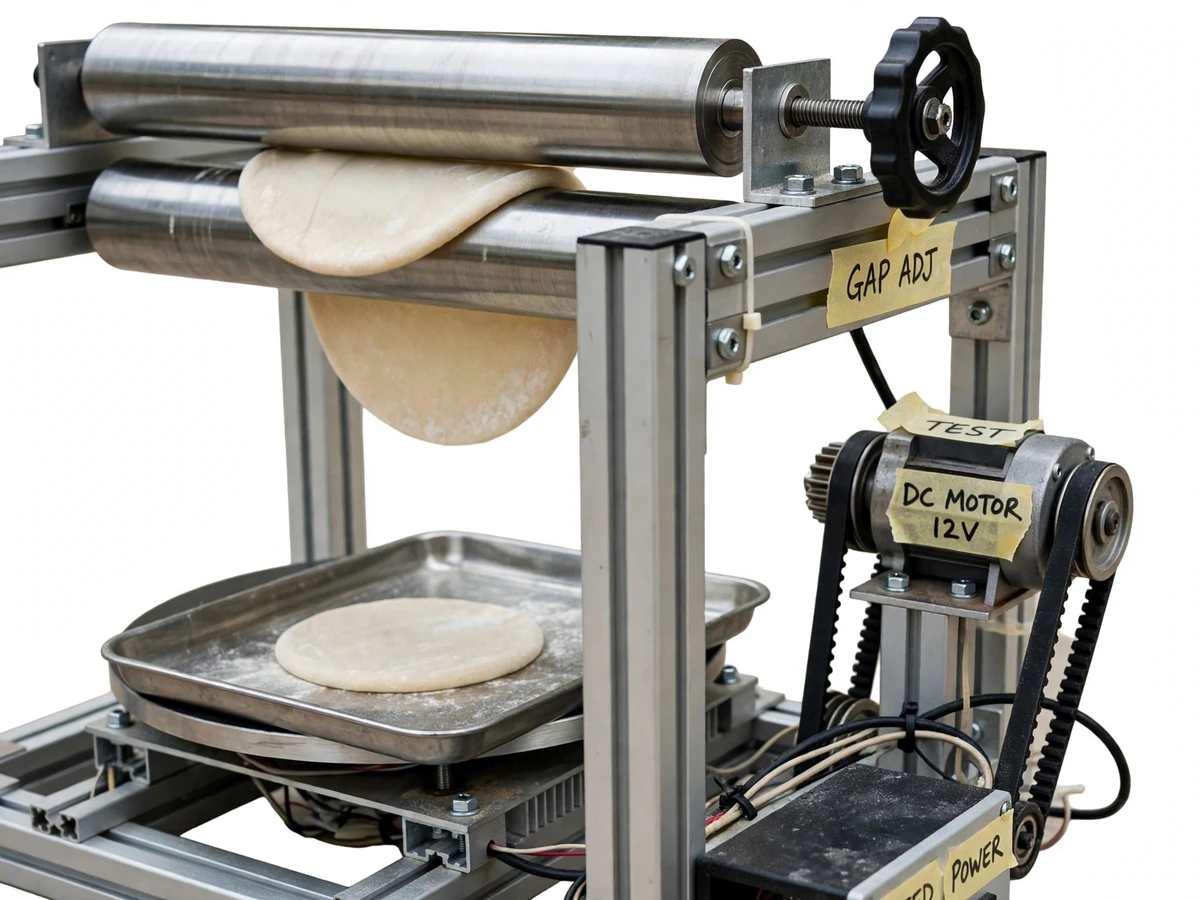
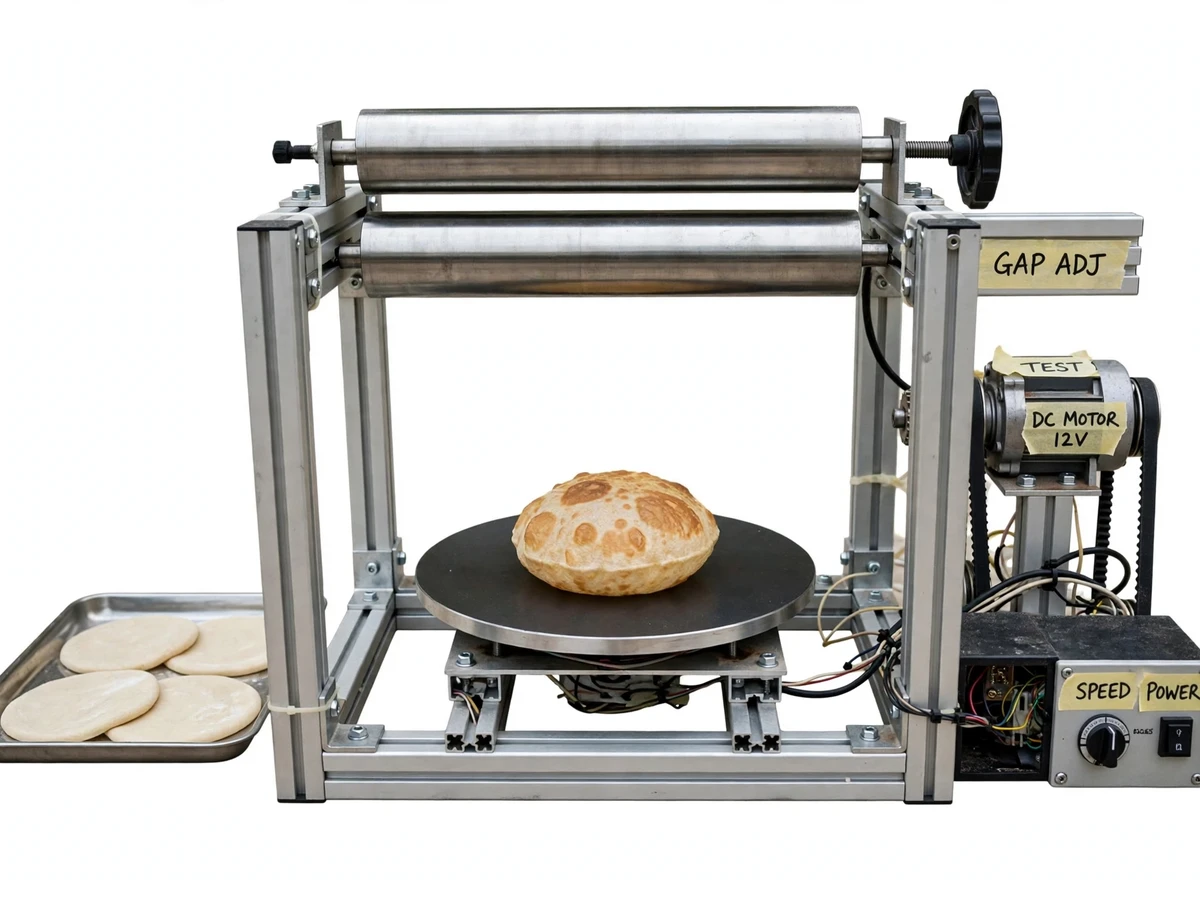
Rolling rotis by hand is slow, tiring and inconsistent: one batch from the same cook mixes thick and thin rotis, and thickness decides whether a roti puffs or stays flat. The Roti Making Machine with Dough Sheeting and Hot Plate Puffing mechanises sheeting, cutting and cooking on a single bench-top frame. A dough ball placed on the infeed tray passes between two food-grade stainless steel rollers whose gap is set with a handwheel and lead screw, so every sheet leaves at the same thickness. A round cutter trims the sheet into a uniform disc, which is then cooked on a thermostat-controlled hot plate, where steam trapped inside the sealed dough puffs it up. A 12 V DC gear motor with belt drive powers the rollers through a PWM speed controller, and guards cover the belt and the roller nip points, with an emergency-stop switch cutting power. The machine suits college demonstration and small-batch use, not commercial production.
Rested wheat dough ball placed on the infeed tray by the operator.
Follow the working sequence
How it works
A dough ball becomes a puffed roti through a chain of three physical steps, each handled by a different part of the machine. First, the two sheeting rollers squeeze the dough ball into a flat sheet: because the roller gap is fixed by the handwheel, the sheet leaves at one even thickness instead of the varying thickness of a hand-rolled roti. Next, the round cutter trims that sheet into a uniform disc, so every roti starts cooking with the same size and thickness. Finally, the disc cooks on the thermostat-controlled hot plate, and puffing needs no press at all: once both surfaces are cooked enough to seal at the rim, the water inside the dough turns to steam and has nowhere to go, so it inflates the roti from inside. The motor drive sets the pace, the operator feeds and flips, and the guards and emergency stop keep the whole sequence safe to demonstrate.
- The operator places a rested dough ball on the infeed tray and sets the roller gap with the handwheel for the thickness wanted.
- The 12 V DC gear motor drives the rollers through the belt, and the dough ball is fed between the rollers, emerging as an even flat sheet.
- The sheet is laid on the cutting board and the round cutter trims it into a uniform disc; offcuts are set aside for re-rolling.
- The disc is placed on the preheated hot plate, whose thermostat holds the design-target surface temperature of 180 °C to 220 °C.
- The first side cooks until small bubbles appear across the surface, showing the dough is sealing.
- The operator flips the roti once with a spatula; the second side cooks, trapped steam inflates the roti, and the operator lifts it onto a tray.
- The speed knob is adjusted between batches for softer or firmer dough, and the emergency-stop switch is within reach throughout the run.
Builder note from this build: a very tight roller gap tears the sheet at the edges, while a slightly wider gap gives an even sheet that puffs reliably on the plate — so the gap is set by trial on the first dough ball of a batch rather than from a fixed number.
Tech stack:
- Food-grade stainless steel 304 rollers and cutter
- Aluminium extrusion frame with mild steel base
- 12 V DC gear motor with belt drive
- PWM DC motor speed controller
- Thermostat-controlled electric hot plate
- Handwheel with lead-screw gap adjustment
- Emergency-stop switch and fixed safety guards
- Mild steel fasteners and bearing blocks
| Parameter | Value |
|---|---|
| Machine footprint | Approximately 600 mm × 400 mm × 450 mm (design target) |
| Roller material | Food-grade stainless steel 304 |
| Roller diameter | Approximately 60 mm (design target) |
| Roller gap adjustment | Handwheel with lead screw · Approximately 1 mm to 5 mm (design target) |
| Roti diameter | Approximately 150 mm (design target, cutter ring) |
| Hot plate diameter | Approximately 250 mm (design target) |
| Plate surface temperature | Design target 180 °C to 220 °C (thermostat-controlled) |
| Motor | 12 V DC gear motor (datasheet value) |
| Drive | Belt drive with PWM speed control |
| Demonstration output | Approximately 1 roti per 2 min (expected, operator-paced) |
| Power supply | 230 V AC mains with 12 V DC adapter (datasheet value) |
| Frame | Aluminium extrusion with mild steel base |
| Machine weight | Approximately 18 kg (design target) |
Project features
The Roti Making Machine with Dough Sheeting and Hot Plate Puffing combines four capabilities that matter most for roti quality: adjustable-gap sheeting rollers that hold one even thickness across a batch, a round cutter that trims every sheet to the same disc, a thermostat-controlled hot plate that cooks both sides evenly, and a guarded motor drive with speed control that keeps the machine safe to run in front of a class. Together these replace the three manual skills — rolling evenly, cutting round and judging plate heat — that make hand-rolled rotis inconsistent. The operator still feeds each dough ball and flips each roti, so the machine demonstrates mechanisation honestly: it removes the repetitive, skill-heavy steps without pretending to be a fully automatic production line, and every claim on this page stays within what the built prototype actually does.
- [Adjustable-gap sheeting rollers] Two food-grade stainless steel 304 rollers flatten each dough ball into an even sheet. The gap is set with a handwheel and lead screw, so one setting holds the same thickness across a whole batch.
- [Round cutting die] An interchangeable cutter ring trims the sheet into a uniform round disc of approximately 150 mm diameter (design target). Offcuts are collected and re-rolled, so no dough is wasted.
- [Thermostat-controlled hot plate] A flat cooking plate held at a design-target surface temperature of 180 °C to 220 °C cooks each side evenly. The operator flips the roti once with a spatula, and steam trapped inside the sealed dough puffs it up.
- [DC gear motor with PWM speed control] A 12 V DC gear motor drives the rollers through a belt, and a speed-control knob lets the operator slow the rollers for soft dough or speed them up for firmer dough.
- [Belt and nip-point guards] Fixed guards cover the belt drive and the roller nip points, and an emergency-stop switch cuts motor power instantly. The guards stay on during every demonstration run.
- [Food-contact and burn safety] Only food-grade stainless steel 304 touches the dough, and the hot plate sits behind a guard rail with insulated handling tools supplied. The plate is clearly marked hot while powered.
- [Bench-top demonstration frame] An aluminium extrusion frame with a mild steel base keeps the machine portable at approximately 18 kg (design target), so it can be carried into a classroom or review hall and set up on a table.
Implemented as standard: all seven features above. Optional at order time: a second cutter ring size and a digital plate-temperature display. Future scope (not built): automatic dough-ball feeding and automatic flipping.
What is included
- Assembled and tested bench-top roti making machine
- Project report PDF (background, design calculations, fabrication method, testing procedure)
- Fabrication and assembly drawings with dimensions
- Wiring diagram for the motor drive and hot plate circuits
- Operation and safety manual for demonstration runs
- PPT presentation for final review
- Viva Q&A preparation document (sheeting mechanics, heat transfer, puffing mechanism, safety)
Limitations & prerequisites
- Dough-ball feeding and roti flipping are manual — the operator places each ball and flips each roti by hand.
- Demonstration output is approximately 1 roti per 2 min (expected, operator-paced) — this is not a commercial production rate.
- Puffing depends on dough consistency and resting time; very dry or over-kneaded dough may puff unevenly.
- One cutter size of approximately 150 mm diameter (design target) is supplied as standard; other sizes are optional add-ons.
- The hot plate runs at a design-target surface temperature of 180 °C to 220 °C, so burn risk is real and the handling procedure must be followed.
- The machine is a demonstration build, not a certified commercial food appliance, and is not certified for commercial food sale.
- The roller gap must be reset by trial for each new dough batch, as described in the builder note.
Frequently Asked Questions
How does the machine make a roti?
The machine turns a dough ball into a puffed roti in three stages: adjustable-gap rollers flatten the ball into an even sheet, a round cutter trims the sheet into a uniform disc, and a thermostat-controlled hot plate cooks the disc until trapped steam puffs it up. The operator feeds each dough ball and flips each roti once, while a 12 V DC gear motor with belt drive powers the rollers and guards cover the moving parts throughout the run.
What thickness can the rollers produce?
The roller gap adjusts from approximately 1 mm to 5 mm (design target) using the handwheel and lead screw, so the operator can choose a thin sheet for crisp rotis or a thicker sheet for softer ones, and the setting holds steady across a whole batch. In this build, a very tight gap tore the sheet at the edges, while a slightly wider gap gave an even sheet that puffed reliably — so the gap is set by trial on the first dough ball of each batch.
Is the machine safe to operate during a demonstration?
Yes, for supervised demonstration use: fixed guards cover the belt drive and the roller nip points, an emergency-stop switch cuts motor power instantly, and the hot plate sits behind a guard rail with insulated handling tools supplied during every run. The plate runs at a design-target surface temperature of 180 °C to 220 °C, so it is clearly marked hot while powered, and the operation manual covers the handling procedure for every run.
What dough works best in this machine?
A standard wheat-flour dough, kneaded soft and rested for approximately 20 min to 30 min before use, gives the most even sheets and the most reliable puffing in this machine, because rested dough relaxes and sheets without springing back, while dry dough cracks at the rollers. Very dry dough resists sheeting and may crack at the rollers, while over-kneaded dough can spring back after cutting; the speed knob lets the operator slow the rollers for softer dough and speed them up for firmer dough.
Can the machine make different roti sizes?
Yes, by changing the cutter ring: the standard ring cuts a roti of approximately 150 mm diameter (design target), and other ring sizes can be ordered as optional add-ons, while the roller gap and hot plate settings stay the same, since only the trimming diameter changes. The plate diameter of approximately 250 mm (design target) sets the practical upper limit for roti size.
Is this project suitable for a final-year project?
Yes — for Mechanical Engineering programs, because it covers machine design, sheet-metal and frame fabrication, power transmission through a belt drive, heat transfer on the cooking plate, and food-safety and guard design in one working prototype, with honest, measurable demonstration results for the review. The build also gives honest viva material: the roller-gap trial procedure, the steam-puffing mechanism, and the quantified limits of a demonstration-rate machine.
Components & software requirements
- Food-grade stainless steel 304 rollers and cutter
- Aluminium extrusion frame with mild steel base
- 12 V DC gear motor with belt drive
- PWM DC motor speed controller
- Thermostat-controlled electric hot plate
- Handwheel with lead-screw gap adjustment
- Emergency-stop switch and fixed safety guards
- Mild steel fasteners and bearing blocks
Delivery information
Built-to-order project. Delivery timeline is shared after order confirmation based on current queue.
Support terms
Complete documentation, setup guide, and viva preparation included. Support for setup and explanation provided.
Download free synopsis (PDF)
Enter your name and WhatsApp number — the synopsis PDF downloads immediately. We may send occasional project updates on WhatsApp; no spam.