
More project photos (3)

The problem
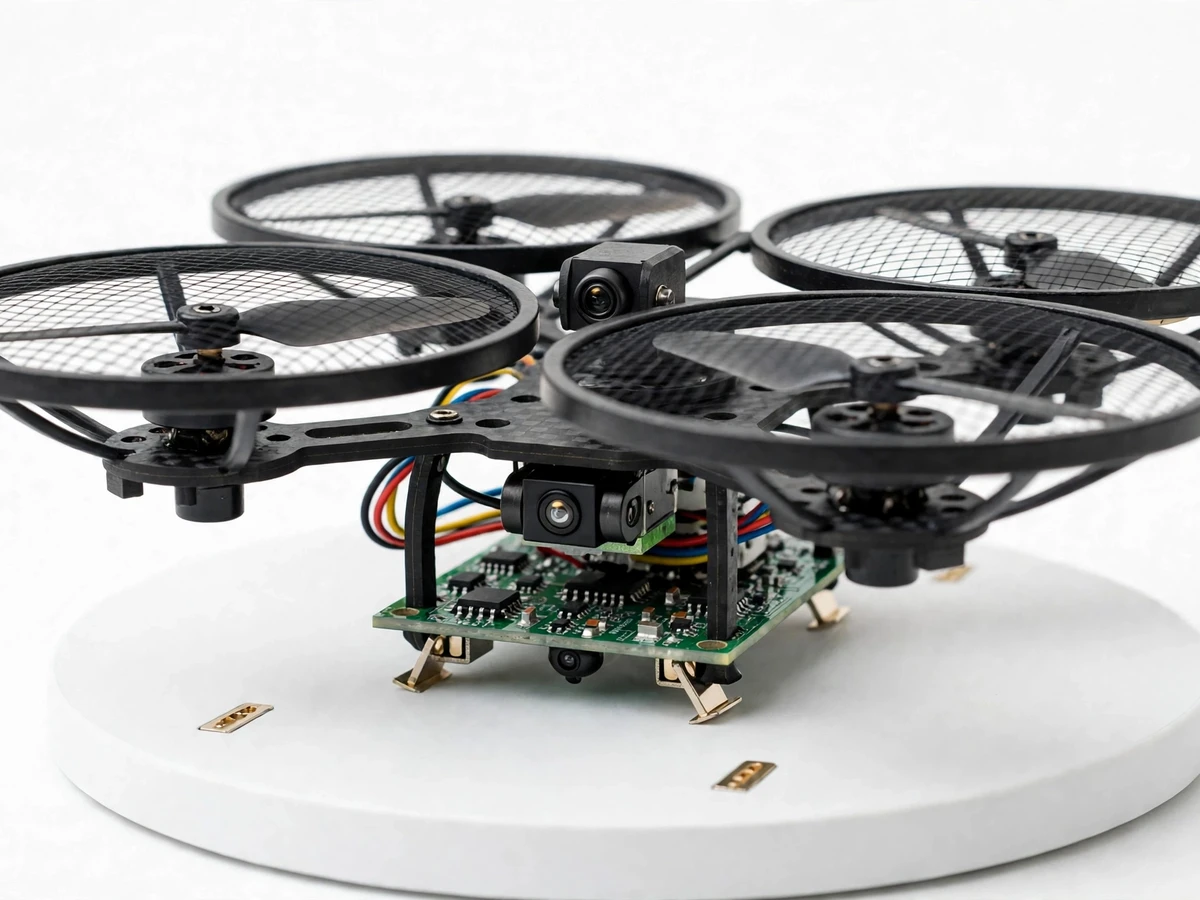
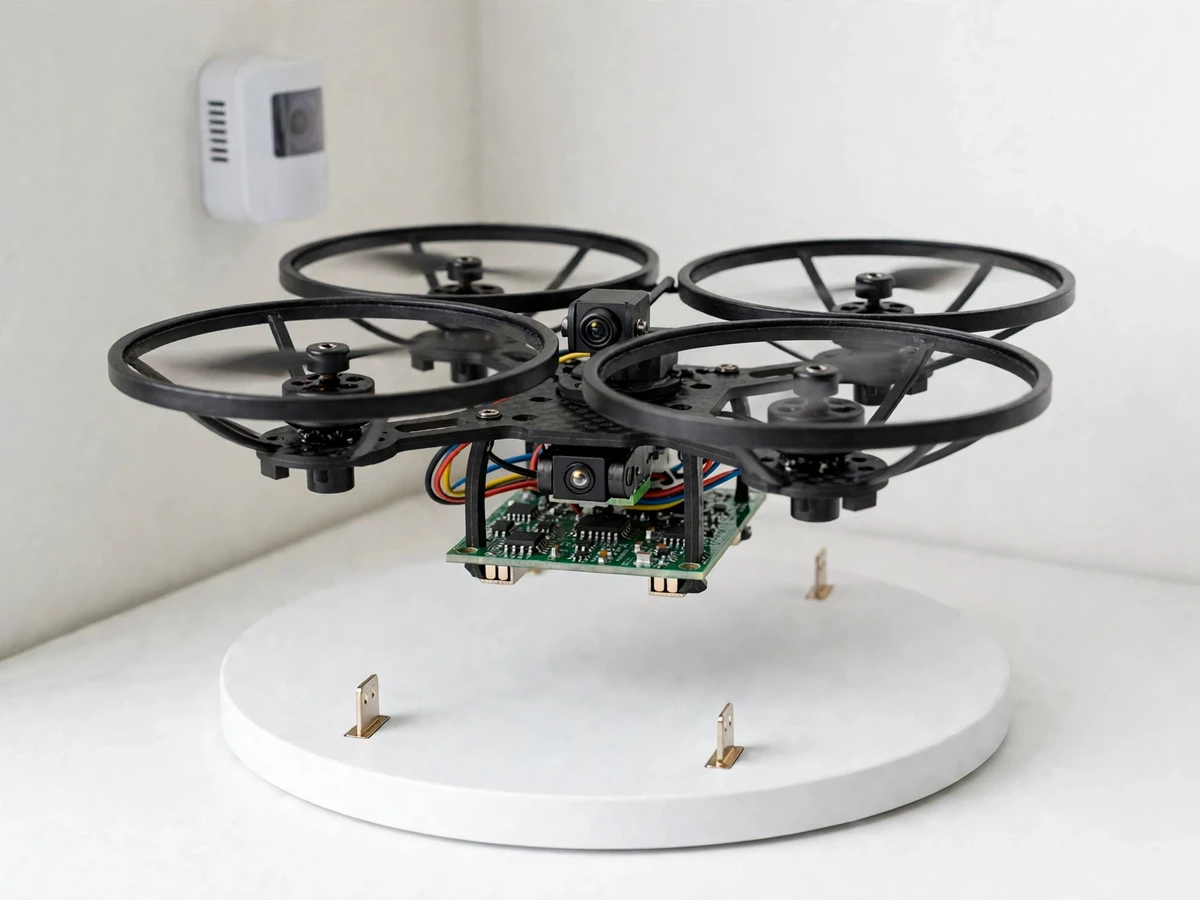
This project builds a Ring Drone Cam-inspired indoor security drone that patrols a home, not a fixed camera on a shelf. The student version is a sub-250 g nano quadcopter with fully enclosed propellers, an ESP32-CAM, a VL53L0X time-of-flight sensor for wall distance, and a PMW3901 optical-flow sensor for indoor positioning, where GPS does not work. It flies patrols between up to 4 stored waypoints, takes off when a wall-mounted PIR sensor reports motion, and returns to its dock, landing on pogo-pin contacts so the battery recharges untouched. The idea follows Ring's Drone Cam, announced on 10 November 2026: a 165 g indoor drone that flies patrol routes from its dock and lands itself if Wi-Fi is lost. Ring's drone is reported at $249.99 and ships on 27 January 2027 pending FCC authorisation; this build copies the idea, with on-device rules instead of Ring's cloud AI Pilot and a 2 MP camera instead of a 2K one.
| This student build | Ring Drone Cam (reported figures) | Plain camera quadcopter (Quadcopter Drone with Camera using Arduino) | |
|---|---|---|---|
| Where it flies | Indoors only · netted demo area · never over people | Indoors · launches from its dock in the home | Outdoors · manual FPV flying in open space |
| Autonomy | Scheduled patrols between up to 4 stored waypoints · PIR-triggered investigation flights · auto-return-to-dock | Pre-programmed patrol routes · responds to motion, door and leak sensor alerts · lands itself if Wi-Fi is lost | Manual stick control only · no patrols · no autonomy |
| Positioning | PMW3901 optical flow plus VL53L0X ToF distance · no GPS indoors | AI Pilot navigation with cameras, vision models, on-device sensors and cloud processing · generates floor plans | No positioning hold · pilot keeps it steady by eye |
| Camera | ESP32-CAM · OV2640 2 MP sensor · live view in the phone browser (Datasheet value) | 2K front camera · 148° FOV · LED illumination for night patrols · 1080p underside camera (reported) | Basic FPV camera · manual viewing only |
| Flight time | Approximately 5–8 min per charge (design target) | About 5–8 min (reported) | 3S LiPo · flight time not stated on the page |
| Charging | Auto-dock: lands on pogo-pin contacts on a 5 V USB dock and recharges without handling | Launches from its own charging dock | Battery removed and charged by hand |
| Weight | Under 250 g (design target) · DGCA nano category | 165 g (reported) | Over 250 g · heavier outdoor frame |
| Price | Built-to-order · quotation | $249.99 (reported) · US-only at launch | Built-to-order · quotation |
Wall-mounted HC-SR501 reports motion in the room.
Follow the working sequence
How it works
The patrol starts on the dock, where the drone sits on its pogo-pin contacts charging from the 5 V USB supply. At the scheduled time, or when the wall-mounted PIR sensor reports motion, the drone lifts off the dock and climbs to its patrol height, with the MPU6050 gyro and accelerometer feeding the stabilisation loop on the ESP32 and the PMW3901 optical-flow sensor watching the floor to hold position, because GPS does not work indoors. The drone flies its stored waypoints in order, the VL53L0X time-of-flight sensor measuring the distance to the nearest wall and stopping the drone before contact, while the ESP32-CAM streams live video to the phone browser. When the patrol ends, or the battery voltage falls below the set threshold, the drone follows the dock's infrared beacon back, descends onto the pogo-pin contacts and resumes charging. If the Wi-Fi link drops at any point, the drone lands itself where it is.
- The builder assembles the nano quadcopter: a small carbon or 3D-printed frame, four 8520 coreless motors with enclosed mesh propeller guards, the ESP32 flight controller, the MPU6050 IMU, the VL53L0X ToF sensor and the PMW3901 optical-flow sensor on the belly, and the ESP32-CAM facing forward.
- The builder builds the dock: a flat circular pad with two gold pogo-pin contacts wired to a 5 V USB charging circuit, an infrared beacon LED at the centre of the pad, and a shallow funnel guide around the pad so the landing feet settle onto the contacts even when the landing is a few centimetres off centre.
- The builder wires and calibrates the sensors: the VL53L0X and PMW3901 are checked over I2C, the MPU6050 is calibrated flat on the bench, the PIR sensor is mounted on the wall facing the room, and the ESP32-CAM stream is opened in the phone browser to confirm the live view.
- The builder sets the patrol: up to 4 waypoints are stored from the phone browser, the patrol height and the low-battery return threshold are set in the firmware, and the schedule is saved so the drone takes off at the set time without a pilot.
- The builder tests the patrol in a netted indoor demo area with a faculty supervisor present: the drone lifts off the dock, flies the waypoints in order, holds position over a textured floor, and the VL53L0X stops it before the wall at each turn.
- The builder tests the trigger and the failsafes: a hand moving past the PIR sensor starts an investigation flight to the nearest waypoint, the Wi-Fi link is switched off mid-flight to show the drone landing itself, and the battery is run down to show the low-battery return to the dock.
- The builder lands the drone on the dock, checks the pogo-pin contacts are touching and the charging LED is on, and records which patrols completed, which triggers fired and which landings needed a second attempt, reporting the results honestly in the report.
Tech stack:
- ESP32 flight controller · dual-core control and Wi-Fi
- ESP32-CAM · OV2640 live-view camera
- VL53L0X ToF sensor · obstacle distance sensing
- PMW3901 optical-flow sensor · indoor positioning
- MPU6050 IMU · gyro and accelerometer stabilisation
- HC-SR501 PIR sensor · motion-triggered investigation
- 8520 coreless motors · 4x quadcopter drive
- 1S 500 mAh LiPo battery · design-target 5–8 min flight
| Parameter | Value |
|---|---|
| Build type | Hardware nano quadcopter plus charging dock and PIR trigger sensor (design target) |
| Take-off weight | Under 250 g (design target) · DGCA nano category |
| Frame | Nano quadcopter frame · fully enclosed mesh propeller guards on all 4 rotors (design target) |
| Motors | 4x 8520 coreless motors · 3.7 V single-cell drive (vendor rating) |
| Flight controller | ESP32 · dual-core Xtensa LX6 up to 240 MHz · 520 KB SRAM · Wi-Fi 802.11 b/g/n (Datasheet value) |
| Camera | ESP32-CAM · OV2640 sensor · 2 megapixels · JPEG stills and MJPEG stream to the phone browser (Datasheet value) |
| Obstacle sensor | VL53L0X · up to 2 m range · ±3% accuracy · I2C interface (Datasheet value) |
| Positioning sensor | PMW3901 · 35×35 pixel optical-flow array · frame rate up to 126 fps (Datasheet value) |
| Stabilisation | MPU6050 · gyro up to ±2000 degrees per second · accelerometer up to ±16 g (Datasheet value) |
| Motion trigger | HC-SR501 PIR sensor · detection up to 7 m · detection angle under 120 degrees (Datasheet value) |
| Battery and flight time | 1S 500 mAh LiPo · 3.7 V nominal · flight time approximately 5–8 min (design target) |
| Patrol | Up to 4 stored waypoints · schedule set from the phone browser · patrol height set in firmware (design target) |
| Charging dock | 5 V USB-powered dock · pogo-pin contacts · infrared landing beacon · shallow funnel landing guide (design target) |
| Link | Wi-Fi 2.4 GHz · live view in the phone browser · approximately 30 m indoors (design target) |
| Trend reference | Ring Drone Cam announced 10 November 2026 · reported figures only: $249.99 · 165 g · 2K front camera with 148° FOV · 1080p underside camera · about 5–8 min flight · launches from its own charging dock · pre-programmed patrol routes · responds to motion, door and leak sensor alerts · lands itself if Wi-Fi is lost · AI Pilot navigation · ships 27 January 2027 pending FCC authorisation · US-only at launch · loud by design · no ceiling sensor · cannot devise a new route around a group of people · never claimed for this build |
| Builder note | GPS signals are too weak to use through a roof, so the drone holds position by watching the floor: the PMW3901 compares successive 35×35 frames and the controller turns that pixel shift into drift, which is why patrols need a textured floor and fail over plain glossy tile. The dock uses a shallow funnel guide around the landing pad so the pogo pins meet even when the landing is a few centimetres off centre, because a flat pad would need landing accuracy the optical-flow hold cannot guarantee. The VL53L0X shares its I2C bus with the PMW3901, so the wiring guide fits a 100 µF decoupling capacitor across the sensor supply and runs SDA and SCL as a twisted pair, keeping the distance readings steady when the motors spool up. |
Project features
This indoor security drone earns its place on a review table because four ideas work together in one build. First, the enclosed-propeller nano quadcopter: mesh guards cover every rotor, so the drone can fly inside a room without an exposed blade touching a wall, a curtain or a hand, and the whole aircraft stays under 250 g in the DGCA nano category. Second, scheduled patrols: the drone stores up to 4 waypoints and flies a short timed route between them, or takes off when the wall-mounted PIR sensor reports motion, so patrols run on their own. Third, auto-dock charging: the drone returns to its dock, settles onto pogo-pin contacts and recharges from a 5 V USB supply, so the drone recharges itself between patrols. Fourth, indoor positioning without GPS: a PMW3901 optical-flow sensor watches the floor drift while a VL53L0X sensor measures wall distance, and the ESP32-CAM streams the live view to the phone browser.
- [Fully enclosed propellers] A mesh guard covers each of the four rotors completely, so no spinning blade is exposed to a wall, a curtain or a hand during an indoor flight, and the guards double as the landing legs that meet the dock contacts — implemented in the base build.
- [Scheduled patrol waypoints] The drone stores up to 4 waypoints and flies a timed patrol route between them at a height set in the firmware, with the schedule set from the phone browser, so a patrol runs the same way every time without a pilot — implemented in the base build.
- [PIR-triggered investigation flights] A wall-mounted HC-SR501 PIR sensor watches the room, and when it reports motion the drone takes off, flies to the waypoint nearest the sensor and holds there with the camera streaming, so the patrol answers a real event instead of flying blind — implemented in the base build.
- [Auto-return-to-dock charging] When the patrol ends or the battery runs low, the drone returns to the dock, descends onto the pogo-pin contacts and recharges from the 5 V USB supply without anyone handling the aircraft, and the dock's infrared beacon marks the landing spot — implemented in the base build.
- [ToF obstacle sensing and optical-flow positioning] The VL53L0X measures the distance to the nearest wall or piece of furniture and the PMW3901 watches the floor moving beneath the drone, so the ESP32 can hold position and stop before a wall indoors, where GPS does not work — implemented in the base build.
- [ESP32-CAM live view in the phone browser] The OV2640 2 MP camera streams live video that opens in the phone browser over Wi-Fi, so the student watches the patrol as it happens and checks a PIR trigger against the live picture before calling it an intrusion — implemented in the base build.
- [Wi-Fi-loss auto-land and low-battery return] If the Wi-Fi link drops, the drone lands itself where it is instead of drifting, and if the battery voltage falls below the set threshold it returns to the dock, so a lost link or a dying battery ends in a landing rather than a crash — implemented in the base build.
- [LED night illumination and two-way audio] Future scope only, not implemented: white LEDs for night patrols and a speaker and microphone for two-way audio, the way Ring's Drone Cam carries LED illumination, listed as extensions rather than claimed features, since the base build has neither.
What is included
- Complete nano quadcopter (frame, four 8520 coreless motors, fully enclosed mesh propeller guards, ESP32 flight controller, MPU6050 IMU, VL53L0X ToF sensor, PMW3901 optical-flow sensor, ESP32-CAM, 1S 500 mAh LiPo battery)
- Auto-dock charging station (circular pad, gold pogo-pin contacts, 5 V USB charging circuit, infrared landing beacon, funnel landing guide)
- Wall-mounted HC-SR501 PIR trigger sensor with its own ESP32 sender board
- Flight firmware (stabilisation, waypoint patrol, PIR-triggered investigation, auto-return-to-dock, Wi-Fi-loss auto-land, low-battery return)
- Setup and calibration guide (sensor checks, waypoint setting, dock alignment, DGCA nano-category rules, netted demo-area checklist)
- Project report PDF (Ring Drone Cam background with reported figures labelled as reported, indoor positioning design, dock design, demonstration results, honest measurement limits)
- PPT presentation for final review
- Viva Q&A preparation document (why GPS fails indoors, how optical flow holds position, how auto-dock charging works, why this build is not the Ring Drone Cam, flight-time and privacy limits)
Limitations & prerequisites
- Not the Ring Drone Cam: this is a student nano quadcopter inspired only by the Ring announcement of 10 November 2026, it shares no parts, software or performance with Ring's drone and must never be presented as one.
- Indoor only, in a netted demo area: the drone flies only indoors in a netted area with a faculty supervisor present, never over people, and it must never be flown outdoors or in a room with people walking under it.
- Short flights: approximately 5–8 minutes per charge as a design target, so a patrol covers a few waypoints and then the drone must return to the dock to recharge — it cannot watch a home all day the way a fixed camera does.
- Wi-Fi dependent: the live view and the patrol schedule need the 2.4 GHz Wi-Fi link, and if the link drops the drone lands itself where it is, so a patrol can end early without warning.
- No cloud AI: there is no AI Pilot, no floor-plan generation and no cloud processing — patrols follow stored waypoints and on-device rules, and the drone cannot devise a new route around a group of people.
- Optical flow needs a textured floor: the PMW3901 holds position by watching the floor, so patrols fail over plain glossy tile or a plain carpet with no pattern, and the VL53L0X measures distance to the nearest surface only, it cannot map a room.
- Privacy and rules: a camera that flies around a home raises real privacy questions — Ring itself paid a $5.8M FTC settlement in 2023 over video-access allegations — so the demo flies only with the consent of everyone in the room, and Indian DGCA nano-category rules for sub-250 g aircraft still apply to the build.
- Honest camera: the ESP32-CAM gives a 2 MP live view, not Ring's reported 2K front camera with 148° FOV, and there is no LED night illumination and no underside camera in the base build.
Frequently Asked Questions
Is this project suitable for a final-year project?
Yes, for IoT, Electronics and Robotics programmes, because it combines flight control, indoor positioning without GPS, time-of-flight sensing, Wi-Fi video and auto-dock charging into one testable build, with a clear review thread around how a drone patrols a home and returns to its dock on its own. The report documents the build, the patrol tests, the dock landings and the honest limits, so the project reads as engineering work rather than a copy of a headline.
Is this the Ring Drone Cam?
No, this is a student nano quadcopter inspired by the Ring announcement, not Ring's Drone Cam: it has a 2 MP camera, stored waypoints and on-device rules, a design-target flight time of about 5–8 minutes, and it shares no parts, software or performance with Ring's drone. Ring announced the Drone Cam on 10 November 2026, reporting a 165 g drone at $249.99 with a 2K front camera, a 148° field of view, LED illumination, pre-programmed patrol routes and AI Pilot navigation, shipping on 27 January 2027 pending FCC authorisation and US-only at launch.
How does it navigate indoors without GPS?
GPS does not work indoors because satellite signals are too weak through a roof, so the drone holds position with a PMW3901 optical-flow sensor that watches the floor moving beneath it and a VL53L0X time-of-flight sensor that measures the distance to the nearest wall. The ESP32 turns the floor drift into a position correction and stops the drone before a wall, which is why patrols need a textured floor and fail over plain glossy tile.
How does auto-dock charging work?
When the patrol ends or the battery runs low, the drone follows the dock's infrared beacon back, descends onto the pad and lands with its feet on two gold pogo-pin contacts wired to a 5 V USB charging circuit, and the charging LED shows the battery is taking charge. A shallow funnel guide around the pad steers the feet onto the contacts even when the landing is a few centimetres off centre, so the dock tolerates the landing error that optical-flow positioning leaves behind.
What happens if Wi-Fi drops or the battery runs low?
If the Wi-Fi link drops, the drone lands itself where it is instead of drifting, the same behaviour Ring reports for its Drone Cam, and if the battery voltage falls below the set threshold the drone returns to the dock and lands on the pogo-pin contacts. A lost link or a dying battery therefore ends in a landing rather than a crash, though a patrol can still end early without warning when the link fails.
What will I receive with the project?
You receive the nano quadcopter with enclosed propellers, the auto-dock charging station, the wall-mounted PIR trigger sensor, the flight firmware with waypoint patrols and failsafes, the setup and calibration guide, the project report, the presentation and the viva Q&A document. A phone or laptop on the same Wi-Fi and a netted indoor demo area with a faculty supervisor are needed, both covered in the setup guide.
Components & software requirements
- ESP32 flight controller · dual-core control and Wi-Fi
- ESP32-CAM · OV2640 live-view camera
- VL53L0X ToF sensor · obstacle distance sensing
- PMW3901 optical-flow sensor · indoor positioning
- MPU6050 IMU · gyro and accelerometer stabilisation
- HC-SR501 PIR sensor · motion-triggered investigation
- 8520 coreless motors · 4x quadcopter drive
- 1S 500 mAh LiPo battery · design-target 5–8 min flight
Delivery information
Built-to-order project. Delivery timeline is shared after order confirmation based on current queue.
Support terms
Complete documentation, setup guide, and viva preparation included. Support for setup and explanation provided.
Download free synopsis (PDF)
Enter your name and WhatsApp number — the synopsis PDF downloads immediately. We may send occasional project updates on WhatsApp; no spam.