
More project photos (2)
The problem
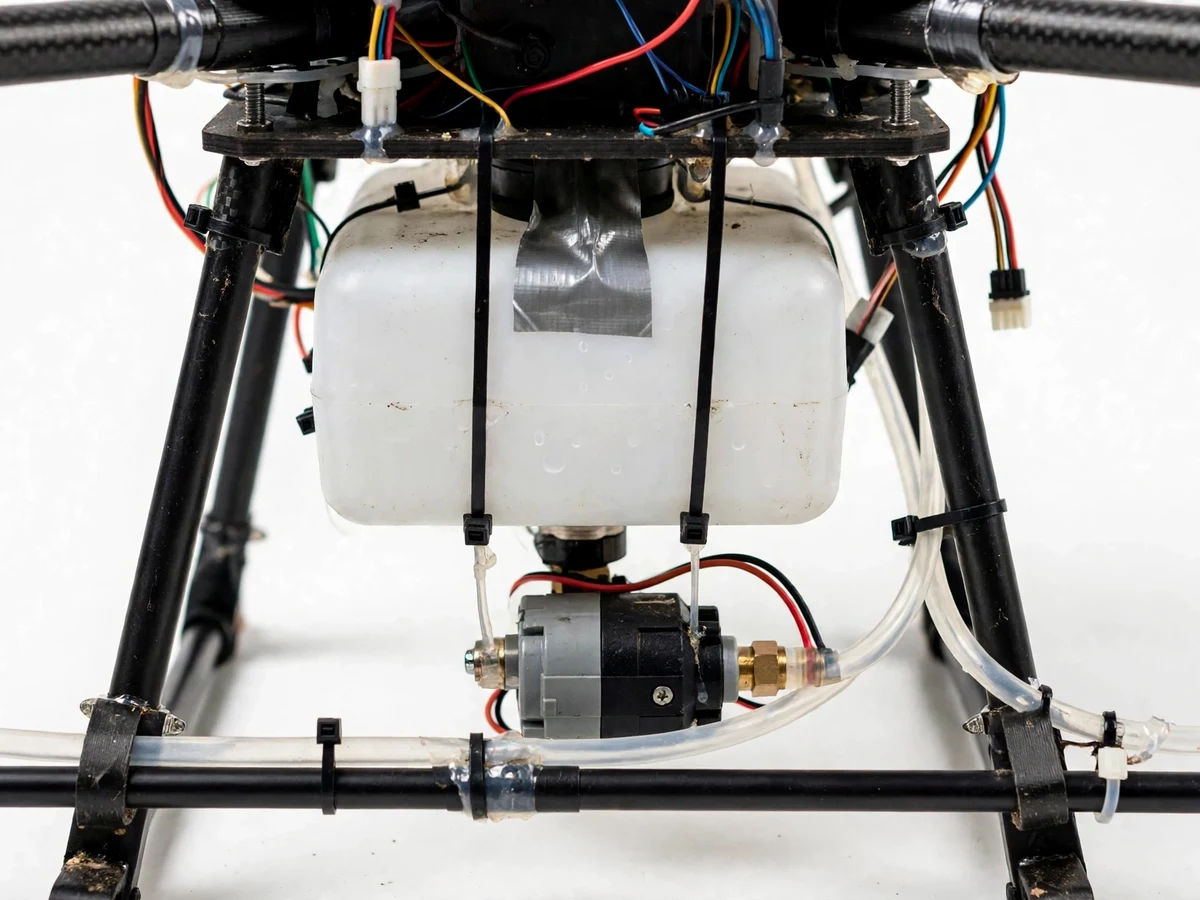
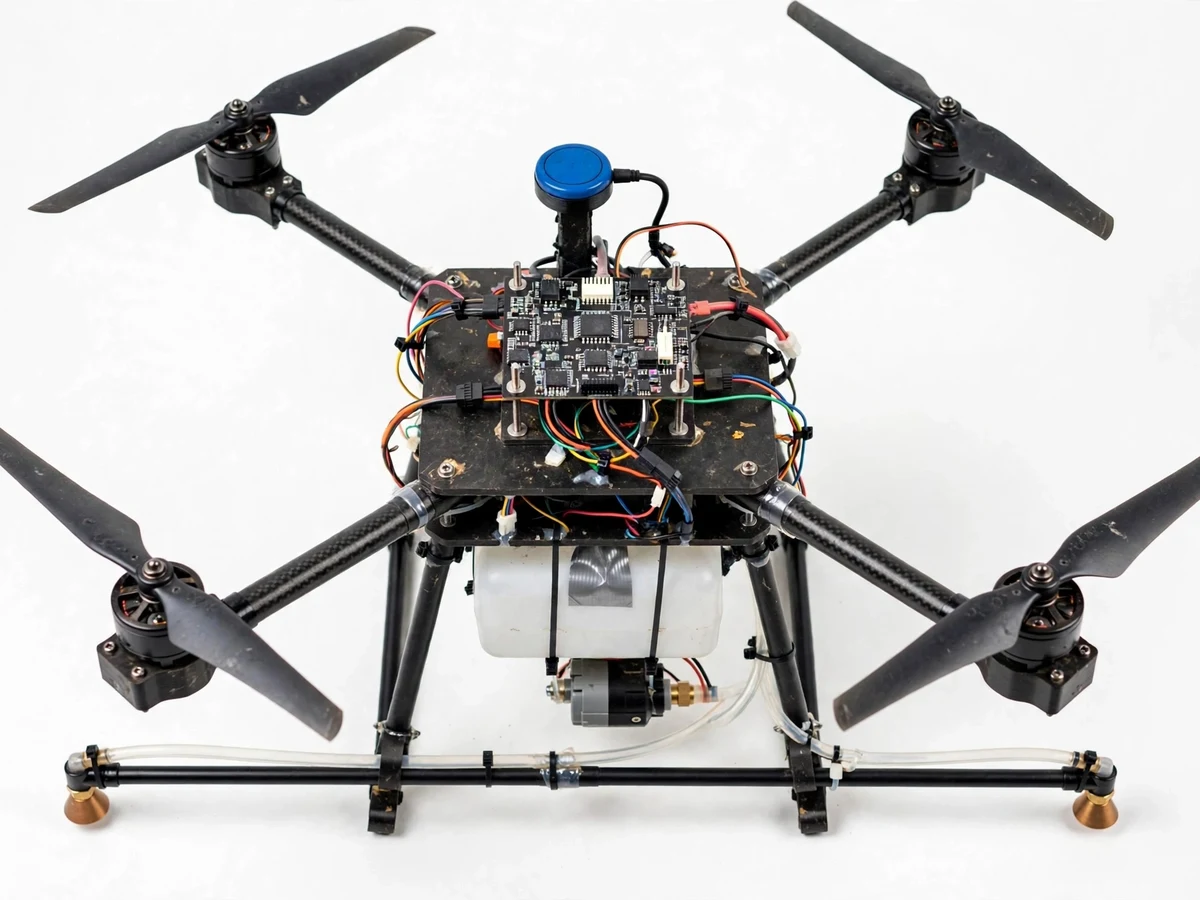
Manual pesticide spraying exposes farm workers to chemicals and applies them unevenly — too much in some rows, too little in others. Agricultural drones solve both problems, but a spraying drone is more than a camera quadcopter with a tank bolted on: the spray flow must stay proportional to ground speed or coverage becomes patchy, and the shifting liquid load changes the aircraft's center of gravity mid-flight. This project builds that complete system. A quadcopter airframe carries a spray tank, diaphragm pump and boom nozzles; the flight controller reads GPS ground speed and modulates pump PWM so the application rate per hectare stays constant. Students calibrate the nozzle flow on the bench, tune the flight controller for the loaded airframe, and fly planned spray missions — learning precision-agriculture engineering, not just drone assembly.
How it works
- The tank is filled with water (for all test flights — real chemical only under supervised field conditions) and the nozzles are bench-calibrated for flow rate at the working pressure.
- A spray mission is planned on the ground station: altitude, speed, swath width and pass overlap for the target plot.
- The drone takes off and flies the waypoint mission; the flight controller holds altitude and heading via GPS.
- During each spray pass, firmware reads GPS ground speed and adjusts pump PWM continuously so the application rate per hectare stays at the calibrated target.
- The pump pressurizes the boom; the nozzles atomize the spray downward in an even swath behind the aircraft.
- Telemetry streams tank level, flow rate and battery to the ground station; low battery or RC loss triggers return-to-launch and instant pump cutoff.
- After landing, the log shows distance flown, estimated area covered and chemical used — the coverage figures for the report.
Tech stack:
- Quadcopter airframe (450-class)
- Flight controller with GPS
- 12 V diaphragm pump + boom nozzles
- LiPo battery + power distribution
- RC transmitter / ground station
- Arduino-class flow-control logic
- Mission planner software
- Telemetry radio link
| Parameter | Value |
|---|---|
| Airframe | 450-class quadcopter (design) |
| Tank capacity | Approximately 2 L (prototype) |
| Spray width | Approximately 2 m swath at 2 m altitude (expected) |
| Flow rate | Calibrated per nozzle on the bench (buyer-run procedure) |
| Flight time | Approximately 10–12 min loaded (expected, battery dependent) |
| Control range | RC link approximately 500 m line-of-sight (design) |
| Fail-safes | Pump cutoff on RC loss + low-battery RTL (implemented) |
| Test medium | Water only for student test flights (safety rule) |
Project features
- [Speed-compensated flow control] Pump PWM is modulated against GPS ground speed so the spray rate per hectare stays constant even as the drone speeds up or slows down.
- [Bench-calibrated nozzles] Each nozzle's flow rate is measured on the bench and documented, so coverage calculations in the report use real numbers from the student's own hardware.
- [GPS mission planning] Spray passes are flown as planned waypoint missions with consistent altitude and overlap, demonstrating precision-agriculture practice.
- [Slosh-aware tank mounting] The tank is baffled and center-mounted to limit center-of-gravity shift as liquid depletes — a real agricultural-drone design consideration.
- [Fail-safe spray cutoff] Loss of RC link or flight-controller failsafe instantly cuts the pump, so chemical is never sprayed uncontrolled.
- [Live telemetry] Battery voltage, GPS status, tank level estimate and flow rate stream to the ground station during flight.
- [Swappable payload] The spray module detaches from the airframe, so the drone can also fly as a standard quadcopter for general flight demos.
What is included
- Quadcopter airframe with flight controller, GPS and motors (assembled, tuned)
- Spray tank, diaphragm pump, boom and nozzles (fitted, bench-calibrated)
- Speed-compensated flow-control firmware with calibration guide
- Ground-station mission planning setup and telemetry link
- Wiring diagram and airframe assembly guide
- Flight-test safety checklist and procedures document
- Project report PDF (background, spray-system design, calibration, results)
- PPT presentation for final review
- Viva Q&A preparation document (flight control, flow calibration, fail-safes)
Limitations & prerequisites
- All student test flights use water only; real pesticide spraying needs trained operators, regulatory clearance and PPE — the report states this safety boundary plainly.
- The 2 L tank and ~10-minute loaded flight time suit demonstration plots, not commercial-scale fields.
- Spray drift in wind is a real limitation; the report covers wind-speed operating limits honestly.
- Flow calibration is bench-measured and must be re-done if nozzles or pump are changed — a buyer-run procedure.
- Local drone regulations (registration, flying zones) apply and are the buyer's responsibility; the safety checklist covers pre-flight compliance checks.
- Coverage uniformity figures in the report come from the student's own bench and flight tests, stated as measured-on-prototype, not as certified application rates.
Frequently Asked Questions
How does the drone keep spray coverage even?
The flow controller reads GPS ground speed and modulates pump PWM continuously: faster ground speed means higher flow, so the volume applied per hectare stays at the calibrated target across the whole pass.
Is it safe for students to fly with pesticide?
No — and the project forbids it. All student test flights use plain water. Real chemical application is discussed in the report as a supervised, regulated operation only.
How are the nozzles calibrated?
On the bench: each nozzle sprays into a measuring cylinder for a timed minute at working pressure, and the flow rate is recorded. These measured values feed the coverage calculations in the report.
What happens if the radio link drops?
The flight controller's failsafe triggers return-to-launch and the pump is cut instantly — chemical (or water) is never sprayed while uncontrolled.
Can the spray module be removed?
Yes, the tank-pump-boom assembly detaches, so the airframe can fly as a standard quadcopter for general flight demonstrations.
Is this project suitable for a final-year project?
Yes — for Electronics, Electrical and IoT programs. It combines drone assembly, flight-controller tuning, fluid-system calibration and precision-agriculture mission planning. Suitable for B.E./B.Tech final-year projects in Electronics, Electrical and IoT.
Components & software requirements
- Quadcopter airframe (450-class)
- Flight controller with GPS
- 12 V diaphragm pump + boom nozzles
- LiPo battery + power distribution
- RC transmitter / ground station
- Arduino-class flow-control logic
- Mission planner software
- Telemetry radio link
Delivery information
Built-to-order project. Delivery timeline is shared after order confirmation based on current queue.
Support terms
Complete documentation, setup guide, and viva preparation included. Support for setup and explanation provided.