
More project photos (2)
The problem
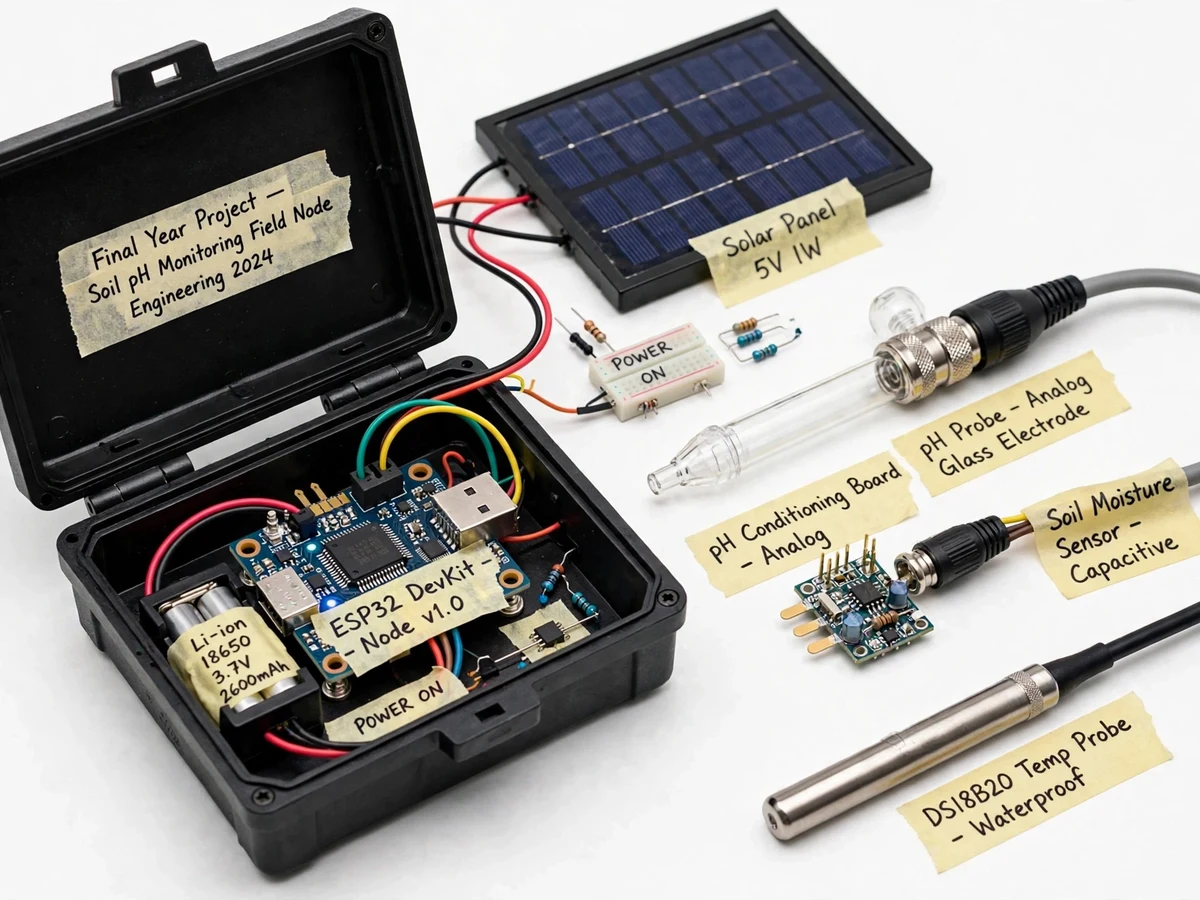
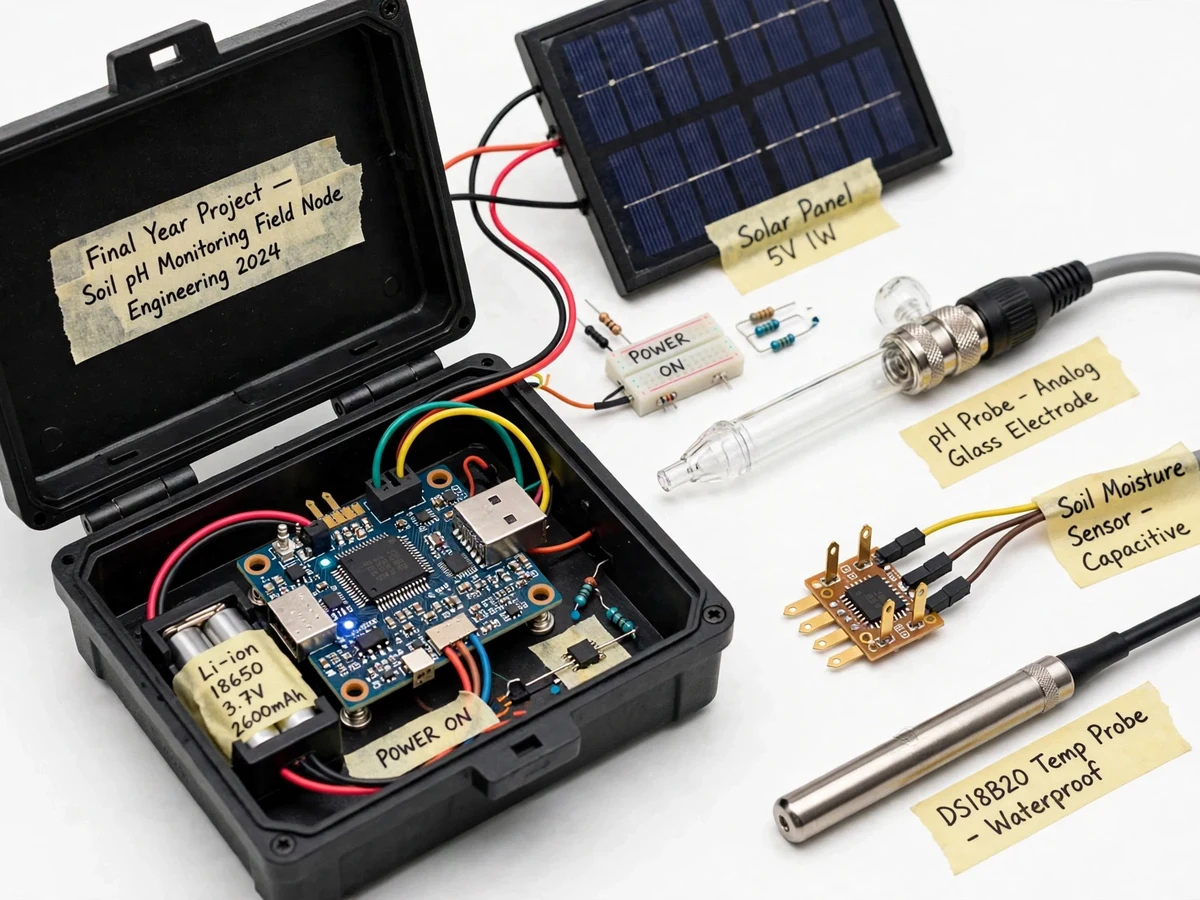
Soil pH decides whether fertilizer actually reaches the plant: most crops absorb nutrients best between pH 6.0 and 7.5, yet farmers apply fertilizer blind to the soil chemistry and blame the seed when yields fall. Lab pH testing is accurate but slow and per-sample expensive. This project builds a field-deployable IoT soil pH node: an analog pH probe with its conditioning board, a capacitive soil-moisture sensor and a DS18B20 temperature probe, all read by an ESP32 that publishes the readings to a farm dashboard over Wi-Fi. The student performs a genuine two-point calibration with pH 4.0 and 7.0 buffer solutions before every measurement campaign and documents it — the calibration step is the part examiners always ask about. Out-of-range pH raises an alert, and the dashboard keeps a seasonal log the farmer can act on.
How it works
- The pH probe, moisture sensor and temperature probe are inserted into the soil at the sampling point.
- The student runs the two-point calibration with pH 4.0 and 7.0 buffer solutions; the ESP32 stores the calibration constants.
- The node wakes on schedule, reads pH, moisture and temperature, and publishes the packet over Wi-Fi with its node ID.
- The cloud dashboard appends the readings to the node's history and renders pH trend charts.
- When pH crosses the configured acidic or alkaline thresholds, the dashboard raises an alert.
- The node returns to deep sleep until the next scheduled reading to conserve battery.
Tech stack:
- ESP32 development board (Wi-Fi)
- Analog soil pH probe + pH-4502C class board
- Capacitive soil moisture sensor
- DS18B20 temperature probe (waterproof)
- pH 4.0 / 7.0 buffer calibration solutions
- ThingSpeak / Blynk class dashboard
- Li-ion battery + solar top-up option
- Arduino IDE (C/C++ firmware)
| Parameter | Value |
|---|---|
| pH range | 0–14 (probe); accuracy approximately ±0.1 pH after two-point calibration |
| Moisture sensor | Capacitive, corrosion-resistant (relative %) |
| Temperature | DS18B20, ±0.5°C (datasheet) |
| Calibration | Two-point, pH 4.0 and 7.0 buffers (buyer-run) |
| Reporting interval | Configurable; typically 15–60 min (design) |
| Battery life | Weeks on a charge with deep sleep (design target) |
| Connectivity | Wi-Fi 2.4 GHz to cloud dashboard |
| Nodes per dashboard | Multiple, via configurable node IDs |
Project features
- [Analog soil pH measurement] A glass-electrode soil pH probe with its conditioning board gives continuous pH readings in the 0–14 range (probe accuracy approximately ±0.1 pH after calibration).
- [Two-point buffer calibration] The firmware supports a genuine two-point calibration with pH 4.0 and 7.0 buffer solutions, and the report documents the procedure step by step.
- [Soil moisture and temperature context] A capacitive moisture sensor and DS18B20 temperature probe are logged alongside pH, since both affect nutrient availability readings.
- [Farm dashboard with history] Readings are published over Wi-Fi to a cloud dashboard with per-node history, so seasonal pH drift is visible.
- [Out-of-range pH alerts] Configurable pH thresholds raise dashboard alerts when the soil drifts acidic or alkaline beyond crop-safe bands.
- [Battery-friendly field design] Deep-sleep firmware and an optional solar top-up let the node run in the field between readings (design target: weeks on a charge).
- [Multi-node ready addressing] Each node carries a configurable ID, so several nodes can feed one dashboard for field-scale mapping.
What is included
- ESP32 field node with pH probe, moisture and temperature sensors
- Two-point calibration procedure with buffer-solution handling guide
- ESP32 firmware (calibration, deep sleep, dashboard publishing)
- Wiring diagram and weatherproofing guide
- Project report PDF (soil chemistry background, calibration, field log template)
- PPT presentation and viva Q&A document
Limitations & prerequisites
- Probe accuracy of approximately ±0.1 pH holds only after the buyer-run two-point calibration; uncalibrated readings are indicative only.
- The probe must be cleaned and stored in storage solution between campaigns — dry storage shortens probe life.
- Wi-Fi range limits node placement; fields without coverage need a hotspot or the LoRa variant (future scope).
- Readings reflect the soil at the probe tip; representative sampling across a field needs multiple nodes.
- No fertilizer recommendation engine is included — the dashboard presents data; agronomic decisions stay with the user.
Frequently Asked Questions
How is the pH probe calibrated?
With a genuine two-point procedure: the probe is rinsed and placed in pH 7.0 buffer, then pH 4.0 buffer, and the ESP32 stores both calibration constants. The report documents every step so the student can defend it in the viva.
How accurate are the readings?
Approximately ±0.1 pH after a fresh two-point calibration — the probe's rated behavior, not a measured claim. Accuracy drifts as the probe ages, which is why the procedure calls for recalibration each campaign.
Why include moisture and temperature?
Both affect nutrient availability and probe behavior. Logging them alongside pH gives the agronomic context a bare pH number lacks.
Can it run on battery in a field?
Yes — deep-sleep firmware targets weeks on a Li-ion charge, with an optional small solar panel for top-up. Wi-Fi coverage at the node location is still required.
How many nodes can one dashboard show?
Multiple — each node carries a configurable ID and the dashboard keeps per-node history, so a field can be mapped with several units.
Is this project suitable for a final-year project?
Yes — for IoT & Embedded, Electronics and Agriculture-Engineering-adjacent programs. It combines analog sensing, real calibration discipline, power budgeting and cloud dashboards. Suitable for B.E./B.Tech final-year projects in IoT & Embedded Systems, Electronics and Instrumentation.
Components & software requirements
- ESP32 development board (Wi-Fi)
- Analog soil pH probe + pH-4502C class board
- Capacitive soil moisture sensor
- DS18B20 temperature probe (waterproof)
- pH 4.0 / 7.0 buffer calibration solutions
- ThingSpeak / Blynk class dashboard
- Li-ion battery + solar top-up option
- Arduino IDE (C/C++ firmware)
Delivery information
Built-to-order project. Delivery timeline is shared after order confirmation based on current queue.
Support terms
Complete documentation, setup guide, and viva preparation included. Support for setup and explanation provided.