
More project photos (3)

The problem
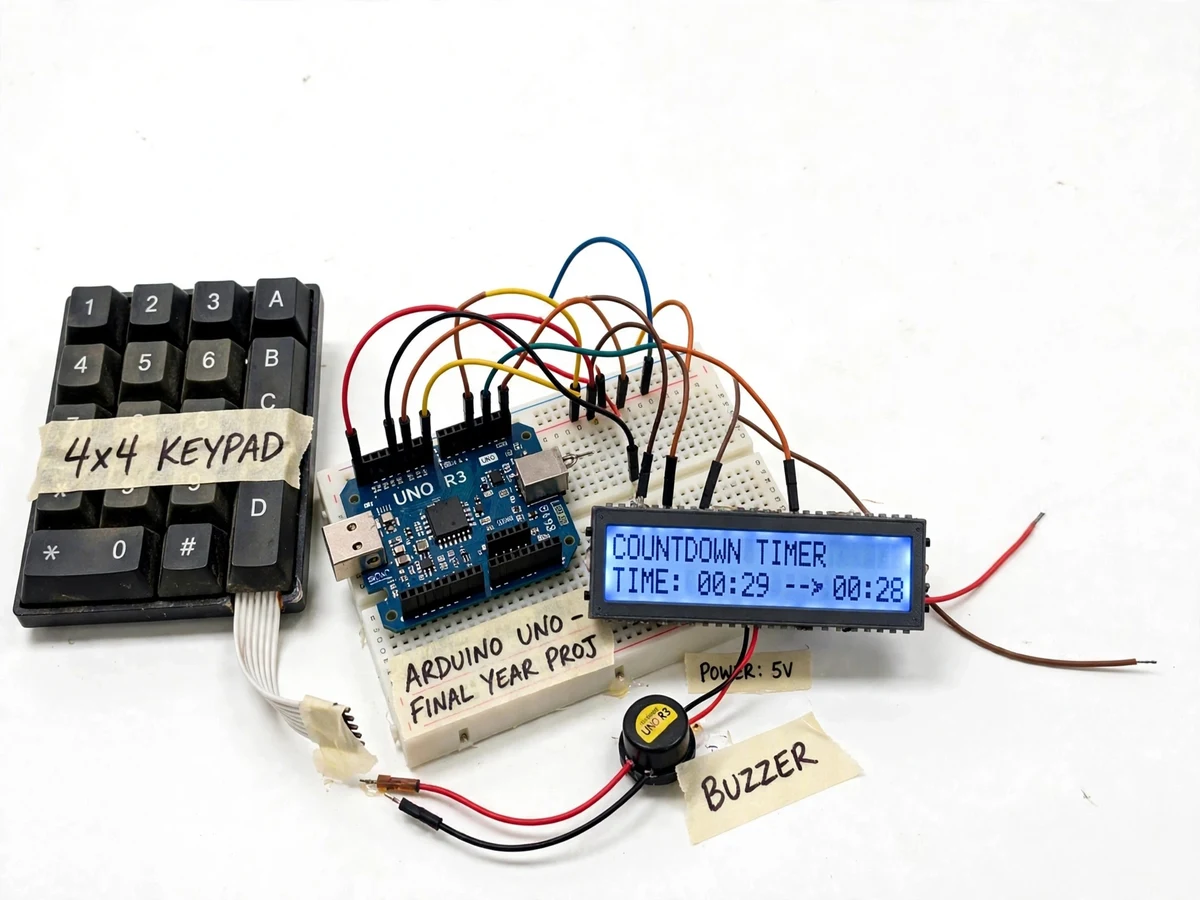
Food left on a flame too long burns, boils over or — in the worst case — becomes a fire risk when the cook gets distracted or steps out. A kitchen timer helps only if someone hears it and acts; a timer that turns the knob itself closes the loop. The engineering work is in the countdown logic, the servo-to-knob coupling and the warning sequence that gives the cook a chance to intervene. This project builds a student-scale automatic cooking timer on an Arduino: the cooking time is entered on a 4x4 keypad, the LCD counts down, the buzzer warns at one minute and again at ten seconds, and at zero the servo rotates the stove knob to the OFF position automatically.
Sets the cooking time in minutes.
Follow the working sequence
How it works
- The cook enters the desired cooking time on the keypad; the LCD echoes the entry and waits for the start key.
- On start, the Arduino begins the countdown, shows the remaining time on the LCD and keeps the servo parked at the knob's ON position.
- At one minute remaining the buzzer sounds the first warning; at ten seconds the beeps accelerate.
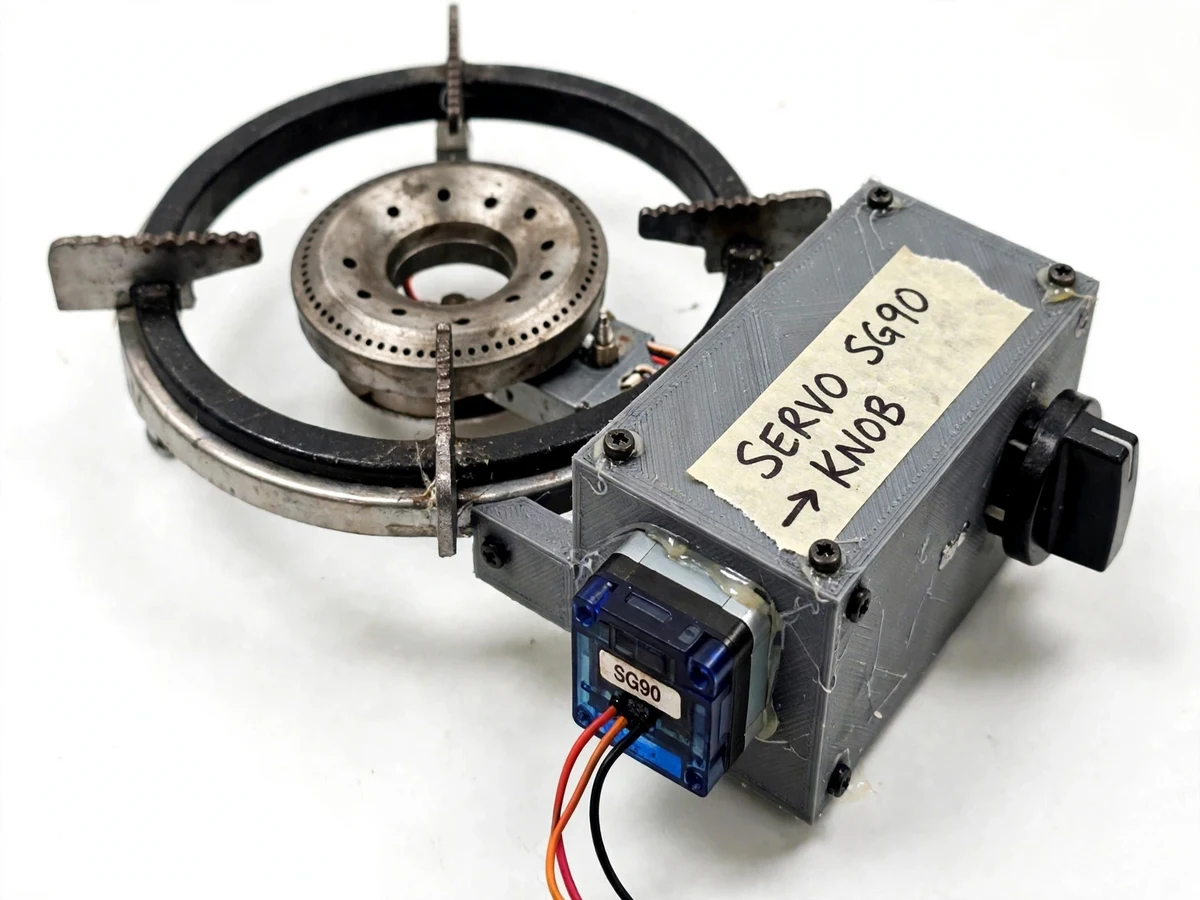
- At zero the Arduino drives the servo through its calibrated arc, rotating the stove knob to the OFF position.
- The LCD switches to GAS OFF and the completion tone confirms the shutoff; the timer resets to SET mode.
- The pause key freezes the countdown at any point, and the cancel key aborts it — both leave the knob where the cook last set it.
Tech stack:
- Arduino Uno (ATmega328P)
- SG90 servo motor with knob coupler
- 4x4 membrane keypad
- 16x2 character LCD
- Buzzer
- Arduino IDE (C/C++ firmware)
- 5 V regulated power supply
| Parameter | Value |
|---|---|
| Controller | Arduino Uno (ATmega328P) |
| Time entry | 4x4 membrane keypad, minutes |
| Shutoff actuator | SG90 servo, calibrated knob arc (design) |
| Display | 16x2 character LCD (countdown + states) |
| Warnings | Buzzer at 1 min and final 10 s (configurable) |
| Timer range | Design 1–99 minutes |
| Power | 5 V regulated supply (design) |
Project features
- [Keypad time entry] A 4x4 membrane keypad sets the cooking time in minutes, confirmed on the LCD before the countdown starts.
- [Servo-driven knob shutoff] An SG90 servo coupled to the stove knob rotates it to the OFF position the moment the countdown reaches zero.
- [Live countdown LCD] A 16x2 LCD shows the remaining time throughout cooking, plus SET, RUNNING and DONE states.
- [Escalating buzzer warnings] Warning tones at one minute remaining and a final countdown beep sequence give the cook time to intervene.
- [Pause and cancel] Dedicated keys pause the countdown or cancel it entirely, returning the knob control to manual.
- [Auto-off confirmation] After shutoff the LCD shows GAS OFF and the buzzer plays a distinct completion tone.
- [Adjustable warning points] The firmware's warning thresholds are configurable so different alert behaviours can be demonstrated.
What is included
- Working model stove setup with servo-coupled knob, Arduino, keypad, LCD and buzzer
- Complete firmware with commented countdown and servo-control logic
- Servo-to-knob coupling bracket and calibration procedure
- Wiring diagram and connection table
- Project report PDF (background, system design, firmware logic, safety notes)
- PPT presentation for final review
- Viva Q&A preparation document (timers, servos, keypad scanning, Arduino)
Limitations & prerequisites
- The prototype is a demonstration model — it is not certified for use on a real gas connection, and any real-stove adaptation needs professional safety review, which is outside the project scope.
- Servo torque and the coupling bracket are sized for the model knob; real stove knobs vary and would need re-engineering.
- The timer is only as reliable as its power supply — a power cut stops the countdown, noted in the report as a design constraint.
- No gas-leak sensing is included; leak detection is a separate project and listed as future scope.
- Timing accuracy follows the Arduino's ceramic resonator (typical, not measured); no precision timing is claimed.
- The buzzer warnings assume someone is within hearing range — the device cannot confirm the cook heard them.
Frequently Asked Questions
How does it turn the gas off?
A servo motor is mechanically coupled to the stove knob. When the keypad-set countdown reaches zero, the Arduino drives the servo through its calibrated arc, rotating the knob to OFF.
Can this be fitted to my real gas stove?
The project ships as a demonstration model and is not certified for real gas installations. The report's safety notes explain why any real-stove adaptation needs professional review.
What if I need more time while cooking?
The pause key freezes the countdown, and entering a new time restarts it — the cook stays in control until the final shutoff.
Does it warn before shutting off?
Yes — the buzzer warns at one minute remaining and beeps through the final ten seconds, so the shutoff never comes as a surprise.
What happens in a power cut?
The countdown stops with the power. The report documents this as a design constraint and suggests battery backup as future scope.
Is this project suitable for a final-year project?
Yes — for Electronics and IoT & Embedded programs. It covers keypad interfacing, timer logic, servo actuation and a real kitchen-safety problem with honest engineering limits. Suitable for B.E./B.Tech final-year projects in Electronics and IoT & Embedded.
Components & software requirements
- Arduino Uno (ATmega328P)
- SG90 servo motor with knob coupler
- 4x4 membrane keypad
- 16x2 character LCD
- Buzzer
- Arduino IDE (C/C++ firmware)
- 5 V regulated power supply
Delivery information
Built-to-order project. Delivery timeline is shared after order confirmation based on current queue.
Support terms
Complete documentation, setup guide, and viva preparation included. Support for setup and explanation provided.
Download free synopsis (PDF)
Enter your name and WhatsApp number — the synopsis PDF downloads immediately. We may send occasional project updates on WhatsApp; no spam.