
More project photos (2)
The problem
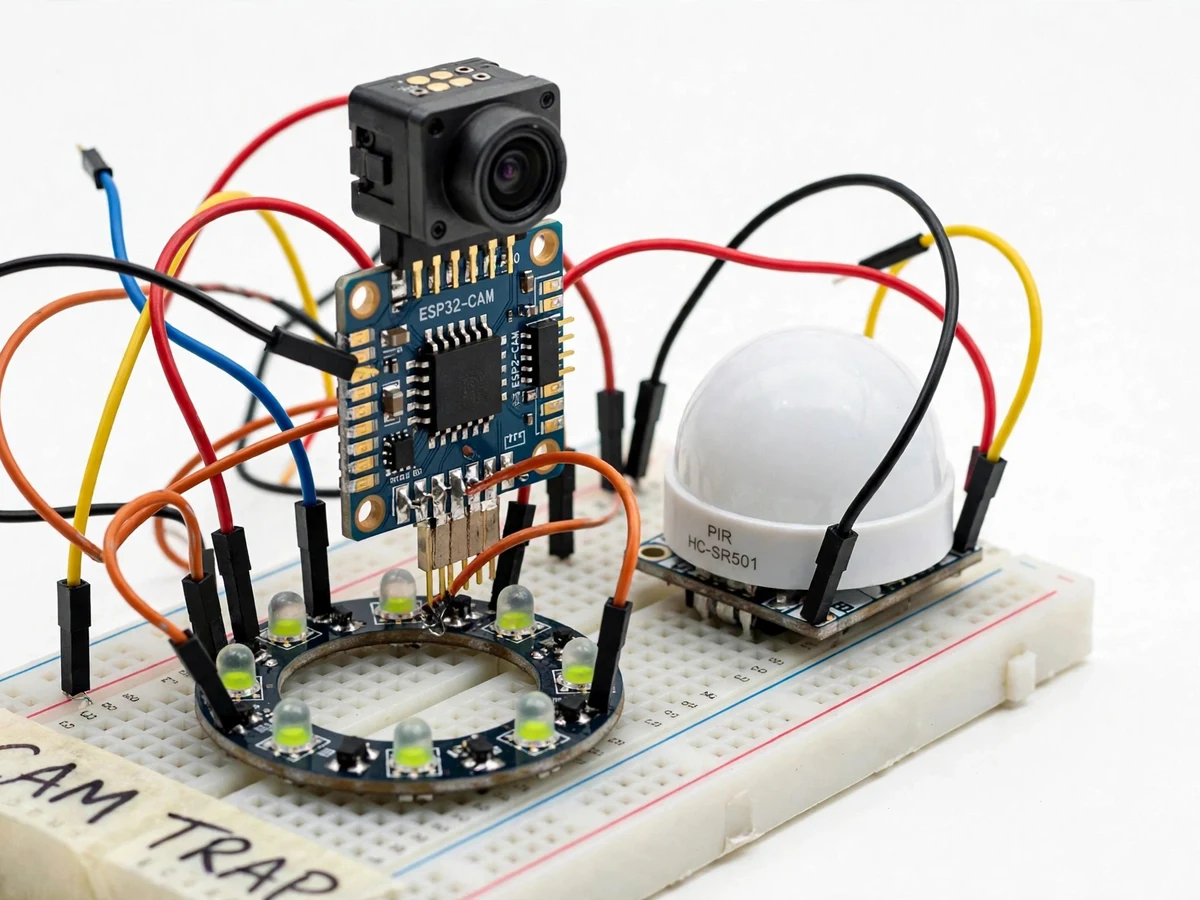
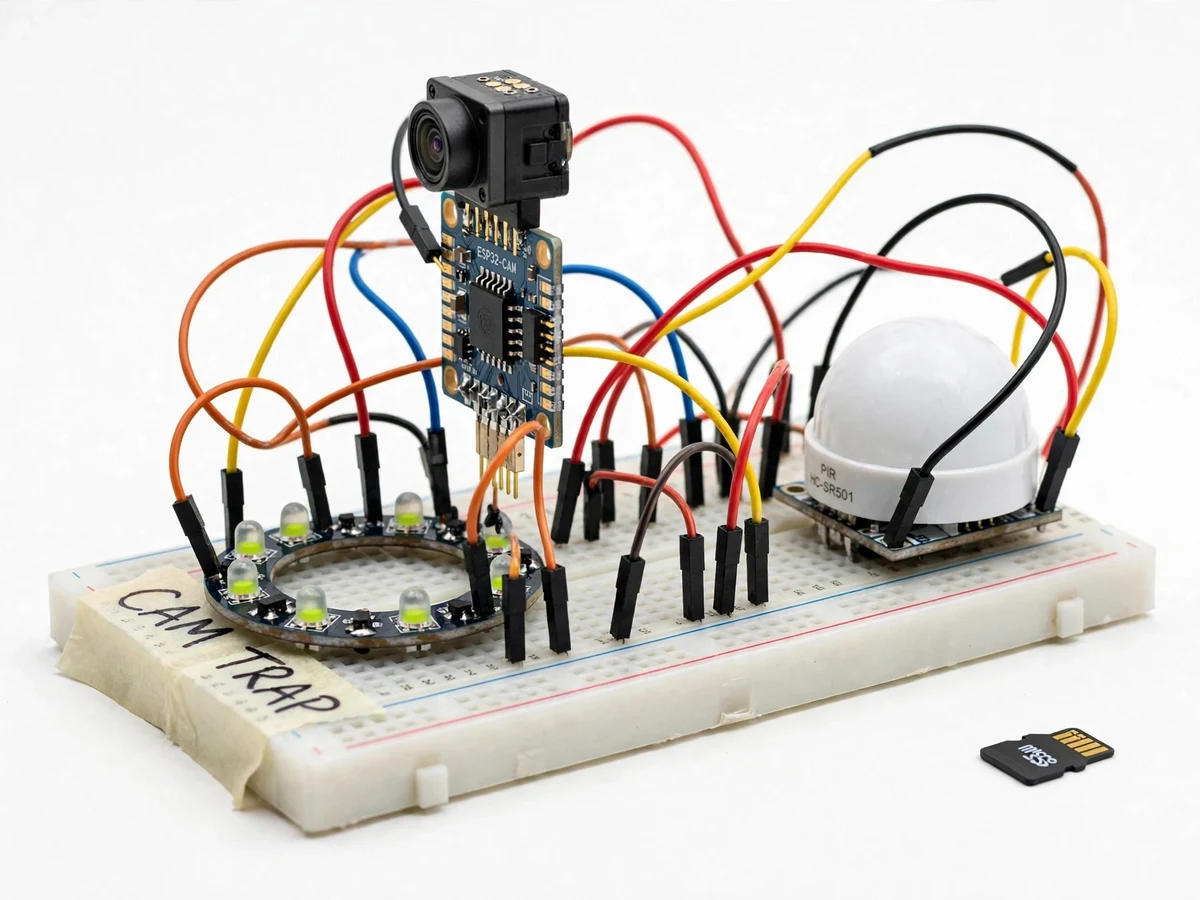
Ecologists and forest departments need to know which animals use a trail and when, but sitting in a hide for nights on end does not scale — and camera traps sold commercially cost far more than a student budget allows. The DIY answer is a motion-triggered camera: a passive-infrared sensor detects the warm body of a passing animal and fires a camera in a fraction of a second, day or night. This project builds exactly that around the ESP32-CAM: an HC-SR501 PIR module wakes the controller from deep sleep, the camera captures a frame lit by an 850 nm infrared LED ring that animals cannot see, and the image is written to microSD with a date-time stamp from the firmware clock. The demo triggers on hand waves in the lab and shows the captured frames, the IR illumination in a darkened room, and the deep-sleep current that makes field deployment plausible. It is a neat package of embedded skills: interrupt-driven wake, camera pipelines, invisible illumination and power budgeting.
How it works
- The unit is armed and the ESP32 enters deep sleep; only the PIR sensor stays powered, watching its detection cone.
- A warm moving body crosses the PIR field; the sensor drives its output high, firing a wake interrupt on the ESP32.
- The firmware boots the camera, checks ambient light, and enables the IR LED ring if it is dark.
- The OV2640 captures a still frame, which is encoded to JPEG at the configured quality setting.
- The image is written to the microSD card with a timestamped filename, and an optional second frame follows after a short delay.
- The ESP32 returns to deep sleep, ready for the next trigger, drawing only the sleep current until then.
Tech stack:
- ESP32-CAM module (OV2640 camera)
- HC-SR501 PIR motion sensor
- 850 nm IR LED illuminator ring
- MicroSD card storage
- Battery pack with deep-sleep design
- LDR for day/night detection
- Arduino IDE (C/C++ firmware)
- Weatherproof housing guidance (buyer-fitted)
| Parameter | Value |
|---|---|
| Controller/camera | ESP32-CAM, OV2640 sensor, configurable up to 1600x1200 stills |
| Motion sensor | HC-SR501 PIR, detection range adjustable up to ~7 m (module datasheet), ~110° cone |
| Night illumination | 850 nm IR LED ring, invisible to animals and humans |
| Storage | MicroSD card, timestamped JPEG filenames |
| Power | Battery pack; deep-sleep current design target in the low microamps (buyer measures during bring-up) |
| Wake latency | PIR-to-capture in well under a second (design target; measured by buyer) |
| Day/night | LDR-based automatic IR enable |
| Deployment | Electronics prototype; weatherproof enclosure fitted by buyer per guidance |
Project features
- [PIR motion trigger] The HC-SR501 passive-infrared sensor detects warm-body movement across its field and generates the wake interrupt — no continuous camera polling needed.
- [ESP32-CAM image capture] The OV2640 camera captures still frames on trigger, with configurable resolution and JPEG quality trading detail against SD card space.
- [Infrared night vision] An 850 nm IR LED ring illuminates the scene for night captures; the light is invisible to animals and to human eyes, so behaviour is undisturbed.
- [Timestamped SD storage] Every capture is saved to microSD with date and time in the filename, producing a sortable, reviewable image log of trail activity.
- [Deep-sleep power design] Between triggers the ESP32 sleeps at microamp-level current (design target), waking only on the PIR interrupt — the key technique for unattended field operation.
- [Day/night auto behaviour] A light-dependent check selects normal capture by day and IR-illuminated capture by night, so one deployment covers the full 24-hour cycle.
- [Adjustable PIR sensitivity] On-board potentiometers set detection range and trigger hold time, letting the student tune the trap to the target animal size and trail width.
What is included
- Working camera trap prototype (ESP32-CAM, PIR sensor, IR LED ring, SD card, battery pack)
- Complete firmware source code (PIR wake, camera capture, IR control, deep sleep, SD logging)
- PIR tuning guide (sensitivity and hold-time adjustment for different trail setups)
- Power-budget worksheet (sleep vs active current, estimated field life calculation method)
- Circuit and wiring documentation
- Project report PDF (camera-trap background, PIR physics, IR illumination, power analysis)
- PPT presentation for final review
- Viva Q&A preparation document (PIR sensing, camera interfacing, deep sleep, IR vs visible light)
- Setup and demonstration guide
Limitations & prerequisites
- This is an unattended-field electronics prototype; the weatherproof enclosure, mounting and camouflage are fitted by the buyer following the included guidance.
- The firmware clock timestamps images from the ESP32's internal RTC, which drifts without network sync — for multi-week deployments a DS3231 add-on is documented as an option.
- PIR sensors detect moving warm bodies; a stationary animal or heavy rain/foliage motion can cause missed or false triggers — sensitivity tuning is part of the documented procedure.
- Night range is limited by the IR LED ring's throw (a few metres); this is a trail-closeup trap, not a long-range spotter.
- Battery life is estimated from the power-budget worksheet, not measured across a full deployment — the buyer validates it during their own field test.
Frequently Asked Questions
How does the camera know when to take a photo?
An HC-SR501 PIR sensor watches its detection cone for the infrared signature of a warm moving body. When triggered, it drives a wake interrupt that pulls the ESP32 out of deep sleep; the firmware then boots the camera and captures a frame within a fraction of a second. There is no continuous polling or video streaming — the interrupt-driven design is what makes battery-powered field operation possible.
How does night vision work without scaring animals?
An 850 nm infrared LED ring illuminates the scene during night captures. That wavelength sits just beyond human and most animal vision, so the trap records in darkness without a visible flash that would startle wildlife or alter behaviour. A light sensor selects normal capture by day and IR-illuminated capture by night automatically.
Where are the photos stored?
On the ESP32-CAM's microSD card as JPEG files with timestamped filenames, at a configurable resolution and quality setting. Higher resolution gives more detail for species identification; lower quality stretches card capacity. Review is as simple as moving the card to a laptop — the files sort chronologically by name.
How long can it run on battery?
That depends on how often animals trigger it, but the architecture is built for endurance: between triggers the ESP32 sits in deep sleep at a microamp-level design target, with only the PIR sensor drawing power. The kit includes a power-budget worksheet so you can estimate field life from your own measured sleep and active currents rather than trusting a claimed number.
What are the main limitations?
The kit ships as an electronics prototype — the weatherproof enclosure, mounting and camouflage are fitted by the buyer per the included guidance. Timestamps come from the internal clock, which drifts over multi-week deployments; PIR sensors can false-trigger in wind-blown foliage or miss stationary animals; and night range is limited to the IR ring's few-metre throw.
Is this project suitable for a final-year project?
Yes — for IoT, Electronics and Embedded programs. Interrupt-driven wake from deep sleep, camera interfacing, invisible IR illumination design and power budgeting form a coherent, demonstrable story. The lab demo — triggering captures and reviewing timestamped images — is concrete and easy for examiners to evaluate. Suitable for B.E./B.Tech final-year projects in IoT, Electronics and Embedded engineering.
Components & software requirements
- ESP32-CAM module (OV2640 camera)
- HC-SR501 PIR motion sensor
- 850 nm IR LED illuminator ring
- MicroSD card storage
- Battery pack with deep-sleep design
- LDR for day/night detection
- Arduino IDE (C/C++ firmware)
- Weatherproof housing guidance (buyer-fitted)
Delivery information
Built-to-order project. Delivery timeline is shared after order confirmation based on current queue.
Support terms
Complete documentation, setup guide, and viva preparation included. Support for setup and explanation provided.