
More project photos (2)

The problem
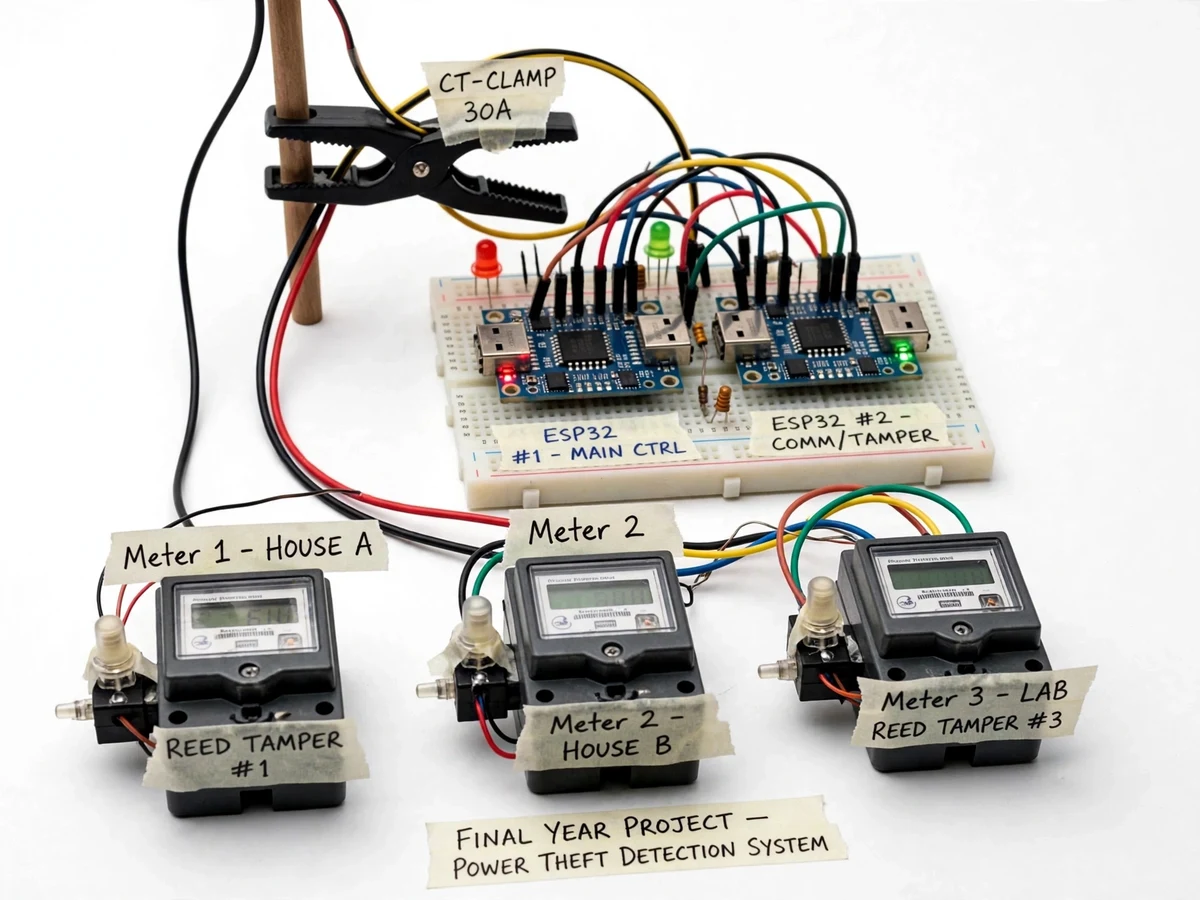
Distribution utilities lose a measurable share of energy to theft — direct tapping, meter bypassing and tamper — but the theft is usually discovered by inspection, months late. The engineering principle behind detection is energy accounting: what the feeder transformer supplies must equal what the meters record plus known technical losses; a persistent gap is non-technical loss. This project demonstrates that principle on a scaled feeder model: a feeder-side CT measures total supply, reference meters measure each consumer, and reed-switch tampers watch the meter enclosures. ESP32 nodes publish all of it over Wi-Fi via MQTT to a utility dashboard with feeder-vs-metered graphs, loss-percentage analytics and a tamper event log. The project is careful about claims: it demonstrates the detection method and the analytics, not a utility-grade revenue-protection system, and the report discusses technical vs non-technical loss honestly.
How it works
- The feeder CT measures total supply current while each consumer branch passes through its own reference meter on the demonstration model.
- ESP32 nodes sample feeder and consumer readings, compute RMS values, and check tamper-switch states on every cycle.
- Every 10 seconds (design target) the nodes publish feeder power, per-consumer power and tamper states as JSON over Wi-Fi via MQTT.
- The dashboard aggregates metered total, subtracts it from feeder supply, and plots the unaccounted-loss percentage over 24 hours.
- When loss crosses the configured threshold or a tamper switch opens, the dashboard raises an alert and writes to the event log.
- A switchable 'theft tap' on the model lets the demonstrator introduce an unmetered load and watch the loss analytics respond.
- The buyer calibrates feeder and meter channels against a reference meter with the documented procedure.
Tech stack:
- ESP32 development boards (feeder + meter nodes)
- SCT-013 feeder current transformer
- Reference energy meter modules x6
- Reed-switch tamper sensors
- MQTT broker + web dashboard
- Arduino IDE (C/C++ firmware)
- Scaled feeder demonstration model
- Switchable theft-tap load (demo)
| Parameter | Value |
|---|---|
| Nodes | Feeder ESP32 + consumer meter nodes, Wi-Fi MQTT (JSON) |
| Feeder sensing | SCT-013 CT; approximately +/-3% typical (expected) |
| Consumer metering | 6 reference meter modules with pulse/serial output |
| Tamper sensing | Reed switches on enclosures; CT-bypass detection wiring |
| Loss computation | Feeder minus metered total, percentage with configurable thresholds |
| Reporting | 10-second design-target interval; MQTT reconnect with backoff |
| Dashboard | Feeder-vs-metered graphs, loss analytics, tamper log, export |
| Demo control | Switchable unmetered tap to demonstrate detection |
Project features
- [Feeder-vs-metered accounting] A feeder CT and per-consumer reference meters let the system compute unaccounted loss continuously — the core theft-detection quantity.
- [Tamper sensing] Reed switches on meter enclosures and CT-bypass detection wiring raise immediate tamper flags with the meter ID and timestamp.
- [Utility vigilance dashboard] Feeder-vs-metered 24-hour graphs, loss-percentage trend, per-consumer comparison and the tamper event log in one view.
- [Loss analytics] The dashboard separates the measured gap into a persistent-loss estimate with configurable thresholds and alert levels.
- [MQTT telemetry] Feeder and meter ESP32 nodes publish readings as JSON over Wi-Fi via MQTT with a design-target 10-second interval.
- [Patrol-ready event log] Tamper and high-loss events log with values and timestamps, exportable for the report's case-study section.
- [Scaled feeder model] A demonstration feeder with transformer model, consumer branches and switchable 'theft' taps makes the accounting visible and testable.
What is included
- Working feeder demonstration model (feeder CT, 6 consumer meters, tamper switches, theft tap)
- Complete firmware source (RMS metering, tamper checks, MQTT)
- Live utility dashboard (graphs, loss analytics, tamper log) demonstrated with the model
- Circuit and wiring documentation
- Feeder/meter calibration procedure against a reference meter
- Component list with ratings
- Project report PDF (distribution loss background, energy accounting, tamper methods, methodology)
- PPT presentation for final review
- Viva Q&A preparation document (CTs, technical vs non-technical loss, tamper techniques, MQTT)
- Setup and demonstration guide
Limitations & prerequisites
- This is a detection-method demonstration on a scaled model — not a utility-grade revenue-protection system and not certified for billing disputes.
- Loss analytics need stable calibration of all channels; drift in any meter channel appears as apparent loss, which the manual discusses.
- The model demonstrates direct-tap and bypass scenarios; sophisticated tamper (meter firmware attacks) is out of scope.
- Approximately +/-3% channel accuracy (expected) sets the floor for the smallest detectable persistent loss.
- Telemetry needs Wi-Fi; local tamper indication (LED/buzzer) works without network.
Frequently Asked Questions
How does it detect theft?
By energy accounting: the feeder CT measures total supply and the consumer meters measure recorded consumption. The persistent gap between them, beyond known technical losses, is unaccounted (non-technical) loss — the theft indicator. Tamper switches add direct evidence at the meter.
What theft scenarios are demonstrated?
A switchable unmetered tap (direct tapping), a bypassed meter branch, and an opened meter enclosure (tamper switch) — the demonstrator triggers each and the dashboard's loss analytics and event log respond in real time.
What is technical vs non-technical loss?
Technical loss is the I2R heating in conductors and transformers — calculable and legitimate. Non-technical loss is everything else: theft, tamper and metering error. The report explains the distinction and how the analytics separate a persistent gap from noise.
How accurate is the loss figure?
Channel accuracy is approximately +/-3% (expected) after calibration, so the smallest reliably detectable persistent loss is a few percent — stated honestly in the report with the calibration procedure.
Can this be deployed by a real utility?
The accounting principle is exactly what utilities use, but deployment needs revenue-grade meters, secure communications and legal process — all listed as future scope. The student build proves the method on the model.
Is this project suitable for a final-year project?
Yes — for Electrical Engineering programs. It covers CT metering, energy accounting, tamper sensing, MQTT telemetry and loss analytics with an honest scope discussion, all strong viva material. Suitable for B.E./B.Tech final-year projects in Electrical Engineering.
Components & software requirements
- ESP32 development boards (feeder + meter nodes)
- SCT-013 feeder current transformer
- Reference energy meter modules x6
- Reed-switch tamper sensors
- MQTT broker + web dashboard
- Arduino IDE (C/C++ firmware)
- Scaled feeder demonstration model
- Switchable theft-tap load (demo)
Delivery information
Built-to-order project. Delivery timeline is shared after order confirmation based on current queue.
Support terms
Complete documentation, setup guide, and viva preparation included. Support for setup and explanation provided.