
More project photos (2)
The problem
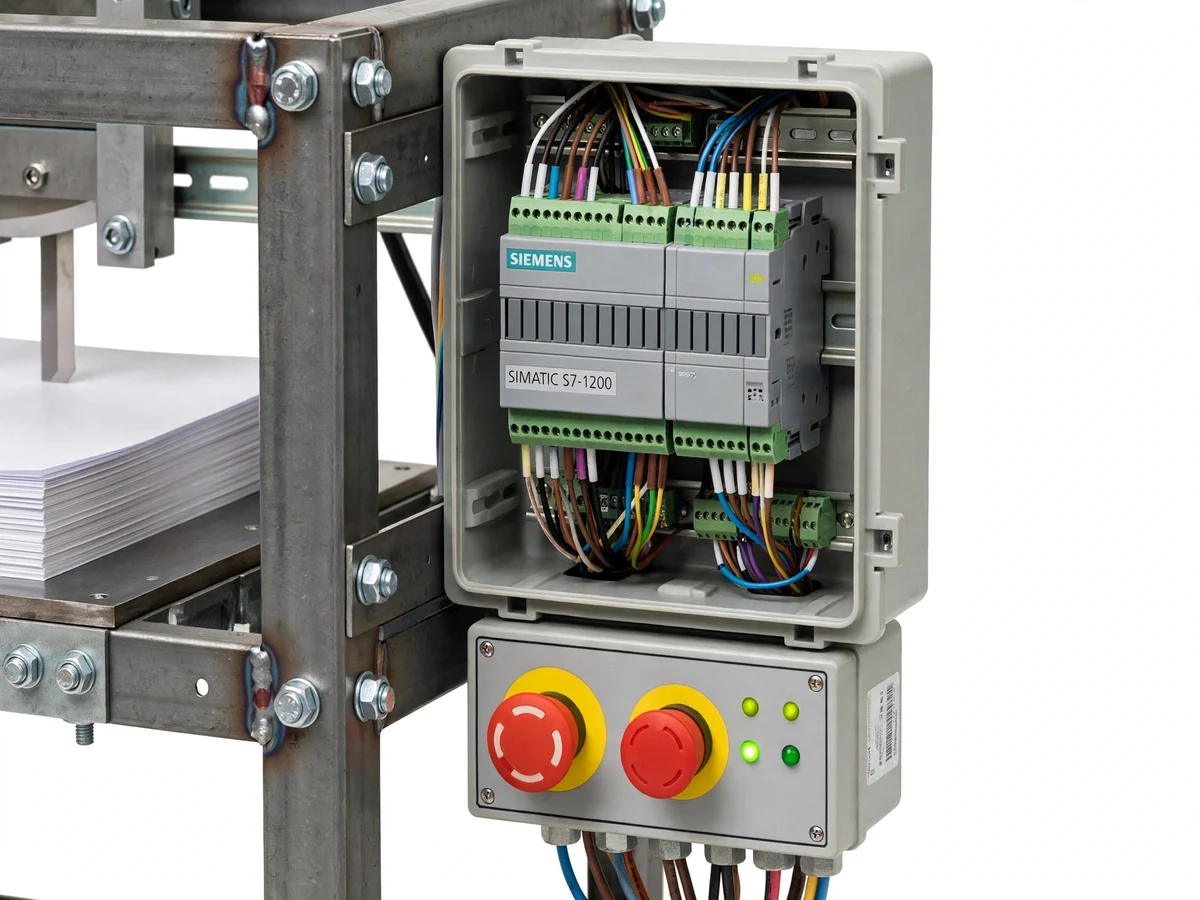
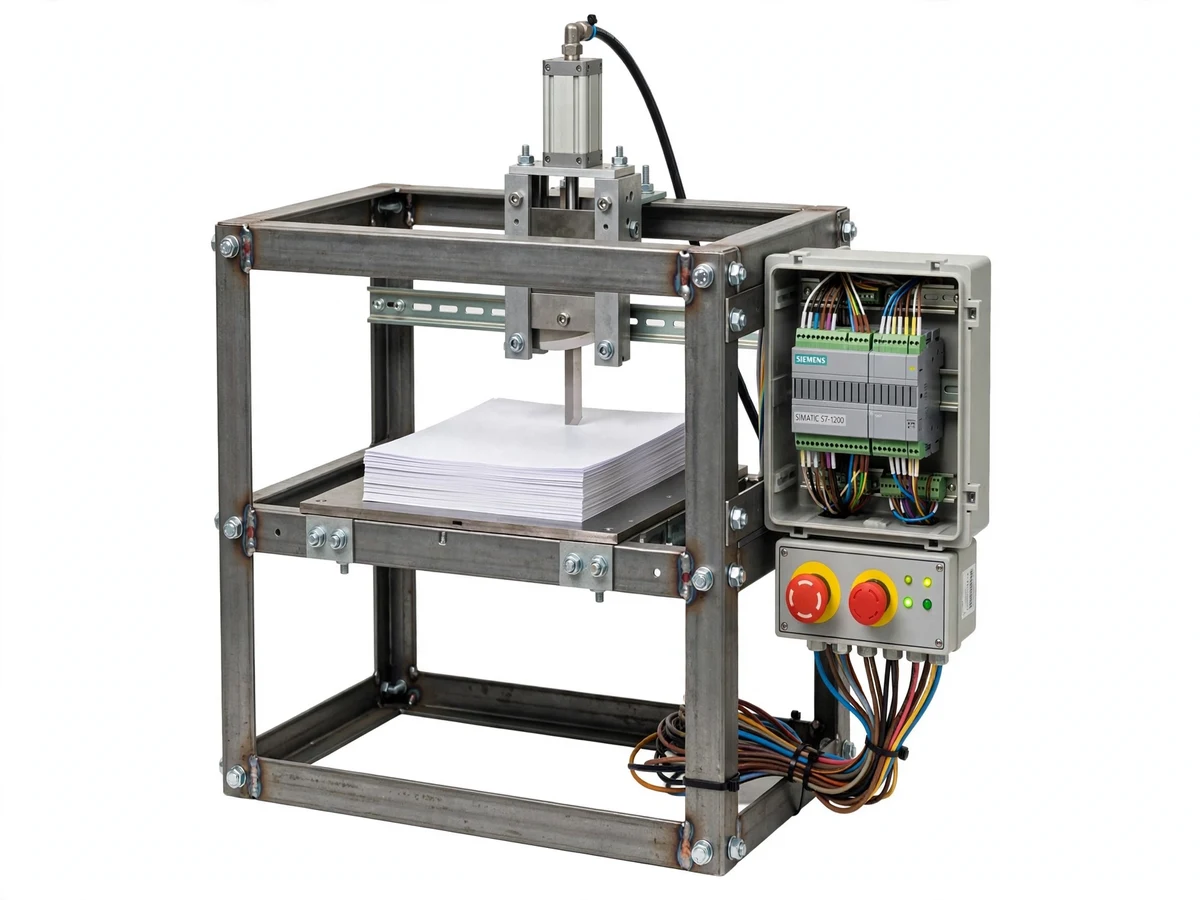
Paper cutting sounds simple until you watch it done by hand: a stack of sheets drifts during the cut, edges come out ragged, and every stroke puts the operator's fingers near the blade. Commercial print shops solved this decades ago with PLC-controlled guillotine cutters — programmable cut sequences, pneumatic clamping that holds the stack still, and safety interlocks that refuse to cycle unless the operator's hands are provably on the buttons. This project rebuilds that industrial machine at student scale: a steel frame carrying a pneumatic cylinder and guillotine blade, a paper stack table, and a genuine Siemens SIMATIC S7-1200 PLC running ladder logic written in TIA Portal. It is an automation trainer as much as a machine — every wire, every rung of logic and every pressure setting is something the student built, programmed and tuned.
How it works
- The operator places a paper stack on the table against the back gauge and selects manual or auto mode.
- In auto mode, pressing both palm buttons inside the timing window starts the cycle — the PLC checks clamp, blade-home and guard inputs first.
- The clamp cylinder extends and a pressure switch confirms the stack is held.
- The main cylinder drives the guillotine blade down through the stack; reed switches report stroke end.
- The blade retracts, the clamp releases, and the retentive counter increments; the cycle repeats for the preset count.
- Any e-stop press, guard fault or pressure loss freezes the sequence mid-cycle and latches the fault until a deliberate reset.
Tech stack:
- Siemens SIMATIC S7-1200 PLC, programmed in TIA Portal (ladder logic)
- Double-acting pneumatic cylinders (clamp + blade drive), 5/2 solenoid valves
- FRL unit (filter-regulator-lubricator), flow-control valves, pressure switches
- 24 V DC industrial I/O: palm buttons, mushroom-head e-stop, reed switches, selector switch
- Steel fabrication: frame, blade guide, paper table, back gauge
- Operator panel with cycle counter display and indicator lamps
| Parameter | Value |
|---|---|
| Controller | Siemens SIMATIC S7-1200 (programmed in TIA Portal, ladder logic) |
| Blade drive | Double-acting pneumatic cylinder; cut speed tunable via flow-control valves |
| Clamp | Pneumatic clamp cylinder with pressure-switch confirmation |
| Safety | Dual-hand start with timing window, latching mushroom-head e-stop, pressure-loss fault latch |
| Operating pressure | Design target ~4–6 bar shop air (buyer-set at the regulator; verify at your build) |
| Capacity | Design target: paper stacks up to ~50 mm thick (verify cut quality at your build) |
| Panel | Cycle counter (retentive), cut-count presets, mode selector, indicator lamps |
| Modes | Manual jog for setup; automatic cycling for production runs |
Project features
- [Siemens S7-1200 PLC control] A genuine SIMATIC S7-1200 runs the machine; students write and download the ladder logic in TIA Portal themselves.
- [Pneumatic guillotine drive] A double-acting pneumatic cylinder strokes the blade through the paper stack; flow-control valves let the student tune cut speed vs. impact.
- [Pneumatic paper clamp] A second cylinder clamps the stack before the blade moves, holding sheets registered so edges cut clean and square.
- [Dual-hand safety start] Two palm buttons must be pressed within a short window to start a cycle — the classic anti-tie-down guard against hand-in-die operation.
- [Emergency-stop chain] A latching mushroom-head e-stop drops all outputs and requires a deliberate reset sequence before the machine can restart.
- [Cut counter and presets] The operator panel shows the cycle count and stores cut-count presets, demonstrating real PLC data handling (retentive counters, recipes).
- [Manual / auto modes] A selector switch gives manual jog for setup and automatic cycling for production, with mode-dependent interlock logic in the program.
What is included
- Assembled machine prototype (steel frame, cylinders, blade, paper table, guards)
- Siemens S7-1200 PLC with the ladder-logic program (TIA Portal project files)
- Pneumatic circuit diagram and component list
- Wiring diagram for all 24 V I/O and safety devices
- Setup and tuning guide (pressure setting, flow-control adjustment, blade alignment)
- Project abstract PDF
- Project report (background, PLC programming, pneumatic design, safety analysis)
- PPT presentation and viva Q&A document (ladder logic, pneumatics, machine safety)
Limitations & prerequisites
- This is a student-scale demonstrator, not an industrial guillotine: it is not certified to machinery-safety standards, and the report keeps that boundary explicit.
- Cut quality depends on blade sharpness, pressure setting and stack thickness; the tuning guide covers the procedure, but results vary with the buyer's build.
- The machine needs a shop-air supply (~4–6 bar); a small compressor or lab air line is a prerequisite, not included.
- The PLC program is written for the S7-1200; migrating to another PLC family is possible as a customization, not part of the base build.
- Pneumatic cylinders and valves are wear items; seals and blade edges need periodic maintenance.
Frequently Asked Questions
Is this project suitable for a final-year project?
Yes — it suits Mechanical, Mechatronics and Electrical programs, demonstrating PLC programming, pneumatic system design, ladder logic and machine-safety interlocking in one build.
Which PLC is used?
A Siemens SIMATIC S7-1200, programmed in TIA Portal with ladder logic. The project files are included so the student can read, modify and re-download every rung.
Is it safe to demonstrate?
The base build includes dual-hand start, a latching e-stop and a pressure-loss fault latch — real industrial safety practice. It is still a sharp blade on a student machine: the safety section of the report and the demonstration procedure must be followed.
What air supply does it need?
Shop air at roughly 4–6 bar through the FRL unit. A lab air line or a small workshop compressor works; the compressor itself is not included.
Can the cut length or stack size change?
The back gauge is adjustable and the PLC stores cut-count presets; blade and table geometry are fixed in the base build, with mechanical modifications possible as customization.
What will I receive with the project?
The assembled machine, the PLC with its TIA Portal program, pneumatic and wiring diagrams, the tuning guide, abstract PDF, report, PPT and viva Q&A. Suitable for B.E./B.Tech final-year projects in Mechanical, Mechatronics and Electrical engineering.
Components & software requirements
- Siemens SIMATIC S7-1200 PLC, programmed in TIA Portal (ladder logic)
- Double-acting pneumatic cylinders (clamp + blade drive), 5/2 solenoid valves
- FRL unit (filter-regulator-lubricator), flow-control valves, pressure switches
- 24 V DC industrial I/O: palm buttons, mushroom-head e-stop, reed switches, selector switch
- Steel fabrication: frame, blade guide, paper table, back gauge
- Operator panel with cycle counter display and indicator lamps
Delivery information
Built-to-order project. Delivery timeline is shared after order confirmation based on current queue.
Support terms
Complete documentation, setup guide, and viva preparation included. Support for setup and explanation provided.