
More project photos (2)
The problem
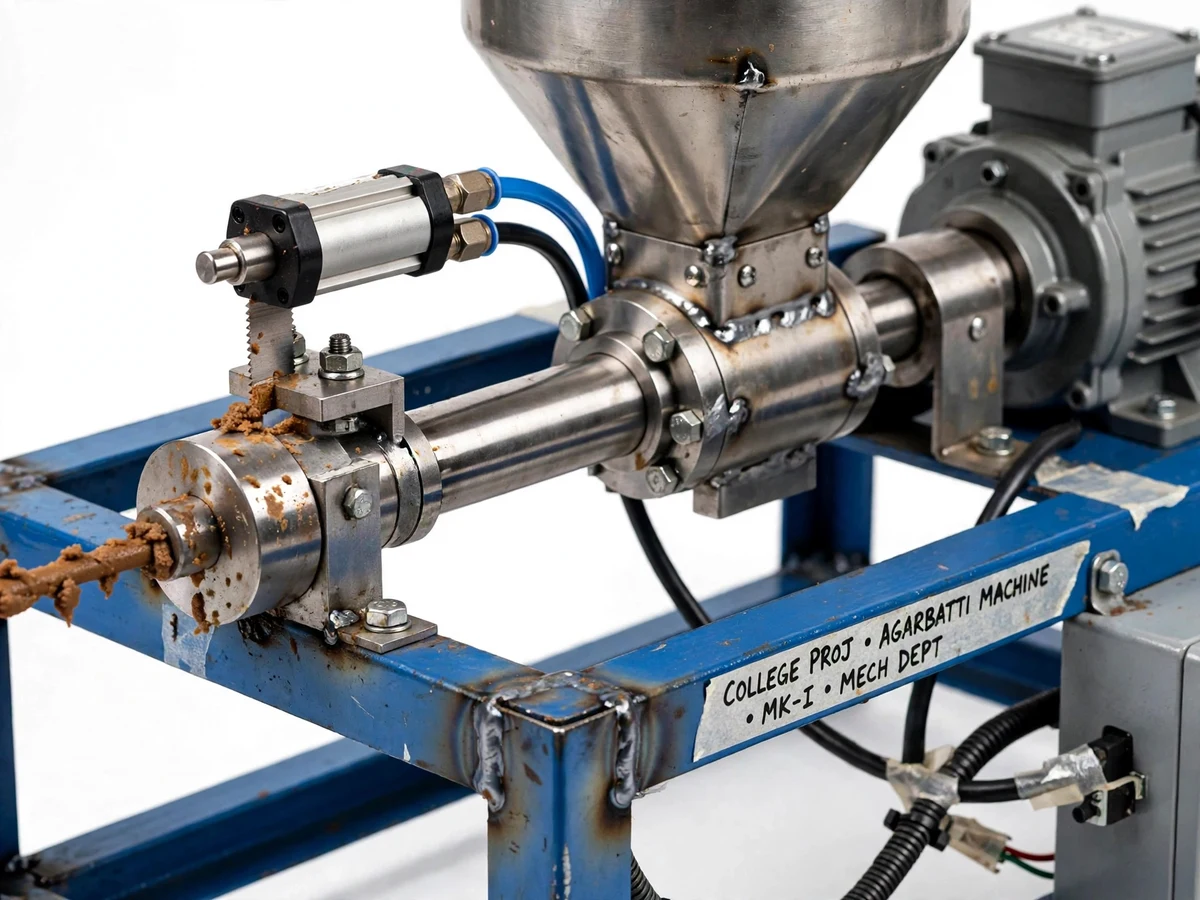
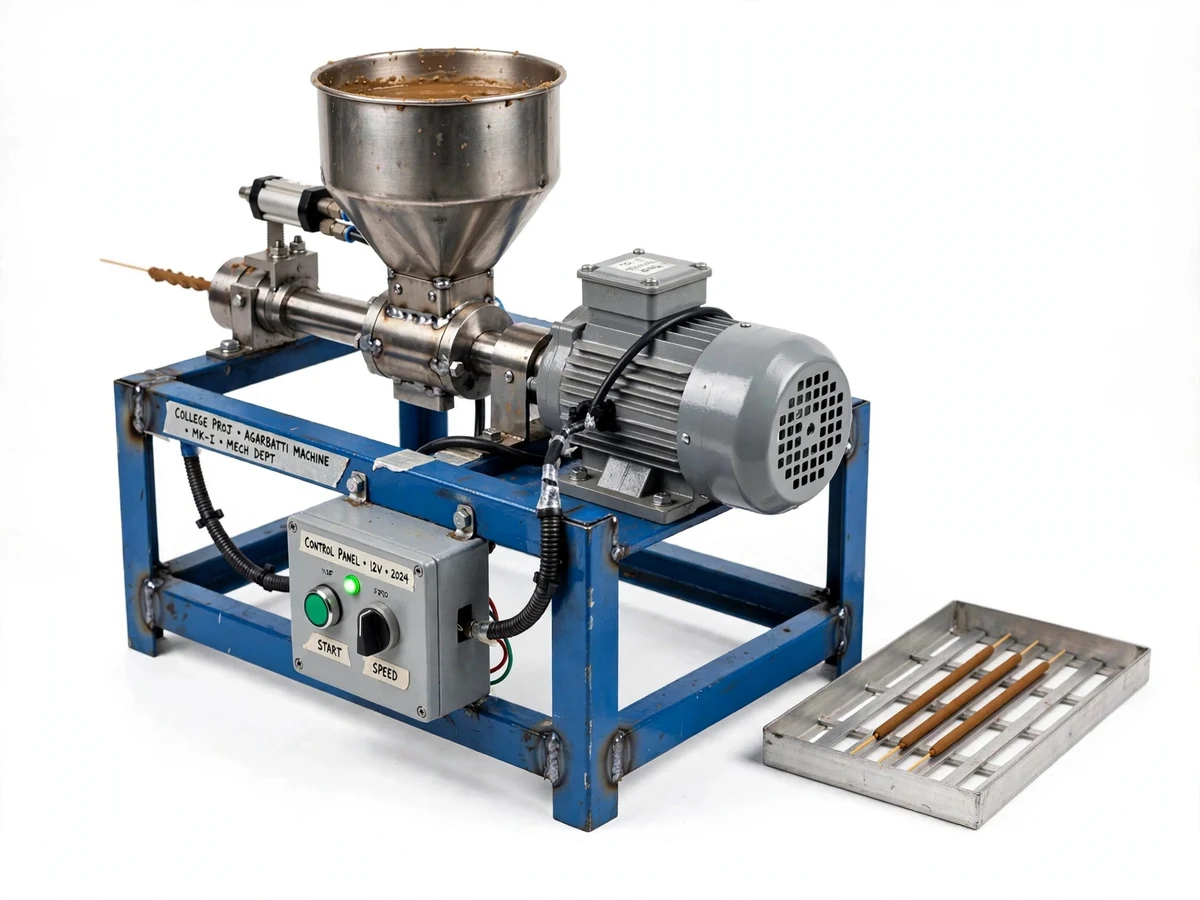
Hand-rolled agarbatti work is slow and uneven: coating thickness varies from stick to stick, lengths are eyeballed, and output is limited by hand speed. Commercial agarbatti machines exist but cost lakhs and run continuous lines far beyond a student lab, so students rarely get to study the actual mechanics — screw extrusion, die forming and pneumatic cutting — that a real production machine combines. This project builds a small, honest version of that machine: a hopper-fed screw extruder coats bamboo sticks with charcoal–jigat dough, and a pneumatic guillotine cutter trims every stick to a set length automatically.
The machine runs a simple, visible cycle. Dough is loaded into the hopper and conveyed by a screw extruder driven through a gearbox, emerging through the die head to coat a hand-fed bamboo stick uniformly. When the coated stick reaches the limit-switch position, a 5/2 solenoid valve fires the pneumatic cylinder and a blade cuts the stick cleanly; it drops into a slotted drying rack while the operator feeds the next stick. A control panel carries start/stop, an auto/manual selector and extruder speed control so the feed rate can be matched to dough consistency.
Prepares the dough, feeds each bamboo stick into the die head and trims extruder speed from the panel.
Follow the working sequence
How it works
- Dough is prepared from charcoal powder and jigat (Machilus macrantha bark) binder mixed to a stiff, workable consistency, then loaded into the hopper above the extruder barrel.
- The operator feeds a bare bamboo stick into the die head and presses start; the geared motor (approximately 0.5 HP, design target) turns the screw, which conveys dough forward and extrudes it through the die to coat the stick uniformly.
- The coated stick advances out of the die until its tip trips the limit switch mounted at the preset cut position on the slotted rail.
- The limit switch energizes the 5/2 solenoid valve; regulated air at approximately 4–6 bar drives the pneumatic cylinder, and the blade cuts the coated stick cleanly in one stroke.
- The solenoid returns, the cylinder retracts, and the cut stick drops into the drying rack slot while the operator feeds the next bamboo stick to restart the cycle.
- Extruder speed is trimmed from the panel to match dough stiffness — a wetter batch tolerates faster feed, a drier batch needs slower feed to avoid tearing the coating.
Tech stack:
- MS angle frame fabrication
- Screw extruder · die head
- 0.5 HP-class geared motor (design target)
- Pneumatic cylinder · 5/2 solenoid valve
- FRL unit (filter-regulator-lubricator)
- Limit switches · relay-logic control
- Control panel · extruder speed controller
| Parameter | Value |
|---|---|
| Machine footprint | Approximately 900 × 450 × 700 mm (design target) |
| Extruder motor | Approximately 0.5 HP with gearbox (design target) |
| Compressed-air supply | Approximately 4–6 bar (required, compressor not included) |
| Coated stick diameter | Approximately 3–5 mm (design range, die-dependent) |
| Stick cut length | Approximately 200–300 mm (configurable, design range) |
| Cut-length accuracy | Approximately ±1 mm (design target) |
| Production rate | Approximately 150–200 sticks per hour (design target, hand-fed) |
| Machine weight | Approximately 45 kg (design target) |
| Power supply | 230 V, 50 Hz, single phase |
| Controls | Start/stop pushbuttons, auto/manual selector, extruder speed control |
Project features
- [Screw extruder coating] A motor-driven screw conveys the charcoal–jigat dough and forces it through a die head, so each hand-fed bamboo stick emerges with a uniform coating — the core forming stage of the machine.
- [Pneumatic guillotine cutter] A double-acting pneumatic cylinder drives a cutting blade across the coated stick; a limit switch at the set length fires the 5/2 solenoid valve so every stick is cut to the same length in one stroke.
- [Adjustable cut length] The limit-switch position slides on a slotted rail, so the cut length is configurable across the approximately 200–300 mm design range without re-fabrication.
- [Speed control] The extruder motor speed is adjustable from the panel, letting the operator slow the feed for stiff dough batches that would otherwise tear.
- [FRL unit] The air line runs through a filter-regulator-lubricator, so the cylinder and valve receive clean, regulated air at the approximately 4–6 bar operating range.
- [Auto/manual cycle mode] The panel runs the cutter in automatic cycle (cut on limit-switch trip) or manual pushbutton mode for setup, die trials and testing.
- [Slotted drying rack] Cut sticks drop into a slotted tray that keeps them separated while the coating dries, instead of piling them where they would stick together.
What is included
- Fabricated machine: MS angle frame, hopper, screw extruder barrel, die head, pneumatic cutter assembly, drying rack
- Geared motor, screw and one standard die; pneumatic cylinder, 5/2 solenoid valve and FRL unit
- Limit switches, control panel with pushbuttons, speed controller and all internal wiring
- Wiring diagram and pneumatic circuit diagram
- Dough recipe guide (charcoal–jigat mixing ratios and consistency targets)
- Calibration guide (die setup, length setting, speed tuning)
- Project report PDF (design calculations, fabrication details, test results)
- PPT presentation for final review
- Viva Q&A preparation document (screw extrusion, pneumatics, machine automation)
Limitations & prerequisites
- Dough consistency decides the output: too-wet dough smears and tears, too-dry dough jams the screw — mixing is manual skill and is not automated by this machine.
- A compressed-air source is required; the compressor is assumed at the user end and is not included.
- The throughput figure is a design target — actual rate depends on the operator hand-feeding sticks and on dough batch quality.
- Drying is ambient on the rack; there is no heated or controlled drying chamber (listed as future scope).
- This is not a certified industrial machine — no food-grade or factory-safety certification; it is intended for study, demonstration and small-scale production.
- Length uniformity is approximate (±1 mm design target); it will not match the consistency of a factory continuous line.
Frequently Asked Questions
How is the incense dough made?
The dough mixes charcoal powder with jigat — a natural binder from Machilus macrantha bark — and water, kneaded to a stiff, putty-like consistency. The recipe guide supplied with the project lists mixing ratios and consistency targets, and the operator adjusts extruder speed at the panel to suit each batch.
Does the machine need an air compressor?
Yes. The pneumatic cutter runs on approximately 4–6 bar of clean, regulated air, so a compressor at the user end is required; it is not part of the supplied build. The FRL unit on the machine handles filtering, regulation and lubrication of the incoming air.
What stick lengths can it produce?
The limit-switch position slides on a slotted rail, giving a configurable cut length across the approximately 200–300 mm design range, with approximately ±1 mm repeatability as a design target.
Can the coating thickness be changed?
Coating thickness is set by the die bore, so a different thickness needs a different die — the build ships with one standard die and additional dies can be made to order. Sticks of a different bamboo diameter need matching die and guide clearances.
Does it dry the sticks automatically?
No — cut sticks are collected on a slotted rack for ambient drying. A heated, controlled drying chamber would be a future-scope addition, along with automatic bamboo-stick feeding.
Is this project suitable for a final-year project?
Yes — for Mechanical Engineering programs. It demonstrates screw-extruder design, die forming, pneumatic actuation, machine fabrication and process tuning, all of which give strong viva material.
Components & software requirements
- MS angle frame fabrication
- Screw extruder · die head
- 0.5 HP-class geared motor (design target)
- Pneumatic cylinder · 5/2 solenoid valve
- FRL unit (filter-regulator-lubricator)
- Limit switches · relay-logic control
- Control panel · extruder speed controller
Delivery information
Built-to-order project. Delivery timeline is shared after order confirmation based on current queue.
Support terms
Complete documentation, setup guide, and viva preparation included. Support for setup and explanation provided.
Download free synopsis (PDF)
Enter your name and email — the synopsis PDF downloads immediately. We may send occasional project updates; no spam, unsubscribe anytime.