
More project photos (3)
The problem
Walk through any packaged-goods factory and the same scene repeats: bottles moving down a conveyor, stopping under a filler, getting capped and counted — thousands of times a day, with almost no human hands involved. That choreography is the daily work of PLCs, the rugged controllers that run sequential automation worldwide. Yet most electrical students meet PLCs only as ladder-logic diagrams on a projector screen, never as a machine they can wire, program and debug. The gap matters because industrial automation is learned through interlocks and timing, not theory: what happens when a bottle is missing under the nozzle, when a station jams, when someone hits the emergency stop. This project closes that gap at desk scale — a conveyor, a timed fill station, a capping station and a bottle counter, all sequenced in ladder logic with the same scan-cycle, interlock and fault-handling discipline used on real production lines.
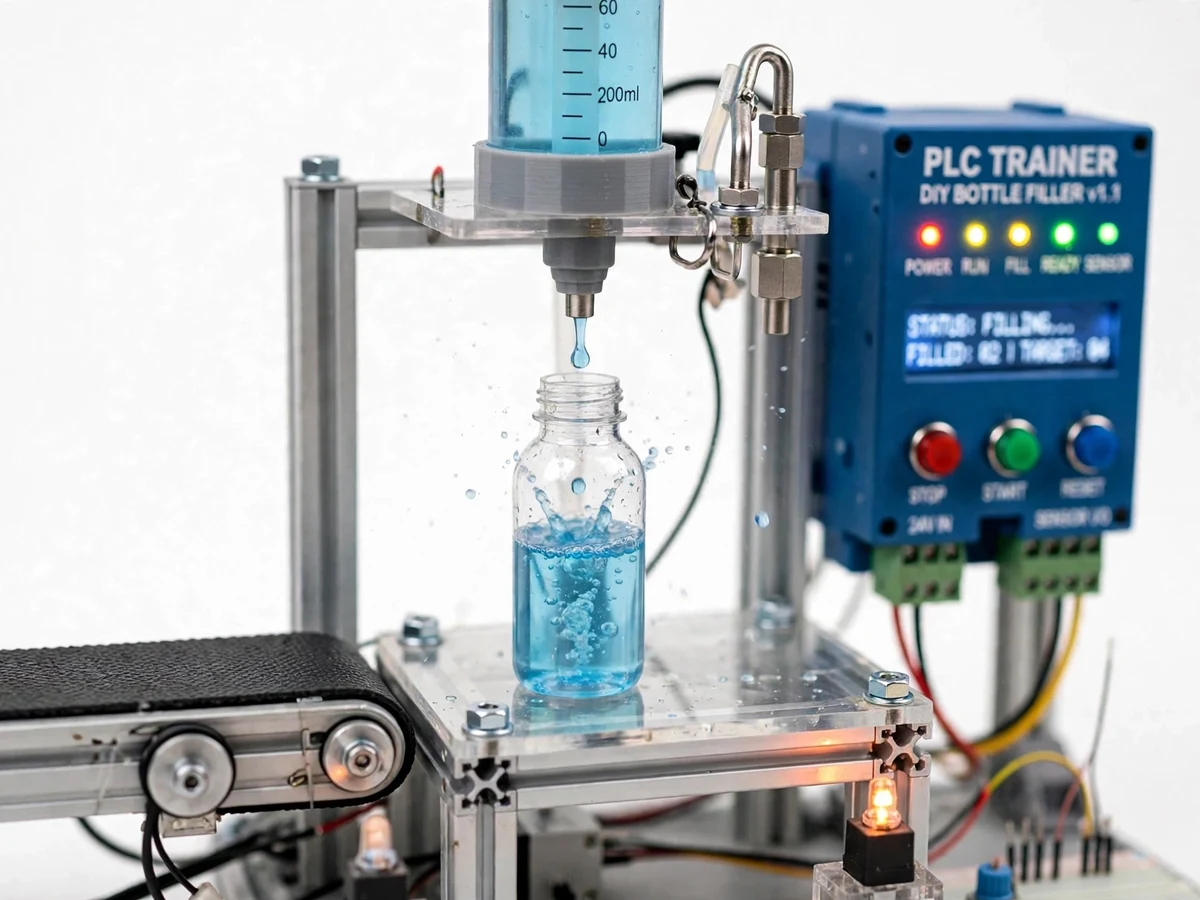
IR and proximity sensors at the fill and cap stations detecting bottle arrival.
Follow the working sequence
How it works
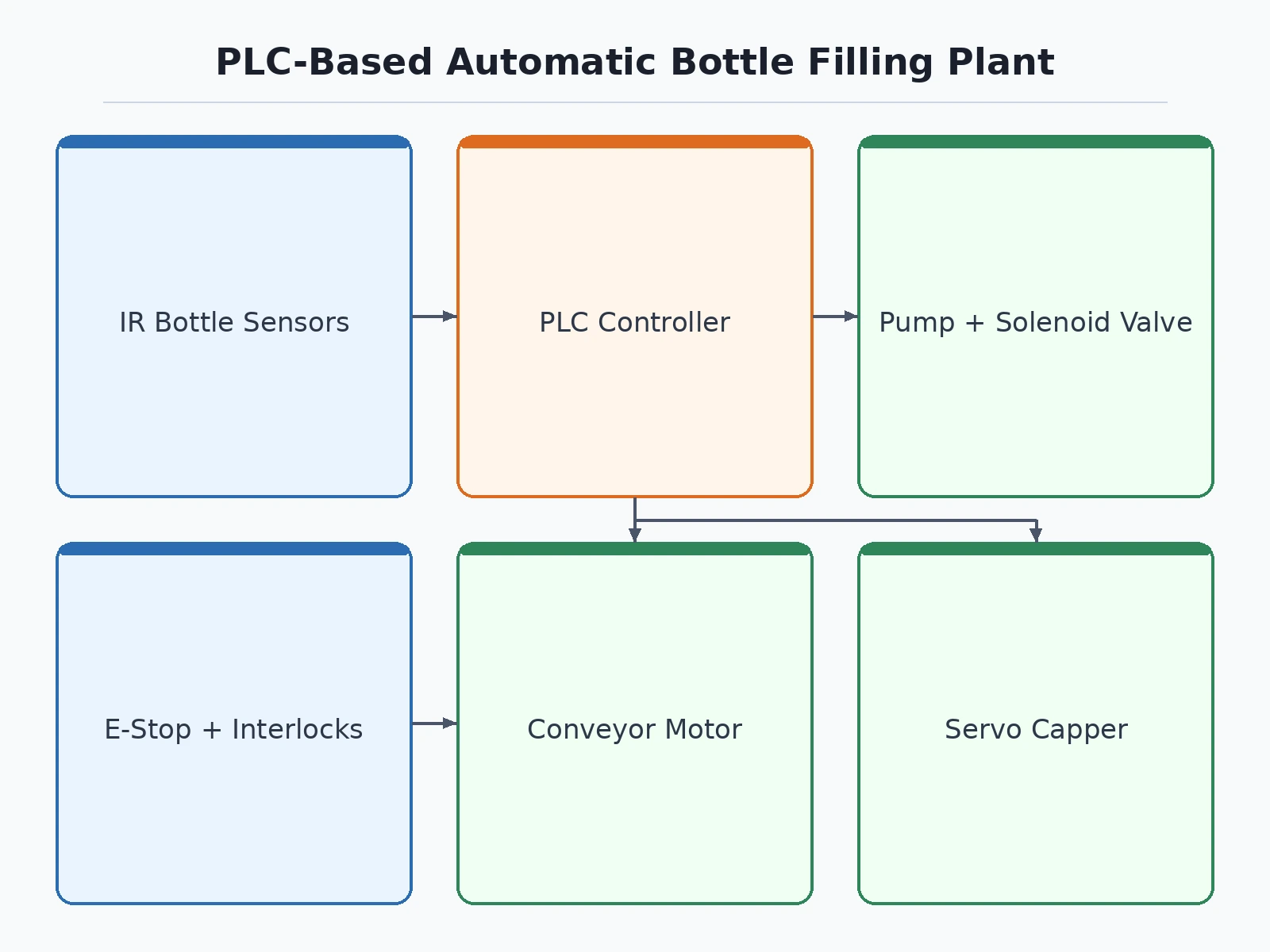
- Empty bottles are placed on the conveyor; the PLC starts the belt motor and the line runs.
- An IR sensor at the filling station detects a bottle's arrival and the PLC stops the conveyor precisely under the nozzle.
- The ladder logic opens the solenoid valve and runs the DC pump for the calibrated fill time, dispensing the measured volume.
- The conveyor restarts and carries the filled bottle to the capping station, where a second sensor triggers the servo to press/seal the cap.
- The bottle counter increments; the cycle repeats for each bottle automatically.
- Any fault — no bottle under the nozzle, station timeout, or E-stop press — freezes the sequence, sounds the buzzer and lights the fault indicator until reset.
Project features
- Automatic conveyor transport of bottles through fill and cap stations
- IR/proximity bottle detection — filling starts only when a bottle is confirmed under the nozzle
- Timed filling via DC pump + solenoid valve with adjustable fill time for different bottle sizes
- Fill accuracy target around ±5 ml on the demo bottles — the calibration procedure is documented
- Capping station with servo actuator that seals each filled bottle
- Bottle counter with total and per-batch counts on the display
- No-bottle/no-fill interlock — the valve never opens without a detected bottle, preventing spills
- Emergency stop with latching halt — the whole sequence freezes until reset
- Jam/timeout alarm — if a bottle doesn't clear a station in time, the buzzer sounds and the line stops
- PLC ladder logic with status LEDs per rung, plus a manual/jog mode for setup and demos
What is included
- Fully assembled and ladder-tested bottle filling plant model
- Complete ladder-logic program with rung-by-rung documentation
- Circuit diagram and wiring schematic (PLC I/O mapping included)
- Fill-calibration procedure sheet (timing vs measured volume)
- Project report PDF (industrial automation background, ladder design, accuracy results, conclusion)
- PPT presentation for final review
- Viva Q&A preparation document (PLC scan cycle, ladder instructions, interlocks, timers)
- Demo runbook — how to run fill-and-cap cycles in your review
FAQs
- Is this a real PLC or an Arduino pretending to be one? The build uses a PLC trainer unit where available, programmed in genuine ladder logic; the Arduino PLC-style fallback runs the same ladder-style sequential logic. Either way the build teaches real PLC concepts — scan cycle, rungs, timers, interlocks.
- How accurate is the filling? Around ±5 ml on the demo bottles after your calibration — the fill-accuracy test procedure and results table go straight into the report.
- What stops the valve from spilling liquid with no bottle? The no-bottle/no-fill interlock: the fill rung requires the fill-station sensor input to be true before the solenoid output can energize. Pull the bottle away mid-cycle and the valve closes — a safe, demonstrable interlock.
- What happens if a bottle jams? Each station has a timeout timer — if a bottle doesn't arrive/clear in time, the line halts, the buzzer sounds and the fault LED marks the station. Reset only works after the jam is cleared.
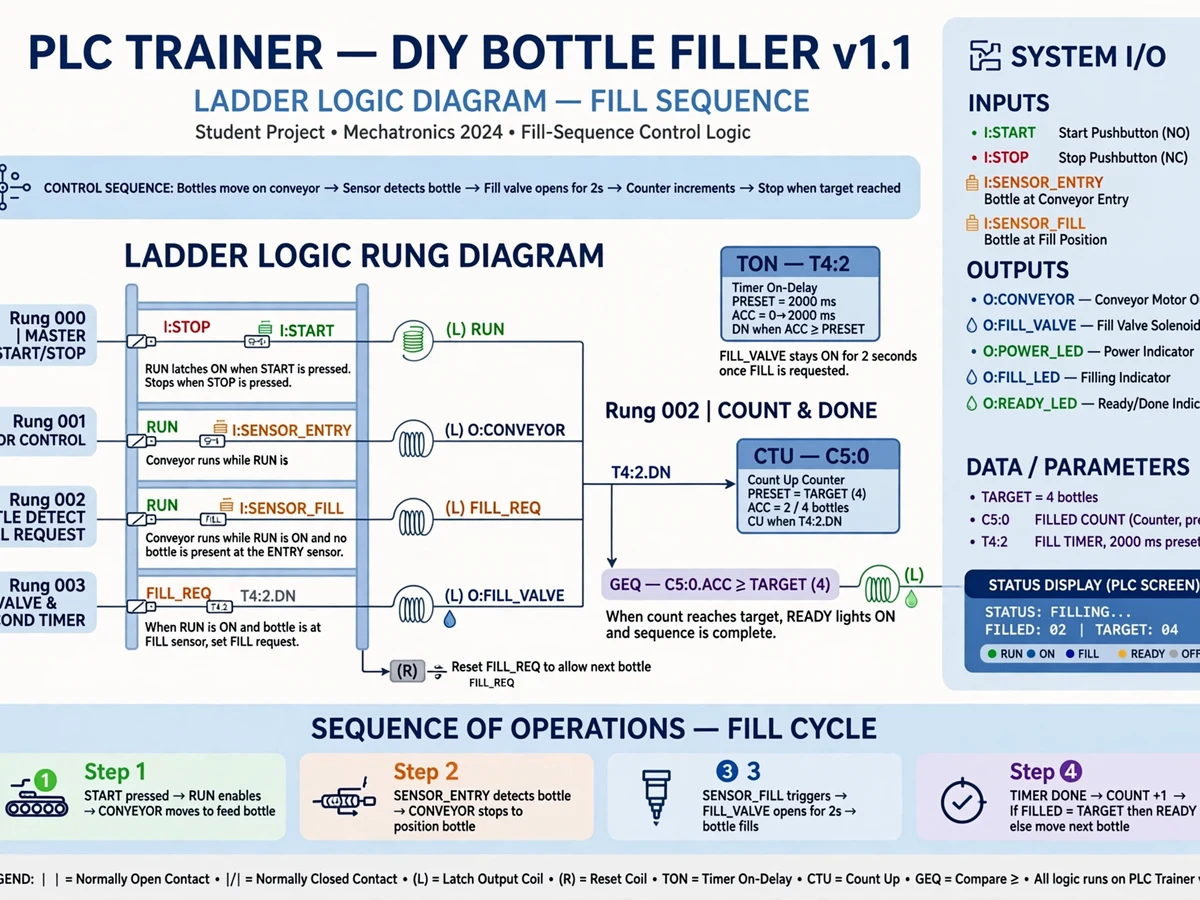
- Can I demo the ladder logic in my review? Yes — the ladder program ships with rung-by-rung documentation, and the G2 diagram shows the fill-sequence rungs. Walk through one rung (bottle detect → stop conveyor → fill timer → valve) and you've demonstrated real automation thinking.
- How can I extend this project? Common extensions include: flow-meter volumetric dosing, HMI touchscreen with recipe selection, multi-size bottle handling with adjustable guides, and a reject-station for underfilled bottles.
Advantages
- Full PLC ladder-logic sequencing with interlocks, a latching emergency stop and fault alarms — industrial-style control on a desk model.
- IR bottle detection with a no-bottle/no-fill interlock — the valve never opens without a detected bottle, preventing spills.
- Timed filling via DC pump and solenoid valve with adjustable fill time for different bottle sizes; ~±5 ml calibration procedure documented.
- Servo capping station that seals each filled bottle, plus a bottle counter with total and per-batch counts on the display.
- Jam/timeout alarm — if a bottle doesn't clear a station in time, the buzzer sounds and the line stops.
- Manual/jog mode for setup and demos, with status LEDs per ladder rung for debugging.
Disadvantages
- Model scale — demo bottles (~100 ml) and flow rates are sized for a desk model; real plants use flow meters and servo dosing, which the report compares.
- Timed filling, not volumetric metering — fill accuracy depends on consistent pump pressure; the calibration sheet covers re-tuning.
- Capping is a press/seal action on demo bottles, not a threaded torque cap like real lines.
- The conveyor handles one bottle size per setup; changing bottle size needs a mechanical and timing re-tune.
Limitations & prerequisites
- Model scale — demo bottles (~100 ml) and flow rates are sized for a desk model; real plants use flow meters and servo dosing, which the report compares.
- Timed filling (not volumetric metering) — fill accuracy depends on consistent pump pressure; the calibration sheet covers how to re-tune it.
- Capping is a press/seal action on demo bottles, not a threaded torque cap like real lines.
- The conveyor handles one bottle size per setup; changing bottle size needs a mechanical and timing re-tune.
Components & software requirements
- PLC trainer unit (or Arduino PLC-style controller) with digital I/O
- Miniature conveyor belt model with DC gear motor drive
- DC pump + solenoid valve (timed filling stage)
- IR/proximity sensors at fill and cap stations (bottle detection)
- Servo actuator (capping station)
- Ladder-logic program: sequential fill-and-cap rungs with interlocks and alarms
- 16×2 LCD or 7-segment display (bottle counter, status)
- Buzzer + fault/status LEDs; E-stop pushbutton (latching)
Specifications
| Parameter | Value |
|---|---|
| Controller | PLC trainer (or Arduino PLC-style), digital I/O, ladder logic |
| Conveyor | DC gear-motor belt, adjustable speed |
| Fill system | DC pump + solenoid valve, timer-based dosing |
| Fill accuracy | ~±5 ml on demo bottles (calibrated fill time) |
| Fill time | Adjustable 1–10 s per bottle (bottle-size dependent) |
| Capping | Servo actuator press/seal station |
| Bottle detection | IR/proximity sensors at fill and cap stations |
| Counting | Total + per-batch bottle counter on display |
| Interlocks | No-bottle/no-fill, station timeout, E-stop latching |
| Alarms | Buzzer + fault LEDs for jam, timeout and E-stop |
| Modes | Auto run, manual/jog for setup and demos |
Download free synopsis (PDF)
Enter your name and WhatsApp number — the synopsis PDF downloads immediately. We may send occasional project updates on WhatsApp; no spam.
Balsaraf et al. (2024), Int. J. for Research in Applied Science & Engineering Technology (IJRASET)