
More project photos (2)
The problem
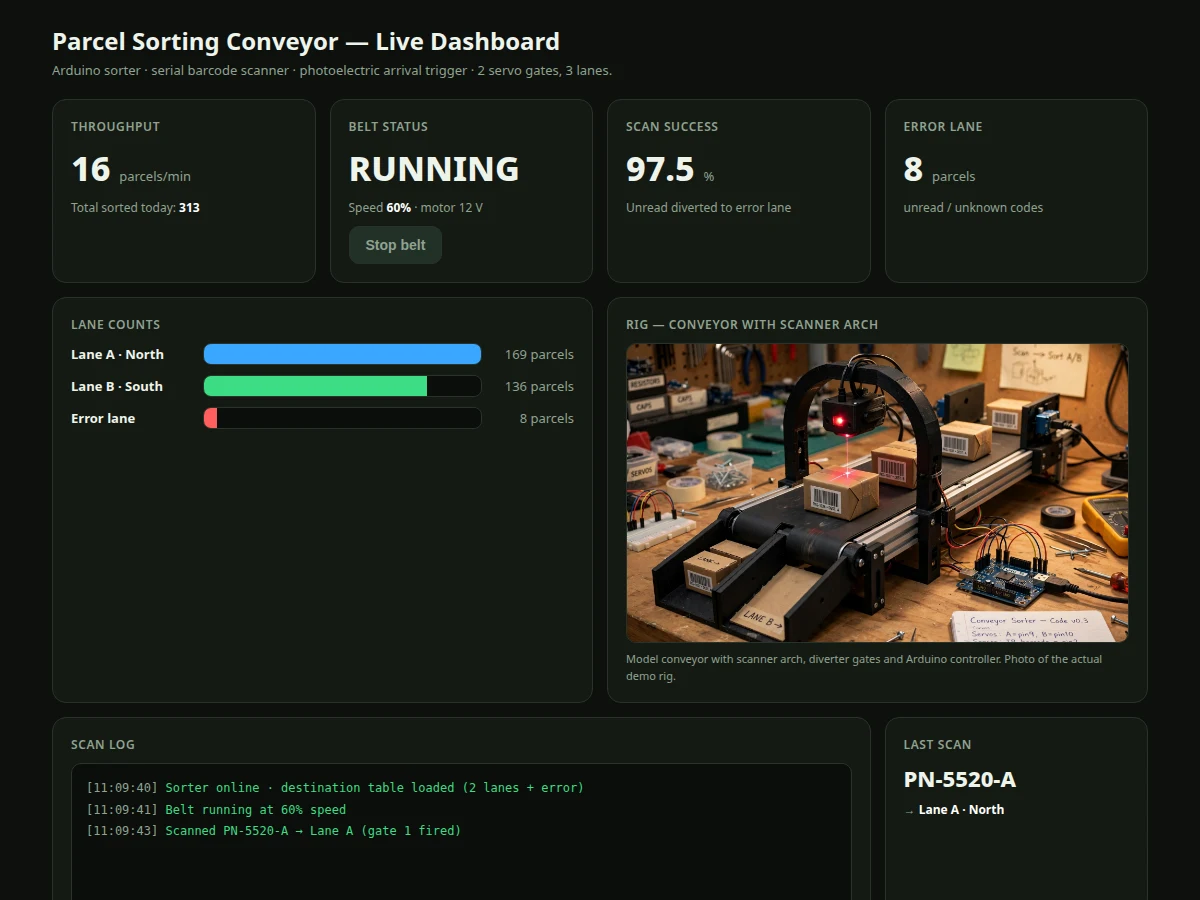
Distribution hubs sort thousands of parcels a day by destination, and the core of that automation is a loop students can build on a bench: move, identify, divert. Manual sorting doesn't scale, fixed diverters can't change destinations, and a sorter that can't read a label is just a conveyor. This project builds the working loop at model scale: a belt conveyor driven by a DC gear motor with speed control, a serial barcode scanner module mounted over the belt, a through-beam photoelectric sensor that triggers a scan window as each parcel arrives, and two servo-driven diverter gates that route parcels to three lanes (two sort lanes plus an error lane). The Arduino matches each decoded barcode against a destination table and fires the right gate at the right time. The dashboard streams throughput, per-lane counts, the scan log and unread-barcode events. The honest limits are built into the design notes: the scanner reads printed labels at close range only, and sort reliability depends on parcel spacing — the test procedure documents the minimum gap the buyer should maintain.
How it works
- Parcels are placed on the belt; the DC gear motor drives the belt at the configured speed.
- The through-beam photoelectric sensor detects an arriving parcel and triggers the barcode scanner's read window.
- The scanner decodes the label and sends the code to the Arduino over serial.
- The Arduino looks the code up in the destination table: lane A, lane B, or error lane for unknown/unread codes.
- At the gate position, the Arduino fires the matching servo diverter, pushing the parcel into its lane; the gate returns to neutral.
- Every scan, sort decision and error is streamed to the dashboard: throughput, per-lane counts, scan log and error events.
Tech stack:
- Arduino (Uno/Mega) control firmware
- DC gear motor + motor driver, PWM speed control
- Serial barcode scanner module
- Through-beam photoelectric sensor
- 2× servo-driven diverter gates, 3 lanes
- Belt conveyor frame (fabrication drawings included)
- Web dashboard (HTML/CSS/JS, live telemetry)
| Parameter | Value |
|---|---|
| Controller | Arduino (Uno/Mega), serial scanner interface |
| Conveyor | Belt, DC gear motor, PWM speed control |
| Scanner | Serial barcode module, close-range printed labels |
| Trigger | Through-beam photoelectric arrival sensor |
| Diverters | 2 servo gates → 3 lanes (2 sort + 1 error lane) |
| Dashboard | Throughput, per-lane counts, scan log, error events |
| Parcel spacing | Minimum reliable gap documented by the test procedure |
| Power | 12 V for motor, 5 V for logic/servos |
Project features
- [Barcode scan on the fly] A serial scanner module reads each parcel's label as it passes under the scanner arch, triggered by the arrival sensor.
- [Servo diverter gates] Two servo-driven gates route parcels to three lanes based on the decoded destination code.
- [Photoelectric arrival trigger] A through-beam sensor detects each parcel and opens the scan window, so scans align with parcel position.
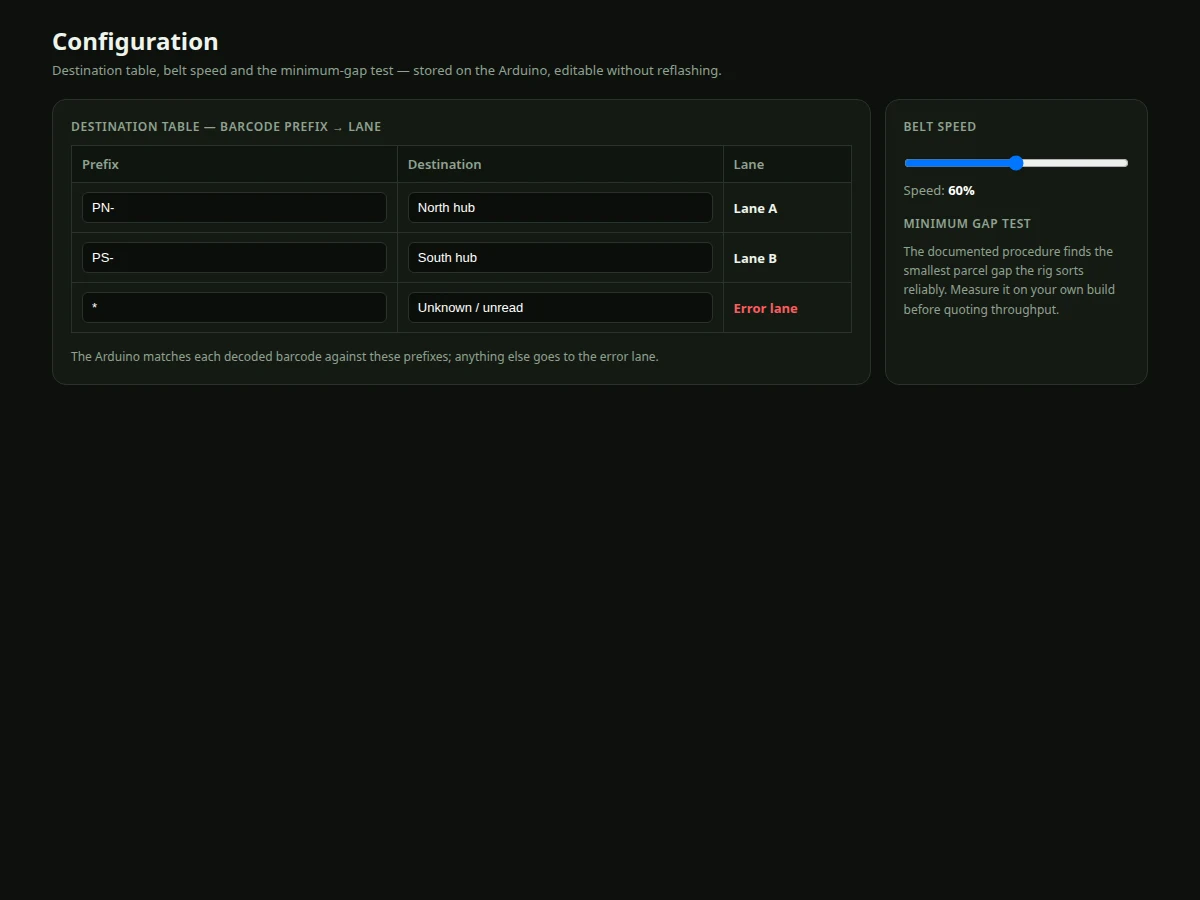
- [Destination table] The Arduino matches decoded codes against a configurable destination table; unknown codes go to the error lane.
- [Speed-controlled belt] DC gear motor with PWM speed control; the dashboard sets and displays belt speed.
- [Throughput dashboard] Live parcels-per-minute, per-lane counts, scan log, error-lane events and uptime.
- [Unread-barcode handling] Parcels whose labels can't be read are diverted to the error lane and logged — a genuine sorter behavior, not a hidden failure.
- [Minimum-gap procedure] Documented spacing test so the buyer knows the smallest parcel gap the rig sorts reliably.
What is included
- Complete Arduino firmware (scan trigger, destination lookup, gate timing, dashboard stream)
- Conveyor fabrication drawings and parts list
- Destination-table configuration tool/guide
- Web dashboard (throughput, lane counts, scan log)
- Minimum-gap test procedure
- Project report PDF (sorting automation, control design, testing)
- PPT presentation for final review
- Viva Q&A preparation document (sensors, servos, serial protocols, sort logic)
Limitations & prerequisites
- This is a model-scale demonstration rig, not industrial sorting equipment — belt size, speed and payload are bench-scale by design.
- The scanner reads printed barcodes at close range; damaged, crumpled or glossy labels may not decode, which is exactly why the error lane exists.
- Sort reliability depends on parcel spacing and belt speed; the test procedure documents the minimum gap, and jamming the belt voids any timing guarantees.
- The destination table is a fixed lookup — the rig does not read addresses or handwriting, only the barcode values it was configured with.
- Lane count is fixed at three in the base build; more lanes need additional gates and servos (documented as the extension path).
Frequently Asked Questions
What does the scanner read?
Printed barcodes on parcel labels, at close range under the scanner arch. The photoelectric sensor triggers each scan so it aligns with the parcel.
What happens to unread or unknown barcodes?
They are diverted to the error lane and logged on the dashboard — this mirrors real sorter behavior for exceptions.
How fast can it sort?
Belt speed is adjustable, but reliable sorting needs the documented minimum parcel gap. The test procedure lets the buyer measure the rig's own reliable throughput.
Can destinations be changed?
Yes — the destination table maps barcode prefixes to lanes and is configurable without reflashing; the guide explains the format.
What power does it need?
12 V for the belt motor and 5 V for the Arduino, servos and scanner — the wiring guide keeps the supplies separated.
Is this project suitable for a final-year project?
Yes — for Mechanical, Mechatronics and Industrial Engineering programs. It demonstrates conveyor design, sensor-triggered control, serial protocols, servo actuation and throughput measurement, all strong viva material. Suitable for B.E./B.Tech final-year projects in Mechanical, Mechatronics and Industrial Engineering.
Components & software requirements
- Arduino (Uno/Mega) control firmware
- DC gear motor + motor driver, PWM speed control
- Serial barcode scanner module
- Through-beam photoelectric sensor
- 2× servo-driven diverter gates, 3 lanes
- Belt conveyor frame (fabrication drawings included)
- Web dashboard (HTML/CSS/JS, live telemetry)
Delivery information
Built-to-order project. Delivery timeline is shared after order confirmation based on current queue.
Support terms
Complete documentation, setup guide, and viva preparation included. Support for setup and explanation provided.