
More project photos (2)
The problem
The Online Tailor Booking Web App with Measurement Profiles and Order Tracking moves the neighbourhood tailor's paper order book onto the web, where customers discover tailors, book fitting slots, store body measurements once as reusable profiles, and follow each garment from cutting to delivery. Walk into most tailoring shops and the workflow is unchanged in decades: measurements scribbled in a notebook, delivery dates promised from memory, and customers calling repeatedly to ask whether their garment is ready. Paper records get lost, repeat customers re-dictate the same measurements every visit, and one missed notebook entry becomes a missed delivery date. Generic booking tools do not understand tailoring — they have no notion of measurement profiles, garment types or stitching stages. A purpose-built web app closes that gap: one saved profile serves every future order, slots are blocked at booking time so tailors are never double-booked, and the live order timeline replaces the anxious follow-up call with visible progress.
Discovers tailors, books fitting slots and attaches a saved measurement profile to each order.
Follow the working sequence
How it works
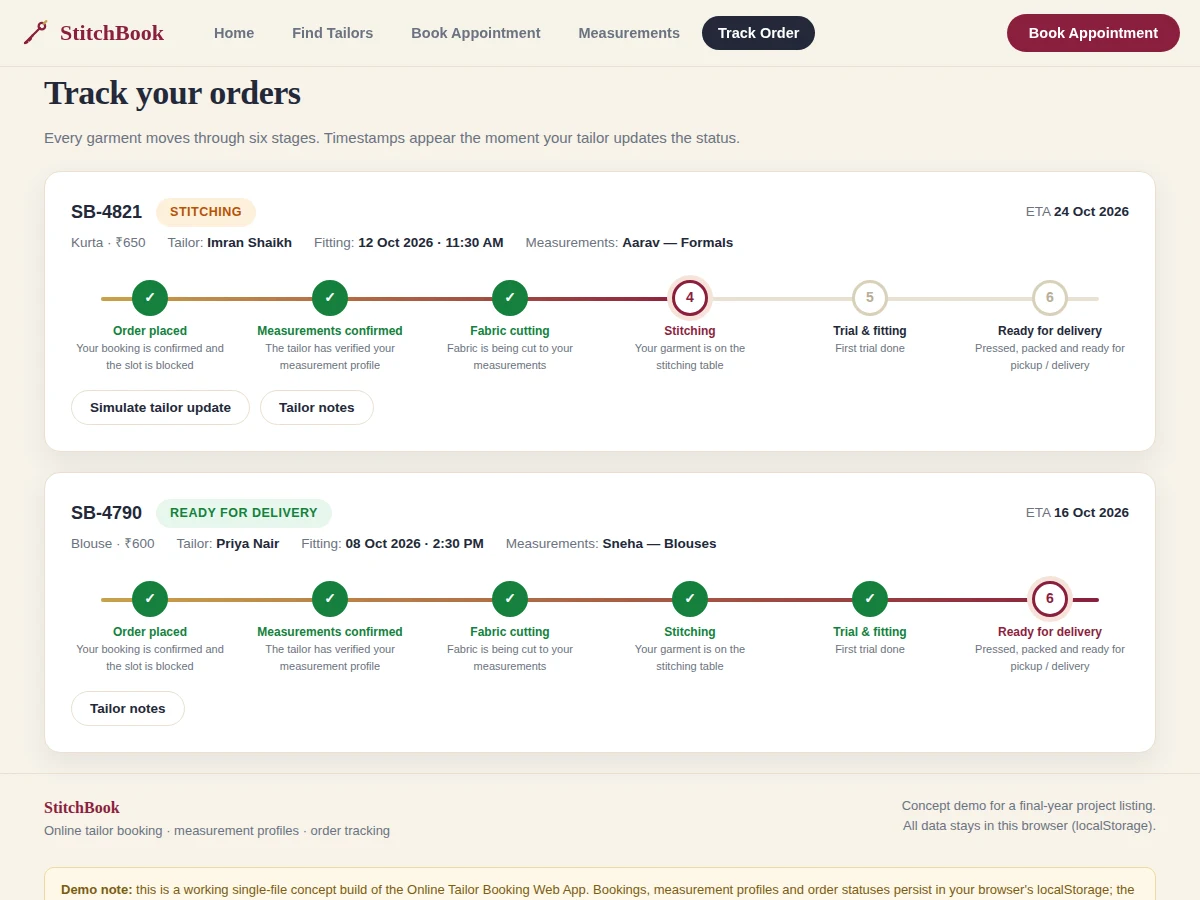
A booking travels through the system in one continuous chain: the customer picks a tailor and a garment, chooses a date and time slot, and attaches a saved measurement profile instead of re-typing 14 fields. The booking engine writes the order, blocks the slot on the tailor's calendar, computes a delivery estimate from the garment's lead time, and confirms both sides. The tailor then advances the order through six stages — order placed, measurements confirmed, fabric cutting, stitching, trial and fitting, ready for delivery — and every transition is timestamped and visible to the customer immediately. Because measurements live in reusable profiles, a repeat order skips the measuring step entirely, and the complete order history stays searchable for both sides. Online payment is deliberately outside the base flow and offered as an optional customization.
- Customers and tailors register with role-based accounts; passwords are bcrypt-hashed and sessions use JWT authentication.
- The customer browses tailor profiles — specialty, rating, reviews, location, starting price — and filters by specialty to shortlist.
- Booking: the customer selects a garment type, a date from the rolling 14-day window and an available time slot, then attaches a saved measurement profile or enters measurements fresh; confirming blocks the slot.
- The system creates the order with a unique ID, computes the delivery estimate from the garment's design-target lead time, and emails confirmations to both parties.
- The tailor's dashboard shows the order queue; the tailor confirms the measurements and advances the order through the six stages, adding notes at any step.
- At the trial-and-fitting stage the customer visits for a fitting; alteration notes are recorded against the order for the final stitching pass.
- When the garment is ready, the status flips to ready-for-delivery, the customer is notified, and the order moves to history with a rating prompt.
Tech stack:
- MongoDB (users, profiles, orders and slots)
- Express.js (REST API)
- React (customer and tailor dashboards)
- Node.js (runtime)
- JWT authentication with bcrypt password hashing
- Tailwind CSS (responsive UI)
- Nodemailer (booking and status emails)
- Razorpay / UPI payments (optional customization)
| Parameter | Value |
|---|---|
| Platform | Responsive web app for desktop and mobile browsers |
| Frontend | React single-page application (design target) |
| Backend | Node.js + Express REST API (design target) |
| Database | MongoDB with Mongoose models (design target) |
| Measurement fields | 14 per profile (implemented in the concept demo) |
| Repeat-order measurement step | One profile selection, down from 14 fields (observed in the concept demo) |
| Booking window | Rolling 14-day calendar (implemented in the concept demo) |
| Slots per day | 6 slots of 90 minutes each (design target) |
| Order stages | 6, from order placed to ready for delivery |
| Delivery lead time | 4–12 working days by garment type (design-target estimate) |
| Auth sessions | JWT, 24-hour token lifetime (design target) |
| Concept demo | Single-file HTML app; data persists in browser localStorage |
Project features
The four capabilities that define this build are the slot-based booking engine, which blocks a tailor's calendar the moment a booking is confirmed so double bookings are structurally impossible; reusable measurement profiles, which store 14 body measurements once and attach them to any future order with a single selection; the six-stage order tracking timeline, which mirrors the tailor's real workflow from measurements to delivery with a timestamp on every transition; and the dual customer–tailor dashboards, which give each side exactly the view it needs and nothing it does not. Around that core sit tailor discovery with ratings and price filters, garment-wise delivery estimates, and email confirmations. Every feature below ships in the base build except the last, which is marked as an optional customization so the scope stays honest — buyers should know exactly what is included on day one.
- [Slot-based booking engine] A rolling 14-day date picker with per-tailor time slots; confirming a booking blocks the slot on the tailor's calendar immediately, so two customers can never hold the same slot.
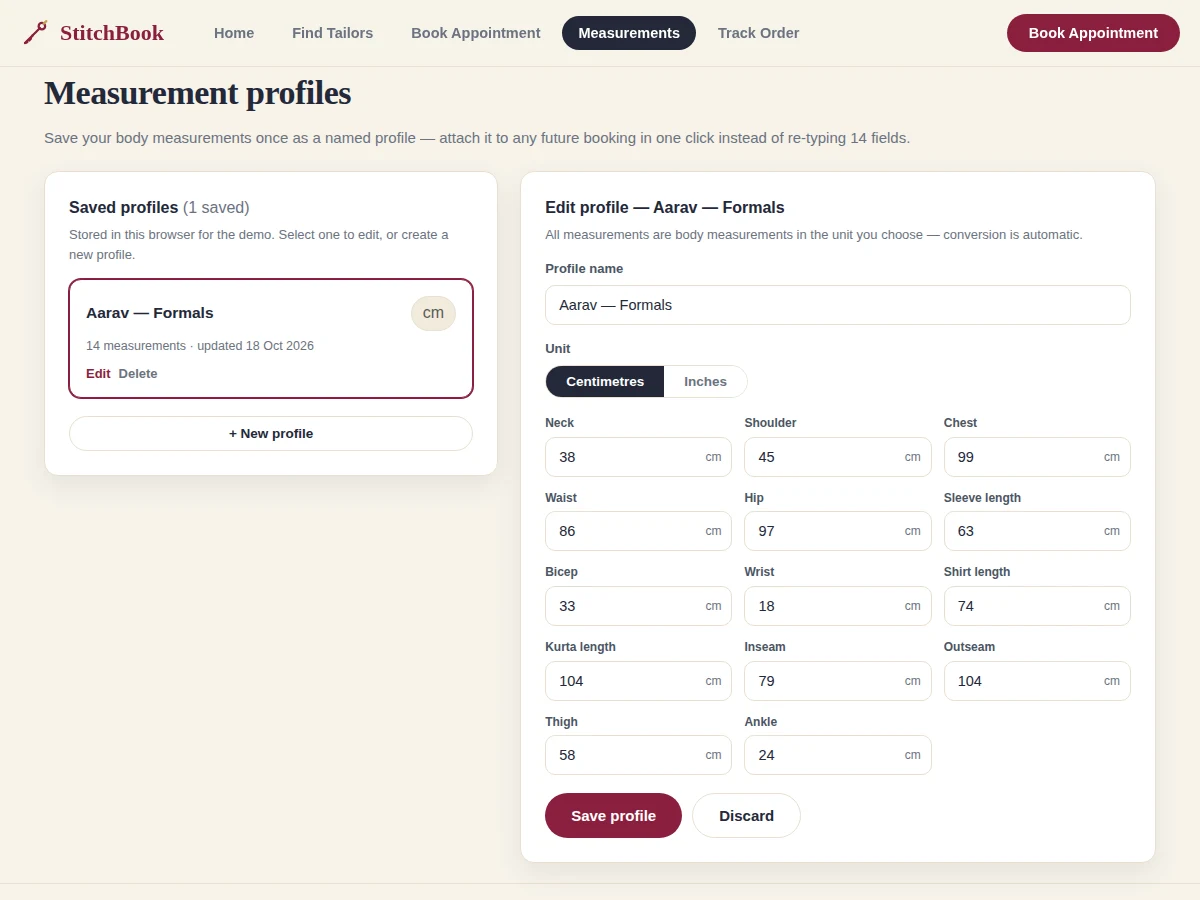
- [Reusable measurement profiles] Named profiles holding 14 body-measurement fields with a cm/inch toggle and automatic conversion; attaching a profile fills every measurement on the booking in one selection.
- [Six-stage order tracking] A live timeline — order placed, measurements confirmed, fabric cutting, stitching, trial and fitting, ready for delivery — with timestamps and tailor notes on each transition.
- [Dual customer–tailor dashboards] Customers see upcoming fittings, active orders and order history; tailors see their order queue, advance statuses, and open each order's measurement profile.
- [Tailor discovery] Searchable tailor profiles with specialty, years of experience, rating, review count, location, languages and starting price, plus specialty filters.
- [Garment-wise delivery estimates] Lead times per garment type (4–12 working days, design-target estimates) shown before booking, so expectations are set honestly.
- [Email and SMS order updates — optional customization] Transactional updates over SMS/WhatsApp via a gateway account can be added on request; the base build notifies by email only.
What is included
- Complete MERN-stack source code (React frontend, Express API, MongoDB models)
- Database schema with seed data (tailors, garments, slots)
- Customer dashboard (upcoming fittings, active orders, history)
- Tailor dashboard (order queue, status controls, measurement views)
- Booking engine with instant slot blocking
- Measurement-profile module (14 fields, cm/inch conversion)
- Six-stage order tracking timeline with tailor notes
- Email notification templates (Nodemailer)
- Setup and deployment guide
- Working concept demo (single-file HTML build of the full flow)
- Project report PDF (background, schema, API design, methodology)
- PPT presentation for final review
- Viva Q&A preparation document (auth, data modelling, booking state machine, deployment)
requirements:
- Node.js 18 or newer with npm
- MongoDB 6 or newer (local install or Atlas)
- A modern browser (Chrome, Edge or Firefox)
- Internet connection for deployment; the concept demo runs fully offline in a browser
- Git (optional, for version control)
Limitations & prerequisites
- The base build has no online payment — Razorpay/UPI integration is an optional customization, not included by default.
- Delivery estimates are design-target lead times (4–12 working days by garment); fabric availability and tailor workload shift real dates.
- The concept demo stores data in the browser's localStorage; multi-user sync needs the full MERN deployment with MongoDB.
- Slot blocking only works if tailors keep their calendars current — the app cannot stop a tailor from overcommitting offline.
- The app stores measurements exactly as entered; it does not validate whether they will produce a good fit.
- Base notifications are email-based; SMS/WhatsApp updates need a paid gateway account and are a customization.
Frequently Asked Questions
Is this project suitable for a final-year project?
Yes — for Computer Science, IT and Web Development programs. It demonstrates full-stack development with the MERN stack: JWT authentication, role-based dashboards, a booking engine with slot blocking, reusable data models for measurement profiles, and a six-stage order tracking timeline. The report documents the schema, the API design and the booking state machine, and the viva kit covers exactly the questions examiners ask about full-stack projects.
Which technology stack is used, and why?
The build uses the MERN stack: MongoDB, Express.js, React and Node.js. MongoDB fits because tailor profiles, measurement sets and order timelines are naturally document-shaped; Express exposes a clean REST API; React powers both the customer and tailor dashboards from shared components; and one JavaScript codebase keeps the project maintainable for a student team. JWT handles authentication with bcrypt-hashed passwords.
Does the project include online payment?
No — online payment is deliberately excluded from the base build and offered as an optional customization. The base flow covers discovery, booking, measurements and tracking, which is the complete academic scope. Adding Razorpay or UPI later is straightforward because every order already carries a final price, and the report lists payment integration as future scope with the touchpoints identified.
How do measurement profiles save time on repeat orders?
A profile stores 14 body measurements once under a name like 'Aarav — Formals'. On the next booking the customer attaches the profile with a single selection instead of re-typing 14 fields — in the concept demo the measurement step collapses to one dropdown choice. Profiles support a cm/inch toggle with automatic conversion, and multiple named profiles cover different family members or garment styles.
What do I need to run and host this project?
For development you need Node.js 18 or newer, MongoDB 6 or newer and a modern browser — the included setup guide walks through local installation step by step. For hosting, any Node-compatible host works with MongoDB Atlas for the database, and the base build needs no paid services. The bundled concept demo runs fully offline as a single HTML file in any browser.
Components & software requirements
- MongoDB (users, profiles, orders and slots)
- Express.js (REST API)
- React (customer and tailor dashboards)
- Node.js (runtime)
- JWT authentication with bcrypt password hashing
- Tailwind CSS (responsive UI)
- Nodemailer (booking and status emails)
- Razorpay / UPI payments (optional customization)
Delivery information
Built-to-order project. Delivery timeline is shared after order confirmation based on current queue.
Support terms
Complete documentation, setup guide, and viva preparation included. Support for setup and explanation provided.
Download free synopsis (PDF)
Enter your name and WhatsApp number — the synopsis PDF downloads immediately. We may send occasional project updates on WhatsApp; no spam.