
More project photos (3)
The problem
Running a quiz in a classroom or training batch usually means printing papers, collecting answer sheets and spending hours grading — and students never get to see how they ranked against their peers in the moment. QuizCraft-style tools solve the grading but are closed products a student cannot dissect for a final-year project. This project builds the full thing from scratch: a quiz builder with multiple question types and quiz settings (time limits, attempt counts, shuffling), a student attempt interface with a countdown timer, instant auto-grading, and a live leaderboard that updates as each participant submits. An analytics view shows per-question success rates so the quiz creator can see which concepts the class struggled with. The whole system runs on a standard web stack with a relational database, and the demo ships with realistic sample quizzes so every screen works out of the box.
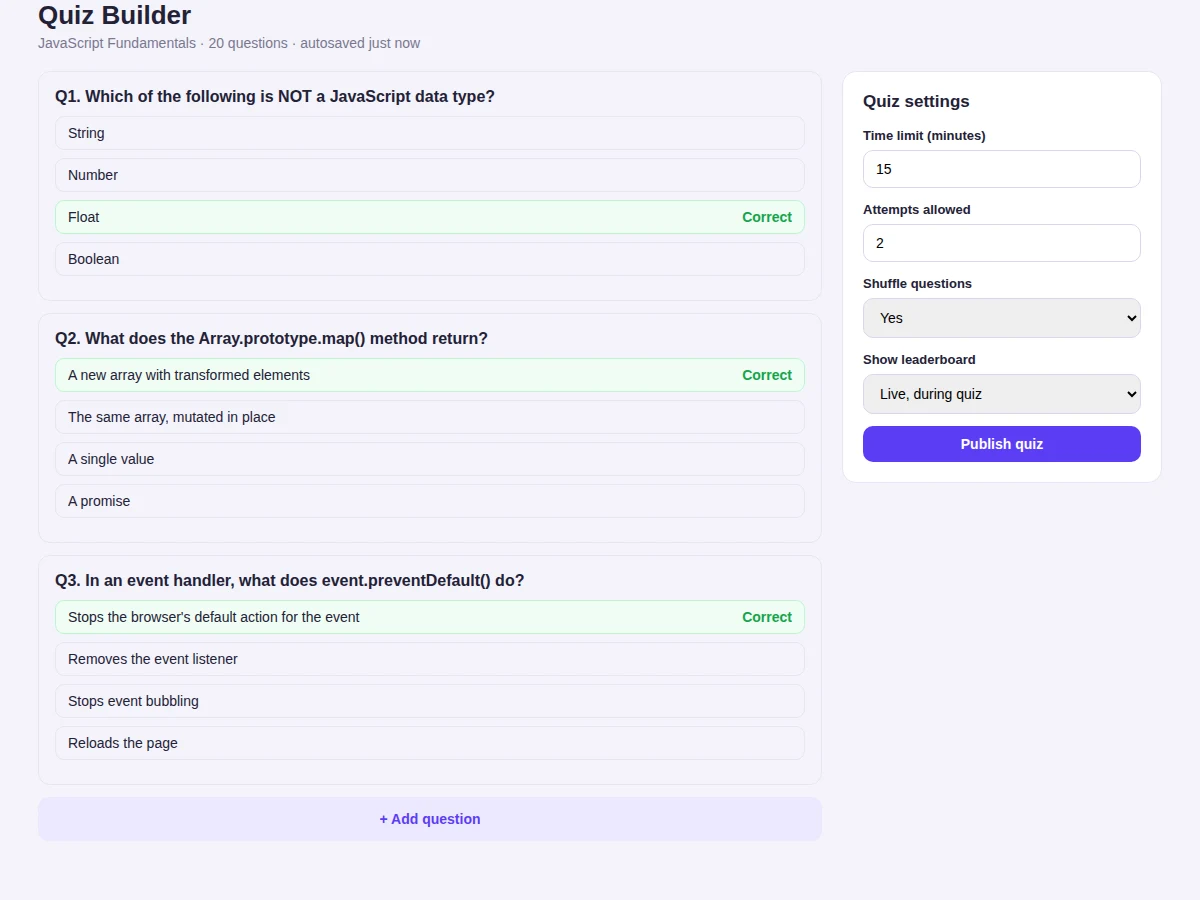
Builds quizzes with the visual question editor, sets time limits and attempt rules, then publishes a shareable link.
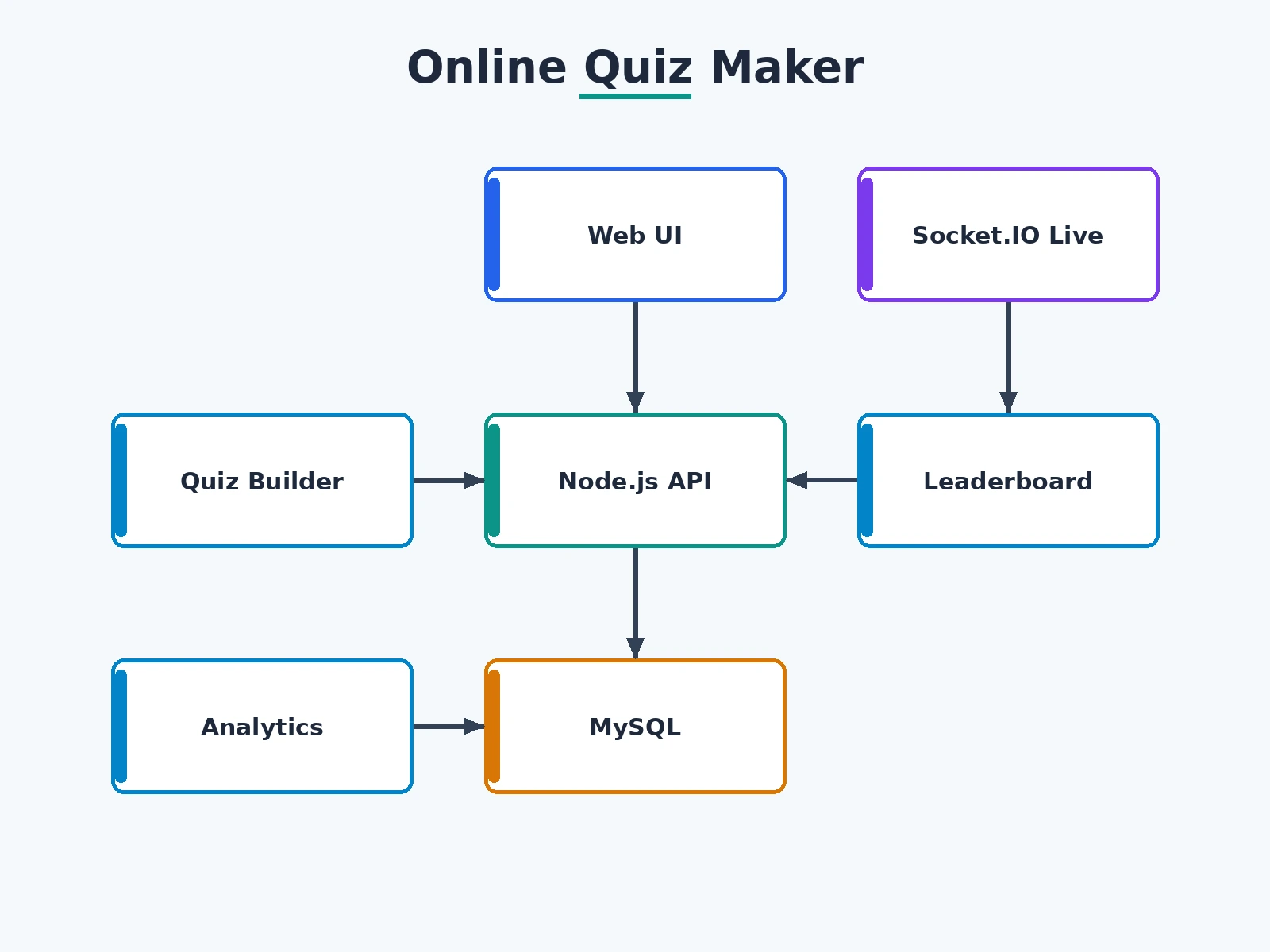
Follow the working sequence
How it works
- The creator signs in and builds a quiz in the builder: adds questions, marks correct options, and sets the time limit, attempts allowed and leaderboard visibility.
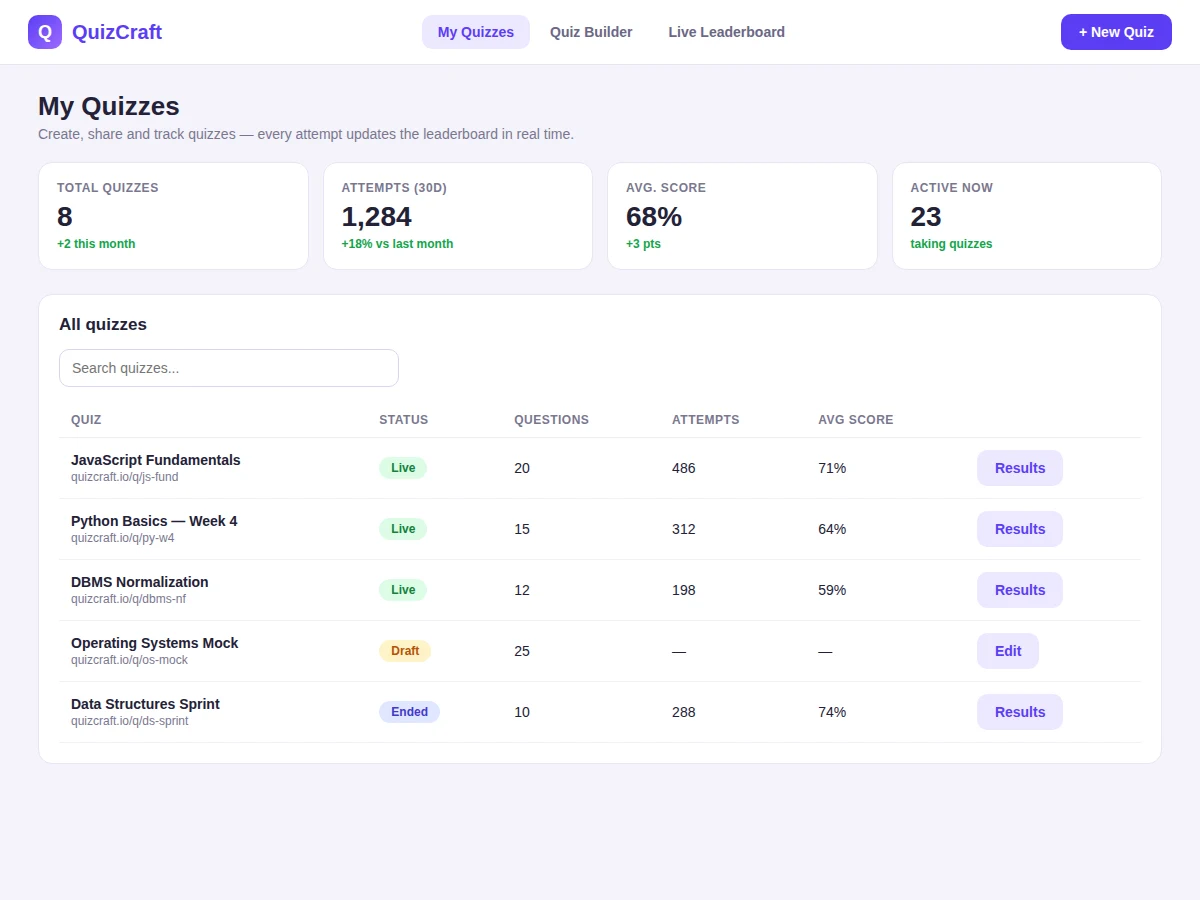
- Publishing generates a shareable link and join code; the quiz moves from Draft to Live status.
- Students open the link, enter a display name, and start the attempt — a countdown timer runs and answers autosave locally.
- On submit (or when time expires), answers are graded against the answer key and the score is computed instantly.
- The result is written to the attempts table and the leaderboard re-ranks all participants by score, then by completion time.
- The creator watches the live leaderboard during the quiz and later opens analytics for per-question success rates and the score distribution.
- Results and the final leaderboard can be exported as CSV for department records.
Tech stack:
- Frontend: HTML5, CSS3, JavaScript (single-page app)
- Backend: Node.js + Express (or PHP/Laravel equivalent)
- Database: MySQL / PostgreSQL (quizzes, questions, attempts, users)
- Real-time leaderboard: WebSockets (Socket.io)
- Auth: session-based login for creators, join-code access for takers
- Export: CSV generation
- Deployment: any shared hosting or VPS
| Parameter | Value |
|---|---|
| Question types | Multiple-choice, true/false, short-answer |
| Time limit | Configurable per quiz, 1–180 minutes |
| Attempts per student | Configurable, 1–10 (design target) |
| Leaderboard update | Near real-time via WebSockets (expected <2 s) |
| Concurrent takers | Approximately 200 on a basic VPS (design target) |
| Results export | CSV download |
| Demo dataset | 5 sample quizzes, approximately 300 seeded attempts |
Project features
- [Visual quiz builder] Create quizzes with multiple-choice, true/false and short-answer questions, mark correct answers, reorder by drag, and configure time limits, attempt limits and question shuffling.
- [Timed attempt interface] Students open a shareable link, answer under a live countdown, and get instant auto-grading with per-question right/wrong feedback on submit.
- [Live leaderboard] Ranks participants by score then completion time, updating in real time as submissions arrive, with a pulsing live indicator and top-3 highlighting.
- [Per-question analytics] Shows success rate per question so creators can spot the concepts the class found hardest, plus score distribution across attempts.
- [Attempt management] Configurable attempts per student, best-or-latest scoring policy, and an attempt log with timestamps for audit.
- [Results export] Download full results and the leaderboard as CSV for record-keeping or importing into spreadsheets.
- [Shareable quiz links] Every published quiz gets a short link and a join code; drafts stay private until published.
What is included
- Complete web application source code (frontend + backend)
- Database schema with migrations and seeded demo quizzes
- Live leaderboard module with WebSocket updates
- Quiz builder, attempt interface and analytics screens
- Project report PDF (background, system design, database schema, methodology)
- PPT presentation for final review
- Viva Q&A preparation document (WebSockets, grading logic, schema design, scaling)
Limitations & prerequisites
- The demo ships with seeded data; connecting a real user base needs the provided registration module to be enabled and tested by the buyer.
- 200 concurrent takers is a design target on a basic VPS — actual capacity depends on hosting resources and was not load-tested beyond the development setup.
- Short-answer grading is keyword-based, not semantic — it checks for expected terms, not meaning.
- No anti-cheating beyond tab-switch detection flags; proctored exams would need the optional webcam module listed in future scope.
- Email/SMS notifications for quiz invites are stubbed in the demo and need the buyer's own gateway credentials.
Frequently Asked Questions
How does the live leaderboard work?
When a student submits, the backend grades the attempt, stores it, and pushes the updated ranking to all connected browsers over a WebSocket. Ranking is by score first, then by completion time, so ties are broken fairly.
What question types are supported?
Multiple-choice (single correct), true/false, and short-answer with keyword matching. Each question carries its own marks, and the builder shows a running total.
Can a student attempt a quiz twice?
Only if the creator allows it. Attempts per student are configurable from 1 to 10, with a best-score or latest-score policy selectable per quiz.
How are results stored and exported?
Every attempt is stored with the student name, per-question responses, score and timestamp. Creators can download the full result set or just the leaderboard as CSV.
Does it work on phones?
Yes — the attempt interface and leaderboard are responsive and tested at mobile widths, since most students join from their phones.
Is this project suitable for a final-year project?
Yes — for Computer Science, IT and Web Development programs. It demonstrates full-stack development, real-time WebSocket communication, database design and a genuinely usable product. Suitable for B.E./B.Tech final-year projects in Computer Science, IT and Web Development.
Components & software requirements
- Frontend: HTML5, CSS3, JavaScript (single-page app)
- Backend: Node.js + Express (or PHP/Laravel equivalent)
- Database: MySQL / PostgreSQL (quizzes, questions, attempts, users)
- Real-time leaderboard: WebSockets (Socket.io)
- Auth: session-based login for creators, join-code access for takers
- Export: CSV generation
- Deployment: any shared hosting or VPS
Delivery information
Built-to-order project. Delivery timeline is shared after order confirmation based on current queue.
Support terms
Complete documentation, setup guide, and viva preparation included. Support for setup and explanation provided.
Download free synopsis (PDF)
Enter your name and WhatsApp number — the synopsis PDF downloads immediately. We may send occasional project updates on WhatsApp; no spam.