
More project photos (3)
The problem
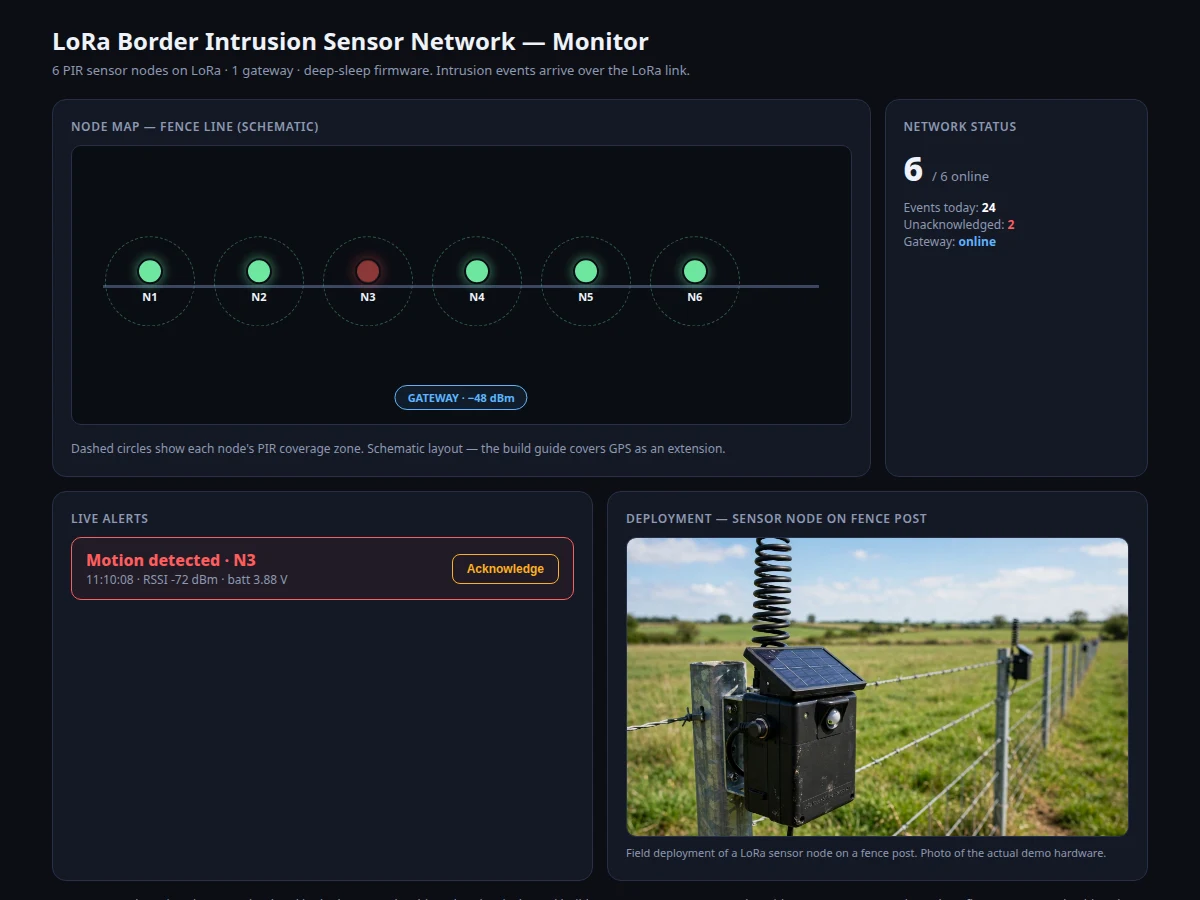
Long borders and remote facilities can't be watched by guards everywhere, and cameras alone need power and connectivity at every pole. A low-power wireless sensor network solves the sensing half: tiny nodes that sleep for months, wake on motion, and report over radio links that reach kilometers. LoRa is the natural fit — long range, unlicensed spectrum, milliwatt power. This project builds that network at demonstration scale: ESP32-based sensor nodes with PIR motion sensors and LoRa radios (e.g. RFM95/SX1276) spaced along a fence line or campus boundary, plus a LoRa gateway node that collects detections and feeds a dashboard. The dashboard shows a node map with positions, live intrusion alerts tagged by node ID and timestamp, per-node battery voltage and RSSI health, and a searchable event log. Because PIR detects motion only within a few metres, node spacing is a design parameter — the report's field-test procedure documents detection range and spacing, and states plainly that this is a demonstration network, not a certified security system.
Armed motion sensor that wakes the node on detection.
Follow the working sequence
How it works
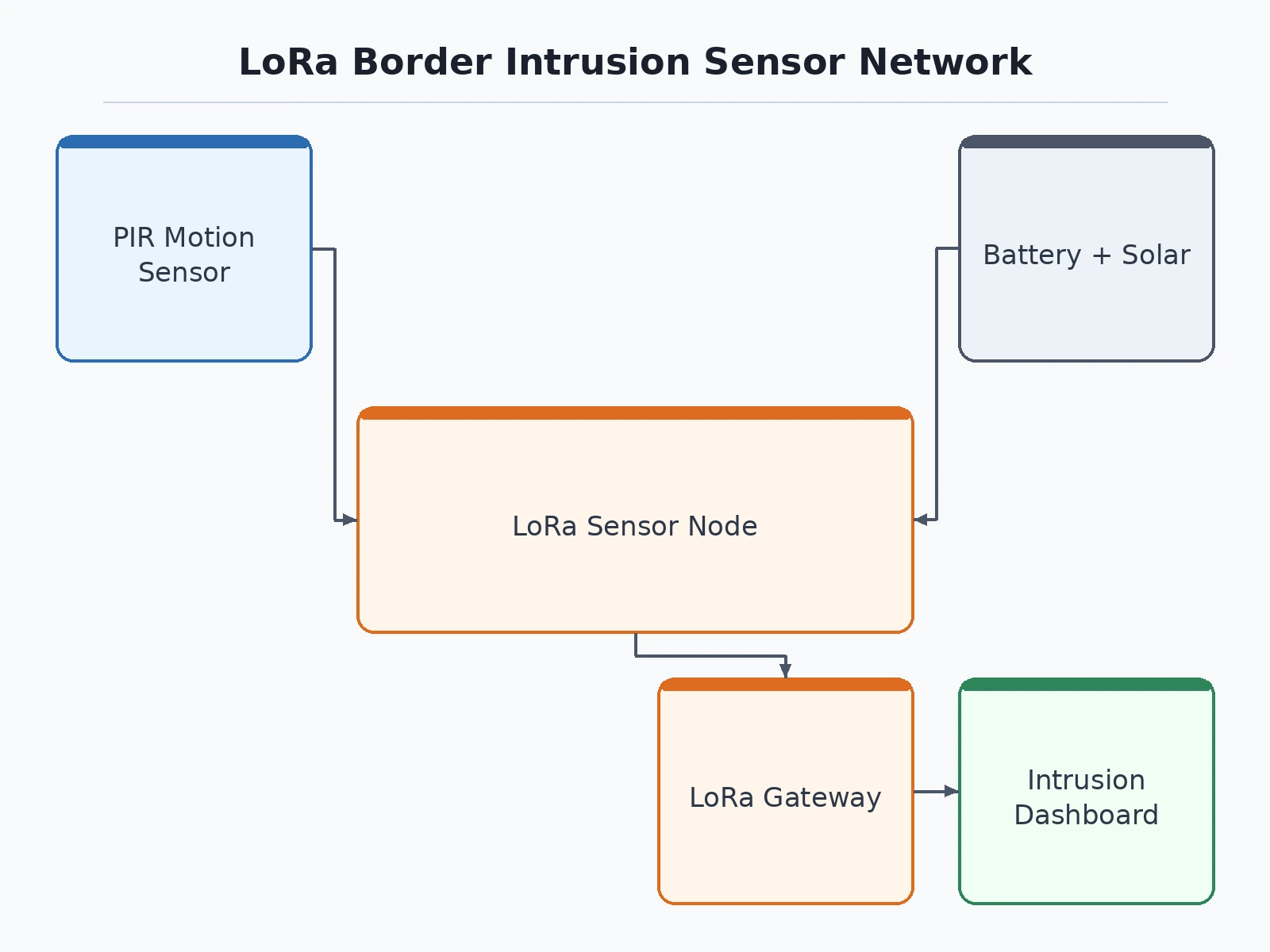
- Each sensor node sleeps in deep sleep with the PIR sensor armed; on motion, the node wakes instantly.
- The node samples the PIR, builds a detection packet (node ID, timestamp, battery voltage) and transmits it over LoRa.
- The gateway node receives the packet, acknowledges it, and forwards it to the dashboard over serial or Wi-Fi.
- The dashboard raises an intrusion alert tagged with the node ID and position on the node map; the event enters the log.
- The operator acknowledges alerts from the dashboard; unacknowledged alerts stay highlighted.
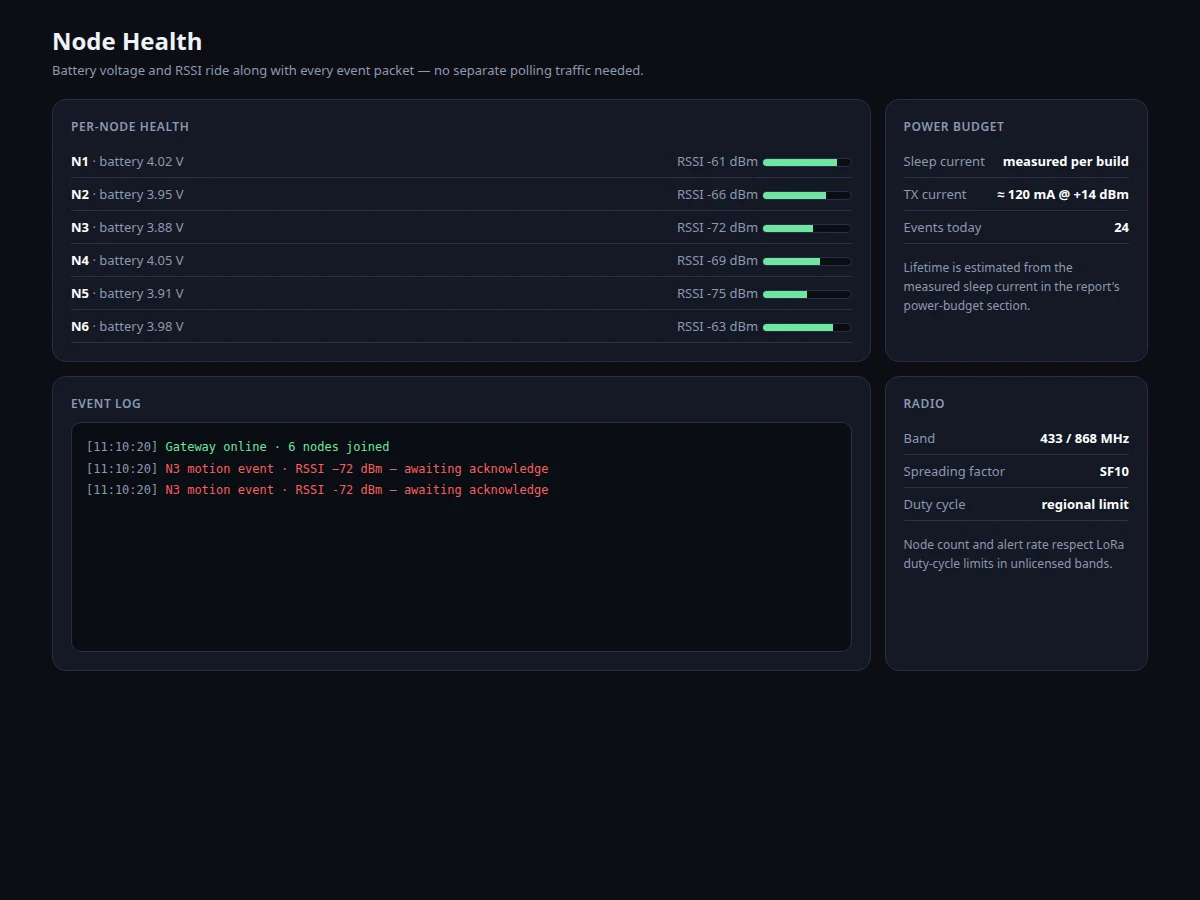
- Battery voltage and RSSI travel with every event, so node health is visible without separate polling traffic.
Tech stack:
- ESP32 sensor nodes + LoRa radios (e.g. RFM95/SX1276, 433/868 MHz)
- PIR motion sensors per node
- LoRa gateway node (ESP32 + LoRa)
- Deep-sleep firmware (Arduino core)
- Web dashboard (HTML/CSS/JS, node map, alerts, health)
| Parameter | Value |
|---|---|
| Nodes | ESP32 + LoRa + PIR per node, battery powered |
| Gateway | ESP32 + LoRa collector, serial/Wi-Fi to dashboard |
| Radio | LoRa, 433/868 MHz (region-appropriate band), unlicensed |
| Range | Line-of-sight dependent; field-test procedure validates actual link |
| Detection | PIR motion, few-metre range per node; spacing is a design parameter |
| Power | Deep sleep between events; measured sleep current in report |
| Dashboard | Node map, live alerts, acknowledge workflow, health, event log |
| Operation | Fully offline-capable on the local network |
Project features
- [LoRa sensor nodes] ESP32 + LoRa radio + PIR motion sensor per node; detection events transmit node ID, timestamp and battery voltage.
- [Gateway collector] A LoRa gateway node receives all node traffic and forwards it over serial/Wi-Fi to the dashboard.
- [Intrusion alert dashboard] Live alerts tagged by node ID and timestamp, with an acknowledge workflow for each event.
- [Node map view] A schematic map showing each node's position along the fence line, with online/offline and alarm state.
- [Node health monitoring] Per-node battery voltage and RSSI reported with every event; the dashboard flags weak batteries and poor links.
- [Deep-sleep power design] Nodes sleep between detections for long battery life; the report documents the measured sleep current.
- [Offline operation] The gateway and dashboard run on the local network — no cellular data or cloud account required.
- [Field-test procedure] Documented PIR range test and LoRa link-budget check to validate spacing before fixing node positions.
What is included
- Complete node firmware (deep sleep, PIR wake, LoRa transmit, addressing)
- Gateway firmware (receive, acknowledge, forward to dashboard)
- Network addressing and spacing design guide
- Web dashboard (node map, alerts, health, event log)
- Field-test procedure (PIR range test, LoRa link-budget check)
- Project report PDF (WSN background, LoRa design, power budget, testing)
- PPT presentation for final review
- Viva Q&A preparation document (LoRa, PIR, deep sleep, link budget, WSN)
Limitations & prerequisites
- PIR sensors detect motion within a few metres and are affected by temperature contrast, vegetation movement and small animals — the field-test procedure documents false-trigger sources, and this is not a certified security system.
- LoRa range follows line-of-sight physics: buildings, terrain and antenna height dominate real range, which is why the field test validates links before final mounting.
- Node count and alert rate are limited by LoRa duty-cycle regulations in unlicensed bands; the report states the practical event-rate limit.
- Battery life depends on event frequency and sleep current; the report documents measured sleep current so lifetime is an estimate from real numbers, not a guess.
- The dashboard's node map is a schematic layout, not a surveyed GIS map — precise geolocation needs GPS modules (documented as an extension).
Frequently Asked Questions
Which controller and radio are used?
ESP32 nodes with LoRa radios (e.g. RFM95/SX1276) on the region-appropriate unlicensed band; a second ESP32 acts as the gateway.
How far apart can nodes be?
That depends on line of sight, antenna height and surroundings — the field-test procedure measures the actual link before nodes are fixed. Lab tests work at hundreds of metres in open ground; obstructions reduce it sharply.
Does it need internet or a SIM card?
No. The gateway feeds the dashboard over the local network; the whole system runs offline.
What triggers false alarms?
PIR responds to any warm moving object — animals, swaying vegetation in sun, people. The report documents these sources and the sensitivity settings that reduce them.
How long do node batteries last?
It depends on event rate and measured sleep current; the report's power-budget section estimates lifetime from the actual sleep current, so heavy-traffic deployments get shorter numbers honestly.
Is this project suitable for a final-year project?
Yes — for IoT, Electronics and Embedded programs. It demonstrates wireless sensor networks, LoRa, deep sleep, event-driven firmware and power budgeting, all strong viva material. Suitable for B.E./B.Tech final-year projects in IoT, Electronics and Embedded Systems.
Components & software requirements
- ESP32 sensor nodes + LoRa radios (e.g. RFM95/SX1276, 433/868 MHz)
- PIR motion sensors per node
- LoRa gateway node (ESP32 + LoRa)
- Deep-sleep firmware (Arduino core)
- Web dashboard (HTML/CSS/JS, node map, alerts, health)
Delivery information
Built-to-order project. Delivery timeline is shared after order confirmation based on current queue.
Support terms
Complete documentation, setup guide, and viva preparation included. Support for setup and explanation provided.
Download free synopsis (PDF)
Enter your name and WhatsApp number — the synopsis PDF downloads immediately. We may send occasional project updates on WhatsApp; no spam.