
More project photos (3)
The problem
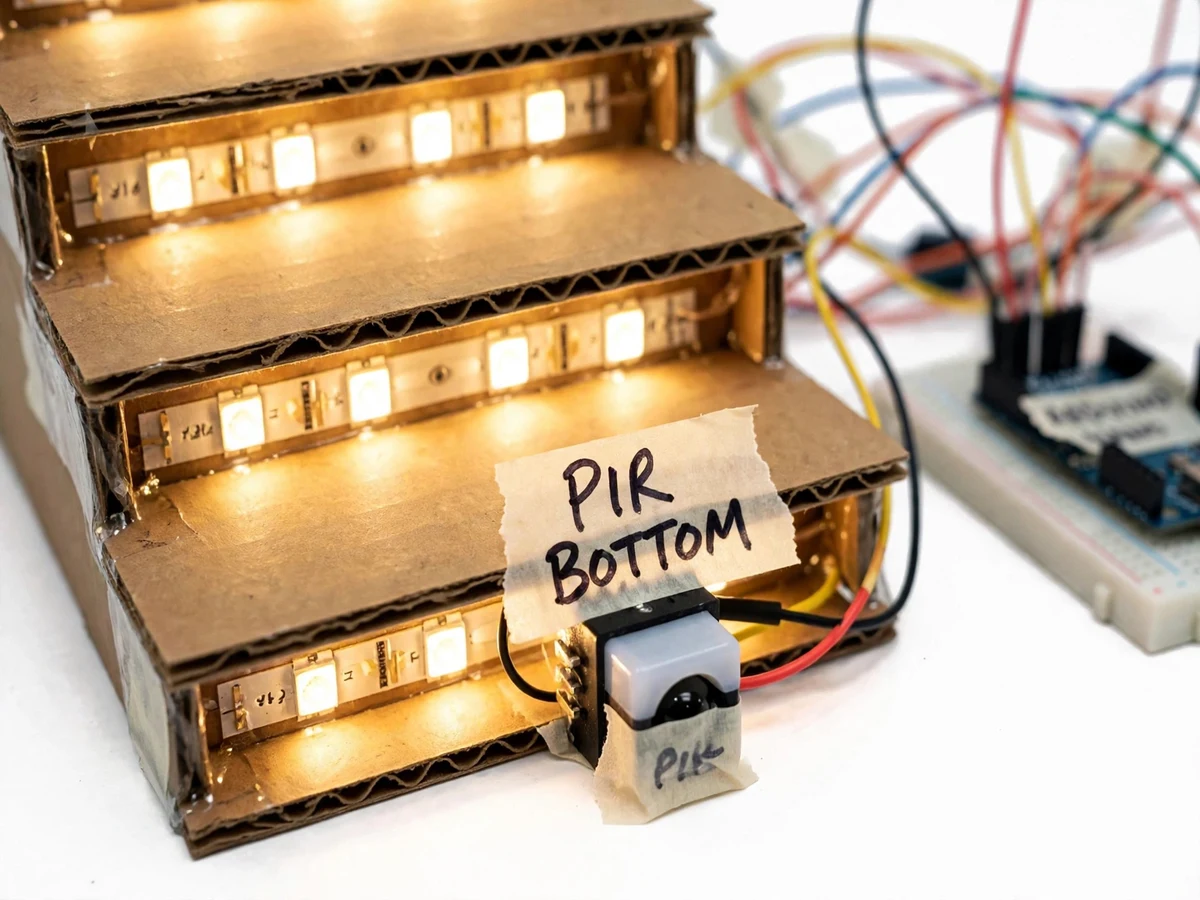
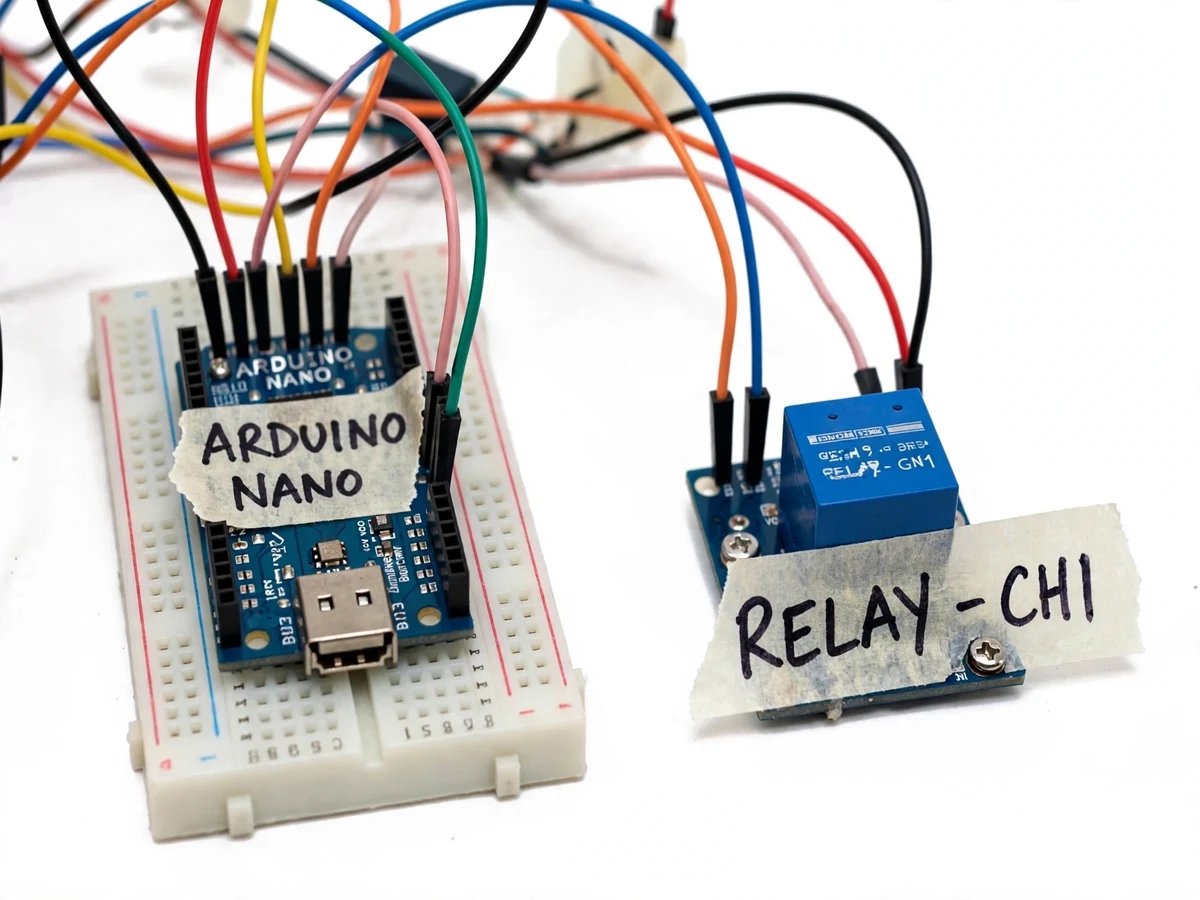
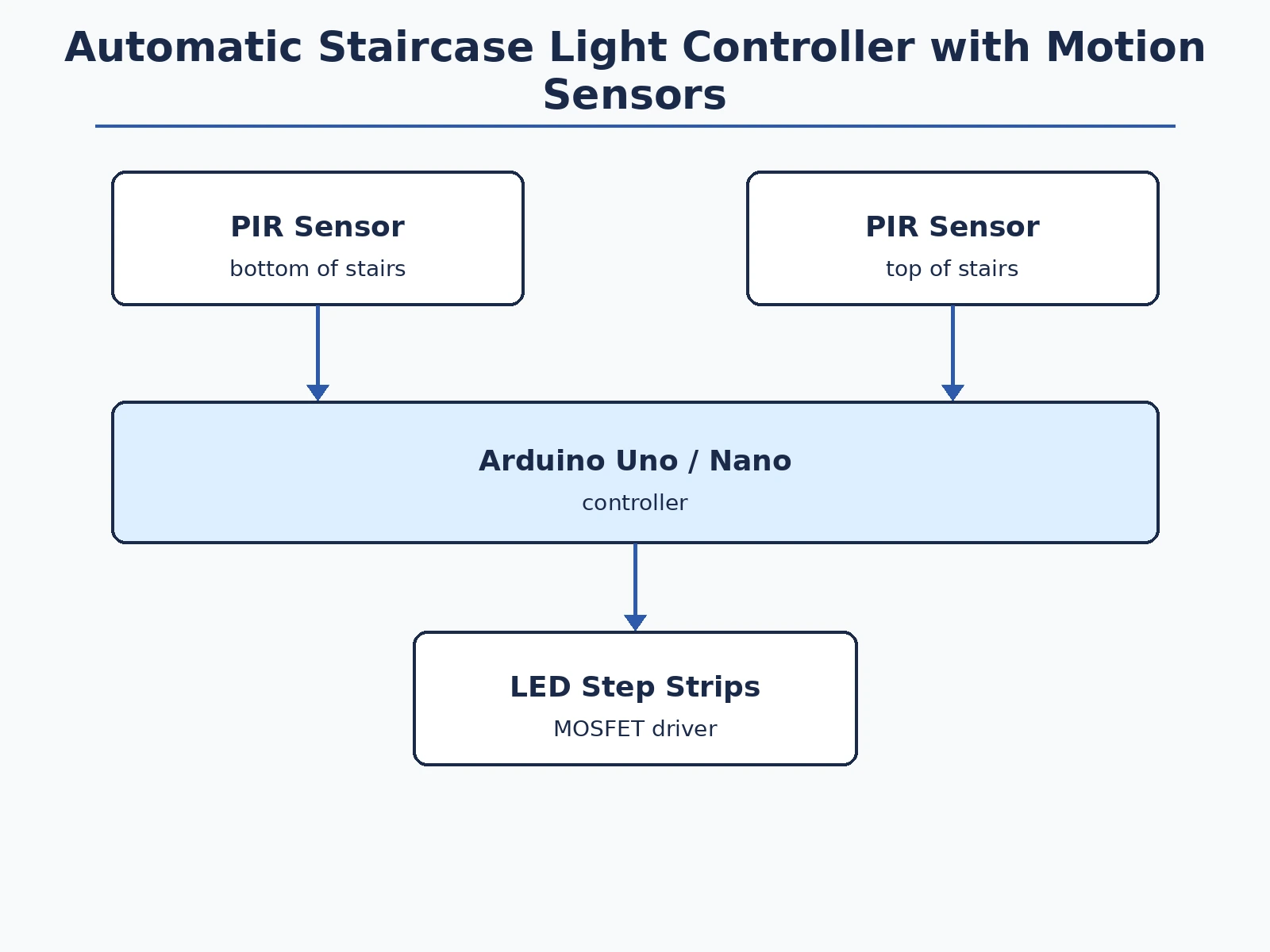
Staircase lights left on all night waste electricity, and fumbling for a switch on dark stairs is a genuine fall risk. Lighting each step in sequence as someone walks — and only then — solves both problems at once. The engineering work is in detecting direction from two sensors, timing the chase effect to a walking pace and switching off reliably afterwards. This project builds a student-scale staircase light controller on an Arduino: PIR sensors at the top and bottom of a model staircase detect entry, the controller identifies up or down from the trigger order, LED strip segments under each step light in a chasing sequence, and an idle timer switches them off after the stairs clear.
Watches the top entry of the staircase for approaching motion.
Follow the working sequence
How it works
- The two PIR sensors watch the top and bottom entries; the Arduino idles with all step LEDs off.
- When a sensor triggers, the controller notes which end fired first and determines the walking direction.
- The LED segment at the entry step lights first, then each following step lights in sequence toward the far end.
- When the far-end PIR fires, the controller knows the person has reached the other side and starts the idle countdown.
- After the configured idle timeout with no further motion, all step LEDs switch off together.
- If motion is detected again mid-timeout, the sequence restarts from the triggered end.
Tech stack:
- Arduino Nano / Uno (ATmega328P)
- PIR motion sensors (2)
- LED strip segments (one per step)
- MOSFET/relay driver stage
- Arduino IDE (C/C++ firmware)
- 12 V LED supply + 5 V logic
| Parameter | Value |
|---|---|
| Controller | Arduino Nano/Uno (ATmega328P) |
| Motion sensing | 2 PIR sensors (top + bottom) |
| Steps (demo) | 4-step model staircase |
| Lighting | LED strip segment per step, sequential chase |
| Chase timing | Configurable, design walking-pace default |
| Idle timeout | Configurable auto-off (design) |
| Power | 12 V LED supply + 5 V logic (design) |
Project features
- [Dual PIR motion sensing] PIR sensors at the top and bottom of the stairs detect a person entering from either end.
- [Direction detection] The controller reads the trigger order to tell walking-up from walking-down and starts the chase from the correct end.
- [Sequential step lighting] LED strip segments under each step edge light in a chasing sequence timed to a walking pace.
- [Auto-off idle timer] All steps switch off after an adjustable timeout once the stairs are clear, saving energy.
- [Adjustable timing] Chase speed and idle timeout are configurable in firmware for different staircase lengths and walking speeds.
- [MOSFET/relay LED driving] Each step's LED segment is switched through a proper driver stage, demonstrating real load driving from a microcontroller.
- [Daylight disable option] Firmware supports an LDR input so the system stays off in daylight (sensor fitted on request).
What is included
- Working model staircase with per-step LED lighting, Arduino, PIR sensors and driver stage
- Complete firmware with commented direction-detection and chase logic
- Wiring diagram and connection table
- Timing-tuning procedure for chase speed and idle timeout
- Project report PDF (background, system design, firmware logic, energy-saving analysis)
- PPT presentation for final review
- Viva Q&A preparation document (PIR sensing, MOSFET driving, Arduino timers)
Limitations & prerequisites
- The prototype is a 4-step model staircase — a real staircase needs one LED segment and wiring run per step, which is installation work outside the project scope.
- PIR sensors detect moving warm bodies; they can miss a person standing still and can be triggered by pets.
- Chase timing is tuned for a typical walking pace; running or very slow movement won't match the effect perfectly.
- Energy-saving figures depend on the buyer's usage pattern; no measured savings are claimed.
- The demo runs on bench power supplies; a real installation needs proper mains wiring by a qualified electrician.
- Daylight disable needs the optional LDR fitted and calibrated by the buyer.
Frequently Asked Questions
How does it know which way I'm walking?
The PIR that fires first tells the controller the entry end. If the bottom sensor fires first you're walking up, so the chase starts at the bottom — and vice versa.
Do the lights follow me step by step?
Yes — each step's LED segment lights in sequence toward the far end, timed to a walking pace that you can adjust in firmware.
When do the lights turn off?
After the far-end sensor fires and the idle timeout expires with no further motion, all steps switch off together. The timeout is configurable.
Will it trigger for my pet?
Possibly — PIR sensors respond to any moving warm body. Sensor positioning and sensitivity adjustment help, and the report covers this honestly.
Can it stay off during the day?
The firmware supports an LDR daylight-disable input; the sensor is fitted on request and calibrated by the buyer.
Is this project suitable for a final-year project?
Yes — for Electronics, Electrical and IoT & Embedded programs. It covers motion sensing, direction logic, LED driver stages and energy-saving automation. Suitable for B.E./B.Tech final-year projects in Electronics, Electrical and IoT & Embedded.
Components & software requirements
- Arduino Nano / Uno (ATmega328P)
- PIR motion sensors (2)
- LED strip segments (one per step)
- MOSFET/relay driver stage
- Arduino IDE (C/C++ firmware)
- 12 V LED supply + 5 V logic
Delivery information
Built-to-order project. Delivery timeline is shared after order confirmation based on current queue.
Support terms
Complete documentation, setup guide, and viva preparation included. Support for setup and explanation provided.
Download free synopsis (PDF)
Enter your name and WhatsApp number — the synopsis PDF downloads immediately. We may send occasional project updates on WhatsApp; no spam.