
More project photos (4)



The problem
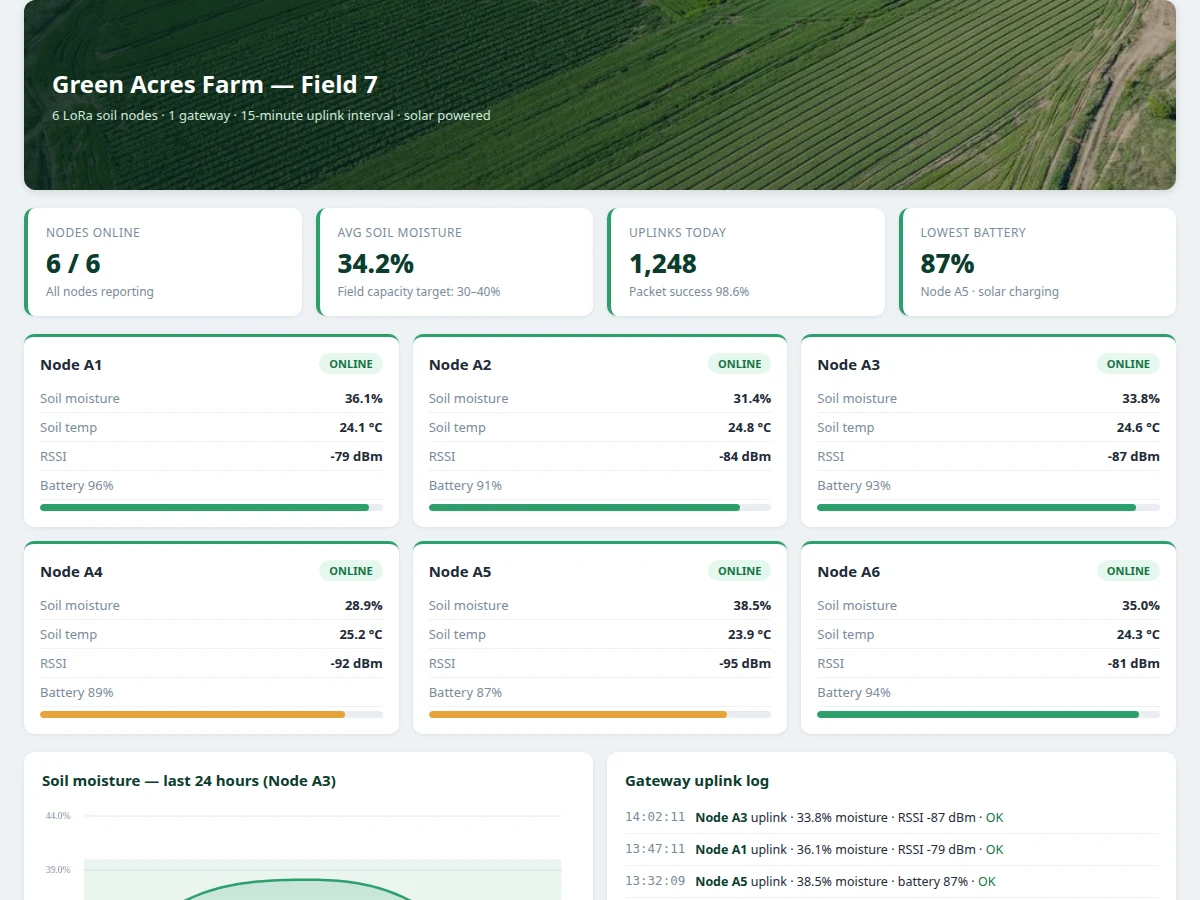
A large field cannot be managed by walking it with a moisture probe, and Wi-Fi does not reach the far corner of a 40-hectare plot. Farmers either irrigate on a fixed schedule — wasting water and energy — or guess. The engineering answer is a low-power wide-area sensor network: small solar-powered nodes scattered across the field that measure soil moisture and temperature and radio the readings back over kilometres to a single gateway. LoRa is the natural fit: kilometre-scale range, licence-free spectrum, and transmit currents a small solar panel and battery can sustain for seasons. This project builds the complete network: field nodes (ESP32 + SX1276 LoRa radio + capacitive soil-moisture probe + temperature sensor in a weatherproof enclosure with solar charging), a gateway node that receives LoRa packets and forwards them over Wi-Fi/MQTT, and a farm dashboard showing every node live, 24-hour moisture charts with the irrigation band marked, link quality (RSSI/SNR) and a timestamped uplink log. Nodes sleep between 15-minute readings, so the power budget is documented and honest.
How it works
- Each field node wakes every 15 minutes, reads the capacitive moisture probe and soil temperature sensor, and measures its own battery voltage.
- The readings are packed with node ID, RSSI/SNR of the last downlink and battery level into a compact LoRa payload.
- The node transmits on 868 MHz and returns to deep sleep within seconds, keeping average current in the microamp range.
- The gateway ESP32 receives the packet, timestamps it and publishes it over Wi-Fi via MQTT.
- The dashboard updates the node's card, appends to the 24-hour moisture and link-quality charts, and writes the uplink log.
- Moisture values are compared against the configured irrigation band (default 30–40%); below-band nodes raise an advisory flag.
- The solar charge controller tops up the 18650 cell during daylight; the report's power budget shows the day/night energy balance.
Tech stack:
- ESP32 + SX1276 LoRa radio modules (node and gateway)
- Capacitive soil-moisture probe, soil temperature sensor
- 5 V solar panel + TP4056-style charge controller + 18650 cell
- Weatherproof enclosure, ground stake, antenna
- MQTT broker + web dashboard (live cards, charts, uplink log)
- Arduino-core firmware (deep sleep, packet framing, gateway forwarding)
| Parameter | Value |
|---|---|
| Radio | LoRa 868 MHz, SX1276; spreading factor configurable (SF7–SF12) |
| Range | Design target ~2–5 km rural line-of-sight; terrain, antenna height and obstructions dependent |
| Sensors | Capacitive soil-moisture probe (analog), soil temperature sensor |
| Uplink interval | 15 minutes default, configurable in firmware |
| Power | Solar panel + 18650 cell; deep sleep between readings |
| Gateway | ESP32 LoRa receiver + Wi-Fi/MQTT backhaul |
| Dashboard | Per-node live cards, 24-h moisture chart, RSSI/SNR chart, uplink log |
| Payload | Node ID, moisture, temperature, battery, link stats — compact binary frame |
| Enclosure | Weatherproof box on ground stake, panel mounted on top |
| Calibration | Two-point soil calibration procedure run in the buyer's own field |
Project features
- [Long-range LoRa uplinks] Field nodes transmit sensor packets over LoRa at 868 MHz; the design target is kilometre-scale rural range, terrain and antenna-height dependent, documented in the report.
- [Solar-powered field nodes] Small solar panel with a charge controller and 18650 cell; the node sleeps between readings so the documented power budget supports season-long unattended operation.
- [Soil moisture + temperature sensing] Capacitive moisture probe (corrosion-resistant) plus soil temperature, with the two-point calibration procedure the buyer runs in their own field.
- [LoRa-to-Wi-Fi gateway] A gateway ESP32 with LoRa receiver forwards packets to the dashboard over Wi-Fi/MQTT; adaptive spreading-factor notes explain the range-vs-battery tradeoff.
- [Farm dashboard] Live per-node cards (moisture, temperature, battery, RSSI), 24-hour moisture chart with the 30–40% irrigation band, and a gateway uplink log with delivery status.
- [Irrigation advisory] Nodes below the moisture threshold are flagged on the dashboard and in the log, so watering decisions follow measured soil state instead of a calendar.
- [Link-quality visibility] Every uplink carries RSSI and SNR; the dashboard charts 24-hour link quality so weak placements can be repositioned during installation.
- [Offline-tolerant design] Nodes keep sensing on schedule without the gateway; readings resume on the dashboard when the link returns.
What is included
- Node firmware (sensing, LoRa TX, deep sleep, battery monitoring) and gateway firmware (LoRa RX, MQTT forwarding)
- Wiring diagram, enclosure assembly and field-installation guide
- Two-point soil calibration guide
- Farm dashboard web app (live cards, charts, uplink log, irrigation advisories)
- Power budget document (sleep/wake energy, solar sizing rationale)
- Project report PDF (background, LoRa link design, power budget, evaluation method)
- PPT presentation for final review
- Viva Q&A preparation document (LoRa vs Wi-Fi, spreading factor, link budget, deep sleep, calibration)
- Setup guide (gateway Wi-Fi provisioning, node placement, first uplink)
Limitations & prerequisites
- LoRa range is a design target, not a guarantee: buildings, trees, hills and antenna height change real-world range dramatically, and the report explains the link-budget math instead of promising kilometres.
- Nodes need direct sun for reliable solar charging; shaded or monsoon-week placements drain faster and the power budget document quantifies this.
- The moisture probe must be calibrated in your own soil — defaults are starting points, and seasonal drift calls for periodic recalibration.
- The gateway needs Wi-Fi within its own range; field nodes themselves need no Wi-Fi or cellular coverage.
- One gateway per field area — very large or hilly farms need gateway placement planning, documented as the extension path.
- This is a monitoring network, not an automated irrigation valve controller; valve actuation is a documented extension.
Frequently Asked Questions
Why LoRa instead of Wi-Fi?
Wi-Fi range collapses beyond a hundred metres in open field; LoRa trades data rate for kilometres of range at milliwatts of transmit power — exactly what occasional sensor readings need. The report compares the two with a link-budget table.
How far can the nodes reach?
The design target is roughly 2–5 km in open rural terrain with the antenna elevated. Walls, tree cover and low mounting cut this sharply — the installation guide covers placement for best range.
How long do the nodes run unattended?
The power budget targets season-long operation on the solar-charged 18650: the node sleeps between 15-minute readings and only wakes for seconds. Shaded placements shorten this and are quantified in the power document.
Does it work without internet?
Nodes and the gateway keep working on the local network; only remote dashboard access and phone alerts need internet. The dashboard can run on a local machine.
How is the moisture sensor calibrated?
With the same two-point dry/wet procedure used in soil-sensing builds: record readings in dry and saturated samples of your own field soil, and the firmware maps between them. The calibration guide walks through it.
Is this project suitable for a final-year project?
Yes — for Electronics, Electrical and IoT programs. It demonstrates LoRa radio design, low-power firmware, solar power budgeting, sensor calibration and a full telemetry dashboard, all strong viva material. Suitable for B.E./B.Tech final-year projects in Electronics, Electrical and IoT.
Components & software requirements
- ESP32 + SX1276 LoRa radio modules (node and gateway)
- Capacitive soil-moisture probe, soil temperature sensor
- 5 V solar panel + TP4056-style charge controller + 18650 cell
- Weatherproof enclosure, ground stake, antenna
- MQTT broker + web dashboard (live cards, charts, uplink log)
- Arduino-core firmware (deep sleep, packet framing, gateway forwarding)
Delivery information
Built-to-order project. Delivery timeline is shared after order confirmation based on current queue.
Support terms
Complete documentation, setup guide, and viva preparation included. Support for setup and explanation provided.