
More project photos (3)
The problem
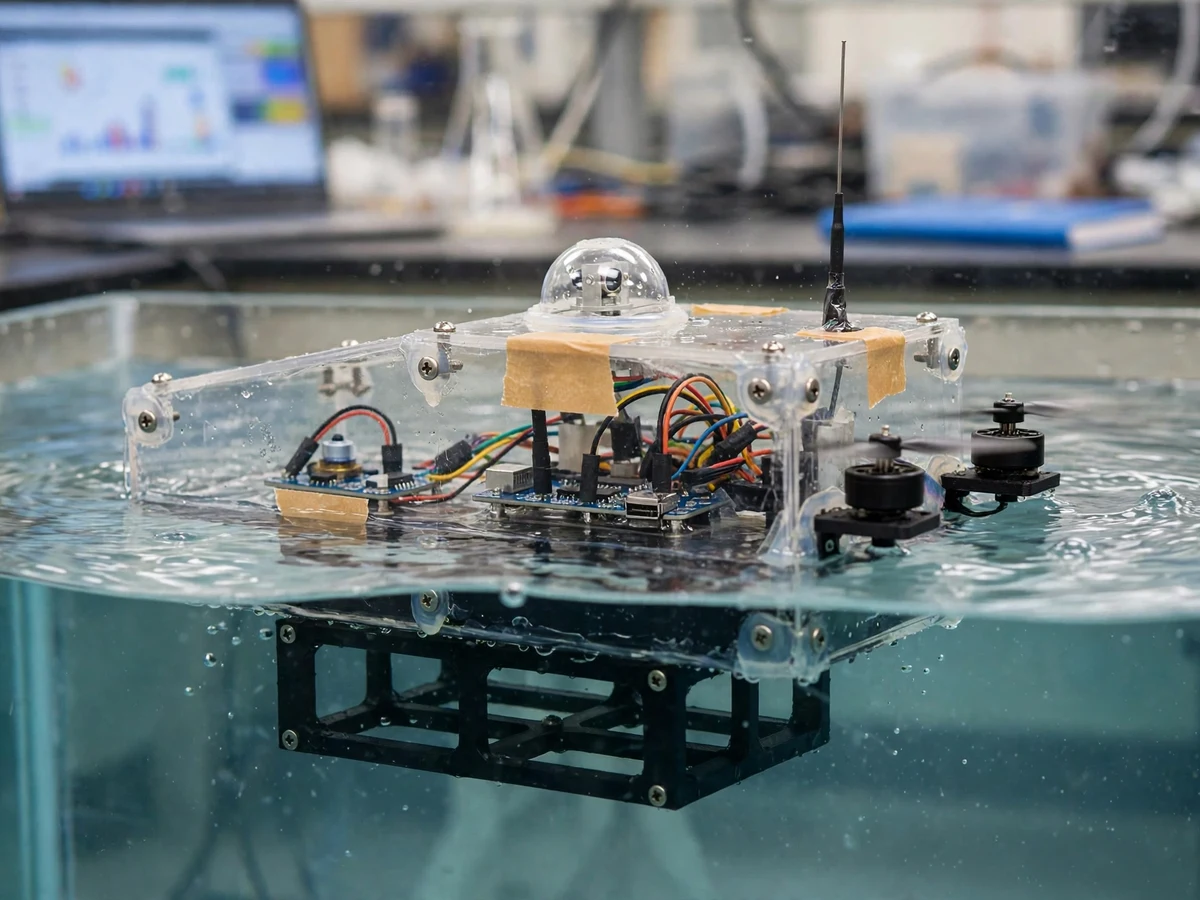
This K600-inspired semi-submersible underwater inspection drone is a tabletop student build for inspecting the inside of water tanks, college ponds and pipeline sections without draining them or sending a person into the water. Tanks, sumps, pond inlets and drain grates need visual checks, yet a team usually has only two options: drain the tank, which wastes water and time, or look from the surface, which shows almost nothing below the waterline. Commercial inspection vehicles cost thousands of rupees and need trained operators, so they are out of reach for a college lab. Kahe Nautic unveiled the K600 semi-submersible drone at Euronaval 2026 in Paris on 3 November 2026, and its shape — a hull riding below the waterline with a communications mast above it — translates to a lab scale: a sealed acrylic hull, an ESP32, two thrusters, a camera in a waterproof dome and a pressure sensor, all run from a web dashboard in a test tank.
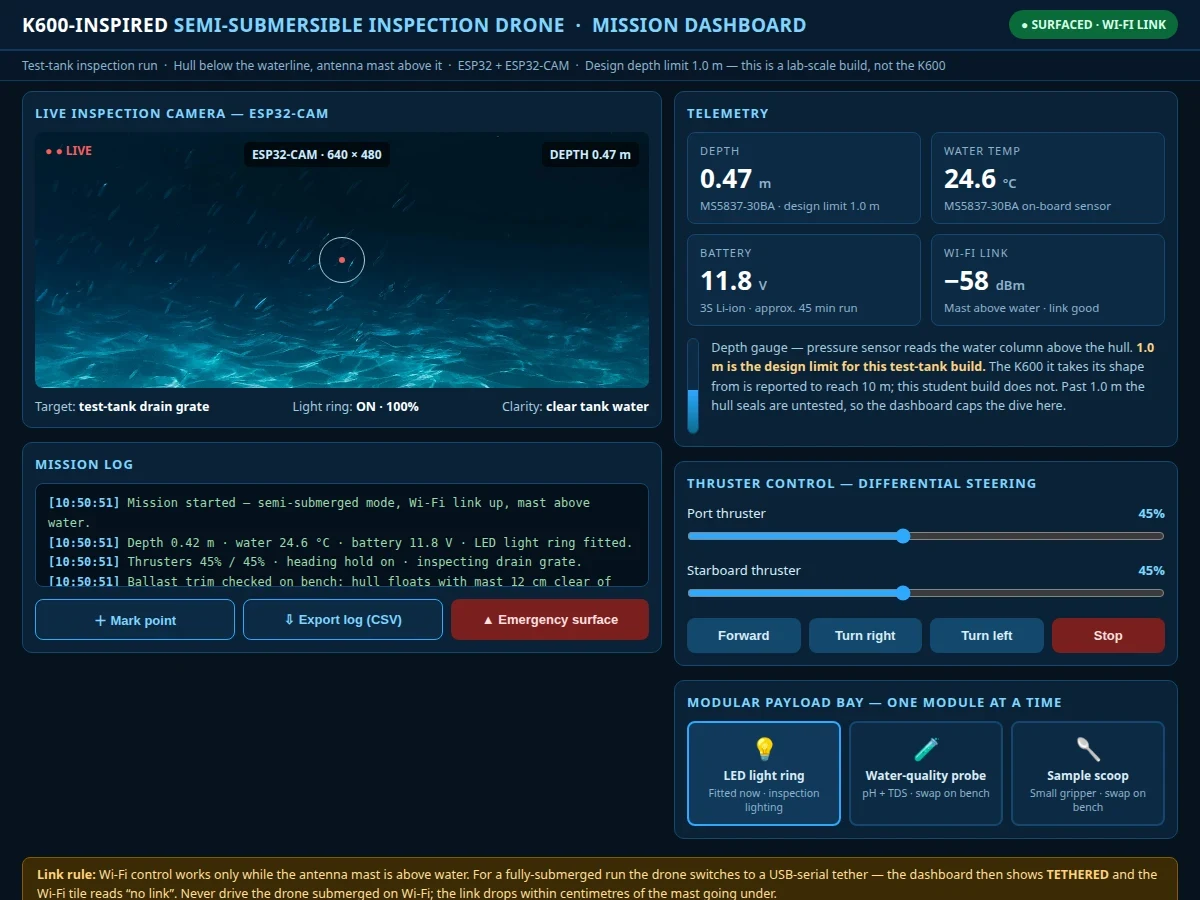
Operator drives the drone and watches the camera, depth gauge and mission log.
Follow the working sequence
How it works
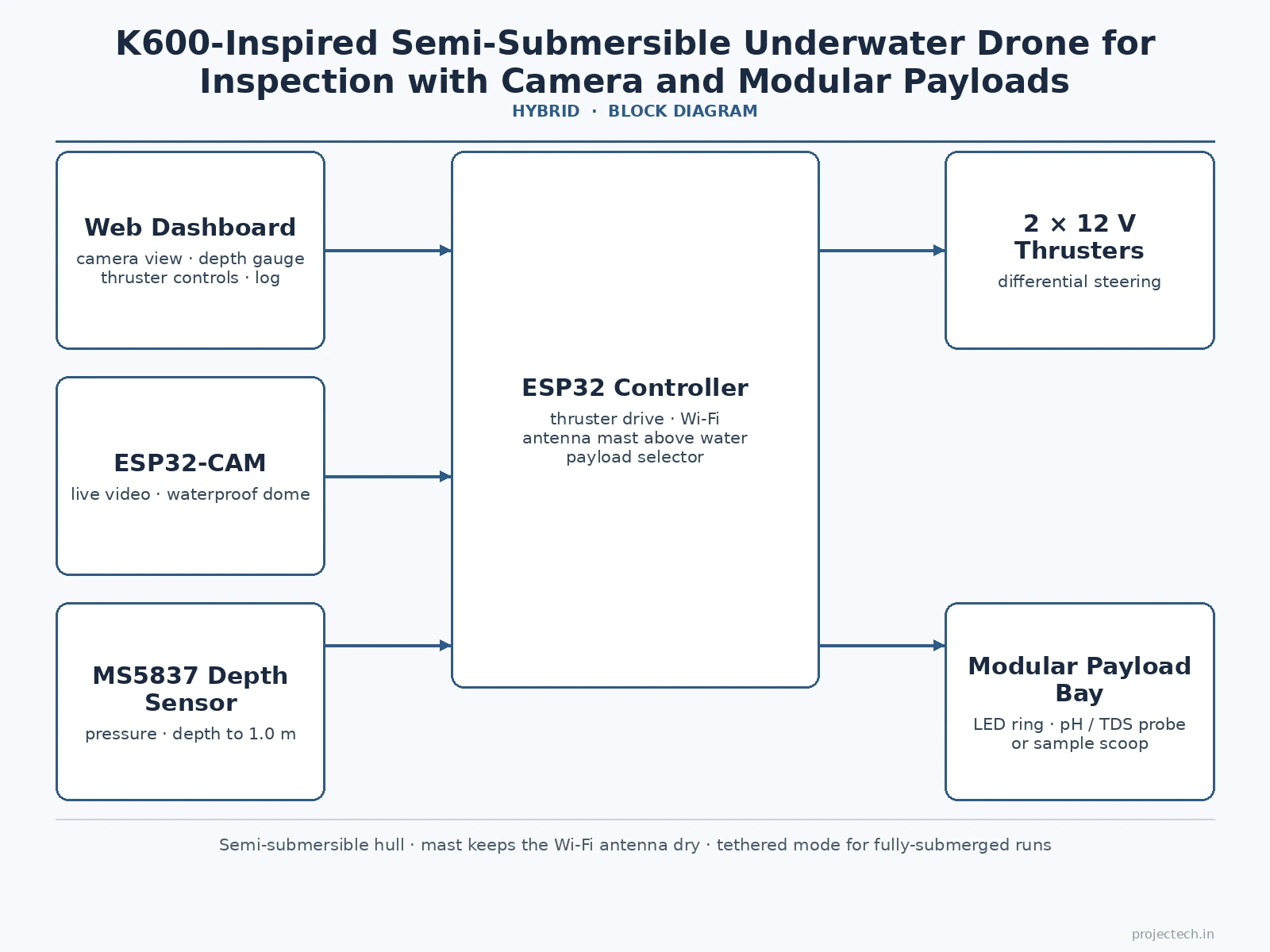
From switch-on to inspection takes six stages a student can trace and test. The sealed hull is ballasted on the bench until it floats with its deck just under the waterline and the mast clear of the water, which is the whole semi-submersible trick: the hull is trimmed until the water it pushes aside balances its weight at that draught, leaving the antenna in air while the camera and sensors sit below the surface. The ESP32 then reads depth from the pressure sensor, which measures the weight of the water column above the hull, and serves the dashboard over Wi-Fi while the mast is up. Differential thrust steers the drone — run both thrusters together to go forward, slow one side to turn — while the camera streams the tank floor, walls and drain grate to the dashboard. When the run needs the drone fully under, the operator connects the USB-serial tether first, because Wi-Fi cannot follow it down.
- The builder assembles the drone: sealed acrylic hull, ESP32 and ESP32-CAM in waterproof housings, MS5837-30BA pressure sensor, two 12 V DC thrusters with propellers at the rear, antenna mast on top, and the payload bay underneath.
- The builder trims the ballast on the bench: the hull is floated in the test tank with the fitted payload module, ballast is added a little at a time until the deck sits just below the waterline with the mast about 12 cm clear of the water, and the trim is re-checked after every payload swap.
- For the surfaced inspection run, the builder connects a laptop or phone to the drone's Wi-Fi, opens the dashboard, and checks the live camera view, the depth gauge and the thruster sliders before moving.
- The builder drives the drone to the inspection target — a drain grate, a tank wall joint or a pipe inlet — watches the camera feed, marks the point in the mission log, and records the depth at which it was found.
- For a payload run, the builder lifts the drone out, dries the hull, swaps the module on the bench — LED light ring for a dark corner, water-quality probe for a pH and TDS reading, or sample scoop for a small grab — re-seals the bay and re-trims the ballast before the next run.
- For a fully-submerged run, the builder connects the USB-serial tether, lowers the drone below the surface, drives it from the dashboard over the tether, then brings it back up, opens the hull, dries the electronics and exports the mission log as a CSV file.
Tech stack:
- ESP32 · dual-core controller with Wi-Fi
- ESP32-CAM · live inspection camera module
- MS5837-30BA · pressure and depth sensor
- 12 V DC thrusters · differential drive pair
- Sealed acrylic hull · semi-submersible test-tank body
- pH and TDS probe · water-quality payload module
- Companion web dashboard · camera, depth and mission log
- Arduino IDE · firmware and dashboard development
| Parameter | Value |
|---|---|
| Build type | Hybrid inspection drone plus companion dashboard software (design target) |
| Controller | ESP32 · Xtensa dual-core LX6 up to 240 MHz · 520 KB SRAM · 2.4 GHz Wi-Fi 802.11 b/g/n up to 150 Mbps (Datasheet value) |
| Camera | ESP32-CAM · OV2640 camera module · 640 × 480 live stream in the demo build (design target) |
| Depth sensor | MS5837-30BA · 0 to 30 bar operating range · 0.2 cm water-depth resolution · I2C interface (Datasheet value) |
| Depth limit | Approximately 1.0 m maximum in the test tank (design target) |
| Thrusters | 2 × 12 V DC thruster motors with propellers · differential steering (design target) |
| Hull | Sealed acrylic hull · approximately 40 cm long (design target) |
| Battery | 3S Li-ion battery · 11.1 V nominal · approximately 45 min run time (design target) |
| Payload bay | 3 swappable modules · one fitted at a time · manual swap on the bench (design target) |
| Dashboard | Web dashboard · live camera view · depth gauge · thruster controls · payload selector · mission log · CSV export (design target) |
| Connectivity | Wi-Fi while the mast is above water · USB-serial tether when fully submerged (design target) |
| Trend reference | Kahe Nautic K600 unveiled 3 November 2026 at Euronaval 2026, Paris · reported figures only: €5,900 · 0.8 × 0.8 × 0.8 m · 15 kg unloaded · 100 kg payload capacity · dual POD 600 thrusters 1,200 W total and 30 kgf thrust · 6–8 knots maximum speed · 1 h at maximum speed and up to 10 h at low speed · 10 m maximum operational depth · 7 application families and 65+ reported applications · TRL 4 with a 300-unit pre-series and TRL 7 targeted September 2027 · never claimed for this build |
| Builder note | Ballast trim procedure from the build: the hull is floated in the test tank with the fitted module in place, ballast is added a little at a time until the deck sits just below the waterline with the antenna mast about 12 cm clear of the water, and the trim is re-checked after every payload swap because each module changes the displacement. Condensation fix from the build: a small silica-gel sachet is fixed inside the hull beside the camera dome and the dome is wiped with anti-fog solution before sealing, after early test runs fogged the lens. A semi-submersible keeps its antenna dry because the hull is ballasted to float with its deck just under the surface while the mast stays in air — radio waves travel through air and fade within centimetres of water, so the antenna must stay dry and a fully submerged run needs a tether. |
Project features
The drone works because it copies one idea from the K600 and nothing else: it rides semi-submerged. The sealed acrylic hull is ballasted until it floats with its deck a few centimetres under the surface, so the water itself presses the seals shut, while a slim mast keeps the Wi-Fi antenna in the air — radio waves cross air easily and fade within centimetres of water, which is why the antenna must stay dry and why a fully submerged run needs a tether instead. An ESP32 drives two thrusters for steering, reads depth from a pressure sensor, and serves a dashboard showing the live camera view, a depth gauge, thruster controls and a mission log. The payload bay under the hull takes one module at a time: an LED light ring, a water-quality probe or a sample scoop, swapped by hand on the bench. Everything below is demonstrated in the same test-tank run, so nothing is claimed on trust.
- [Semi-submersible hull with antenna mast] The sealed acrylic hull is ballasted to float with its deck just below the waterline while a slim mast holds the Wi-Fi antenna above the surface, copying the K600's semi-submerged shape at student scale — implemented in the base build.
- [Differential thruster steering] Two 12 V DC thrusters with propellers steer the drone: both together drive it forward and slowing one side turns it, with speed set from the dashboard sliders — implemented in the base build.
- [Live inspection camera in a waterproof dome] An ESP32-CAM in a clear waterproof dome streams live video of the tank floor, walls and drain grate to the dashboard, so the inspection target is seen rather than assumed — implemented in the base build.
- [Pressure-based depth sensing] An MS5837-30BA pressure sensor measures the water column above the hull and the dashboard shows the result as a live depth gauge, capped at the 1.0 m design limit — implemented in the base build.
- [Modular payload bay] The bay under the hull takes one swappable module at a time — an LED inspection light ring, a water-quality probe measuring pH and TDS, or a sample scoop with a small gripper — and the dashboard payload selector records which module is fitted — implemented in the base build.
- [Companion web dashboard] The dashboard shows the live camera view, depth gauge, water temperature, battery level, thruster controls, payload selector and mission log, with CSV export of the logged run, on a laptop or phone on the same Wi-Fi — implemented in the base build.
- [Tethered fully-submerged mode] For runs below the surface the drone switches to a USB-serial tether, and the dashboard shows the tethered state plainly, because Wi-Fi cannot follow the drone underwater — implemented in the base build.
- [Autonomous inspection transect] Future scope only, not implemented: a pre-set straight-line run across the tank with the camera recording throughout, listed as an extension rather than a claimed feature, since the base build is driven by hand from the dashboard.
What is included
- Complete fabricated inspection drone (sealed acrylic hull, ESP32 and ESP32-CAM in waterproof housings, MS5837-30BA pressure sensor, two 12 V DC thrusters, antenna mast, payload bay)
- Three swappable payload modules (LED inspection light ring, water-quality probe for pH and TDS, sample scoop with small gripper)
- ESP32 firmware and companion web dashboard (live camera view, depth gauge, thruster controls, payload selector, mission log, CSV export)
- Setup and calibration guide (ballast trim procedure, seal check, condensation fix, tether procedure, tank and pond safety notes)
- Project report PDF (K600 background with reported figures labelled as reported, semi-submersible buoyancy design, pressure-based depth, Wi-Fi limits in water, demonstration results, honest measurement limits)
- PPT presentation for final review
- Viva Q&A preparation document (why the hull floats semi-submerged, how pressure gives depth, why Wi-Fi needs the mast above water, why this build is not the K600, payload and depth limits)
Limitations & prerequisites
- Not a K600: this is a tabletop student build inspired only by the K600's semi-submerged shape; it shares no parts, performance or capability with the K600 and must never be presented as one.
- Civilian inspection only: built for test tanks, college ponds and short pipeline sections; it is not for open water, rivers or the sea, and it is built only for civilian inspection work.
- Test tank and pond only: calm, clear, shallow water with no current or waves; moving water, weed and silt can trap the hull or block the thrusters.
- Depth design target about 1 m: the K600 is reported to reach 10 m, but this build is not tested beyond about 1 m and its prototype seals are untested at greater depth.
- Wi-Fi only while surfaced: the antenna mast must stay above water, and a fully-submerged run needs the USB-serial tether; the drone must never be driven submerged on Wi-Fi, because the link drops within centimetres of the mast going under.
- Camera limits: the ESP32-CAM gives a usable picture in clear tank water only; murky water, low light and glare through the dome reduce visibility, and there is no underwater sonar — depth comes from the pressure sensor only and obstacle detection is by camera alone.
- One payload module at a time: the bay fits the LED light ring, the water-quality probe or the sample scoop singly, and swapping is manual on the bench, never in the water.
- Short sessions and drying: approximately 45 min run time per charge (design target), and the hull must be opened, dried and re-sealed after each session; the seals are a prototype solution, not a rated enclosure.
Frequently Asked Questions
Is this project suitable for a final-year project?
Yes, for Electronics, IoT and Computer Science programmes, because it combines embedded hardware, a pressure sensor, wireless control and a web dashboard into one testable loop, with a clear review thread around semi-submersible buoyancy, pressure-based depth measurement and why Wi-Fi fails underwater.
How is this different from a normal underwater ROV?
A normal inspection ROV is fully submerged and fully tethered for its whole run. This drone rides semi-submerged with its antenna mast above the water, so it can be driven over Wi-Fi while surfaced, and it only uses a tether when it goes fully under — the same shape idea the K600 uses, rebuilt at student scale for a test tank.
Why does Wi-Fi stop working underwater?
Water absorbs 2.4 GHz radio waves within a few centimetres, so the ESP32 loses its link as soon as the antenna mast goes under the surface. That is why the mast must stay above water in surfaced mode and why fully-submerged runs use a USB-serial tether instead of Wi-Fi.
What is the maximum depth?
About 1 m in the test tank, as a design target. The K600 this build takes its shape from is reported to reach 10 m, but that figure is not claimed for this student build, whose prototype seals are untested beyond about 1 m.
What will I receive with the project?
The fabricated inspection drone with ESP32, ESP32-CAM, pressure sensor, two thrusters and antenna mast, the three swappable payload modules, the firmware and web dashboard, the setup and calibration guide, the project report, the presentation and the viva Q&A document. A test tank or pond and a laptop or phone on the same Wi-Fi are needed, both covered in the setup guide.
Components & software requirements
- ESP32 · dual-core controller with Wi-Fi
- ESP32-CAM · live inspection camera module
- MS5837-30BA · pressure and depth sensor
- 12 V DC thrusters · differential drive pair
- Sealed acrylic hull · semi-submersible test-tank body
- pH and TDS probe · water-quality payload module
- Companion web dashboard · camera, depth and mission log
- Arduino IDE · firmware and dashboard development
Delivery information
Built-to-order project. Delivery timeline is shared after order confirmation based on current queue.
Support terms
Complete documentation, setup guide, and viva preparation included. Support for setup and explanation provided.
Download free synopsis (PDF)
Enter your name and WhatsApp number — the synopsis PDF downloads immediately. We may send occasional project updates on WhatsApp; no spam.